12 Seraphinite Benefits for Angelic Connection & Healing
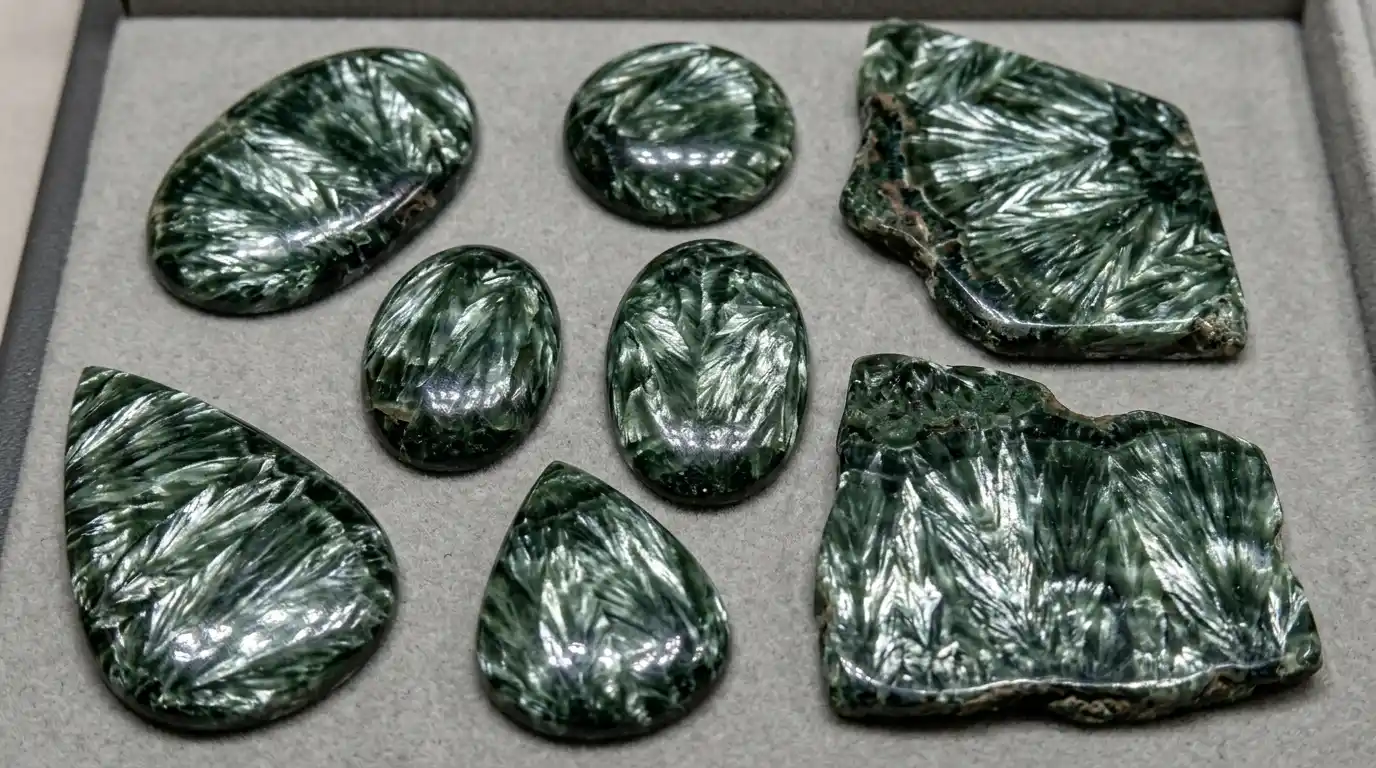
Seraphinite benefits begin with the unusual physical beauty of a green clinochlore variety rather than with claims about angels or medical healing. Seraphinite belongs to the chlorite group and is known for dark green to gray-green color crossed by silvery, feather-like, radiating structures that reflect light as the stone moves.
Mineralogically, seraphinite is not a separate species. It is a trade variety of clinochlore, a magnesium aluminum silicate hydroxide with the ideal formula Mg5Al(AlSi3O10)(OH)8. Clinochlore is monoclinic, commonly only about 2 to 2.5 on the Mohs scale, and has perfect basal cleavage, making seraphinite visually impressive but much softer and more delicate than quartz, garnet, tourmaline, sapphire, or ruby.
Modern crystal traditions add angelic connection, spiritual healing, compassion, heart-centered reflection, and personal transformation to seraphinite benefits. These interpretations can be meaningful within meditation or personal belief, but seraphinite has not been shown to heal disease, repair organs, change hormones, remove toxins, or establish measurable communication with supernatural beings.
12 Seraphinite Benefits at a Glance
- Silvery feather-like reflections create one of the most recognizable appearances among ornamental green stones.
- Its clinochlore mineralogy provides a useful example of the chlorite group and sheet-silicate structure.
- Green, gray-green, bluish-green, and silvery patterns give seraphinite strong decorative and collector appeal.
- Radiating and plumose crystal structures create movement and shimmer when polished correctly.
- Cabochons, pendants, carvings, slabs, and display pieces can emphasize its natural feather-like patterns.
- Its Russian occurrence gives collectors a strong connection with a specific mineral-producing region.
- Perfect cleavage and Mohs hardness around 2 to 2.5 make seraphinite useful for understanding gemstone durability limits.
- Modern angelic symbolism can provide a personal focus for prayer, meditation, or spiritual reflection.
- Heart-centered traditions can symbolize compassion and relationship reflection without implying medical heart effects.
- Healing symbolism can represent personal recovery or emotional growth without replacing medical or psychological care.
- Careful cleaning and storage help preserve the soft polished surface and reflective internal structure.
- Personal seraphinite benefits can come from geology, collecting, jewelry, spirituality, gifts, or important life transitions.
Seraphinite Benefits Begin With Clinochlore Mineralogy
The strongest scientific seraphinite benefits come from understanding clinochlore. Clinochlore belongs to the chlorite group, a family of hydrated sheet silicates in which thin structural layers give the mineral its micaceous appearance, perfect cleavage, and relatively low hardness.
The ideal clinochlore formula is Mg5Al(AlSi3O10)(OH)8, although natural specimens may contain significant iron and other substitutions. Iron can deepen the color from pale green toward medium green, dark green, or nearly black-green.
Clinochlore crystallizes in the monoclinic system and can form tabular crystals, flakes, foliated masses, radiating groups, and dense aggregates. Seraphinite is especially prized when radiating or plumose structures create bright silvery patterns through the green host.
These real mineral properties explain much of the stone’s beauty. No metaphysical explanation is required to understand why a well-polished seraphinite cabochon can appear to contain moving feathers or wings.
Feather-Like Reflections Create Seraphinite’s Signature Beauty
One of the most obvious seraphinite benefits is its optical appearance. Silvery white or pale green structures can spread through the darker green stone in sweeping, branching, feathery patterns.
These patterns arise from the orientation and aggregation of reflective chlorite structures. When polished and viewed under directional light, individual areas reflect strongly while neighboring areas remain darker, creating an effect that changes as the stone moves.
Some trade descriptions call this chatoyancy, although the effect is often less like a single sharp cat’s-eye line and more like broad moving feathered reflections. A well-oriented cabochon or polished slab can display the phenomenon much more clearly than rough stone.
The appearance is the reason the name seraphinite became associated with seraphim and angel wings. The name is symbolic, while the visible shimmer comes from real mineral structure.
Seraphinite Benefits for Cabochons and Decorative Cutting
Seraphinite is usually cut to display pattern rather than brilliance. Cabochons, polished freeforms, pendants, slabs, spheres, and carvings allow broad surfaces to reveal the radiating silver-green structures.
Cut orientation matters greatly. A cutter who follows the internal structure can expose large feather-like patterns, while poor orientation may produce an ordinary dark green surface with much weaker reflection.
The stone’s softness makes polishing more challenging than its appearance suggests. Clinochlore can scratch easily, and perfect cleavage may cause thin areas to separate if too much mechanical pressure is applied.
These limitations make seraphinite benefits particularly dependent on skilled lapidary work. A good polish can transform an unremarkable piece of rough into a striking ornamental gem, but careless cutting can damage the same stone quickly.
Russian Origin Adds Collector Value
Knowing where seraphinite is found gives the stone a much stronger geological identity. The best-known seraphinite is associated with the Korshunovskoye iron deposit near Zheleznogorsk-Ilimsky in Russia’s Irkutsk region.
This source became closely associated with commercial seraphinite because it produces clinochlore with the radiating plumose structures valued for cutting. The stone is often described commercially as coming from Siberia or the Lake Baikal region, although precise locality information is preferable when available.
Quartz, calcite, hematite, and other minerals may occur in association with clinochlore at the deposit. These associations give collectors additional information about the geological environment in which the stone formed.
Provenance can therefore become one of the real seraphinite benefits. A known locality connects the polished gemstone with an actual mineral deposit rather than leaving it as an anonymous green decorative stone.
Seraphinite Benefits for Mineral Identification
Seraphinite benefits gemology students because its trade name can easily hide its true mineral identity. The correct starting point is clinochlore, not the assumption that seraphinite represents a separate mineral species.
Hardness around 2 to 2.5 is an immediate clue. This is dramatically softer than quartz at 7, jadeite around 6.5 to 7, nephrite around 6 to 6.5, or most common jewelry gems.
Perfect basal cleavage and a pearly to greasy luster also fit chlorite-group mineralogy. Some more transparent areas can show pleochroism from yellow-green or greenish yellow toward bluish green.
Professional identification may use refractive properties, microscopy, Raman spectroscopy, X-ray diffraction, or chemistry when the identity of an unusual green stone needs confirmation. Visual similarity alone should never be the only test.
Seraphinite Is Too Soft for Demanding Jewelry
Durability is one of the most important limits to understand before considering seraphinite benefits for jewelry. Mohs hardness around 2 to 2.5 means ordinary household dust containing quartz can scratch a polished surface.
Perfect cleavage creates another weakness. A sharp blow can separate the stone along structural planes even when the surface previously looked intact.
Pendants, earrings, brooches, and protected decorative pieces are therefore safer choices than exposed everyday rings. A ring can be made, but it should be treated as occasional jewelry rather than worn during physical work.
Seraphinite should also be stored separately from harder gemstones. Quartz, garnet, tourmaline, topaz, sapphire, ruby, and diamond can all scratch it easily.
Angelic Connection Comes From Appearance and Modern Symbolism
Angelic connection is probably the most familiar spiritual theme among seraphinite benefits. The silver feather-like patterns resemble wings, which led to the trade name’s association with seraphim, the angelic beings described in religious traditions.
That visual resemblance can make the stone meaningful to someone whose faith or spiritual practice includes angels. A polished piece may be used during prayer, meditation, or reflection as a symbolic reminder of compassion, protection, or spiritual aspiration.
Seraphinite does not scientifically establish communication with angels, spirits, or supernatural entities. No mineralogical test can demonstrate that clinochlore opens a channel to another realm.
The symbolism can still matter personally. A spiritual object does not need to function as a scientific instrument to have religious or emotional meaning for its owner.
Heart-Centered Symbolism and Compassion
Green gemstones are frequently connected with heart-centered themes in modern crystal traditions, and seraphinite is no exception. Compassion, forgiveness, emotional openness, and relationship reflection commonly appear in discussions of seraphinite benefits.
The seraphinite chakra tradition often connects the stone with the heart chakra, while some practitioners extend its symbolism toward crown-centered spiritual themes because of the angelic imagery.
Chakras are spiritual frameworks rather than anatomical structures. Wearing seraphinite near the chest does not physically change the heart, lungs, circulation, thymus, hormones, or nervous system.
A heart-centered practice can still provide structure for reflection. Someone may use the stone while considering how to communicate more compassionately or establish healthier relationship boundaries.
Healing Symbolism Without Medical Claims
Healing appears directly in the H1 because it is one of the most common themes people search for when researching seraphinite benefits. The word needs careful interpretation.
Modern crystal practices may use healing to describe emotional recovery, personal transformation, forgiveness, or moving through a difficult period. These are human experiences that can be represented symbolically by a gemstone.
Claims that seraphinite physically regenerates cells, repairs the spinal cord, detoxifies organs, treats cancer, restores nerve function, improves circulation, or heals disease are not supported by reliable medical evidence. Clinochlore should not replace diagnosis, medication, therapy, surgery, or other professional healthcare.
The seraphinite healing properties are therefore best approached as spiritual traditions and personal symbolism rather than clinical effects.
Personal Transformation Through Symbolism
Seraphinite’s changing reflective pattern makes transformation another natural symbolic theme. The same stone can appear dark green from one direction and suddenly flash with bright silvery feathers when moved.
A person may use this visual change as a reminder that perspective can alter how a situation appears. Another may associate the stone with a transition such as changing careers, leaving an old habit, relocating, or beginning a new stage of life.
The mineral does not cause transformation. It becomes a physical object linked to a decision the person has already chosen to make.
This keeps seraphinite benefits practical. The gemstone provides continuity and symbolism while change happens through behavior, circumstances, relationships, and time.
Color Adds Another Layer of Meaning
Seraphinite commonly ranges from medium to dark green, gray-green, bluish green, and nearly black-green, with silvery or pale reflective structures. Iron substitutions within clinochlore can deepen its color.
Modern seraphinite color meaning may connect green with compassion, growth, nature, or emotional renewal and silver-white patterns with spiritual light or angelic imagery.
These interpretations come from human color symbolism. The actual green color and silvery effect arise from mineral chemistry, structure, and light reflection.
Both ideas can coexist as long as they are not confused. Gemology explains the physical color, while the owner decides what that color represents personally.
Seraphinite Care Requires a Gentle Approach
Care is one of the most practical seraphinite benefits because understanding the stone’s softness can prevent permanent damage. A soft dry or slightly damp cloth is generally safer than aggressive scrubbing.
The question of whether seraphinite is safe in water should be approached conservatively. Brief contact during careful cleaning is different from prolonged soaking, repeated immersion, saltwater rituals, or placing the stone in drinking water.
Avoid steam, ultrasonic cleaners, harsh household chemicals, acids, abrasive powders, and stiff brushes. These methods are unnecessary for a soft mineral with perfect cleavage.
Dry the stone promptly and store it separately. A padded compartment protects the polished surface from harder jewelry.
Seraphinite Benefits for Collectors
Collectors may value seraphinite for pattern quality, color contrast, polish, locality, specimen size, and the strength of the feather-like reflection. Large polished slabs can show structures that are difficult to appreciate in small cabochons.
Natural rough also has value because it preserves the chlorite structure before cutting. Some collectors may prefer mineral specimens associated with quartz, calcite, or hematite rather than polished jewelry.
Unusually bright silver patterns are not automatically evidence of higher metaphysical energy. They are visual features created by crystal structure and orientation.
For serious collecting, accurate identification and locality information are more useful than exaggerated spiritual claims.
Personal Meaning Can Be the Strongest Benefit
Seraphinite does not need one universal spiritual definition. A stone can represent faith, a relationship, personal recovery, a trip, a family gift, a meditation practice, or a milestone in a mineral collection.
Someone may connect the feathered pattern with angels, while another sees leaves, frost, branches, or flowing light. Neither personal interpretation changes the clinochlore mineralogy.
The meaning develops through human experience. A particular pendant may become significant because of who gave it or what happened while it was worn.
This is often one of the most lasting seraphinite benefits because personal meaning can remain even when spiritual interpretations change.
Conclusion
Seraphinite benefits include distinctive silvery feather-like patterns, chlorite-group mineralogy, Russian geological provenance, decorative cutting potential, collector appeal, and strong educational value for understanding clinochlore. Angelic connection, heart-centered practice, healing, and personal transformation can provide meaningful symbolism, but seraphinite remains a very soft, perfectly cleavable mineral that requires careful handling and should not be treated as medical therapy.
FAQs
What are the main seraphinite benefits?
Seraphinite benefits include distinctive feather-like reflective patterns, collector appeal, decorative cutting potential, interesting clinochlore mineralogy, and connection with a notable Russian locality. Modern spiritual traditions also associate it with angelic symbolism, compassion, healing, and personal transformation.
What is seraphinite made of?
Seraphinite is a trade variety of clinochlore, a magnesium aluminum silicate hydroxide in the chlorite group. Its ideal clinochlore formula is Mg5Al(AlSi3O10)(OH)8.
Is seraphinite a separate mineral?
No. Seraphinite is a variety or trade name for clinochlore with distinctive radiating or plumose structures. Clinochlore is the recognized mineral species.
Why does seraphinite look like angel wings?
Radiating and feather-like chlorite structures reflect light against the darker green host, producing silvery patterns that resemble wings. This appearance inspired the seraphim-related trade name.
Is seraphinite a hard gemstone?
No. Clinochlore is only about 2 to 2.5 on the Mohs scale and has perfect cleavage. Seraphinite scratches and chips much more easily than quartz, garnet, tourmaline, or sapphire.
Does seraphinite connect people with angels?
There is no scientific evidence that seraphinite creates communication with angels or supernatural entities. It can still be used as a meaningful spiritual symbol during prayer or meditation.
Does seraphinite have healing powers?
Seraphinite has not been shown to cure disease, regenerate organs, heal nerves, or produce clinical psychological effects. Healing is better understood as spiritual symbolism or personal reflection rather than medical treatment.
What chakra is seraphinite associated with?
Modern crystal traditions commonly associate seraphinite with the heart chakra and sometimes with crown-centered spiritual themes. Chakra systems are spiritual frameworks rather than anatomical structures.
Can seraphinite go in water?
Brief gentle cleaning is different from prolonged immersion. Because seraphinite is soft and perfectly cleavable, prolonged soaking, saltwater, chemical baths, and repeated water rituals are best avoided.
Is seraphinite suitable for everyday rings?
Seraphinite is too soft for demanding everyday ring wear. Pendants, earrings, brooches, protected settings, and display pieces are generally safer choices.
Where does seraphinite come from?
The best-known seraphinite comes from the Korshunovskoye iron deposit near Zheleznogorsk-Ilimsky in Russia’s Irkutsk region. This source is especially associated with the feathered green clinochlore used in the gem trade.
Can seraphinite have personal meaning?
Yes. Seraphinite can represent faith, compassion, personal recovery, a relationship, travel memory, spiritual practice, or collecting milestone. Personal symbolism does not require a universal metaphysical explanation.
Disclaimer: Angelic-connection, healing, chakra, compassion, transformation, protective, and energetic descriptions of seraphinite reflect spiritual beliefs and personal practices. Seraphinite is not a medical or psychological treatment and cannot guarantee supernatural communication or health outcomes.