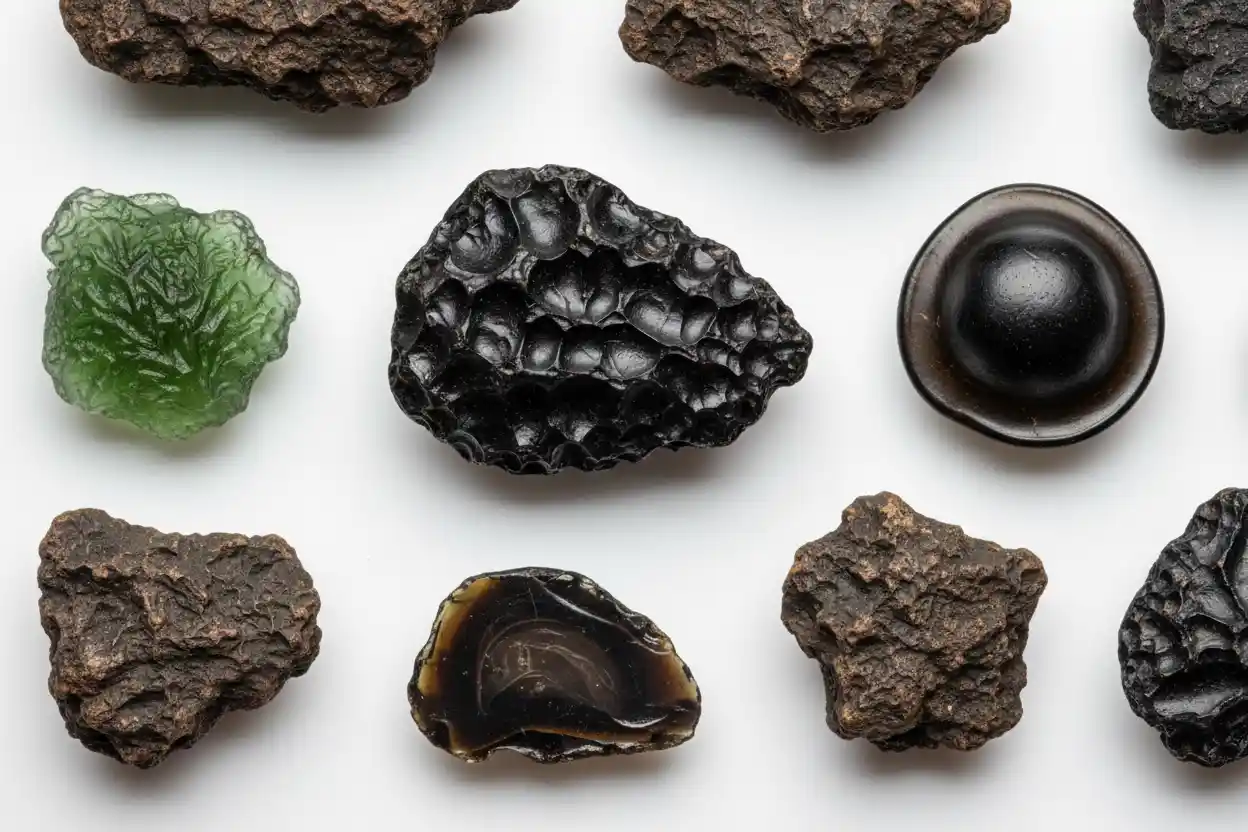
9 Tektite Healing Properties: Modern Wellness Beliefs, Impact-Glass Facts & Safe Use
Tektite healing properties are usually described in modern crystal practice as support for emotional steadiness, perspective during change, meditation, intention setting, mental focus, and spiritual reflection. These ideas can make a tektite useful as a personal reminder or ritual object, but they are not scientifically established medical effects. Tektite is not proven to treat anxiety disorders, depression, post-traumatic stress disorder, insomnia, chronic pain, immune conditions, neurological disease, or any other physical or psychiatric illness.
The science of tektite is compelling for a very different reason. Tektites are natural impact glasses created when a high-energy extraterrestrial impact melts terrestrial surface rock and ejects droplets or masses of molten glass over large distances. They are not pieces of the meteorite itself, and they do not have a crystal lattice. Their real geology gives tektite healing properties an unusual cultural setting because a stone associated with sudden impact, heat, flight, and cooling can easily become a symbol for change, resilience, perspective, and transformation.
Modern crystal users often work with tektite by holding it during reflection, keeping it near a journal, carrying it as an intention reminder, or placing it beside a meditation space. Used this way, tektite healing properties can support a chosen practice through attention and symbolism without requiring claims that the glass emits a medically active force.
9 Tektite Healing Properties Commonly Used as Wellness Beliefs
- Emotional steadiness during periods of rapid change.
- Clearer reflection when thoughts feel scattered or repetitive.
- Greater willingness to release habits that no longer feel useful.
- Focus during meditation or quiet contemplation.
- Confidence when adapting to unfamiliar situations.
- A sense of perspective when everyday problems feel overwhelming.
- Spiritual curiosity and openness to personal interpretation.
- Intentional journaling around goals, transitions, and identity.
- Symbolic grounding after intense emotional or spiritual experiences.
What Tektite Really Is: Natural Impact Glass, Not a Meteorite
Understanding the geology helps keep tektite healing properties separate from exaggerated stories about extraterrestrial crystals. Tektite is an amorphous silicate glass rather than a mineral species with an ordered crystal system. Most tektites contain a high proportion of silica together with aluminum, iron, calcium, magnesium, sodium, potassium, titanium, manganese, and other elements in varying amounts. Because the glass cooled rapidly, it lacks the repeating crystal structure expected in quartz, feldspar, or other crystalline minerals.
Tektites form when a hypervelocity impact generates enough heat and pressure to melt near-surface terrestrial rock. Some of that melt is launched through the atmosphere and cools into glass before falling across a strewn field. Major groups include Australasian tektites, Central European moldavites, North American tektites, and Ivory Coast tektites. Their colors range from black and very dark brown through green and brownish green, depending on composition and group. Surfaces may be smooth, grooved, pitted, sculpted, button-shaped, splash-formed, or irregular.
The name comes from a Greek root meaning “molten,” a fitting description for glass produced by extreme heating. Early explanations sometimes treated tektites as glass meteorites, but geochemical and petrographic evidence supports melted terrestrial source rock. This distinction matters because tektite healing properties belong to human interpretation, while the stone’s origin belongs to impact geology.
Tektite Wellness Beliefs for Reflection, Change, and Emotional Regulation
Emotional steadiness without medical promises
One of the most common tektite healing properties is the belief that the stone helps a person remain steady during disruptive change. A practical way to use that idea is to make the stone a cue for a repeatable behavior: slow down, name what has changed, separate facts from assumptions, and decide what can be influenced today. The stone does not regulate the nervous system or treat anxiety, but the ritual can give structure to a moment that otherwise feels chaotic.
Some users connect this practice with the dramatic origin of tektite itself. The glass formed through an extreme geological event, so it can become a personal symbol of surviving disruption and taking a new shape afterward. That symbolism is also part of tektite meaning, where impact, transformation, and perspective are interpreted as human themes rather than measurable energies.
Mental focus, perspective, and intentional decisions
Tektite healing properties are also associated with concentration, perspective, and breaking repetitive thought patterns. There is no evidence that holding tektite changes neurotransmitters, memory circuits, or attention disorders. A reader-controlled practice is more defensible: place the stone beside a notebook, write down one question, and spend five quiet minutes identifying the next concrete action instead of trying to solve every problem at once.
The value comes from the behavior attached to the object. A tactile cue can help someone remember a chosen routine, just as a timer, bracelet, note card, or meditation cushion can become linked with a habit. People who enjoy carrying, displaying, or meditating with the glass may also find practical ideas among tektite benefits, while tektite healing properties remain focused on wellness beliefs and their evidence limits.
Release, resilience, and adapting to change
Another recurring theme is “letting go.” In crystal language, this can sound as though the stone removes emotional burdens on its own. A more useful interpretation is behavioral: identify a habit, expectation, or unresolved task that consumes attention, decide whether it is actionable, and either schedule it, communicate about it, or consciously stop revisiting it for the day. The tektite serves as the prompt, not the agent causing the change.
This approach preserves the personal appeal of tektite healing properties without suggesting that grief, trauma, compulsive behavior, or mood disorders can be cured through a stone. Serious or persistent psychological symptoms deserve qualified professional care, while reflective crystal practice can remain an optional personal ritual.
Tektite Meditation, Spiritual Awareness, and Chakra Associations
Tektite healing properties in contemporary spiritual practice often include heightened awareness, stronger intuition, vivid meditation, energetic clearing, or a feeling of connection with something larger than everyday concerns. These experiences are subjective. They may feel significant to an individual, but they do not demonstrate that tektite transmits a measurable spiritual field, predicts future events, or changes consciousness through a proven physical mechanism.
Chakra associations vary because there is no single historical tektite tradition shared across all cultures. Modern practitioners often connect dark tektites with the root chakra for grounding, while green moldavite is frequently linked with the heart or higher chakras. Others place tektite near the third eye or crown during meditation. Chakras are spiritual frameworks rather than anatomical structures, so these placements should be understood as symbolic practices.
A restrained meditation can be simple: hold the stone, choose one question, notice breathing without forcing it, and record any thoughts afterward. If tektite healing properties are used this way, the person remains in control of the practice. The glass becomes a focus object rather than proof of supernatural protection, guaranteed intuition, or objective energetic cleansing.
Tektite Physical Care, Hardness, Water Safety, and Dust Precautions
Tektite typically falls around 5 to 7 on the Mohs scale depending on composition and type, but hardness does not make natural glass tough. Tektites are brittle, have no cleavage because they are amorphous, and commonly break with a conchoidal fracture that can produce sharp edges. Store rough specimens where they cannot strike harder gems, metal tools, countertops, or one another. A padded box or separate cloth pouch reduces chipping, especially for deeply sculpted pieces.
For routine cleaning, use lukewarm water, a small amount of mild soap, and a soft cloth or very soft brush. Brief contact with clean water is generally reasonable for an untreated tektite, but prolonged soaking is unnecessary. Avoid sudden temperature changes, strong household chemicals, harsh acids or alkalis, and abrasive cleaners. Hydrofluoric acid is especially dangerous and attacks silica-rich glass. Because tektites may contain bubbles, internal stress, inclusions, or pre-existing fractures, steam and ultrasonic cleaning are poor choices when the specimen’s condition is uncertain.
Ordinary handling does not create a meaningful dust exposure, but cutting, grinding, drilling, or polishing any silica-rich glass can generate fine particles. Lapidary work should use wet methods, local dust control, eye protection, and suitable respiratory protection. Do not intentionally inhale dust, lick rough specimens, grind tektite for elixirs, or ingest chips or powder. Tektite healing properties do not become stronger through practices that create avoidable physical risk.
Safer Symbolic Cleansing for Tektite
For people who connect tektite healing properties with cleansing rituals, symbolic cleansing does not physically purify a stone or change its chemistry, but it can mark the beginning or end of a personal ritual. Safer options include placing the tektite on a clean cloth, using sound from a bell or singing bowl, passing it briefly through incense smoke in a ventilated space, or simply holding it while restating an intention. Moonlight can be used as a symbolic practice if the specimen is kept dry and secure.
Avoid salt burial, boiling water, flame, harsh chemical baths, or striking the glass against other stones. Physical cleaning and ritual cleansing serve different purposes. The first removes dirt; the second carries personal meaning.
Conclusion
Tektite healing properties are best understood as modern wellness and spiritual beliefs built around a remarkable natural impact glass. Reflection, meditation, grounding, perspective, and intentional change can all be meaningful personal practices, but the tektite is not a medical treatment or a proven source of measurable healing energy. Its strongest factual story is already extraordinary: terrestrial rock was melted by impact, launched, cooled into glass, and preserved across distinctive strewn fields.
FAQs
What are the main tektite healing properties?
Tektite healing properties commonly include emotional steadiness, perspective, focus, meditation, resilience during change, intentional release, spiritual curiosity, and grounding. These are personal or spiritual beliefs rather than medically proven effects.
Is tektite a meteorite?
No. Tektite is natural glass formed when an extraterrestrial impact melts terrestrial surface rock and ejects molten droplets or masses that cool into glass.
Is tektite a crystal?
Not in the mineralogical sense. Tektite is amorphous glass with no ordered crystal lattice, although it is often grouped with “crystals” in modern wellness culture.
Can tektite healing properties reduce anxiety or depression?
There is no scientific evidence that tektite treats anxiety disorders, depression, PTSD, or other mental health conditions. It can be used as a personal reminder during journaling or meditation, but professional care remains appropriate for clinical symptoms.
Which chakra is tektite associated with?
Modern sources vary. Dark tektites are often associated with the root, third-eye, or crown chakras, while some green tektites are linked with the heart. Chakras are spiritual frameworks, not anatomical systems.
Can tektite go in water?
Brief cleaning with lukewarm water and mild soap is generally reasonable for an untreated specimen. Long soaking, hot water, saltwater rituals, and aggressive chemical solutions are unnecessary and may increase the chance of surface or fracture problems.
Is tektite safe to wear or hold?
Yes, intact tektite is generally safe to handle. Chipped glass can develop sharp edges, and cutting or grinding should use proper dust control because fine silica-rich particles should not be inhaled.
Can tektite be cleaned in an ultrasonic machine?
It is safer to avoid ultrasonic cleaning when the specimen contains bubbles, fractures, weathered surfaces, or unknown treatments. Warm soapy water and gentle hand cleaning are sufficient for most pieces.
Does tektite have scientifically proven energy?
No measurable healing field has been established for tektite. People may still find the stone personally meaningful as a focus object, symbol, or part of a reflective ritual.
Tektite healing properties reflect contemporary spiritual and personal interpretations rather than medical treatment and should not replace qualified medical or mental health care.