Tektite: Meaning, Properties & Symbolism
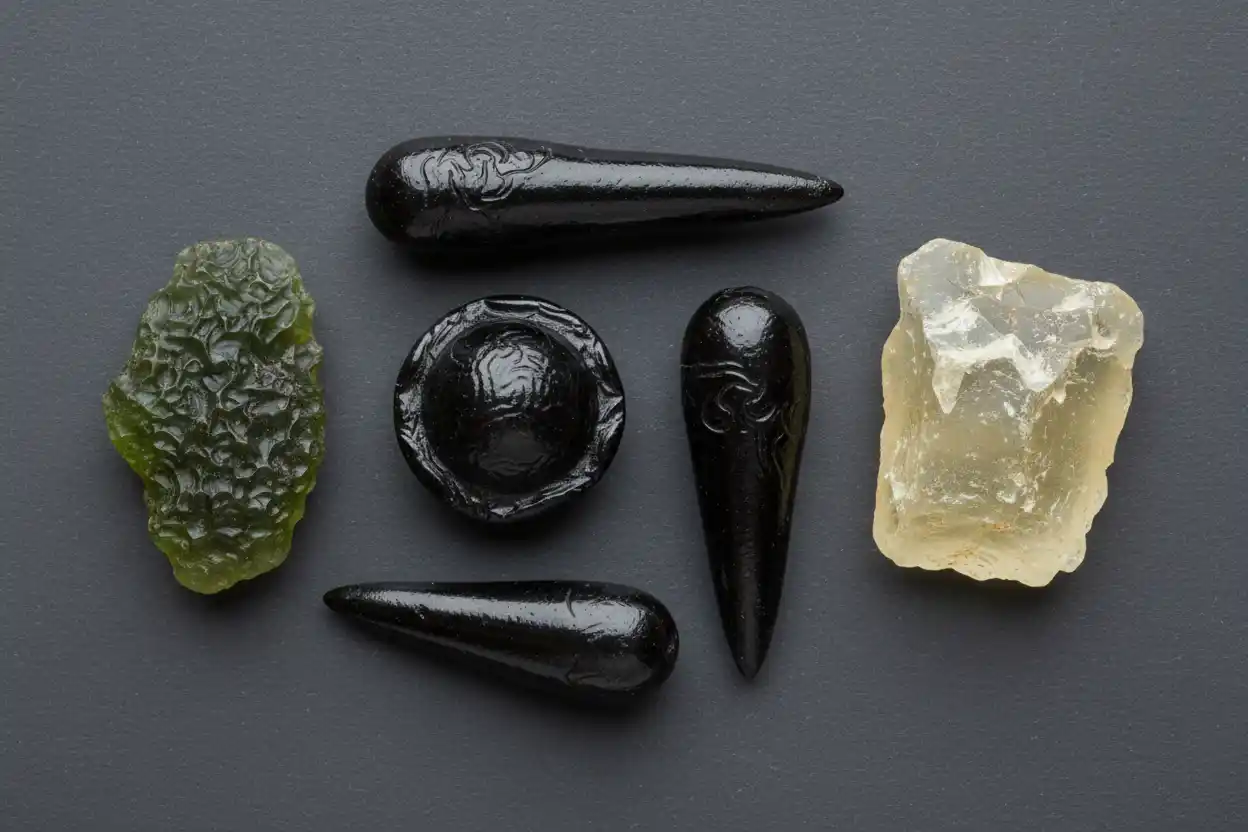
Tektites are natural silica-rich glasses formed when a large meteorite or asteroid impact melts terrestrial surface rock and ejects molten droplets far from the crater. The droplets cool while traveling through the atmosphere or after landing, producing rounded, pitted, layered, button-shaped, teardrop, disc, dumbbell, rod, and irregular glass bodies.
Although an impact creates them, Tektites are not meteorites. Their material comes predominantly from melted Earth rocks rather than from the incoming space object.
Tektite at a Glance
| Property | Tektite |
|---|---|
| Composition | Variable silica-rich terrestrial impact glass containing aluminum, iron, magnesium, calcium, sodium, potassium, and trace elements |
| Group or type | Natural impact glass; mineraloid |
| Color | Black, dark brown, brown-green, olive green, bottle green, grey, yellow-green |
| Crystal system or texture | Amorphous glass, commonly flow-banded or vesicular |
| Habit | Splash forms, spheres, discs, teardrops, dumbbells, rods, buttons, layered masses, irregular fragments |
| Luster | Vitreous, dull, waxy, or frosted depending on weathering |
| Transparency | Transparent at thin edges to opaque |
| Mohs hardness | Commonly approximately 5–6.5 |
| Cleavage | None |
| Tenacity | Brittle |
| Common uses | Scientific and collector specimens, pendants, carvings, cabochons, faceted Moldavite |
| Primary care concern | Chipping, sharp conchoidal fracture, glass imitations, provenance, surface damage, and cutting dust |
What Is a Tektite?
A Tektite is a natural glass produced by a hypervelocity impact into Earth’s surface. The impact shock melts target rock, accelerates the melt outward, and disperses it across a broad geographic region.
The molten material cools so rapidly that atoms cannot organize into crystals. Consequently, a Tektite is a mineraloid rather than a crystalline mineral.
Tektites are generally more chemically homogeneous than many impact glasses found inside craters. They also have exceptionally low water content compared with volcanic glass.
The name comes from a Greek word associated with melting.
Tektites belong within the natural-glass section of types of gemstones. The tracker links them to the broader obsidian family for navigation, although Tektites and obsidian form through completely different processes.
They are also listed in the crystals that start with T and gemstones that start with T directories.
Are Tektites Meteorites?
No. A meteorite is material from an asteroid, comet, Moon, Mars, or another extraterrestrial body that survives passage through the atmosphere and lands on Earth.
A Tektite is primarily melted terrestrial rock. The incoming object supplies the energy, but the glass comes from the impact site.
Tiny amounts of meteoritic material can become mixed into impact melt, yet this does not change the basic classification.
A seller describing a Tektite as “a meteorite transformed into glass” is therefore oversimplifying the process.
The most accurate description is terrestrial impact ejecta: Earth material melted and launched during an extraterrestrial collision.
How Tektites Form
A large object strikes Earth at several kilometers per second. The sudden release of kinetic energy generates extreme pressure and temperature.
Rock near the impact point shatters, vaporizes, and melts. Part of the melt is accelerated upward and outward.
Small molten masses stretch, spin, flatten, and break into droplets. Surface tension produces spheres, discs, rods, teardrops, dumbbells, and other splash forms.
The droplets cool into glass during flight or shortly after landing. Aerodynamic heating can later reshape some pieces as they re-enter denser parts of the atmosphere.
Larger masses can land while still hot and deform on impact. Layered Muong Nong-type Tektites may form through different ejection and deposition conditions from ordinary splash forms.
Weathering subsequently pits, etches, rounds, or frosts the surface. Many deeply sculpted textures formed in soil long after the impact rather than while the glass was airborne.
Strewn Fields
A strewn field is the geographic area across which ejecta from one impact event is distributed.
Four major classic Tektite strewn fields are recognized:
- The Australasian strewn field
- The Central European strewn field
- The North American strewn field
- The Ivory Coast strewn field
Each field contains glass with a characteristic age and chemical relationship to its source region.
The Central European field is linked to the Ries impact crater in Germany. Its green Tektites are called Moldavites.
The North American field is linked to the Chesapeake Bay impact structure. Bediasites and Georgiaites belong to this event.
The Ivory Coast field is linked to the Bosumtwi crater in Ghana.
The Australasian field is the largest and youngest major field. It covers much of Southeast Asia, Australia, and adjacent regions, but its source crater remains unresolved.
Australasian Tektites
Australasian Tektites formed approximately 790,000 years ago. Their enormous distribution covers a significant part of Earth’s surface.
Indochinites occur across Vietnam, Laos, Cambodia, Thailand, southern China, and neighboring areas. They are commonly black or dark brown and appear as irregular fragments, teardrops, discs, dumbbells, rods, and layered masses.
Philippinites come from the Philippines and include rounded splash forms and deeply pitted specimens.
Javanites and Billitonites occur in Indonesia. Their surface textures, colors, and shapes vary by locality.
Australites occur in Australia. Some preserve aerodynamic flanges and button forms created when an earlier splash-form body re-entered the atmosphere and melted around its rim.
Muong Nong-type Tektites are large, layered, blocky masses found mainly in parts of Southeast Asia. Their internal banding and size distinguish them from ordinary splash forms.
Moldavite
Moldavite is the green Tektite variety associated with the approximately 15-million-year-old Ries impact in southern Germany.
Most Moldavite occurs in the Czech Republic, with smaller deposits in neighboring areas.
Its green, olive, yellow-green, and brown-green colors make it the most widely used Tektite in faceted jewelry.
Moldavite’s etched surface can be highly sculptural, especially in material from deposits such as Besednice. However, deep texture alone does not prove authenticity because glass can be molded or chemically etched.
Moldavite has its own buying, identification, and market. Detailed valuation belongs on the dedicated Moldavite price page.
The general Tektite guide should not apply Moldavite prices to common black Indochinite material.
North American Tektites
The North American strewn field formed during the Chesapeake Bay impact approximately 35 million years ago.
Bediasites are dark brown to black Tektites found mainly in Texas. They are typically irregular, rounded, or splash-like and may transmit brown light at thin edges.
Georgiaites occur in Georgia and are much rarer. Fine examples can be translucent olive, yellow-green, green, or brown-green.
North American Tektites are less abundant than Indochinites and can command substantial collector premiums.
Provenance is critical because ordinary bottle glass and industrial glass can resemble green or brown fragments.
Ivory Coast Tektites
Ivory Coast Tektites formed during the Bosumtwi impact approximately 1.07 million years ago.
They occur in Côte d’Ivoire and in offshore sediments as microtektites.
Typical specimens are dark brown to black, often rounded or irregular, and considerably scarcer in commerce than common Southeast Asian Tektites.
Their scientific connection to the Bosumtwi crater is well established through age and compositional evidence.
Export history and limited availability contribute to their higher collector value.
Tektites Versus Impact Glass
Not every glass produced by an impact is a Tektite.
Tektites travel as distal ejecta and occur across broad strewn fields. Many other impact glasses remain inside or close to their crater.
Libyan Desert Glass is a yellow silica-rich impact glass found in the Great Sand Sea of Egypt and Libya. It is commonly discussed with Tektites but is generally treated as a separate impactite category.
Darwin Glass from Tasmania is another impact glass rather than a classic distal Tektite.
Impact-melt glass inside suevite breccia also differs from free-flying Tektite droplets.
The distinction depends on geological context, composition, distribution, and relationship to a known impact—not merely on whether the object is natural glass.
Tektites Versus Obsidian
Obsidian forms when silica-rich volcanic lava cools rapidly. Its source is volcanic magma.
Tektites form when an impact melts surface rocks and ejects the melt. Their source is terrestrial target material transformed by collision.
Both are amorphous natural glasses and can break with sharp conchoidal fracture.
Black obsidian and Indochinite may appear similar, but their water content, chemical composition, internal structures, surface features, and geological settings differ.
Apache Tears are rounded nodules of obsidian weathered from volcanic flows. They are not impact glass.
A seller should not use “volcanic Tektite” as a scientific classification. Volcanic glass and impact glass belong to different formation processes.
Tektite Shapes and Surface Textures
Primary splash forms include spheres, discs, teardrops, rods, dumbbells, boats, and irregular stretched droplets.
Rotation and aerodynamic forces shape the molten material. Surface tension rounds edges while the glass remains liquid.
Australite buttons and flanged forms reflect secondary aerodynamic modification during atmospheric re-entry.
Many natural pits, grooves, and channels develop through chemical weathering in soil. Acidic groundwater attacks some glass components more quickly than others.
Deeply sculpted Moldavite surfaces can therefore reflect long burial history rather than only the original flight shape.
Fresh breaks expose glossy conchoidal fracture. Old natural surfaces are usually duller, etched, or soil-stained.
Composition and Physical Properties
Tektites are predominantly silica-rich, commonly containing approximately 65–80% SiO₂, although composition varies by strewn field.
Aluminum oxide forms another major component. Iron, magnesium, calcium, sodium, potassium, titanium, and trace elements reflect the chemistry of the target rock.
Most Tektites contain fewer vesicles and far less water than ordinary volcanic glass.
Hardness commonly falls around 5–6.5. Specific gravity usually ranges approximately from 2.2 to 2.8.
Refractive index varies with composition but commonly lies near 1.48–1.52.
No cleavage is present because the material lacks a crystal lattice. Fracture is conchoidal and can produce cutting edges.
Inclusions and Internal Features
Tektites may contain elongated bubbles, round vesicles, flow lines, schlieren, compositional bands, lechatelierite, and microscopic mineral remnants.
Lechatelierite is high-temperature silica glass produced when quartz melts. Its presence can support an impact origin.
Muong Nong-type Tektites show pronounced layering and compositional banding.
Moldavite may contain elongated bubbles and flow structures whose appearance differs from ordinary bottle glass.
Most Tektites lack the unmelted crystals and abundant mineral fragments seen in many local crater glasses.
Internal features must be interpreted together. Bubbles alone do not prove authenticity because manufactured glass can contain them as well.
How to Identify a Tektite
Provenance is the strongest starting point. A credible specimen should be linked to a recognized strewn field and locality.
Appearance, weight, surface texture, transmitted color, refractive index, density, and magnification then help test the claim.
Common Indochinites usually appear black but transmit brown light at a thin edge. Natural surfaces may show irregular pits, grooves, and soil weathering.
Manufactured glass often has mold seams, uniform repeating texture, abundant round bubbles, or a composition inconsistent with the claimed locality.
Magnetic attraction is generally weak or absent, although soil contamination and iron-rich inclusions can affect individual pieces.
A Tektite should not display a meteorite fusion crust, metal grains, chondrules, or ordinary stony-meteorite interior.
Raman spectroscopy, electron-microprobe analysis, trace-element chemistry, and water-content measurements can support identification. The how to identify crystals guide explains the broader evidence-based process.
Common Fakes and Mislabels
Bottle glass, slag, furnace glass, resin, molded glass, and artificially etched glass are common substitutes.
Black glass can be heated, tumbled, acid-etched, and coated with soil to resemble Indochinite.
Green bottle glass and purpose-made glass are widely used to imitate Moldavite. The dedicated real vs fake Moldavite guide owns detailed Moldavite authentication.
Resin copies may reproduce surface pits convincingly but feel light, scratch easily, or show mold lines.
Some materials sold as Agni Manitite, Pearl of Fire, or Indonesian Tektite are volcanic glass or obsidian rather than scientifically accepted Tektites.
Saffordites, Colombianites, and similar regional glasses also require caution. Some may be volcanic, archaeological, industrial, or of unresolved origin rather than established impact ejecta.
A metaphysical trade name does not establish a strewn field or impact event.
Treatments and Alteration
Tektites generally require no color enhancement.
Tumbling and polishing remove natural weathered surfaces. The result can still be genuine Tektite, but its collector value differs from that of an intact splash form.
Acid etching can exaggerate pits and grooves, particularly on Moldavite imitations. Natural and artificial etching must be evaluated through texture, provenance, chemistry, and magnification.
Oil or wax can deepen surface color and create a wet-looking finish.
Resin filling may strengthen fractured carvings or pendants. Glue can repair broken pieces or attach a bail.
Heat can soften or reshape glass, allowing manufacturers to produce artificial splash forms.
The gemstone treatments explained guide covers polishing, coating, filling, reconstruction, and other alterations.
Cutting and Jewelry Use
Common Indochinite can be tumbled, carved, drilled, or cut as a cabochon. Polished surfaces reveal a dark brown-to-black glassy interior.
Moldavite is commonly faceted, especially when damaged fragments lack important natural sculpture. Cutting can produce bright transparent green gems.
Rare Georgiaites, australites, and museum-quality forms are usually more valuable intact. Removing their surface destroys information about flight, re-entry, and weathering.
Glass is brittle and chips easily during drilling. Sharp conchoidal flakes can form without warning.
Thin cabochons and faceted stones should retain enough edge thickness to avoid chipping.
Wire wrapping can preserve a natural surface more effectively than drilling, although the wire should not place pressure on thin projections.
Durability and Jewelry Suitability
Tektite hardness provides moderate resistance to scratching, but the glass remains brittle.
Pendants and earrings are safer than daily rings or bracelets. Raised natural forms can strike hard surfaces and chip.
A bezel protects the edges of a cabochon. Faceted Moldavite also benefits from secure, low-profile settings.
Thermal shock can fracture natural glass. Avoid sudden movement between hot and cold environments.
Naturally etched surfaces should not rub against harder stones or metal chains because high points can become polished or broken.
A museum-quality Tektite should be handled as a geological specimen rather than converted into jewelry.
Tektite Value and July 2026 Asking Prices
Tektite pricing varies dramatically by strewn field, rarity, shape, condition, provenance, and authenticity.
As of July 2026, common small Indochinites frequently sell for approximately $3–$15 per piece, with ordinary material often near $0.30–$1 per gram.
Better splash forms, larger documented pieces, unusual shapes, and older collection specimens may ask $20–$150.
Australites with intact flanges, buttons, or strong aerodynamic form can range from tens to hundreds of dollars, while exceptional examples may cost much more.
Moldavite occupies a separate premium market. Genuine pieces commonly ask approximately $40–$130 per gram, with deeply sculpted or well-documented forms reaching higher levels.
Georgiaites, Ivory Coast Tektites, and rare North American or African material may command $50–$300 per gram or more, depending heavily on provenance and condition.
The broad variation means “Tektite price per gram” is not useful without naming the strewn field and variety.
Buying Tektite
The dedicated where to buy Tektite guide owns detailed seller and authenticity intent.
Ask for the variety, strewn field, country, locality, weight, dimensions, collection history, and whether the piece is natural-surfaced, polished, etched, repaired, or drilled.
A seller should distinguish Indochinite, Australite, Moldavite, Bediasite, Georgiaite, and Ivory Coast material rather than using the word Tektite alone.
Request transmitted-light photographs of black or brown pieces. Thin edges should show natural glass color without painted opacity.
Magnified photographs can reveal mold seams, repetitive artificial pits, bubbles, fractures, and surface coatings.
Very rare material should have credible provenance or specialist verification. A certificate issued only by the seller has limited evidentiary value.
The how to buy gemstones online guide provides wider safeguards for returns, payment, scale, photographs, and independent examination.
Cleaning and Storage
Clean a stable Tektite with lukewarm water, mild soap, and a soft brush or cloth. Rinse briefly and dry it carefully.
Use minimal brushing on deeply etched natural surfaces. Thin ridges and projections can snap.
Avoid steam, boiling water, and sudden temperature changes.
Ultrasonic cleaning is unnecessary and can enlarge fractures or damage repaired pieces.
Do not use aggressive acid to “improve” the texture. Chemical etching removes natural surface history and can create misleading features.
Store each specimen separately in a padded box. Natural splash forms should not strike one another because their edges can chip.
Tektite Meaning and Symbolism
Tektites have inspired symbolism connected with sudden change, impact, transformation, travel, and the meeting of terrestrial and extraterrestrial forces.
Although the glass comes mainly from Earth rocks, its formation would not have occurred without a cosmic collision. That relationship can serve as a metaphor for unexpected events creating lasting change.
Splash forms may symbolize movement, adaptation, and finding stability after disruption. Their wide strewn fields can also represent distance, dispersal, and connection across geography.
Modern crystal practices commonly associate black Tektites with grounding, resilience, protection, and personal transformation. Moldavite has developed its own separate metaphysical tradition focused on rapid change and spiritual growth.
These interpretations belong to personal and spiritual belief systems. Scientific evidence does not show that Tektites attract extraterrestrials, transmit cosmic energy, predict events, or treat disease.
Frequently Asked Questions
1. Is Tektite a meteorite?
No. It is terrestrial rock melted and ejected by a meteorite or asteroid impact.
2. Is Tektite a mineral?
No. Tektite is amorphous natural glass and is classified as a mineraloid.
3. How is Tektite different from obsidian?
Tektite forms through impact melting, while obsidian forms when volcanic lava cools rapidly.
4. Is Moldavite a Tektite?
Yes. Moldavite is the green Central European Tektite associated with the Ries impact.
5. Is Libyan Desert Glass a Tektite?
It is a natural impact glass but is generally treated as a separate impactite rather than a classic distal Tektite.
6. Why are most Indochinites black?
Their iron-bearing composition and thickness absorb most visible light, although thin edges commonly transmit dark brown.
7. What creates Tektite splash shapes?
Molten droplets rotate, stretch, and cool while traveling through the air after an impact.
8. Why do some Tektites have deep pits?
Many pits and grooves develop through long-term chemical weathering in soil after the glass lands.
9. Where is the Australasian Tektite crater?
Its source crater has not been conclusively identified.
10. Are green Tektites always Moldavite?
No. Georgiaites can also appear green, while manufactured green glass is a common imitation.
11. Can Tektite be worn in a ring?
It can be set carefully, but brittle glass is better suited to protected occasional wear than daily impact.
12. What most affects Tektite value?
Strewn field, rarity, natural form, surface preservation, size, provenance, condition, and authenticity determine value.
A credible Tektite should be understood as a piece of Earth transformed by impact. Its strewn-field history, natural surface, and evidence-based provenance carry far more value than presenting it inaccurately as a fragment of the meteorite itself.
Broken Tektite can produce extremely sharp glass edges, while cutting, drilling, and grinding generate fine glass and silica-rich dust. Handle fractured pieces carefully and use wet methods, effective local exhaust ventilation, eye protection, cut-resistant handling procedures, suitable respiratory protection, and controlled cleanup during lapidary work.