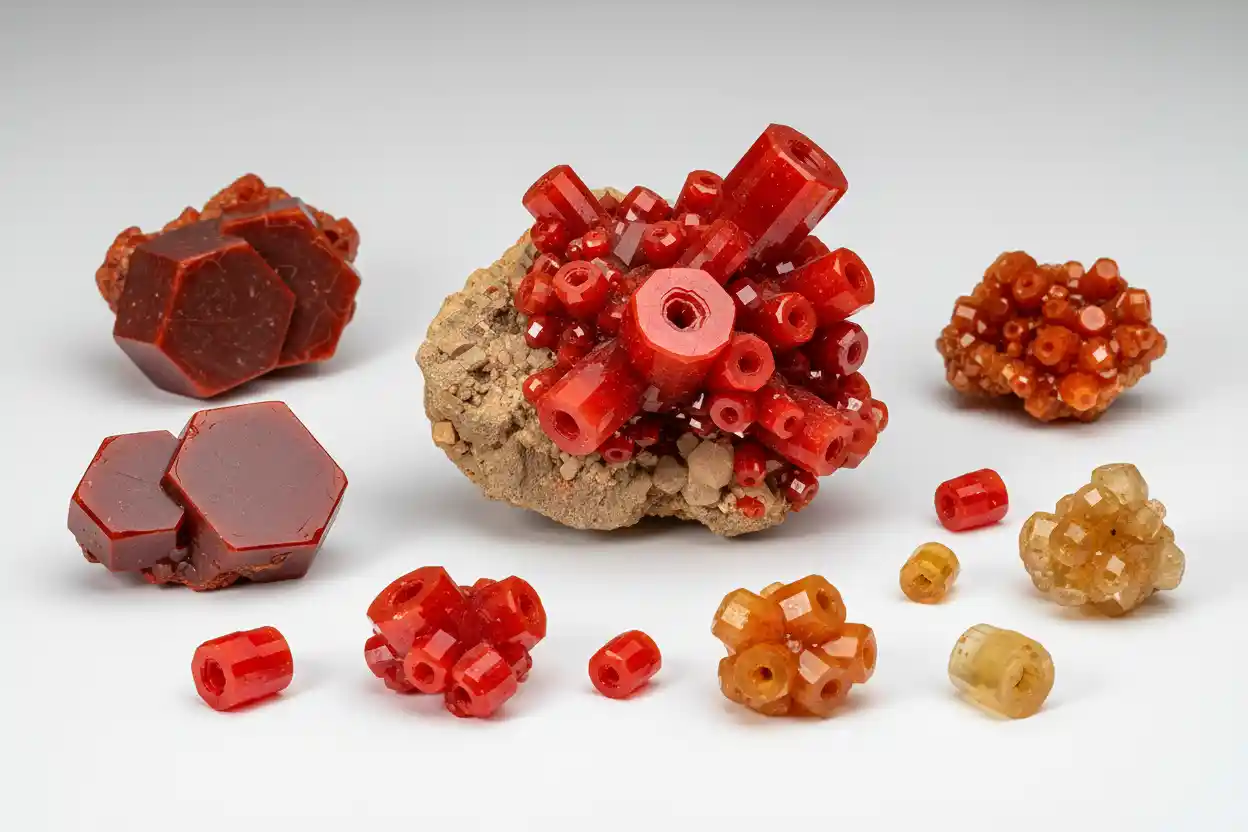
11 Vanadinite Healing Properties: Modern Beliefs, Lead Safety & Mineral Facts
Vanadinite healing properties are commonly associated with motivation, focused action, persistence, creativity, confidence, organization, and turning intentions into practical steps. Its vivid red, orange, and brown hexagonal crystals make it visually striking, so modern crystal practice often interprets the mineral as stimulating or energizing. These associations can support personal rituals, but vanadinite is not scientifically proven to treat fatigue, attention disorders, depression, pain, sexual dysfunction, hormonal conditions, circulation problems, or any other medical condition.
Vanadinite requires a stronger safety emphasis than many collectible stones because it is a lead-bearing mineral. Its ideal chemical formula is Pb₅(VO₄)₃Cl, and lead makes up a substantial share of that composition. The mineral is also soft and brittle, which means crushing, grinding, drilling, or careless cleaning can produce particles that should not be inhaled or ingested. Vanadinite should never be licked, placed in drinking water, powdered for consumption, or used in a ritual that intentionally creates dust.
A responsible approach to vanadinite healing properties combines evidence-safe symbolism with cautious specimen handling. A securely displayed crystal can serve as a reminder to define a goal, start a task, review progress, or protect time from distraction. Personal meaning does not require direct skin contact or a belief that lead-bearing mineral particles are therapeutic.
11 Vanadinite Healing Properties Commonly Used in Modern Crystal Practice
- Motivation to begin a delayed task.
- Focus on one priority at a time.
- Persistence through repetitive or difficult work.
- Organization of goals into practical steps.
- Creative energy for writing, design, or problem-solving.
- Confidence when making a deliberate decision.
- Awareness of distractions and time-wasting habits.
- Commitment to realistic routines.
- Reflection on ambition without overextending oneself.
- Spiritual symbolism connected with vitality and purpose.
- Intentional action balanced with rest, safety, and sound judgment.
What Vanadinite Really Is: Lead Chlorovanadate in the Apatite Group
Vanadinite healing properties belong to modern spiritual interpretation, while the mineral itself has a precise scientific identity. Vanadinite is lead chlorovanadate with the formula Pb₅(VO₄)₃Cl. It belongs to the apatite supergroup and crystallizes in the hexagonal system. Well-developed crystals often form short hexagonal prisms or barrel-like shapes in orange-red, red-brown, brown, yellow, and occasionally paler colors.
The mineral has a Mohs hardness of only about 2.5 to 3, making it much softer than quartz and most familiar jewelry gems. It is brittle, unusually dense, and commonly displays resinous to sub-adamantine luster. These physical properties explain why fine specimens are usually collected for display rather than worn as everyday jewelry.
Vanadinite forms mainly as a secondary mineral in oxidized lead deposits, especially in arid environments. Weathering alters earlier lead-bearing ores while vanadium becomes available from surrounding rocks or minerals, allowing new vanadinite crystals to form. Exceptional specimens are associated with Morocco, Mexico, the United States, and other lead-mining districts.
Vanadinite Healing Properties for Motivation, Focus, and Follow-Through
Motivation as a Cue to Begin
Motivation is one of the most repeated vanadinite healing properties. Modern crystal descriptions sometimes portray the mineral as supplying physical energy or awakening hidden reserves of drive. There is no evidence that vanadinite increases cellular energy, changes metabolism, treats chronic fatigue, or stimulates the nervous system.
A safer interpretation is behavioral. Someone can keep a securely positioned specimen near a workspace and use its bright color as a visual cue to begin one predefined task. Rather than waiting to feel motivated, the person might commit to a short period of focused work, review what was completed, and then decide whether to continue. The mineral does not generate the effort, but it can become associated with starting.
This approach also reduces unnecessary contact. Because vanadinite contains lead, viewing a stable specimen is preferable to repeatedly carrying, rubbing, or handling a raw crystal.
Focus and Organization Through Defined Priorities
Focus is another recurring theme among vanadinite healing properties. No scientific evidence shows that the mineral treats attention disorders or directly improves cognitive performance. A structured ritual can instead reduce the number of competing choices.
Before working, someone might write down the single outcome that matters most, remove obvious distractions, and let the displayed specimen serve as a reminder not to switch tasks without a reason. When attention drifts, the visual cue can prompt a return to the chosen activity.
Modern vanadinite meaning often emphasizes drive, purpose, action, and transformation. Those themes can support personal interpretation without becoming claims that the mineral changes brain chemistry or attention pathways.
Persistence Without Glorifying Exhaustion
Persistence and endurance also appear frequently within vanadinite healing properties. Used carelessly, motivational symbolism can encourage the idea that someone should keep working despite exhaustion. A healthier interpretation treats persistence as returning consistently to an important task while respecting sleep, recovery, health, and changing circumstances.
A person might use vanadinite as a reminder to ask whether a goal still matters, whether the current strategy is working, and whether rest would improve the next attempt. This keeps ambition connected to judgment. Vanadinite does not remove the biological need for sleep, nutrition, medical care, or reasonable workloads.
Claims that a crystal can overcome unexplained exhaustion deserve particular caution because persistent fatigue can have many physical and psychological causes.
Creativity, Confidence, and Moving Ideas Into Action
Creativity is another theme linked with vanadinite healing properties, partly because its saturated colors and geometric crystals are visually stimulating. A writer, designer, or artist might use a safely displayed specimen as a signal to move from collecting ideas into producing a rough draft, prototype, or first sketch.
Confidence can be approached the same way. Before making a decision, someone can identify known facts, remaining uncertainty, possible consequences, and the smallest reasonable action that moves the situation forward. The crystal becomes a symbolic marker for commitment rather than a source of certainty.
Several vanadinite benefits are entirely physical and collectible: vivid color, sharply defined crystal forms, substantial density, strong visual contrast on matrix, and geological interest. None depends on therapeutic claims.
Vanadinite Healing Properties in Chakra and Spiritual Practice
Modern crystal systems often associate vanadinite healing properties with the root or sacral chakras because of the mineral’s red-to-orange coloration. Practitioners may connect it with vitality, creative drive, confidence, sexuality, or grounded action. These interpretations vary considerably and are not standardized mineral properties.
Chakras are spiritual frameworks rather than anatomical structures. Vanadinite does not regulate reproductive organs, raise testosterone or estrogen, improve fertility, treat sexual dysfunction, change circulation, or alter endocrine function. Color-based chakra associations remain symbolic.
A spiritual practice can reduce contact with the mineral by keeping the specimen on a stable surface. Someone might meditate while viewing it and reflect on one goal that deserves action, one distraction that can be reduced, and one limit that prevents burnout. This preserves the symbolism of vanadinite healing properties while respecting the mineral’s lead content.
Vanadinite History Does Not Support an Ancient Healing Tradition
Vanadinite has a genuine mineralogical history, but its current metaphysical reputation should not be presented as ancient medicine. The mineral was recognized through scientific investigation of lead and vanadium-bearing deposits, and its modern name reflects vanadium, one of its defining chemical components.
Its importance developed through mineralogy, mining, and specimen collecting rather than a documented ancient therapeutic tradition. Modern vanadinite healing properties appear mainly within contemporary crystal culture, where red and orange colors are interpreted through themes such as energy, creativity, motivation, and grounded ambition.
There is no need to invent a historical pedigree. Vanadinite already has considerable scientific significance as a secondary lead mineral and considerable collector appeal because of its brilliant hexagonal crystals.
Lead Content Makes Vanadinite Handling Different From Ordinary Crystals
Safety is central to any responsible use of vanadinite healing properties. Vanadinite contains lead, and lead exposure can damage the nervous system, kidneys, blood, and other organs. The most avoidable risks for collectors involve swallowing particles, transferring contaminated residue to the mouth, or breathing dust created through cutting, drilling, crushing, grinding, sanding, or aggressive dry cleaning.
A stable intact specimen in a collection does not create the same exposure as airborne dust, but unnecessary handling should still be minimized. Wash hands thoroughly after touching raw vanadinite or loose fragments and before eating or touching the face. Keep specimens away from food preparation areas and out of reach of young children and pets.
Never lick a specimen, place it in the mouth, or prepare a vanadinite elixir. Direct-contact rituals are unnecessary because vanadinite healing properties are symbolic beliefs, not something that requires lead-bearing particles to contact the body.
Cutting, tumbling, grinding, sanding, and drilling should be avoided by ordinary collectors. If a specimen sheds fragments, do not blow the particles around or dry-sweep fine residue. Preventing dust generation is far safer than trying to manage it after exposure.
Vanadinite Care: Softness, Brittleness, Cleaning, and Storage
Vanadinite’s low hardness means its crystal faces and edges scratch easily. Its brittleness also makes well-formed terminations vulnerable to chipping. Handle specimens by a stable matrix or base rather than gripping exposed crystals, and keep each piece in a secure fitted box or stable display where it cannot fall or rub against harder minerals.
Cleaning should remain minimal. Avoid aggressive brushing, compressed air, ultrasonic cleaning, steam, acids, and harsh household chemicals. Soaking is also a poor default because associated matrix, repaired areas, old adhesives, labels, and fragile crystal contacts may respond differently to water.
Preventive storage is usually more useful than repeated cleaning. An enclosed case also reduces accidental handling and keeps loose fragments contained. Vanadinite healing properties do not become weaker when the mineral is protected behind glass or acrylic.
Safer Spiritual Cleansing for Vanadinite
A lead-bearing mineral does not need water, salt, smoke residue, oils, body contact, or physical rubbing to be used symbolically. Sound, spoken intention, meditation, visualization, or simply repositioning a securely mounted specimen in a dedicated space are lower-contact alternatives.
If brief handling is unavoidable, hold the stable base carefully and wash your hands afterward. Do not place vanadinite near food or drinks, and keep it away from locations where children or pets could reach loose crystals. These precautions respect both the specimen and the real chemistry behind it.
Conclusion
Vanadinite healing properties are modern wellness and spiritual associations centered on motivation, focus, persistence, organization, creativity, confidence, and purposeful action. Vanadinite itself is a soft, brittle lead chlorovanadate mineral valued for vivid color and distinctive hexagonal crystals.
A securely displayed specimen can serve as a visual cue to begin a task, clarify a priority, or review progress without unnecessary physical contact. Its beauty and symbolic meaning do not make its lead content therapeutic.
FAQs
What Are the Main Vanadinite Healing Properties?
Vanadinite healing properties commonly include motivation, focus, persistence, organization, creativity, confidence, purposeful action, awareness of distractions, disciplined routines, ambition, and spiritual vitality.
Are Vanadinite Healing Properties Scientifically Proven?
No. There is no reliable evidence that vanadinite treats fatigue, attention disorders, depression, pain, hormonal conditions, circulation problems, or other medical conditions.
What Is Vanadinite Made Of?
Vanadinite is lead chlorovanadate with the formula Pb₅(VO₄)₃Cl. It belongs to the apatite group and crystallizes in the hexagonal system.
Is Vanadinite Toxic?
Vanadinite contains lead and should be handled as a lead-bearing mineral. Avoid ingestion and dust, minimize handling, wash hands after contact, and keep specimens away from children, pets, and food areas.
Can I Hold Vanadinite During Meditation?
Visual meditation is the safer choice because direct handling is unnecessary. If a raw specimen is briefly handled, wash your hands afterward and avoid touching food or your face first.
Can Vanadinite Go in Water?
Routine soaking is not recommended. Vanadinite is soft and brittle, while associated minerals, repairs, adhesives, and matrix can create additional cleaning concerns.
Which Chakra Is Vanadinite Associated With?
Modern crystal practice commonly connects red or orange vanadinite with root or sacral chakra themes. Chakras are spiritual frameworks rather than anatomical structures.
Can Vanadinite Be Used in a Crystal Elixir?
No. Vanadinite is lead-bearing and should never be placed in drinking water or used to prepare anything intended for ingestion.
How Hard Is Vanadinite?
Vanadinite has a Mohs hardness of about 2.5 to 3. It scratches easily and is brittle, so exposed crystal edges and terminations need careful protection.
Is Vanadinite an Ancient Healing Crystal?
No well-supported ancient vanadinite healing tradition is known. Its current metaphysical associations are predominantly modern.
How Should Vanadinite Be Spiritually Cleansed?
Non-contact methods such as sound, visualization, meditation, and spoken intention are preferable. Avoid soaking, powders, oils, salt burial, and other practices that increase handling or create particles.
Vanadinite healing properties are modern spiritual beliefs rather than medical treatment, and this lead-bearing mineral should always be handled with appropriate safety precautions.