15 Vanadinite Benefits for Focus, Stamina & Creative Energy
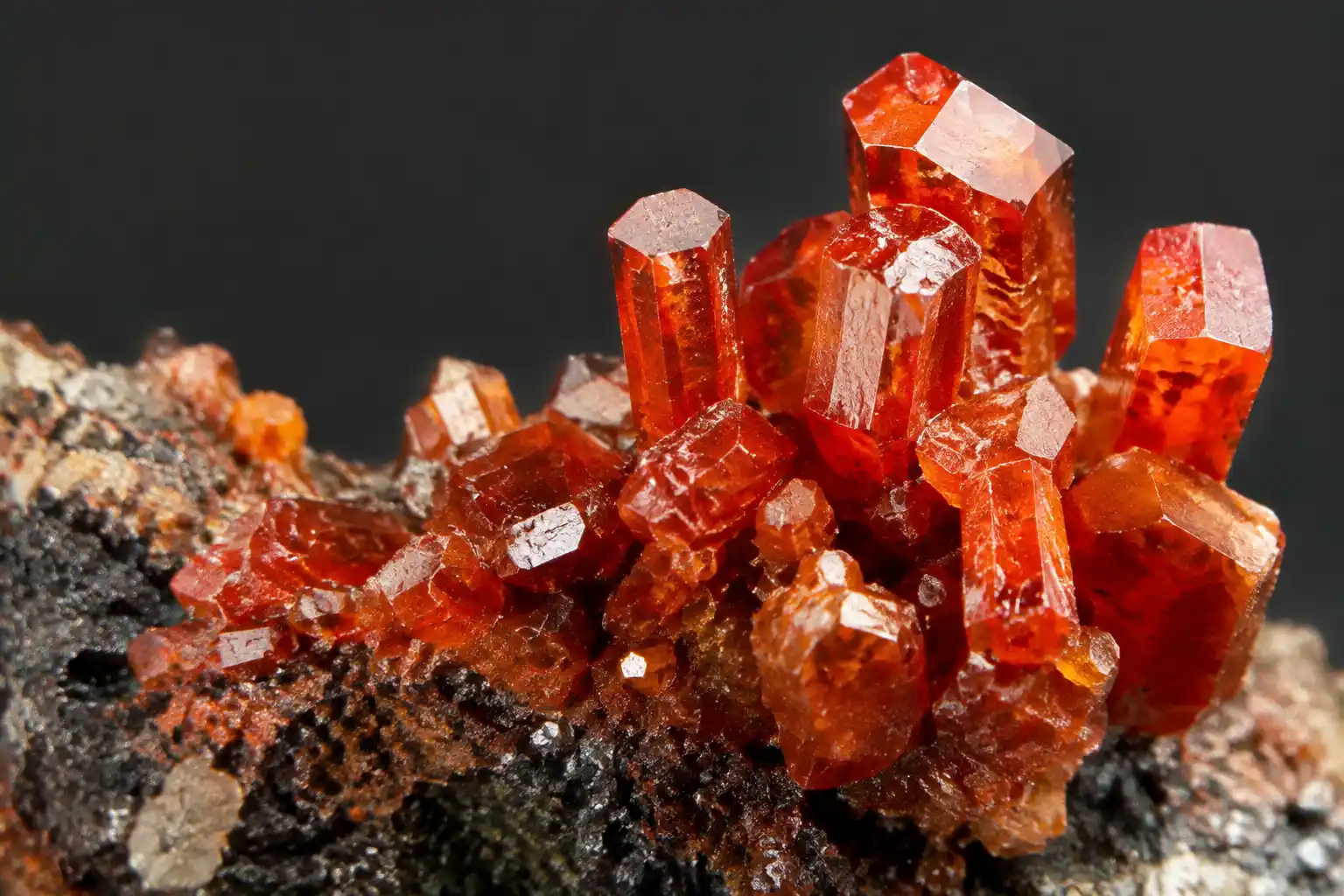
Vanadinite benefits are commonly described through themes of concentration, persistence, disciplined action, creative motivation, grounding, productivity, and accomplishment. Its brilliant red, orange, and reddish-brown crystals have an energetic visual presence, while its dense, sharply defined hexagonal forms make it an intuitive symbol for structure and sustained effort. In modern crystal traditions, these qualities are often interpreted as support for focus and personal drive.
Mineralogically, vanadinite is a lead chlorovanadate with the formula Pb₅(VO₄)₃Cl. It belongs to the apatite supergroup, crystallizes in the hexagonal system, commonly has a Mohs hardness of only 2.5 to 3, and has an unusually high specific gravity near 6.88 because lead is a major part of its chemistry. It is generally brittle and commonly forms in the oxidized portions of lead deposits, particularly in dry geological environments.
These physical facts should be kept separate from metaphysical claims. Vanadinite does not scientifically increase stamina, stimulate creativity, improve concentration, or supply biological energy. It can, however, become a memorable visual reminder of a chosen task or creative commitment, which is a more grounded way to interpret its modern spiritual reputation.
15 Vanadinite Benefits at a Glance
- Focus: staying with one task.
- Persistence: continuing useful work.
- Discipline: following planned routines.
- Motivation: beginning delayed work.
- Creativity: encouraging idea development.
- Grounding: returning to practical priorities.
- Organization: structuring complex projects.
- Confidence: trusting prepared decisions.
- Productivity: converting plans into action.
- Patience: tolerating gradual progress.
- Accomplishment: finishing what was started.
- Self-awareness: noticing distraction patterns.
- Collector interest: appreciating vivid crystal forms.
- Mineralogical learning: understanding lead vanadates.
- Responsible spiritual practice: symbolism without medical claims.
What Vanadinite Actually Is
Vanadinite is a distinct mineral species rather than a variety of quartz, calcite, garnet, or another familiar gem. Its lead-rich chemistry gives it exceptional density, so even a relatively small specimen may feel surprisingly heavy when compared with similarly sized quartz or feldspar.
Its crystals are frequently short hexagonal prisms, sometimes barrel-shaped or tabular, and can occur in striking clusters coating a host rock. Colors include bright red, orange-red, red-brown, yellow, brown, and less commonly very pale shades. Mindat lists sub-adamantine to resinous luster, translucent appearance, brittle tenacity, no observed cleavage, and irregular fracture.
| Mineralogical Property | Vanadinite |
|---|---|
| Chemical formula | Pb₅(VO₄)₃Cl |
| Mineral class | Vanadate |
| Crystal system | Hexagonal |
| Mohs hardness | 2.5 to 3 |
| Specific gravity | About 6.88 |
| Typical colors | Red, orange-red, brown, yellow |
| Luster | Sub-adamantine to resinous |
| Tenacity | Brittle |
| Cleavage | None observed |
| Geological occurrence | Oxidized zones of lead deposits |
| Important safety point | Contains lead |
Its relationship with pyromorphite and mimetite is especially interesting. These minerals share closely related structures, while phosphorus, arsenic, and vanadium occupy corresponding positions in their chemistry. Vanadinite can also form solid-solution relationships with them, illustrating how mineral chemistry can vary while a basic structural framework remains recognizable.
Focus as the Most Practical Vanadinite Benefit
Focus is perhaps the most useful symbolic interpretation of vanadinite benefits because the stone’s compact, geometric crystals naturally suggest structure and direction.
In practical terms, focus means deciding what deserves attention and temporarily refusing less important distractions. A vanadinite specimen placed near a workspace can become associated with that decision.
For example, someone beginning a writing session may use the stone as a cue to work on one defined section before checking messages. A student could associate it with a specific study block. A designer might use it as a reminder to move one concept from rough idea to finished draft.
The mineral does not improve concentration biologically. Its value comes from becoming linked with a repeatable routine.
Stamina as Consistency Rather Than Endless Energy
Stamina is frequently mentioned among vanadinite benefits, but the idea should not be interpreted as physical stimulation.
Vanadinite does not increase oxygen delivery, muscular endurance, metabolism, or neurological energy. Claims that it physically energizes the body are not established.
A more useful definition of stamina is consistency across time. Many worthwhile goals require ordinary effort repeated long after the initial excitement has disappeared.
A person may associate vanadinite with returning to a task day after day, particularly when progress is slow. That symbolism fits creative work, study, administration, business planning, or long-term skill development.
This interpretation also allows rest to remain part of stamina. Sustainable effort depends on recovery, sleep, health, and realistic workload rather than trying to remain productive constantly.
Creative Energy and the Difference Between Ideas and Output
Vanadinite’s red and orange coloration makes it visually suited to modern symbolism involving creative energy, enthusiasm, and initiative.
Creativity, however, involves more than having ideas. A creative project must eventually pass through selection, revision, technical work, and completion.
Vanadinite can symbolize that transition from inspiration to execution.
A person may have dozens of ideas for a design, article, business, photograph, or artistic project. The useful question is not whether more ideas can be generated, but which idea deserves development now.
This is where focus and creativity reinforce each other. Creativity expands possibilities, while discipline chooses which possibility receives time.
Grounding Ambition in Realistic Planning
The bright appearance of vanadinite might suggest intensity, but its strongest practical symbolism comes from pairing ambition with structure.
A goal that sounds exciting but has no timeline, resources, or measurable next step often remains only an intention. Grounding means translating the idea into something specific enough to act upon.
Someone using vanadinite symbolically might ask: What is the next task? What information is missing? What obstacle is most likely to delay progress? What can be completed today?
These questions reduce vague motivation into manageable action.
That is a more useful interpretation than assuming the crystal itself supplies productivity.
Vanadinite and the Symbolism of Red and Orange
Vanadinite belongs visually among striking red crystals, although its hues often extend into orange, rust, brown, and yellow.
Red and orange are frequently associated culturally with heat, activity, courage, urgency, creativity, and movement. These associations help explain why contemporary crystal traditions connect vanadinite with productivity and vitality.
The physical cause of vanadinite’s color is a mineralogical issue, not evidence of an energetic effect on the body.
Color can influence symbolism powerfully without creating a medical mechanism.
Accomplishment and Finishing Difficult Projects
Starting projects is often easier than finishing them. New work carries novelty, possibility, and emotional momentum, while later stages may involve repetitive revision and problem-solving.
Vanadinite’s accomplishment symbolism is most useful during this less glamorous phase.
A stone placed beside a project can represent the commitment to completion rather than excitement.
A writer may need to edit. A business owner may need to finish accounting tasks. A student may need to review weak areas rather than favorite topics. A designer may need to make final technical corrections.
Completion often depends on continuing after motivation becomes ordinary.
Vanadinite Healing Claims Need Clear Boundaries
Modern crystal writing sometimes describes vanadinite as a stone for vitality, physical energy, breathing, circulation, hormones, or other bodily functions.
Those claims are not established medical effects.
The beliefs discussed under vanadinite healing properties should therefore be treated as metaphysical traditions rather than medical guidance.
This boundary is especially important because vanadinite actually contains lead. Its chemistry gives a concrete reason to focus on safe handling rather than consuming, licking, grinding, or intentionally producing dust from specimens.
Lead exposure can occur through inhalation or ingestion of contaminated dust. CDC guidance for lead exposure emphasizes avoiding dust, preventing hand-to-mouth transfer, and using appropriate hygiene after handling lead-containing substances.
Safe Handling Matters More Than Crystal Lore
Vanadinite’s softness and brittleness mean crystals can be damaged relatively easily. Specimens should be handled carefully by the matrix rather than repeatedly touching delicate crystal faces.
Because vanadinite contains lead, it should never be used in crystal elixirs, drinking water, food preparation, or any practice involving ingestion. It should also not be ground, sanded, drilled, or polished casually, since those activities can generate particulate matter.
After handling a specimen, good hygiene is sensible, especially before eating or touching the mouth. Lead dust exposure is a recognized health concern, and grinding or other dust-producing work increases risk.
Children should not be allowed to mouth or play unsupervised with lead-containing mineral specimens.
These precautions do not mean an intact display specimen is inherently dangerous to observe. They mean its real chemistry deserves respect.
Vanadinite as a Collector Mineral
Many of vanadinite’s strongest genuine benefits belong to mineral collecting.
Well-formed crystals can show exceptional color, sharp hexagonal geometry, bright luster, and attractive contrast against dark or pale matrix. Moroccan specimens from the Mibladen mining district are especially well known in the mineral trade, although important occurrences exist in several countries.
Collectors may evaluate crystal size, completeness, color saturation, luster, aesthetics, damage, association with other minerals, locality, and provenance.
Vanadinite is often more appropriate as a display specimen than as jewelry because its hardness is low and crystals are brittle.
This collector role gives the mineral lasting appeal without requiring metaphysical claims.
Mineralogical Learning and the Apatite Supergroup
Vanadinite offers a useful introduction to mineral classification because it belongs to the apatite supergroup but looks very different from the transparent apatite gemstones familiar to many collectors.
The structural relationship shows why mineral families are defined by chemistry and crystallography rather than visual similarity.
Modern interpretations of apatite benefits may overlap with themes such as motivation and focus, but the actual connection between apatite and vanadinite is mineralogical rather than energetic.
Vanadinite is the vanadate analogue within a structural family that also includes phosphate and arsenate members.
That scientific relationship is more precise than saying two crystals “work together” because they feel similar.
Using Vanadinite for Meditation Without Overstating Its Power
Vanadinite can be used visually during meditation without direct skin contact or elaborate crystal rituals.
Place the specimen at a safe distance and choose one work-related theme such as concentration, completion, or creative direction. Spend a few minutes identifying the most important unfinished task and the reason it remains incomplete.
The meditation becomes useful when it produces a decision.
Perhaps the project needs a smaller next step. Perhaps a distraction needs to be removed. Perhaps the work should be delegated. Perhaps the original goal is no longer worth pursuing.
The stone provides a visual anchor, not the answer.
Productivity Without Burnout
Productivity is often presented as constant output, but sustained accomplishment requires limits.
Vanadinite symbolism can therefore include knowing when not to work. Endless effort without adequate sleep, food, exercise, healthcare, or recovery eventually reduces performance.
Focus means choosing priorities.
Stamina means sustaining effort responsibly.
Creative energy means turning ideas into work.
Accomplishment means finishing what matters.
None of these requires sacrificing health.
This interpretation gives vanadinite benefits a more realistic and useful role in everyday life.
Conclusion
Vanadinite benefits combine genuine mineralogical interest with modern symbolism involving focus, stamina, creativity, discipline, grounding, productivity, and accomplishment. Scientifically, it is a dense, soft, brittle lead chlorovanadate that commonly forms vivid hexagonal crystals in oxidized lead deposits.
Its spiritual value is best treated as symbolic. Vanadinite cannot medically energize the body or increase concentration through a proven physical mechanism, but it can become a memorable reminder to structure work, reduce distractions, and finish meaningful projects. Because it contains lead, responsible handling is more important than any unsupported healing claim.
FAQs
What are the main vanadinite benefits?
Modern spiritual traditions associate vanadinite with focus, discipline, creative motivation, grounding, persistence, productivity, and accomplishment. Its genuine benefits include collector value, striking crystal forms, mineralogical interest, and educational value.
Is vanadinite a gemstone?
Vanadinite is primarily collected as a mineral specimen rather than used as a conventional gemstone. Its low hardness and brittleness make it poorly suited to most jewelry.
What is vanadinite made of?
Vanadinite is lead chlorovanadate with the formula Pb₅(VO₄)₃Cl. It contains significant lead and belongs to the apatite supergroup.
Is vanadinite safe to touch?
Brief careful handling of an intact specimen is different from creating dust, but because vanadinite contains lead, good hygiene is appropriate. Avoid touching the mouth while handling it, wash hands afterward, and never grind or ingest the mineral.
Can vanadinite improve focus?
There is no scientific evidence that vanadinite directly alters concentration. It may serve as a visual reminder to reduce distractions and return attention to a chosen task.
Does vanadinite increase physical stamina?
No reliable evidence shows that vanadinite improves endurance, metabolism, circulation, or physical energy. Stamina is better understood symbolically as consistent effort over time.
Can vanadinite go in drinking water?
No. Vanadinite contains lead and should not be placed in drinking water or used for ingestible crystal elixirs.
Why is vanadinite so heavy?
Its high density comes largely from its lead-rich chemistry. Mindat lists measured specific gravity near 6.88, much higher than quartz or feldspar.
Is vanadinite hard?
No. Vanadinite is relatively soft at about 2.5 to 3 on the Mohs scale and is brittle, so specimens require careful handling.
Disclaimer: Spiritual, energetic, motivational, grounding, creative, chakra, manifestation, and healing interpretations associated with vanadinite reflect beliefs and personal practices rather than established medical or psychological effects. Vanadinite contains lead and should not be ingested, licked, placed in drinking water, or casually cut, ground, or sanded. It should not replace professional healthcare or established lead-safety practices.