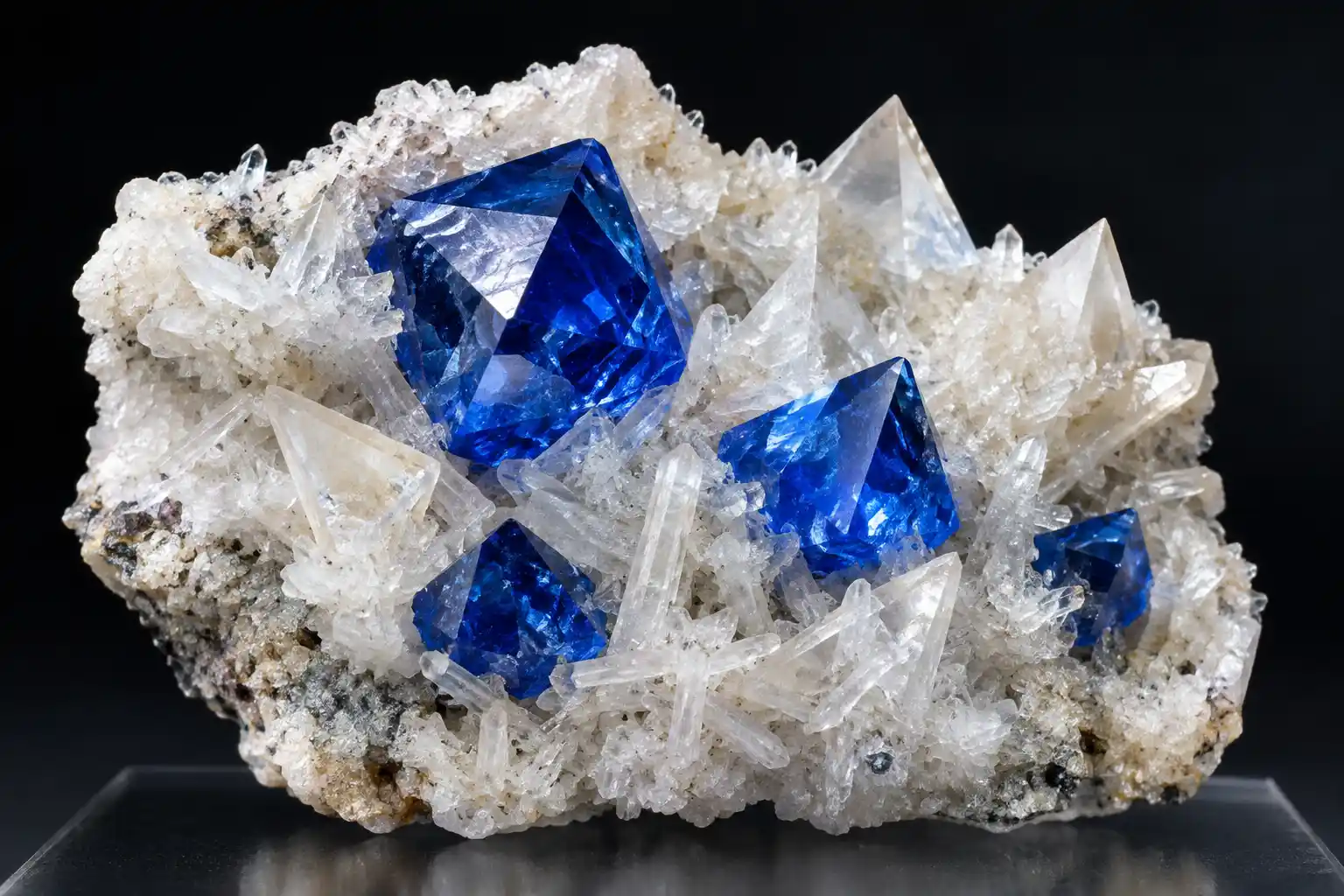
7 Benitoite Benefits: Rare Blue Color, Exceptional Dispersion & Collector Value
Benitoite benefits begin with a combination rarely found in one gemstone: vivid sapphire-like blue, strong dispersion, pronounced dichroism, ultraviolet fluorescence, genuine geological rarity, and an unusually specific connection with California. Benitoite is a barium titanium silicate, BaTiSi₃O₉, and the finest gem-quality crystals are associated with a small area in San Benito County, where the mineral was first recognized as a new species.
Its optical behavior is particularly remarkable. Benitoite has high refractive indices and dispersion around 0.046, slightly exceeding diamond’s commonly cited dispersion. A well-cut stone can therefore display noticeable spectral fire in addition to blue body color. Strong dichroism can show different intensities from nearly colorless to deep blue depending on viewing direction, while many specimens fluoresce bright blue under short-wave ultraviolet radiation.
The strongest benitoite benefits are gemological, collectible, geological, educational, and decorative. Its relative softness and brittle nature make it less forgiving than sapphire for daily jewelry, but its rarity and optical performance give fine stones exceptional appeal to collectors who value unusual natural gems.
7 Benitoite Benefits at a Glance
- Vivid blue color can rival the visual intensity of fine sapphire in attractive stones.
- Strong dispersion can create colorful fire around bright facet reflections.
- Pronounced dichroism adds directional color complexity.
- Short-wave ultraviolet fluorescence provides a distinctive gemological feature.
- Exceptional rarity and concentrated California occurrence create strong collector interest.
- Unusual crystal structure, geology, and mineral associations provide substantial scientific value.
- Faceted benitoite offers distinctive jewelry and collector-gem appeal when its moderate durability is respected.
Rare Blue Color Leads the Most Visible Benitoite Benefits
Color is the first feature most people notice when considering benitoite benefits. Fine stones can display bright medium to deep blue with enough saturation to invite comparison with sapphire, although benitoite and corundum are completely different minerals.
Benitoite is also strongly dichroic. Depending on crystallographic orientation, the same transparent crystal can show a range extending from very pale or nearly colorless to intense blue. Cutting orientation therefore has an enormous influence on the final appearance.
A lapidary cannot simply maximize retained weight. The crystal must be positioned so the desirable blue direction contributes effectively to face-up color while proportions still support brightness and dispersion.
This interaction among orientation, color, and cutting makes benitoite much more interesting than a gemstone whose appearance depends only on overall saturation.
Exceptional Dispersion Creates Colorful Fire
One of the most technically impressive benitoite benefits is dispersion. Dispersion describes how white light separates into its component spectral colors as it travels through a gemstone and exits through properly oriented facets.
Benitoite’s dispersion is approximately 0.046, placing it slightly above diamond’s familiar value of about 0.044. That does not mean benitoite automatically looks more brilliant than diamond because brilliance also depends on refractive index, cutting, body color, lighting, facet angles, and observer position.
In a well-cut benitoite, however, small flashes of red, orange, yellow, green, and other colors can appear around bright reflections. Blue body color may partially mask some dispersion, but high-quality cutting can still produce striking fire.
These optical benitoite benefits give even relatively small stones significant visual presence.
Dichroism Makes Benitoite a Gem Cutter’s Challenge
Benitoite is strongly dichroic, meaning it can show two noticeably different colors or color intensities depending on viewing direction. In blue stones, one direction may appear nearly colorless while another carries much stronger blue.
This property creates both opportunity and difficulty. Orienting the table incorrectly can leave a finished stone much paler than the rough initially suggested. Orienting correctly can concentrate stronger blue while still preserving acceptable yield.
Crystal shape adds another complication. Benitoite commonly forms distinctive tabular or triangular-looking crystals, and gem-quality portions may be limited by inclusions, fractures, or crystal thickness.
Cutting skill therefore belongs among the genuine benitoite benefits. A finished stone demonstrates not only mineral rarity but the lapidary’s ability to balance color orientation, light return, dispersion, and limited rough.
Ultraviolet Fluorescence Adds Identification and Collecting Interest
Fluorescence is another unusual feature among benitoite benefits. Many benitoite specimens produce strong blue fluorescence under short-wave ultraviolet radiation, creating a dramatic contrast with their normal-light appearance.
Pale or colorless examples may also display additional luminescence behavior under different ultraviolet wavelengths. Fluorescence alone should not establish identity, but it can become a valuable part of a complete gemological examination.
For collectors, the response creates two viewing experiences from one specimen. Under ordinary light, color, crystal form, and dispersion dominate. Under suitable ultraviolet illumination, luminescence becomes the focus.
This property is especially appealing in mineral collections that include fluorescent species because benitoite can combine rarity, crystallography, blue color, and ultraviolet response within one small specimen.
California Origin Gives Benitoite Exceptional Geographic Identity
Benitoite has one of the strongest locality identities of any modern gemstone. It was first recognized from the New Idria district of San Benito County, California, and the area’s deposits have produced the finest and most commercially significant gem-quality crystals.
The mineral was initially mistaken for sapphire before mineralogical study established that it was a previously undescribed species. Its name derives from the San Benito region.
Although benitoite has been reported in small amounts from other locations, gem-quality production is overwhelmingly associated with the California occurrence. This concentrated origin makes provenance particularly important for collector specimens.
The connection became strong enough that benitoite was designated California’s official state gemstone. That status adds cultural recognition to genuine geological rarity.
Benitoite Geology Creates Strong Scientific Interest
Benitoite benefits mineral collectors because its geological setting is as unusual as the gemstone itself. At the classic California deposit, benitoite occurs with altered blueschist within serpentinite and formed in fractures influenced by hydrothermal processes.
Associated minerals can include natrolite, neptunite, joaquinite-group species, and other unusual minerals characteristic of the deposit. White natrolite matrix can create particularly attractive contrast with transparent blue benitoite crystals and dark neptunite.
This association means a natural specimen can be more scientifically informative than a faceted gem. Matrix relationships, crystal orientation, associated species, and locality all preserve information that disappears after cutting.
Collectors consequently face an interesting choice when rough is exceptionally attractive: preserve the crystal as a mineral specimen or sacrifice natural form to reveal transparent gemstone potential.
Small Faceted Sizes Add to Benitoite’s Rarity
Gem-quality benitoite crystals are not usually large, and crystal shape can limit faceting yield. Many finished stones are therefore modest in carat weight, while larger clean examples become increasingly exceptional.
This scarcity differs from simply declaring a gemstone rare. Benitoite’s size distribution, limited commercial source, geological occurrence, and cutting constraints combine to make fine faceted stones genuinely difficult to replace.
The relationship between rarity, size, color, cutting, transparency, and provenance strongly influences benitoite price. A small intensely blue, well-cut stone may be more desirable than a heavier gem with weak color or poor brilliance.
Collector value also means natural crystal specimens and faceted gems should not be judged by identical standards.
Benitoite Has Moderate Rather Than Exceptional Jewelry Durability
Benitoite generally sits around Mohs 6 to 6.5. That is adequate for careful jewelry, but considerably lower than sapphire at Mohs 9 and lower than quartz at 7.
The mineral is also brittle, so hard blows can chip or fracture a stone. Daily-wear rings therefore require more caution than earrings or pendants. Protective settings are sensible when the stone has significant value.
The crystal hardness chart helps show why visual similarity to sapphire should never imply similar durability. Benitoite may look sapphire-like in blue color, but its physical wear characteristics are different.
Jewelry owners should store benitoite away from harder gemstones and remove rings before heavy manual work.
Benitoite Is Useful for Learning Professional Gem Identification
Benitoite’s optical properties make it an excellent teaching gem. Blue color can suggest sapphire at first glance, yet refractive indices, birefringence, dichroism, dispersion, fluorescence, and other observations distinguish the two.
This makes accurate testing one of the educational benitoite benefits. A gemologist learns quickly that appearance alone cannot establish identity, even when two stones share a convincing blue hue.
Benitoite’s unusual properties also demonstrate how several tests reinforce one another. No single clue needs to carry the entire identification when refractive behavior, optic character, spectroscopy, fluorescence, microscopy, and physical properties all contribute.
For collectors, professional documentation becomes especially worthwhile as value rises because uncommon gemstones deserve more than a seller’s visual opinion.
Benitoite’s State-Gem Status Adds Cultural Recognition
Benitoite holds the distinction of being California’s official state gemstone. The designation reflects the mineral’s unusually strong connection with the state and the importance of the San Benito occurrence to mineralogy and gem collecting.
State recognition adds another layer to benitoite benefits for collectors interested in geographic identity. A natural specimen is not merely a rare blue mineral but a gem closely associated with California’s geological heritage.
This local significance can also make benitoite appealing to people with personal connections to California, San Benito County, geology, or American mineral collecting.
The symbolism does not change physical value automatically, but provenance and cultural identity can matter greatly to a collector.
Benitoite Meaning Can Add a Personal Layer Without Changing the Gemology
Modern benitoite meaning may connect the gem with rarity, individuality, clarity, ambition, self-expression, or pursuing an unusual path. The intense blue color and exceptional geographic scarcity naturally encourage themes around distinction and uniqueness.
These associations are modern personal symbolism rather than measurable properties of BaTiSi₃O₉. Someone may use a benitoite pendant to represent a California connection or an important accomplishment without claiming that the mineral physically changes confidence or health.
This is where symbolic and verified benitoite benefits can coexist comfortably. Gemology explains what makes the stone rare and beautiful, while the owner decides what that rarity represents personally.
Gentle Care Protects Benitoite’s Facet Edges and Polish
Warm water, mild soap, and gentle hand cleaning are sensible for benitoite jewelry. A soft brush can be used cautiously around settings when the stone is free of vulnerable fractures.
Avoid aggressive ultrasonic or steam cleaning when inclusions, fractures, repairs, or setting condition create uncertainty. Strong impacts deserve even more attention because brittleness can damage facet junctions or edges.
Store loose stones separately from sapphire, diamond, topaz, quartz, and other harder gems. Individual containers or soft-lined compartments prevent unnecessary abrasion.
These precautions preserve the optical qualities responsible for many benitoite benefits without treating the gemstone as too fragile to enjoy.
Conclusion
Benitoite benefits include vivid blue color, strong dispersion, pronounced dichroism, distinctive ultraviolet fluorescence, exceptional California rarity, fascinating geology, professional identification value, and unusual collector appeal.
Its hardness and brittleness make it less durable than sapphire, but benitoite was never remarkable because it imitated sapphire. Its own combination of optical fire, geographic rarity, fluorescence, crystal structure, and state-gem identity gives it a character few gemstones can match.
FAQs
What Are the Main Benitoite Benefits?
Benitoite benefits include intense blue color, strong dispersion, dichroism, ultraviolet fluorescence, geological rarity, collector value, and distinctive gemological properties.
What Is Benitoite Made Of?
Benitoite is a barium titanium silicate with the formula BaTiSi₃O₉.
Is Benitoite Rare?
Yes. Gem-quality benitoite is strongly concentrated in a small area of San Benito County, California, and fine faceted stones are scarce.
Does Benitoite Have More Dispersion Than Diamond?
Benitoite has reported dispersion around 0.046, slightly higher than diamond’s commonly cited value of about 0.044, although overall visible fire depends on several additional factors.
Does Benitoite Fluoresce?
Many specimens show strong blue fluorescence under short-wave ultraviolet radiation.
Is Benitoite the Same as Sapphire?
No. Benitoite and sapphire are completely different minerals despite sometimes showing similar blue color.
How Hard Is Benitoite?
Benitoite is around Mohs 6 to 6.5, making it softer than quartz and much softer than sapphire.
Is Benitoite Good for Rings?
It can be used in carefully protected rings, but pendants and earrings are less exposed to impacts. Valuable stones deserve protective settings.
Why Is Benitoite Associated With California?
The classic and commercially important gem occurrence is in San Benito County, and benitoite is California’s official state gemstone.
Are Large Benitoites Common?
No. Fine faceted benitoites are usually relatively small, and larger clean stones become increasingly unusual.
Does Benitoite Have Proven Healing Benefits?
No reliable evidence establishes benitoite as a treatment for physical or mental health conditions.
Modern symbolic benitoite benefits are personal beliefs and should not replace qualified medical or mental health care.