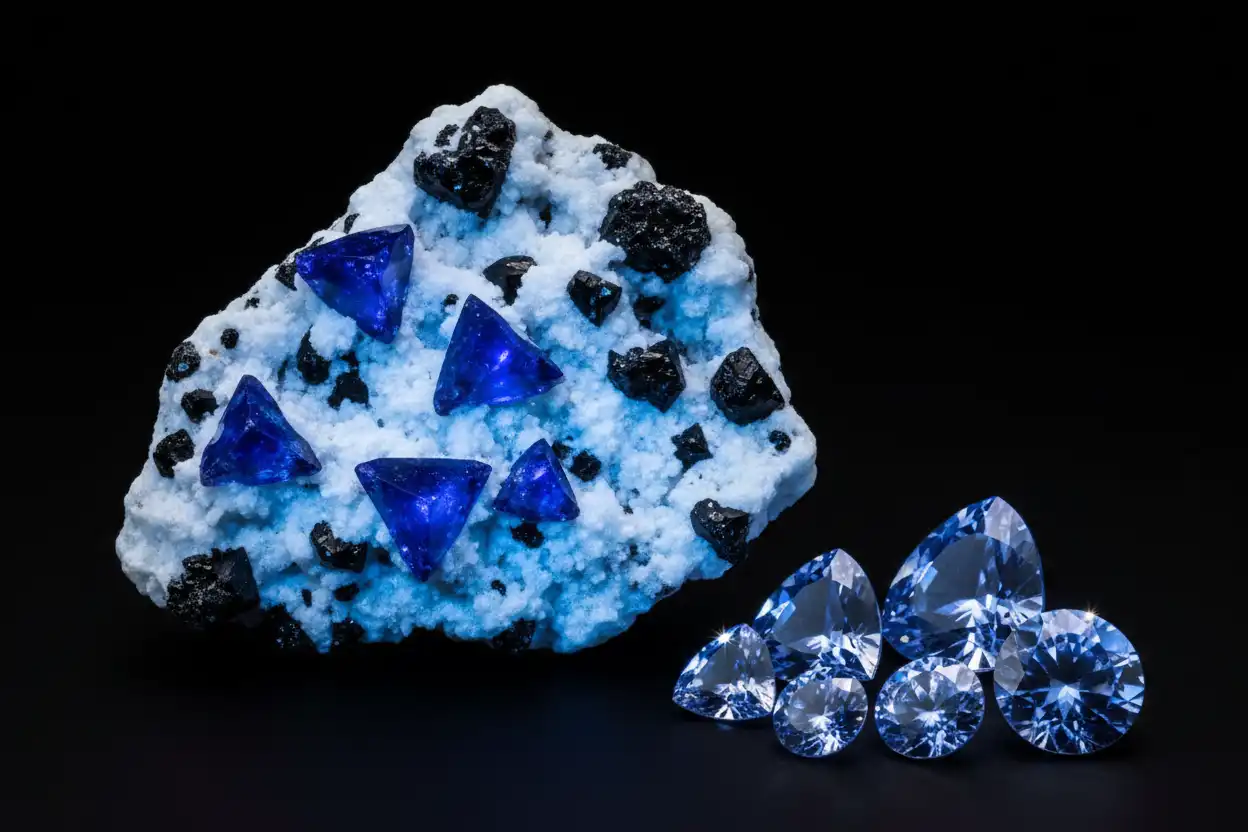
Benitoite Meaning: Mineral Identity, Color & Symbolism
Benitoite meaning begins with an unusually distinctive barium titanium silicate whose intense blue color, high dispersion, strong birefringence, and characteristic crystal geometry make it one of the more recognizable rare collector gemstones. Benitoite has the formula BaTiSi₃O₉ and crystallizes in the hexagonal system, commonly producing flattened tabular or triangular crystals whose outlines can look dramatically different from the prisms associated with sapphire, beryl, or tourmaline. Transparent material ranges from colorless through pale blue to vivid blue and violet-blue, while less commonly encountered crystals may show pinkish or other subdued hues.
Benitoite has a Mohs hardness of roughly 6–6.5 and specific gravity around 3.6–3.7, placing it above quartz in density but below sapphire in scratch resistance. Its refractive indices are high, approximately 1.76 and 1.80, and its birefringence is unusually strong for a faceted blue gem. Benitoite also has dispersion comparable with or exceeding many familiar gemstones, so well-cut colorless or lighter material can show visible spectral fire when lighting, proportions, and orientation allow it.
Modern benitoite meaning commonly includes clarity, individuality, confidence, insight, communication, purpose, and appreciation of rarity. Those ideas can work as personal symbolism, particularly for a mineral whose recognizable blue crystals occur only under specialized geological conditions. They are not measurable effects of barium titanium silicate. Benitoite has not been shown to improve intelligence, activate chakras, alter consciousness, heal illness, attract prosperity, or cause favorable events.
Readers exploring other evidence-led mineral references can browse the wider Gemstone Guides.
Benitoite Identity at a Glance
| Property | Benitoite |
|---|---|
| Mineral species | Benitoite |
| Chemical formula | BaTiSi₃O₉ |
| Mineral class | Cyclosilicate / barium titanium silicate |
| Crystal system | Hexagonal |
| Common crystal habit | Tabular, triangular, flattened, pyramidal forms |
| Common colors | Blue, violet-blue, colorless; rarer subdued pinkish tones |
| Transparency | Transparent to translucent |
| Luster | Vitreous |
| Mohs hardness | Approximately 6–6.5 |
| Specific gravity | Approximately 3.6–3.7 |
| Optical character | Uniaxial positive |
| Typical refractive indices | Approximately 1.76–1.80 |
| Birefringence | Strong, about 0.04–0.05 |
| Dispersion | High |
| Fluorescence | Frequently strong blue under shortwave ultraviolet radiation |
| Famous geological setting | Natrolite-bearing veins within altered blueschist/serpentinite-related rocks |
| Classic associated minerals | Natrolite, neptunite, joaquinite and related minerals |
| Main gem locality association | San Benito County, California |
| Main ownership concern | Moderate hardness, brittle behavior and collector rarity |
Benitoite meaning is more distinctive when these properties are considered together. Many minerals are blue, but few combine this chemistry, symmetry, birefringence, ultraviolet response, triangular crystal habit, density, and specialized geological association.
Benitoite Is a Barium Titanium Silicate
Benitoite’s formula, BaTiSi₃O₉, contains barium, titanium, silicon, and oxygen in a defined crystalline arrangement. It is therefore chemically unrelated to sapphire even though vivid faceted benitoite can overlap visually with blue corundum.
Sapphire is aluminum oxide, Al₂O₃.
Benitoite is a silicate containing essential barium and titanium.
This difference affects virtually every gemological property: density, hardness, refractive index, birefringence, crystal form, cleavage and fracture behavior, fluorescence, geological occurrence, and durability.
The presence of titanium is particularly notable because titanium is an essential structural component rather than merely an occasional impurity.
That fact should not be converted into a biological claim. Wearing titanium-bearing benitoite does not deliver a useful titanium dose to the body.
Benitoite’s Triangular Crystals Are a Major Clue
Natural benitoite often develops triangular or flattened tabular crystals that can appear almost geometric enough to look manufactured. This morphology reflects its hexagonal crystal symmetry and characteristic crystal forms.
Some crystals are relatively thin plates, while others develop thicker pyramidal or modified forms. Terminated crystals can display sharp edges and multiple small faces that produce an intricate outline under magnification.
The triangular shape is valuable as an initial identification clue, particularly on matrix specimens.
It is not sufficient by itself.
Several unrelated minerals can form triangular-looking sections, twins, plates, or broken fragments. Crystal shape becomes convincing when chemistry, optical properties, density, fluorescence, and geological association also agree.
How Benitoite Forms
The classic benitoite occurrence is geologically unusual. Crystals formed in mineralized veins associated with strongly metamorphosed and altered rocks in San Benito County, California. Benitoite commonly occurs within white natrolite-rich vein material accompanied by dark neptunite and other uncommon minerals, producing striking blue-white-black specimens.
The surrounding geological environment includes blueschist-related rocks enclosed within or associated with serpentinite. Fluid alteration and vein formation created conditions capable of bringing barium, titanium, silica, sodium, and other components together in the unusual combinations required for benitoite and its associated mineral assemblage.
Benitoite therefore does not represent an ordinary granite-pegmatite gem such as many beryls or tourmalines.
Its formation belongs to a much more specialized metamorphic and hydrothermal system.
Host-rock relationships, vein sequence, natrolite formation, associated minerals, and locality-specific geology are examined separately in Benitoite formation and deposit geology.
The White Matrix Is Often Natrolite
Many classic benitoite specimens show vivid blue crystals protruding from bright white material. That white mineral is commonly natrolite, a zeolite mineral that formed within the same vein system.
Natrolite can surround benitoite so completely that specimen preparation sometimes requires careful removal of matrix to reveal previously concealed crystals.
This process can make a cleaned collector specimen look dramatically different from the material as originally recovered.
The contrast is scientifically useful as well as aesthetic. Blue benitoite, white natrolite, and black neptunite create one of the most visually recognizable mineral associations in gem mineralogy.
A clean white matrix should nevertheless not be used to assign locality automatically. Provenance still requires documentation.
Neptunite Is a Classic Associate
Black to very dark reddish-black neptunite crystals frequently accompany classic benitoite specimens. Neptunite is chemically and structurally different from benitoite, yet the two formed within the same unusual mineralizing environment.
This association can be extremely attractive because transparent blue crystals stand out sharply against white natrolite and glossy black neptunite.
Other unusual minerals may also occur within the assemblage.
An associated black crystal should not automatically be called neptunite solely because benitoite appears nearby. The specimen may contain several dark phases, and exact identification still depends on morphology, optical properties, chemistry, or analytical testing.
Why Benitoite Is Blue
Benitoite’s blue color is associated with electronic processes involving titanium within its crystal structure and related defect chemistry. The explanation is more complex than saying simply that “titanium makes it blue,” because titanium is present in benitoite regardless of whether an individual crystal is strongly blue, pale, or colorless.
Crystal chemistry, oxidation state, defects, trace constituents, and optical absorption all influence the final visible appearance.
This distinction matters because color-causing mechanisms should describe why light is absorbed differently, not merely list an element that happens to occur in the formula.
The strongest blue can appear vivid under appropriate daylight-equivalent illumination, while some crystals become noticeably violet or lighter when viewed through different orientations.
The detailed relationship among absorption, refractive indices, pleochroism, birefringence, orientation, and transmitted light is explored in Benitoite optical properties and color behavior.
Benitoite Can Show Noticeable Pleochroism
Blue benitoite can show directional color differences because it is optically anisotropic. Depending on orientation, a crystal may appear deeper blue in one direction and much paler or nearly colorless in another.
This matters to both identification and cutting.
A faceter who ignores crystal orientation can produce a stone that looks lighter or less saturated than the rough suggested. Conversely, orienting only for maximum blue may reduce yield or produce a shape that performs poorly optically.
Pleochroism is not the same as a true lighting-dependent color change.
It describes color differences caused by the direction in which light travels through the crystal.
Benitoite Has Exceptional Birefringence for a Blue Gem
One of benitoite’s strongest diagnostic characteristics is the large separation between its two principal refractive indices.
Its ordinary refractive index is roughly in the upper 1.75 range, while the extraordinary index is around 1.80. The difference is approximately 0.04–0.05, producing conspicuous birefringence.
This means light entering the crystal can split into two rays traveling at different velocities.
Under magnification, correctly oriented faceted stones may show doubling of back-facet edges because the two rays produce slightly displaced images.
This feature is very different from sapphire, which has considerably lower birefringence.
The combination of high refractive index and strong birefringence makes conventional gemological testing highly effective.
Benitoite Also Has High Dispersion
Dispersion describes the separation of white light into spectral colors because different wavelengths refract by different amounts.
Benitoite has unusually high dispersion for a colored gemstone.
When the body color is light enough and the stone is cut effectively, flashes of red, orange, yellow, green, and violet may appear within the broader blue gem. Strong dark blue can partially mask this fire, which is why colorless or lighter stones sometimes display dispersion more obviously.
The effect should not be exaggerated in photography.
A natural benitoite does not look like a permanently rainbow-filled crystal under all lighting. Fire depends on light source size, stone orientation, facet design, body color, and viewing angle.
Shortwave UV Fluorescence Is a Powerful Clue
Benitoite is famous for strong blue fluorescence under shortwave ultraviolet radiation. Natural crystals can glow vivid blue when exposed to an appropriate shortwave UV source, making fluorescence particularly useful for locating crystals in matrix and supporting identification.
Longwave ultraviolet response can be much weaker or absent in many specimens.
The wavelength therefore matters.
A seller saying simply “UV reactive” provides less useful information than specifying the UV range.
Fluorescence is also not sufficient to prove benitoite because other minerals can fluoresce blue. Its strongest diagnostic value comes from combining the response with morphology, refractive properties, density, and mineral association.
Fluorescence Is Not the Normal Color
A benitoite crystal glowing bright blue under ultraviolet radiation is displaying luminescence, not its ordinary daylight color.
This distinction matters in mineral photography. UV images are valuable when clearly understood as fluorescence photographs, but they should not be used to imply that a specimen emits intense blue light continuously.
Under ordinary illumination, benitoite reflects and transmits visible light like other gemstones.
Under suitable ultraviolet excitation, its crystal structure can absorb higher-energy radiation and re-emit part of that energy as visible fluorescence.
The glow stops when the excitation source is removed.
Diagnostic Traits of Benitoite
Benitoite becomes relatively straightforward to identify when several independent properties converge: high refractive index, strong birefringence, uniaxial-positive optical character, specific gravity around 3.6–3.7, hardness near 6–6.5, triangular hexagonal morphology, blue shortwave-UV fluorescence, and a characteristic mineral assemblage.
Faceted material can be separated efficiently from sapphire, spinel, zircon, tourmaline, blue glass, and synthetic imitations using conventional gemological equipment.
Sapphire is significantly harder and less birefringent.
Spinel is singly refractive.
Blue zircon has different refractive behavior and density.
Tourmaline has different optical values and typically stronger elongated prismatic morphology.
Glass lacks benitoite’s crystalline optical behavior.
When material is mounted or unusually small, Raman spectroscopy or another nondestructive analytical method can provide additional certainty.
Original Benitoite Specimen and Photo Checklist
| Observation | What it may reasonably support | What it cannot prove alone |
|---|---|---|
| Vivid blue triangular crystal | Strong visual compatibility with benitoite | Definitive species identity |
| White natrolite-like matrix | Classic geological association | San Benito origin |
| Black prismatic associated crystals | Possible neptunite association | Neptunite without identification |
| Vitreous transparent surface | Expected appearance | Natural origin |
| Violet-blue directional color | Compatible pleochroism | Exact color mechanism |
| Strong blue shortwave UV fluorescence | Important benitoite clue | Species identity by itself |
| Weak or absent longwave response | Compatible behavior | Definitive identification |
| SG around 3.65 | Strong supporting evidence | Geographic provenance |
| RI values around 1.76–1.80 | Very strong gemological evidence | Locality |
| Strong facet-edge doubling | Compatible high birefringence | Benitoite without other tests |
| Raman result matching benitoite | Strong species identification | Geographic origin |
| X-ray diffraction matching benitoite | Strong structural evidence | Treatment history |
| Seller claims California origin | Provenance claim | Independent proof |
| Original mine label | Strong locality evidence | Independent gem identification |
| Repaired matrix junction | Condition information | Whether repair was disclosed when collected |
A photograph can make benitoite a strong visual possibility, particularly when triangular blue crystals occur with white natrolite and black neptunite. Laboratory-style optical properties remain much stronger evidence than resemblance alone.
Microscopic examination of growth zoning, inclusions, fractures, surface features, associated minerals, repairs, and cutting characteristics is explored in the Benitoite microscope inclusion notebook.
Benitoite Claims That Need Qualification
| Claim | More accurate interpretation |
|---|---|
| “Benitoite is a type of sapphire” | False; benitoite is a barium titanium silicate |
| “Every vivid blue triangular crystal is benitoite” | Shape and color are strong clues, not proof |
| “Titanium alone explains every blue benitoite” | The color mechanism involves titanium-related electronic and structural factors rather than a simple element-to-color rule |
| “Benitoite always glows under any UV lamp” | Fluorescence depends strongly on UV wavelength |
| “Benitoite glows blue in the dark” | Fluorescence requires excitation from an appropriate radiation source |
| “All benitoite comes from one exact spot” | Additional occurrences exist, although classic gem-quality material is strongly associated with San Benito County |
| “Rarity guarantees investment returns” | Future value cannot be guaranteed |
| “Benitoite is as durable as sapphire because both are blue” | Benitoite is significantly softer and more vulnerable |
| “Barium makes benitoite dangerous to touch” | Normal handling of an intact gemstone is different from exposure to soluble barium compounds |
| “Titanium in benitoite benefits the body” | Wearing the crystal does not provide a controlled therapeutic titanium dose |
| “Benitoite activates higher consciousness” | This is metaphysical symbolism rather than measured mineral behavior |
| “Blue fluorescence proves supernatural energy” | Fluorescence is a measurable photophysical response |
These boundaries preserve what makes benitoite genuinely unusual without adding claims that its mineralogy cannot support.
Benitoite and Sapphire Can Look Similar Face-Up
Fine blue benitoite can resemble sapphire because both may show saturated blue color, transparency, vitreous luster, and attractive brilliance.
The similarities end quickly under testing.
Sapphire has Mohs hardness 9, whereas benitoite is around 6–6.5.
Sapphire has specific gravity close to 4, while benitoite is somewhat lighter.
Benitoite has far stronger birefringence.
Benitoite’s dispersion can also be much more conspicuous, particularly in lighter-colored stones.
A refractometer, polariscope, dichroscope, microscope, and UV examination can separate them without destructive testing.
Color is therefore an identification starting point rather than a conclusion.
Benitoite and Beryl Are Structurally Different Silicates
Beryl meaning concerns Be₃Al₂Si₆O₁₈, the mineral species that includes emerald and aquamarine. Benitoite is a different silicate with essential barium and titanium.
Aquamarine can overlap with pale blue benitoite visually, but beryl generally has lower refractive index, lower density, lower birefringence, different crystal morphology, and different geological environments.
This difference is especially useful when a small pale-blue transparent stone has lost all obvious rough-crystal context.
Instrumental identification quickly separates the two.
Benitoite and Bauxite Share Aluminum-Industry Context Only Indirectly
Bauxite meaning concerns an aluminum ore rock composed of multiple mineral phases. Benitoite is a precisely defined crystalline mineral species.
The two materials illustrate opposite ends of geological classification.
A bauxite sample is understood through bulk mineralogy and rock texture.
A benitoite crystal is identified through a specific structure and chemistry.
Both may be scientifically important, but for entirely different reasons.
California Is Central to Benitoite’s Cultural Identity
Benitoite was named for San Benito County, the region most strongly associated with its discovery and classic gem occurrence. The mineral later became California’s official state gemstone.
That geographic relationship contributes significantly to its identity in mineral collecting.
The association should still be handled carefully in individual purchases. A blue benitoite gemstone can be mineralogically genuine without a seller’s claimed mine or collection history automatically being correct.
Provenance requires evidence beyond species identity.
Original labels, collection records, mine documentation, and ownership history are therefore particularly useful for important specimens.
A structured approach to locality and disclosure is provided in the Benitoite provenance and disclosure checklist.
Locality Matters More Than With Many Common Gems
Gem-quality benitoite has a highly concentrated geographic reputation, so provenance can add scientific and collector importance beyond the mineral name itself.
This creates an unusual situation.
For an inexpensive quartz specimen, losing exact locality may have limited effect on identification.
For a fine benitoite crystal, losing an original locality label can remove significant historical and geological context.
Color cannot reconstruct that information.
Neither can fluorescence.
A properly preserved old specimen label may therefore be nearly as important as the specimen box protecting the crystal.
Benitoite Is Rare but “Rare” Is Not a Price
Benitoite’s restricted gem-quality supply contributes to collector and jewelry interest, but rarity alone does not determine value.
Transparent faceted stones are evaluated through color, clarity, size, cut, brilliance, condition, provenance, and overall appearance. Natural specimens depend additionally on crystal form, matrix aesthetics, associated minerals, damage, repair, locality documentation, and whether the specimen retains meaningful geological context.
Large clean gems are especially uncommon, but a numerical price should never be inferred from size alone.
The dedicated Benitoite price guide addresses valuation separately so mineral identity does not become mixed with changing market methodology.
Buying Benitoite Requires More Than Finding a Blue Stone
The rarity and strong geographic identity of benitoite make seller disclosure important. A purchase should separate at least four questions: Is the material actually benitoite? Is the stated treatment status supported? Is the claimed locality documented? Is the price appropriate for the individual object’s quality?
Those are not the same question.
A laboratory report can support species identity.
A provenance label can support geographic history.
Neither automatically establishes whether a price is reasonable.
Transaction-specific seller checks and purchasing decisions are covered in buy benitoite.
Benitoite Treatments Are Not the Center of Its Identity
Unlike some major colored gemstones, benitoite is not primarily defined in the market by a routine treatment tradition. That does not mean every object should be assumed untreated without examination.
Coatings, assembled objects, repairs, matrix reconstruction, fracture filling, or misleading representations can occur in the broader gem and specimen market.
Natural matrix specimens may be repaired where crystals or host rock have broken.
A repaired specimen can still be valuable when the restoration is disclosed.
The important principle is to distinguish mineral identity from condition and treatment rather than assuming that rarity guarantees an untouched object.
Benitoite Is Durable Enough for Jewelry With Care
A hardness around 6–6.5 gives benitoite moderate scratch resistance, but it is not an ideal gemstone for careless everyday wear.
Quartz can potentially scratch it.
Sapphire, spinel, topaz, and diamond are substantially harder.
A hard impact can damage facet junctions, edges, or already fractured areas.
Pendants and earrings expose the stone to less mechanical wear than rings or bracelets. A ring can still be appropriate when the setting protects vulnerable edges and the owner understands that the gemstone deserves more care than sapphire.
Setting pressure, prong placement, girdle protection, ring exposure, and repair considerations are explored in Benitoite setting and wear engineering.
Cutting Benitoite Requires Balancing Blue Color and Fire
Benitoite presents an interesting lapidary problem because its strongest blue orientation does not necessarily produce the largest or most brilliant finished gemstone.
The cutter must consider pleochroism, natural crystal shape, fractures, inclusions, thickness, dispersion, and yield.
A very dark orientation may suppress spectral fire.
A very pale orientation may maximize brilliance but lose the saturated blue buyers associate with the gem.
Because clean rough is scarce, every unnecessary loss of weight can be significant, yet preserving weight at the expense of optical performance can produce an inferior stone.
Orientation, facet design, polish, birefringence, and color management are explored in Benitoite cutting, orientation and polish.
Natural Crystals Can Be More Important Than Cut Stones
A sharp benitoite crystal on original matrix preserves information that a faceted gem cannot: natural crystal habit, growth surfaces, mineral associations, orientation within the vein, potential alteration relationships, and locality context.
Cutting such a crystal permanently removes much of that information.
Gem-quality rough is legitimately fashioned when appropriate, but an exceptional natural specimen may be scientifically or aesthetically more important intact.
This is particularly true when benitoite occurs beside neptunite or other characteristic minerals.
Long-term storage, matrix support, repairs, label preservation, and handling of important specimens are covered in the Benitoite specimen conservation record.
Safe Ownership Is Straightforward
Normal ownership of an intact benitoite crystal or faceted gemstone does not require unusual precautions.
The main routine risks concern scratching, impact, loss of small rare specimens, and damage to delicate matrix material.
Warm soapy water and gentle manual cleaning are sensible for sound faceted stones when no coating, fracture filling, adhesive, or unusual mounting is present. Collector specimens should be treated more conservatively because natrolite and associated minerals may respond differently from the benitoite itself.
Aggressive ultrasonic or steam cleaning is unnecessary when fractures, repairs, and matrix stability are unknown.
Physical condition should determine care.
Barium in Benitoite Needs Context
Barium is an essential part of benitoite’s chemistry.
That does not make an intact gemstone equivalent to a soluble barium compound.
Elements incorporated within stable mineral structures can behave very differently from soluble chemical salts. Exposure pathway matters.
At the same time, natural mineral specimens should not be eaten, ground into powders for wellness use, or treated as pharmaceutical materials.
The balanced approach is simple: normal handling is different from ingestion or deliberate dust generation.
Do Not Use Benitoite in Drinking Water Remedies
Benitoite should not be placed in drinking water for supposed healing benefits or crushed into ingestible powder.
The ideal formula does not account for every inclusion, matrix phase, repair material, contaminant, or associated mineral that may occur in a natural specimen.
There is also no demonstrated health benefit from exposing drinking water to barium titanium silicate.
Symbolic use does not require ingestion.
A valuable crystal is better preserved than dissolved, damaged, or contaminated through unnecessary wellness practices.
Modern Benitoite Meaning and Individuality
Individuality is one of the most fitting modern symbolic themes for benitoite because its mineral identity is highly distinctive. Few gems combine barium-titanium chemistry, intense blue color, triangular crystals, strong birefringence, high dispersion, ultraviolet fluorescence, and a famous restricted geological occurrence.
A person may use benitoite as a reminder that distinctiveness does not require similarity to more familiar standards.
The mineral does not create confidence or individuality automatically.
Its rarity can simply provide a physical object around which someone builds that personal interpretation.
Benitoite Meaning and Clarity
Benitoite’s transparent crystals, strong brilliance, and crisp optical behavior can inspire symbolism around clarity or seeing a problem more precisely.
A person may use the stone as a reminder to separate observation from assumption, particularly when making a difficult decision.
That symbolic practice can be practical.
No established evidence shows that benitoite improves intelligence, memory, concentration, or reasoning through mineral energy.
Clarity remains a human cognitive process.
Benitoite Meaning and Communication
Blue gemstones are frequently linked with communication in modern metaphysical systems. Benitoite is consequently associated with speaking clearly, expressing individuality, or communicating personal truth.
These ideas can be translated into useful behavior: prepare before an important conversation, listen carefully, avoid ambiguous wording, or write down the central point before speaking.
Those actions may improve communication.
The gemstone itself has not been demonstrated to alter language processing, confidence, vocal function, or another person’s response.
Benitoite Meaning and Purpose
The rarity and specialized geological formation of benitoite can also inspire associations with purpose or finding one’s particular role.
As metaphor, the idea is straightforward: a mineral requiring an uncommon combination of chemical components and geological conditions can symbolize the value of specific circumstances coming together.
It does not mean that benitoite reveals a predetermined destiny.
A person can use the stone during reflection about goals, career, creative work, or priorities without treating it as an oracle.
Benitoite Does Not Have Established Healing Properties
There is no established scientific evidence that wearing, holding, or meditating with benitoite treats medical or psychological conditions.
Its barium content does not provide therapeutic barium.
Its titanium content does not create biological energy.
Its ultraviolet fluorescence does not demonstrate a healing field.
Its blue color does not alter neurological function.
A gemstone can hold personal significance while medical decisions remain based on qualified healthcare and relevant evidence.
The broader distinction between symbolism, spiritual belief, and health claims is explained in the Gems Lore Disclaimer.
Original Evidence Ladder for Benitoite Claims
Direct observation can establish blue color, transparency, triangular habit, matrix, visible associations, fractures, repairs, luster, and overall condition.
Basic gemological examination can establish refractive indices, strong birefringence, uniaxial-positive behavior, density, pleochroism, hardness context, dispersion, and fluorescence response.
Microscopy can reveal inclusions, growth zoning, doubling, fractures, surface features, repairs, polishing characteristics, and matrix relationships.
Spectroscopic or structural analysis can confirm benitoite when a tiny or mounted specimen cannot be identified confidently through routine methods.
Color interpretation requires appropriate optical and spectroscopic evidence rather than assuming that titanium presence alone explains every shade.
Geological interpretation requires natrolite-vein relationships, associated minerals, host-rock evidence, metamorphic setting, and locality context.
Provenance requires original labels, mine records, collection history, dealer documentation, or another traceable source.
Value interpretation requires separate market evidence rather than converting rarity directly into a price.
Historical claims require documentation tying benitoite to the stated human use.
Metaphysical claims remain belief-based even when a modern tradition is documented. Evidence that people associate benitoite with insight or purpose does not prove that the mineral physically produces those states.
This evidence ladder prevents one striking blue photograph from being asked to establish mineral identity, California provenance, treatment status, value, and spiritual properties simultaneously.
What Benitoite Meaning Can Responsibly Represent
Benitoite’s genuine characteristics provide unusually specific metaphors. Its restricted geological occurrence can symbolize individuality. Its intense blue crystals emerging from contrasting white matrix can represent visibility or self-expression. Strong dispersion can represent seeing multiple aspects within one situation, while pleochroism offers a natural metaphor for perspective changing with direction.
These meanings come from interpretation.
They do not require benitoite to heal illness, activate a chakra, reveal destiny, or transmit supernatural information.
Someone may choose the gem as a reminder to communicate clearly, value what is distinctive, or examine an issue from more than one perspective.
The evidence-led approach used throughout Gems Lore is described on About Gems Lore. Questions about an individual benitoite specimen can be submitted through Contact Gems Lore.
Frequently Asked Questions
What is benitoite?
Benitoite is a rare barium titanium silicate mineral with the formula BaTiSi₃O₉, best known for transparent blue crystals and gemstones.
What is benitoite meaning?
Benitoite meaning can refer to the mineral’s scientific identity and geographic history or to modern symbolic themes such as individuality, clarity, communication, insight, and purpose.
Why is benitoite blue?
Its blue color is associated with titanium-related electronic and structural processes within the crystal. Exact color intensity also depends on crystal chemistry, defects, orientation, and optical absorption.
Is benitoite always blue?
No. Colorless, pale blue, violet-blue, and rarer subdued color variations can occur.
What crystal system is benitoite?
Benitoite crystallizes in the hexagonal system.
Why are benitoite crystals triangular?
Its characteristic hexagonal symmetry and crystal forms commonly produce flattened triangular-looking outlines.
How hard is benitoite?
Benitoite is approximately 6–6.5 on the Mohs hardness scale.
Is benitoite harder than sapphire?
No. Sapphire has Mohs hardness 9 and is substantially more scratch-resistant.
What is benitoite’s specific gravity?
It is commonly around 3.6–3.7.
Does benitoite have high refractive index?
Yes. Its refractive indices are approximately in the 1.76–1.80 range.
Does benitoite have strong birefringence?
Yes. Its birefringence is unusually strong, approximately 0.04–0.05.
Does benitoite have fire?
Yes. Benitoite has high dispersion and can display visible spectral fire, particularly in well-cut lighter-colored material.
Does benitoite fluoresce?
Many specimens show vivid blue fluorescence under shortwave ultraviolet radiation.
Does benitoite glow in the dark?
No. Fluorescence requires an appropriate excitation source. The visible glow stops when that excitation is removed.
Does benitoite fluoresce under longwave UV?
Many specimens respond much more strongly to shortwave UV, while longwave response may be weak or absent.
Where does benitoite form?
The classic occurrence is associated with natrolite-bearing veins in unusual metamorphic and altered rocks in San Benito County, California.
What minerals occur with benitoite?
Classic associates include white natrolite and dark neptunite, along with several other uncommon minerals.
Is benitoite a type of sapphire?
No. Sapphire is corundum, Al₂O₃. Benitoite is BaTiSi₃O₉.
Is benitoite a California gemstone?
Benitoite is strongly associated with California and is the state’s official gemstone.
Does all benitoite come from California?
Benitoite has been reported from other geological occurrences, but classic gem-quality blue material is especially associated with San Benito County.
Is benitoite rare?
Gem-quality benitoite is uncommon, particularly in larger clean faceted sizes and well-formed collector crystals.
Is benitoite expensive?
Some specimens and gemstones can be valuable because of rarity, quality, size, provenance, and demand. Changing market valuation is covered separately in the Benitoite price guide.
Where can I buy benitoite?
Identity, seller disclosure, documentation, laboratory reports, and transaction-specific considerations are covered in buy benitoite.
Can benitoite be worn every day?
It can be worn with care, but its moderate hardness makes it less suitable for rough everyday exposure than sapphire or spinel.
Is benitoite good for engagement rings?
It can be used in a protected setting for someone willing to accept greater maintenance and damage risk, but it is not as durable as traditional engagement-ring stones.
Can benitoite be cleaned with water?
Sound untreated faceted benitoite can generally tolerate gentle warm soapy water. Matrix specimens, repairs, fracture fillings, and associated minerals may require more conservative care.
Is benitoite safe to handle?
Normal handling of an intact gemstone or stable specimen is different from ingesting or grinding mineral material and generally requires ordinary mineral-collection precautions.
Can benitoite go in drinking water?
It should not be used to prepare ingestible crystal remedies. Natural mineral specimens are not food or pharmaceutical materials.
What does benitoite symbolize?
Modern benitoite meaning commonly includes individuality, clarity, communication, insight, purpose, confidence, and perspective.
Does benitoite open the throat chakra?
That association belongs to modern metaphysical practice rather than established anatomy or gemology.
Does benitoite improve communication?
A person may use it symbolically as a reminder to communicate clearly, but no established evidence shows that the mineral itself changes communication ability.
Does benitoite have healing properties?
There is no established scientific evidence that benitoite treats medical or psychological conditions.
Why is provenance important for benitoite?
The mineral’s strong association with a famous California occurrence means locality documentation can add significant geological and collector context that appearance alone cannot establish.
Benitoite meaning becomes far more distinctive when the mineral’s real properties come first. It is a barium titanium silicate with intense blue color, triangular hexagonal crystals, high refractive indices, strong birefringence, substantial dispersion, shortwave ultraviolet fluorescence, and one of the most recognizable mineral associations in collector gemology.
Its documented connection with San Benito County and its occurrence with white natrolite and dark neptunite give benitoite an identity that does not need invented ancient traditions. Its genuine optical properties also provide natural symbolic possibilities: pleochroism can represent perspective, dispersion can represent seeing multiple components within one issue, and geographic rarity can represent individuality.
Those interpretations remain metaphors rather than physical powers. Benitoite does not need healing claims, supernatural communication, or guaranteed life transformation to be meaningful; its mineralogy, geology, optical behavior, rarity, and documented cultural connection with California already make it exceptional.