10 Real Blue Tiger’s Eye Benefits: Meaningful Traditions, Evidence, Safe Use & Clear Limits
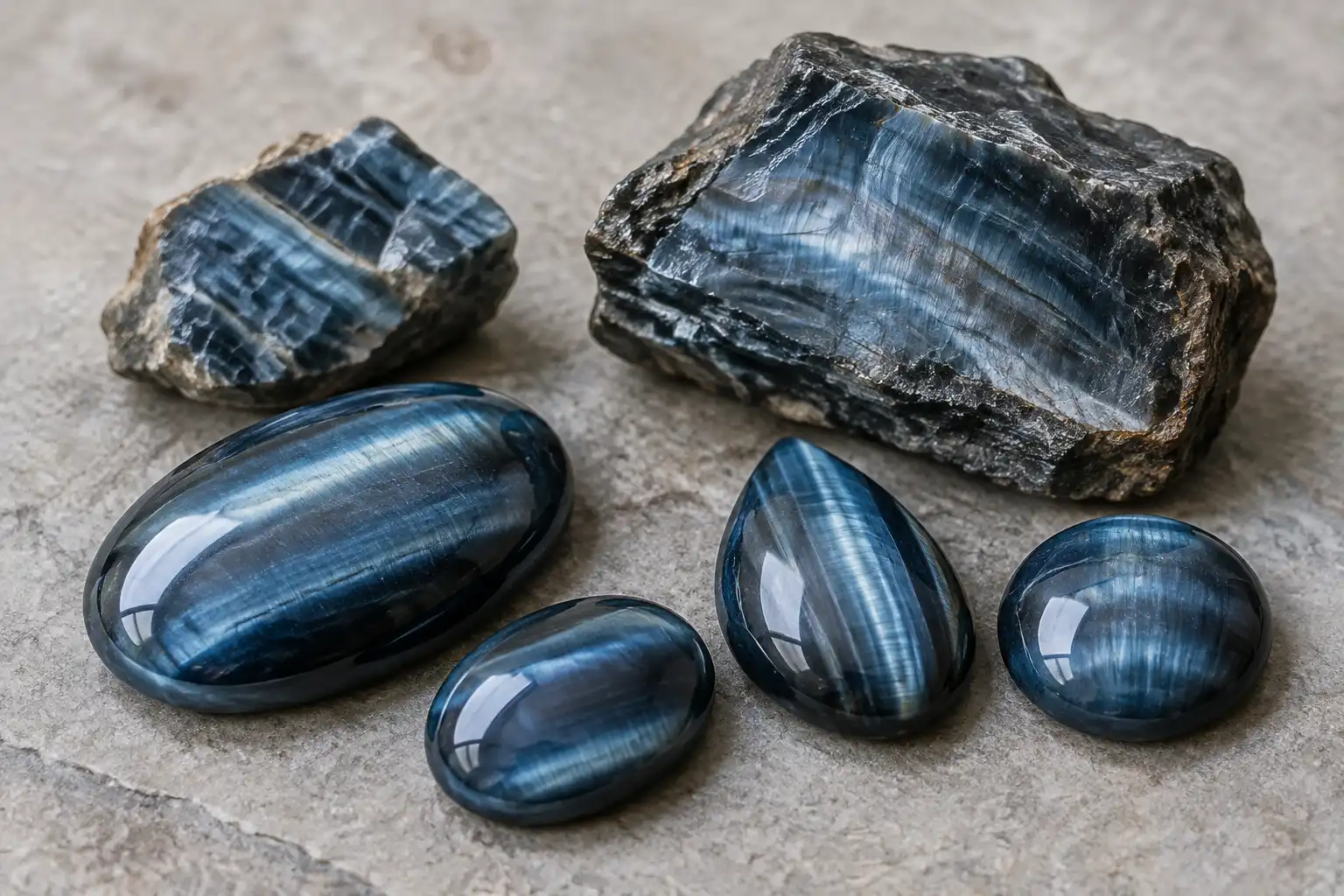
Blue tiger’s eye benefits begin with an optical effect that makes this quartz variety immediately recognizable. Often sold as hawk’s eye or falcon’s eye, blue tiger’s eye typically shows blue-gray, steel-blue, or dark bluish tones crossed by a silky moving band of reflected light. This phenomenon, called chatoyancy, develops from aligned fibrous structures within the quartz and becomes especially visible when the stone is cut with the correct orientation.
The gemstone also offers more than visual appeal. Quartz hardness gives suitable pieces practical jewelry durability, while fibrous texture, color change across the surface, lapidary orientation, and historical relationship with tiger’s eye make the stone useful for collecting and mineral education. GIA describes tiger’s-eye as chatoyant quartz formed around fibrous crocidolite within iron-rich geological environments, while mineralogical literature also recognizes ongoing discussion about exactly how quartz and the fibrous structures developed together.
Modern crystal traditions add blue tiger’s eye benefits involving calm focus, confidence, observation, protection, and emotional steadiness. Those themes may function as personal symbolism, but they are not established medical effects. The stone does not treat anxiety disorders, improve eyesight, regulate the nervous system, block harmful radiation, or change brain function because of its color or fibrous structure.
10 Blue Tiger’s Eye Benefits at a Glance
- Chatoyancy creates a distinctive moving band of light across polished surfaces.
- Quartz hardness makes many pieces practical for jewelry and decorative use.
- Blue-gray coloration offers a different visual character from golden-brown tiger’s eye.
- Fibrous structure provides an accessible example of how internal texture affects optical appearance.
- Cabochon cutting teaches the importance of orienting rough correctly to reveal the cat’s-eye effect.
- Collectors can compare blue hawk’s-eye material with golden tiger’s eye and related quartz varieties.
- Jewelry designers gain a neutral blue stone that works with many metals and colors.
- Gemstone identification encourages attention to fiber direction, chatoyancy, color, and treatment.
- Modern symbolism can represent observation, patience, confidence, or measured action without health claims.
- Straightforward quartz care makes stable pieces suitable for long-term ownership.
Blue Tiger’s Eye Benefits Begin with Natural Chatoyancy
The most obvious of all blue tiger’s eye benefits is chatoyancy. The word comes from the appearance of a cat’s eye and describes a narrow band of light that appears to move across a polished stone as either the stone or the light source changes position. In tiger’s-eye quartz, aligned fibrous structures create the conditions necessary for this silky optical effect. GIA describes the sheen as light reflecting from fibrous structures encased in quartz.
The effect is strongest when rough is oriented properly before cutting. Lapidaries generally cut tiger’s-eye varieties as cabochons because a smooth rounded surface allows the moving band to appear clearly. If the fibers are oriented poorly, the finished stone may display weak or diffuse chatoyancy even when the rough contains attractive color.
This makes blue tiger’s eye benefits particularly interesting from a craftsmanship perspective. A good cabochon is not merely a polished blue stone. It reflects careful observation of fiber direction, dome height, cutting orientation, symmetry, and polish.
The moving band also creates visual depth. A stone may appear nearly black or gray-blue from one direction and reveal a bright silvery or bluish line when turned. This changing appearance gives blue tiger’s eye a character that ordinary uniformly colored quartz does not have.
Quartz Hardness Gives Blue Tiger’s Eye Practical Jewelry Durability
Blue tiger’s eye belongs to the quartz family and generally has a Mohs hardness around 7. Mindat lists tiger’s-eye as a quartz variety with hardness 7 and describes it as a popular ornamental and lapidary stone.
That hardness provides useful resistance to everyday scratching and is one of the strongest practical blue tiger’s eye benefits. Cabochons, beads, pendants, earrings, bracelets, and rings can all be made from suitable pieces.
Hardness does not make the stone indestructible. A hard blow can still chip an exposed edge or fracture a stone along an existing weakness. Rings and bracelets naturally experience more impacts than pendants or earrings, so protective settings and sensible wear remain useful.
The stone also takes a good polish, which enhances the silky effect. A dull or scratched surface can reduce the clarity of the moving band, while careful polishing allows light to interact more effectively with the aligned internal structures.
For everyday ownership, this balance between durability and beauty makes blue tiger’s eye easier to maintain than many softer decorative stones.
Blue Color Creates a Distinct Identity Within the Tiger’s-Eye Family
Blue tiger’s eye is often called hawk’s eye or falcon’s eye. The blue-gray appearance reflects less oxidized fibrous material than the familiar golden-brown tiger’s-eye, where alteration and iron oxides contribute warmer coloration. GIA has described hawk’s-eye as dark blue silicified fibrous material that can show yellow-brown areas where alteration progresses toward typical tiger’s-eye.
This relationship creates one of the more educational blue tiger’s eye benefits. A collector can compare blue hawk’s-eye, golden tiger’s-eye, and intermediate stones to see how changes in mineral chemistry and alteration influence visible color.
Some specimens contain both blue and brown areas, revealing that the division between trade varieties is not always absolute. Others show gray, greenish, or nearly black zones depending on the material and lighting.
The color also gives the gemstone a different design character. Golden tiger’s eye often feels warm and earthy, while blue tiger’s eye appears cooler and more subdued. That difference can influence jewelry choices without implying that one variety has stronger spiritual properties than another.
Lapidary Work Makes Blue Tiger’s Eye an Excellent Study Stone
Cutting is another source of blue tiger’s eye benefits because the quality of chatoyancy depends heavily on orientation. A lapidary cannot simply shape the rough in any convenient direction and expect the best optical result.
The fibrous structure needs to run in a suitable relationship to the polished dome so the light band forms clearly across the face. Cutting too far off-axis can weaken the effect. Dome shape also influences how concentrated or broad the band appears.
This makes blue tiger’s eye useful for learning how optical phenomena interact with craftsmanship. The rough itself contains the necessary structure, but human cutting determines whether that structure becomes visually obvious.
A successful stone may show a narrow bright line that moves smoothly from one side to another. Other specimens produce a softer sheen spread across a larger area. Both appearances can be attractive when the cutting suits the rough.
The general tiger’s eye benefits associated with durability, chatoyancy, lapidary use, collecting, and ornamental value also apply to blue material, although blue tiger’s eye has its own cooler coloration and trade identity.
Collecting Reveals More Than a Single Shade of Blue
Collectors benefit from the wide visual range within hawk’s-eye and related tiger’s-eye material. Some stones are strongly blue-gray, while others appear almost black until a bright light reveals the silky band. Intermediate pieces may contain gold, brown, greenish, or gray areas.
Natural rough can be especially informative because the fibrous structure may remain visible before polishing. Slabs reveal band direction and color zoning, while finished cabochons show how those internal structures behave once the surface has been carefully oriented.
South African material is historically important, and Mindat records classic hawk’s-eye and tiger’s-eye from the Northern Cape. The wider tiger’s-eye story also includes significant occurrences in Western Australia and other regions.
Locality labels are therefore useful when they are genuinely documented. A stone described simply as “African blue tiger’s eye” provides less geological information than a specimen with reliable provenance.
One of the lasting blue tiger’s eye benefits is that an inexpensive polished stone can still demonstrate fiber structure, chatoyancy, quartz durability, and mineral alteration in a way that is easy to observe without specialized equipment.
Jewelry Designers Gain Color, Movement, and Useful Contrast
Blue tiger’s eye works well in jewelry because it combines dark neutral color with movement. Silver-colored metals often reinforce the blue-gray tone, while yellow gold, brass, or copper can produce a warmer contrast.
Large cabochons are especially effective because they provide enough surface area for the moving band to travel visibly. Smaller beads can create repeated flashes as a bracelet or necklace moves.
The relatively dark color also pairs well with clear quartz, moonstone, black stones, golden tiger’s eye, and other neutral gems. Designers can emphasize either the blue tone or the chatoyancy depending on surrounding colors.
Matching pairs for earrings may require careful selection because fiber direction and color vary naturally. Two stones can have similar dimensions but produce different light bands when viewed from the same angle.
These aesthetic blue tiger’s eye benefits arise from observable optical behavior rather than spiritual claims, making the stone appealing even to people with no interest in crystal symbolism.
Identification Helps Separate Blue Tiger’s Eye from Similar Stones
Dark blue and gray-blue stones can look deceptively similar in photographs. Blue tiger’s eye may be confused with dyed quartz, glass, blue aventurine, sodalite, dark chalcedony, or other decorative stones when only color is considered.
Chatoyancy provides an important clue. A genuine hawk’s-eye-type stone should display a directional silky sheen associated with aligned internal structures rather than random glitter or a uniform glassy reflection.
Color alone is not enough. Treatments and commercial naming can complicate identification, and artificial products can imitate some natural appearances. Buyers should consider chatoyancy, fibrous texture, polish, translucency, treatment disclosure, and provenance when available.
A person deciding where to buy blue tiger’s eye should look for photographs or video showing the stone under movement rather than only one static angle. The moving optical effect often reveals more than a heavily edited image.
Developing these observational habits is one of the more transferable blue tiger’s eye benefits because the same principles help with many chatoyant gemstones.
Historical Mineralogy Gives Blue Tiger’s Eye Genuine Context
Blue tiger’s eye benefits from a real mineralogical history that does not need invented mystical antiquity. Early naturalists described tiger’s-eye-type material from southern Africa in the late eighteenth and early nineteenth centuries, and Mindat records both historic collecting and later scientific study of its origin.
The precise formation story has also been discussed scientifically. Tiger’s-eye was long interpreted primarily as quartz replacing fibrous crocidolite while preserving its form. Later research proposed that the structures responsible for chatoyancy may instead reflect synchronous mineral growth during repeated crack-seal vein formation. Mindat summarizes both interpretations rather than presenting the formation mechanism as completely settled.
This scientific debate is one of the hidden blue tiger’s eye benefits because it shows how geological understanding can change when new evidence appears.
A gemstone does not become less interesting when scientists revise a formation model. The opposite is often true. The stone becomes an example of how mineral textures preserve complicated geological processes that may require multiple interpretations before they are fully understood.
Modern Symbolism Can Emphasize Observation and Measured Action
Contemporary crystal traditions often describe blue tiger’s eye benefits in terms of focus, protection, confidence, patience, intuition, and calm decision-making. These themes fit the stone’s moving eye-like band and cool blue-gray color, but they remain symbolic interpretations.
Observation is a particularly natural theme. The chatoyant line appears to move as the viewing angle changes, so the stone can represent paying closer attention before reaching a conclusion. Someone may keep a cabochon on a desk as a reminder to check facts before reacting or wear a bracelet to symbolize patience during a demanding project.
Confidence can also be interpreted practically. The stone does not generate courage, but it can represent speaking or acting after adequate preparation rather than waiting for complete certainty.
Beliefs involving blue tiger’s eye healing properties may extend these ideas into claims about anxiety, vision, energy, hormones, or neurological function. Such ideas belong to spiritual practice rather than established medicine.
Blue tiger’s eye benefits remain more credible when symbolism supports intentional behavior without becoming a substitute for healthcare.
Safe Care Preserves Chatoyancy and Polish
Stable blue tiger’s eye is relatively easy to maintain. Lukewarm water, mild soap, and a soft cloth or brush are generally suitable for routine cleaning. Because the optical effect depends partly on surface polish, avoiding scratches helps keep the chatoyant band clear.
Hard impacts should still be avoided. Quartz can chip or fracture, particularly along thin edges or where internal weaknesses exist. Rings should be removed during heavy manual work, sports, or activities likely to strike hard surfaces.
Separate storage prevents harder gemstones from scratching polished cabochons. A lined compartment or individual pouch works well for most jewelry.
Cutting and grinding require appropriate silica-dust precautions. Tiger’s-eye varieties are quartz-rich, so lapidary work should use wet methods, eye protection, ventilation, and suitable professional dust control rather than dry grinding that produces respirable silica.
These simple precautions protect the most useful blue tiger’s eye benefits: color, chatoyancy, workmanship, and long-term wearability.
Conclusion
Blue tiger’s eye benefits include striking chatoyancy, useful quartz hardness, lapidary education, collecting value, jewelry versatility, mineral identification, geological interest, and personal symbolism. The stone’s blue-gray fibrous appearance distinguishes it from familiar golden tiger’s eye while preserving the same compelling moving light effect.
Modern themes of observation, patience, confidence, protection, and focus can remain meaningful when treated as personal symbolism rather than medical effects. Understanding the stone’s chatoyancy, fibrous structure, geological history, and real durability gives blue tiger’s eye benefits far more substance than unsupported healing claims.
FAQs
What are the main blue tiger’s eye benefits?
The most verifiable blue tiger’s eye benefits include chatoyancy, jewelry durability, lapidary value, collecting, mineral education, identification practice, decorative use, and personal symbolism.
Is blue tiger’s eye the same as hawk’s eye?
Blue tiger’s eye is commonly sold under the trade names hawk’s eye or falcon’s eye. It represents blue to blue-gray chatoyant fibrous quartz related to golden tiger’s eye.
What causes the moving band in blue tiger’s eye?
Aligned fibrous structures within the quartz reflect light directionally, producing chatoyancy, the moving cat’s-eye-like band visible across a correctly cut surface.
Is blue tiger’s eye durable?
Yes. Its quartz component has a Mohs hardness around 7, making many pieces practical for jewelry, although strong impacts can still cause chips or fractures.
Is blue tiger’s eye naturally blue?
Natural blue-gray hawk’s-eye material occurs, particularly where the original fibrous structures remain less oxidized than in golden-brown tiger’s eye.
Is blue tiger’s eye good for jewelry?
Yes. Cabochons and beads are especially effective because they reveal chatoyancy. Rings benefit from sensible protection, while pendants and earrings generally receive fewer impacts.
What does blue tiger’s eye symbolize?
Modern symbolism commonly emphasizes observation, confidence, patience, protection, focus, and measured decision-making. These are personal or spiritual interpretations.
Does blue tiger’s eye treat anxiety or improve eyesight?
There is no established clinical evidence that blue tiger’s eye treats anxiety disorders, vision problems, neurological conditions, or other medical concerns.
How should blue tiger’s eye be cleaned?
Use lukewarm water, mild soap, and a soft cloth or brush for stable pieces. Avoid hard impacts, abrasive storage, and harsh cleaning methods.
Why is blue tiger’s eye valuable for collectors?
Collectors can study chatoyancy, fibrous structures, color variation, mineral alteration, cutting orientation, and the relationship between hawk’s-eye and golden tiger’s eye.
Blue tiger’s eye benefits described as healing, protective, emotional, or energetic effects belong to spiritual and personal belief and should not replace qualified medical or mental-health care.