17 Tigers Eye Benefits for Courage, Confidence & Protection
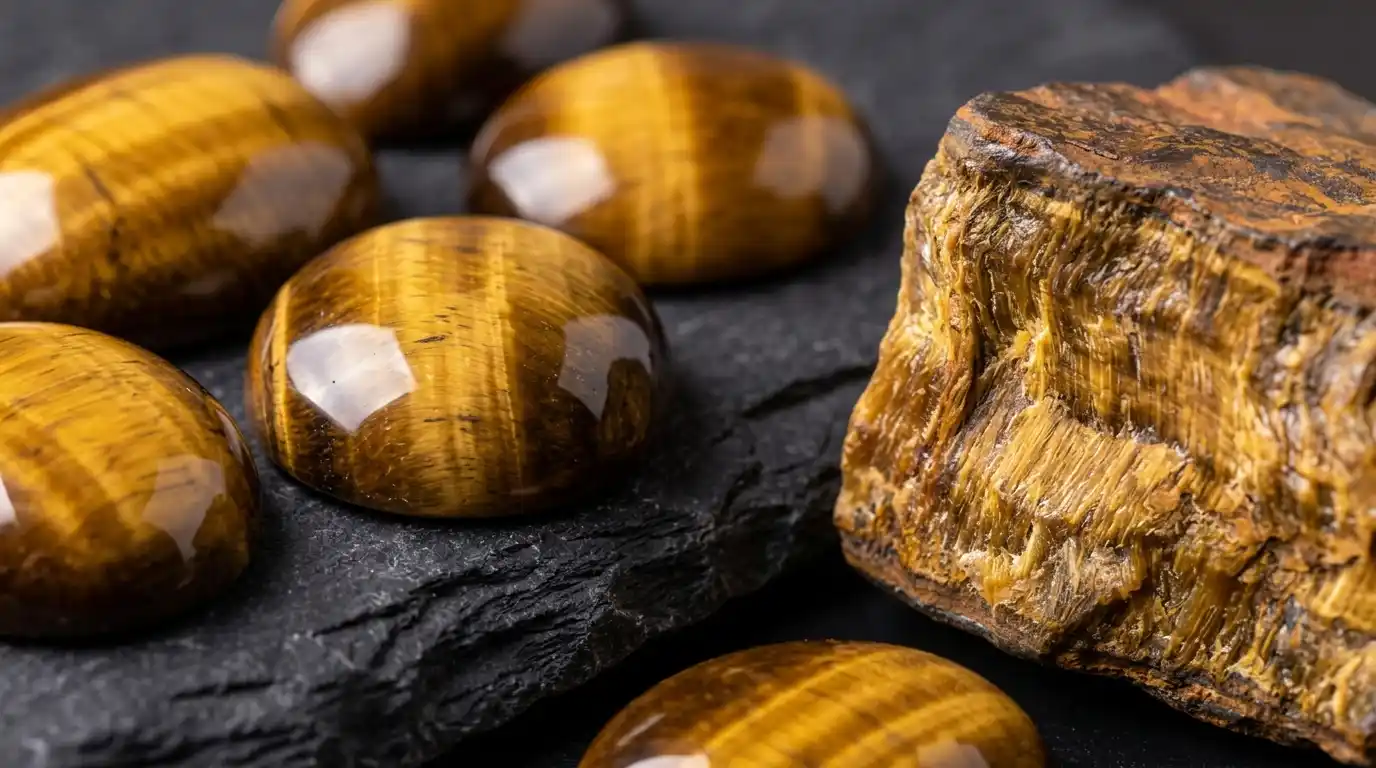
Tigers eye benefits are most responsibly understood as a combination of genuine gemological qualities and modern symbolic practices. Physically, tiger’s eye is a chatoyant quartz gem known for moving bands of golden, brown, bronze, and yellow light. Spiritually, it is widely associated with courage, confidence, grounded decision-making, protection symbolism, motivation, self-discipline, and the ability to remain composed when circumstances feel uncertain.
The gemstone’s striking appearance comes from aligned fibrous structures associated with crocidolite and quartz, together with iron-rich components that contribute its familiar golden-brown coloration. The parallel structures reflect light in a narrow moving band, producing chatoyancy, the optical effect responsible for the “eye” that travels across a well-cut cabochon. GIA describes tiger’s-eye as quartz containing fibrous crocidolite-related structures and iron oxides that create its characteristic color and silky sheen.
The spiritual claims need a different standard of evidence. Tiger’s eye does not scientifically increase confidence, block negative energy, cure anxiety, attract wealth, or guarantee protection. A person may nevertheless use the stone as a tactile reminder to act courageously, evaluate risk, maintain boundaries, or return attention to a chosen goal. In that form, its symbolism can support an intentional practice without being mistaken for medical or supernatural treatment.
17 Tigers Eye Benefits at a Glance
- Courage: Tiger’s eye can symbolize acting despite reasonable fear instead of waiting for fear to disappear completely.
- Confidence: Its strong golden chatoyancy may serve as a reminder to trust skills that have been developed through real experience.
- Grounding: Brown and earthy colors are commonly associated with steadiness, practical thinking, and attention to present responsibilities.
- Protection symbolism: Modern crystal traditions use tiger’s eye as a protective symbol, although it cannot guarantee physical or supernatural safety.
- Clear decision-making: The moving eye effect can represent looking carefully at several parts of a problem before choosing a direction.
- Self-discipline: A person may associate the stone with following through on commitments even when motivation fluctuates.
- Focus: Its distinct chatoyant band can provide a simple visual anchor during meditation, study, or reflective practice.
- Motivation: Golden coloration is often interpreted as a symbol of initiative, ambition, and purposeful action.
- Emotional composure: Tiger’s eye may remind someone to pause before reacting during an emotionally charged moment.
- Healthy boundaries: Protection symbolism can be translated into practical boundary-setting rather than claims of invisible shielding.
- Resilience: Its durable quartz structure can symbolically represent persistence when progress becomes difficult.
- Self-awareness: The “eye” imagery can encourage examination of motives, habits, assumptions, and recurring patterns.
- Practical confidence: Tiger’s eye can symbolize preparation-based confidence rather than unsupported certainty.
- Creative inspiration: Chatoyant bands, golden color, and natural patterning can inspire jewelry design, photography, carving, and collecting.
- Collector interest: Fine chatoyancy, attractive banding, polish quality, color, and natural provenance give the stone genuine lapidary appeal.
- Mindful action: Keeping the gemstone near a workspace can act as a reminder to convert intentions into specific tasks.
- Responsible spiritual practice: Tiger’s eye allows symbolic reflection while keeping crystal beliefs separate from healthcare, safety, and evidence-based decision-making.
What Tiger’s Eye Really Is
Tiger’s eye belongs to the quartz family and derives its visual identity from highly organized fibrous structures. Quartz itself is silicon dioxide, SiO₂, with a Mohs hardness of 7, refractive indices around 1.544 to 1.553, and specific gravity near 2.66. Those figures are consistent with crystalline quartz and help explain why polished tiger’s eye works well in beads, cabochons, carvings, and many jewelry styles.
Its formation is more interesting than the simple phrase “quartz replaced crocidolite” suggests. Older explanations commonly treated tiger’s eye as a classic pseudomorph in which quartz replaced pre-existing crocidolite while preserving the fibrous form. Later mineralogical research proposed a more complicated crack-seal growth process in which quartz and crocidolite-related fibers developed through repeated fracture filling rather than simple one-for-one replacement. Mindat specifically notes this revised interpretation.
| Gemological Characteristic | Tiger’s Eye |
|---|---|
| Main mineral | Quartz |
| Chemical composition | SiO₂ for the quartz component |
| Typical colors | Golden yellow, honey, bronze, brown, reddish brown |
| Mohs hardness | About 7 |
| Refractive index | Approximately 1.544 to 1.553 for quartz |
| Specific gravity | Around 2.66, with variation possible from inclusions |
| Key optical effect | Chatoyancy |
| Typical cutting style | Cabochon, bead, carving, polished slab |
| Important fibrous association | Crocidolite-related structures |
| Golden-brown coloration | Strongly influenced by iron-rich components |
The chatoyant band is strongest when cutters orient the parallel fibers correctly. A flat cut may show attractive stripes, but a properly oriented cabochon concentrates reflected light into a narrow luminous line that appears to move as the stone or light source moves.
Courage Without Pretending Fear Has Disappeared
Courage is perhaps the best-known symbolic tiger’s eye benefit. Yet courage becomes more useful when defined accurately. It does not mean feeling no fear. It means recognizing risk and choosing an appropriate action despite uncertainty.
The stone’s golden-brown appearance suits this symbolism because it combines brightness with earthy color. Modern spiritual practice often interprets the gold as confidence and initiative while the brown areas represent stability and realism. Those ideas are symbolic color associations, not measurable energies produced by quartz.
A person facing a difficult presentation, business decision, examination, negotiation, or conversation might keep tiger’s eye nearby as a reminder to prepare, evaluate the facts, and proceed deliberately. The stone does not create courage. The preparation and action do.
This distinction matters because confidence built on preparation is very different from overconfidence. Tiger’s eye symbolism is most constructive when it encourages a person to ask, “What have I done to become ready?” rather than assuming the gemstone will make the outcome favorable.
Confidence Built on Observation and Skill
The moving eye across polished tiger’s eye naturally lends itself to themes of observation and awareness. Confidence is stronger when it develops from understanding one’s abilities, limitations, and surroundings.
Someone using tiger’s eye symbolically might connect it with three questions: What do I know? What do I still need to learn? What action can I take with the information available?
This type of confidence is flexible. It allows someone to change direction when new evidence appears. It also makes room for admitting uncertainty without assuming that uncertainty equals weakness.
Modern claims about Tiger’s Eye healing properties sometimes connect the gem with reduced fear, emotional stability, or physical wellness. Those claims should be interpreted as spiritual traditions rather than clinical effects. Tiger’s eye cannot treat anxiety disorders, depression, trauma, hormonal conditions, pain, or other medical problems.
Grounding and Practical Decision-Making
Grounding is another frequently mentioned tiger’s eye benefit. In everyday language, grounding can mean bringing attention back to immediate facts, physical surroundings, practical responsibilities, and decisions that can actually be controlled.
That interpretation makes more sense than describing grounding as an invisible force transferred through the skin. When a person feels overwhelmed, a practical grounding exercise might involve naming the immediate problem, identifying which part is controllable, and choosing one next step.
Tiger’s eye can become the visual cue for that process.
Its natural color supports the metaphor. Brown, gold, ochre, and bronze commonly remind people of soil, rock, sunlight, and earth tones. Cultural associations with color can shape spiritual symbolism even when no physiological effect is involved.
Protection as Boundaries Rather Than an Invisible Shield
Tiger’s eye has a long-standing modern reputation as a protective stone. Some people wear bracelets, pendants, rings, or beads because they associate the stone with safety, courage, or shielding against harmful influences.
Protection becomes more useful when translated into ordinary behavior. It can mean recognizing manipulation, setting boundaries, using proper safety equipment, securing valuables, checking contracts, leaving unsafe situations, or refusing commitments that violate personal limits.
The gemstone cannot stop accidents, crime, illness, financial loss, or supernatural harm. Treating it as guaranteed protection can create false confidence.
A responsible spiritual practice can still use tiger’s eye as a protective symbol. The stone becomes a reminder to take protective action rather than a substitute for that action.
Blue and Red Tiger’s Eye Show How Color Changes Symbolism
Tiger’s eye occurs in related color forms that have developed their own symbolic traditions. Blue-gray fibrous quartz, often called hawk’s eye or blue tiger’s eye, tends to be associated with observation, patience, composure, and communication. The established blue tiger’s eye benefits often reflect those cooler visual qualities while keeping the same distinction between spiritual symbolism and physical evidence.
Reddish tiger’s eye is commonly associated with motivation, energy, determination, and action. Interpretations of red tiger’s eye benefits therefore tend to emphasize drive and persistence.
These symbolic differences show how strongly color influences crystal traditions. The underlying physical stone remains quartz-rich and chatoyant, while people assign different meanings according to visual appearance.
Focus, Self-Discipline, and Consistent Action
Focus is one of the easier tiger’s eye benefits to apply without supernatural claims. The stone’s moving band of reflected light immediately attracts attention, which makes it a useful physical object for brief meditation or task-setting rituals.
A person might place the stone beside a written list of three priorities. Before beginning work, they can choose the most important task and associate the stone with finishing that task before moving to distractions.
Over time, the benefit comes from the routine rather than the gemstone.
Self-discipline works in the same way. Motivation naturally rises and falls. A physical cue associated with a repeated habit can remind someone what they decided to do when motivation was stronger.
That can be useful for study, exercise, saving, writing, business administration, or almost any activity that depends on consistency.
Confidence and Financial Symbolism
Golden gemstones are often connected with prosperity, ambition, money, or success in modern crystal culture, and tiger’s eye is no exception. Some people carry it in a wallet, keep it near financial records, or use it during manifestation rituals.
There is no evidence that tiger’s eye attracts money or changes financial probability.
The symbolism becomes more constructive when gold coloration is associated with financial awareness instead. A person might use the stone as a reminder to review spending, check account balances, compare prices, avoid impulsive purchases, or make regular contributions to savings.
In this interpretation, “prosperity” is linked to behavior and planning rather than a promise that the gemstone produces wealth.
Tiger’s Eye for Meditation and Reflective Practice
Tiger’s eye can be used in meditation by focusing on the moving chatoyant band while breathing normally. The purpose is not to absorb energy from the stone but to give visual attention somewhere stable to return whenever thoughts wander.
A reflective session might focus on courage. The useful question is not “How can the stone remove my fear?” but “What action am I avoiding because I want certainty before I begin?”
Another session might focus on protection. The question could be, “Which boundary needs to become clearer?” For confidence, it might be, “What evidence shows that I am prepared, and where do I still need practice?”
These questions turn symbolic associations into deliberate self-observation.
Jewelry, Durability, and Everyday Use
Tiger’s eye inherits the scratch resistance of quartz, making it practical for beads, pendants, earrings, bracelets, and many rings. A hardness near 7 means ordinary household dust containing quartz can still abrade softer stones, while harder gems such as sapphire and diamond can scratch tiger’s eye.
The stone can also fracture if struck hard enough. Beads should not be assumed indestructible merely because they tolerate normal wear well.
Most polished tiger’s eye can be cleaned gently with lukewarm water, mild soap, and a soft cloth or brush. Sudden severe temperature changes and harsh chemicals are unnecessary.
Lapidary work requires a more serious safety distinction. Tiger’s eye is silica-rich, and dry cutting or grinding quartz can create respirable crystalline silica dust. Because the stone’s fibrous history involves crocidolite-related structures, hobbyists should not casually saw or grind rough specimens without proper professional dust and water controls. Finished polished jewelry poses a very different exposure situation from dry mechanical cutting.
Collector Benefits and Quality Appreciation
Fine tiger’s eye rewards close observation. The strength and sharpness of chatoyancy, uniformity of parallel fibers, bodycolor, contrast, polish, size, shape, and absence of distracting fractures can all affect visual quality.
A strong eye band should appear crisp and mobile rather than dull or scattered. Skilled cabochon cutting can greatly improve the effect by orienting the curved dome correctly over the fibers.
Collectors may also value regional occurrence, unusual color transitions, large polished slabs, natural rough, or specimens showing relationships among blue-gray, golden, and reddish zones.
This gives tiger’s eye considerable interest beyond metaphysical use. It is an accessible demonstration of how mineral structure and cutting orientation can create a dramatic optical phenomenon.
Conclusion
Tigers eye benefits are most convincing when genuine gemological qualities and spiritual symbolism are kept separate. The stone is a chatoyant quartz gem whose aligned fibrous structures and iron-rich coloration produce its famous moving golden eye. Its practical appeal includes durability, collector interest, lapidary beauty, and educational value.
Courage, confidence, grounding, protection, motivation, and focus are modern symbolic interpretations. Tiger’s eye cannot medically heal, guarantee protection, or attract success, but it can become a meaningful reminder to prepare carefully, maintain boundaries, act deliberately, and continue worthwhile work.
FAQs
What are the main tigers eye benefits?
The main practical benefits include attractive chatoyancy, good quartz hardness, versatility in jewelry, collector value, and usefulness as a meditation focal point. Modern crystal traditions also associate tiger’s eye with courage, confidence, grounding, protection, focus, motivation, and self-discipline.
Does tiger’s eye really increase confidence?
There is no scientific evidence that tiger’s eye directly changes confidence or brain function. It can be used as a symbolic reminder of preparation, past achievements, and deliberate action, which may make a personal confidence practice more structured.
Why is tiger’s eye associated with protection?
Its eye-like optical effect, golden-brown coloration, and long-standing modern spiritual symbolism have encouraged protective interpretations. The gemstone cannot create a guaranteed shield, so protective symbolism is best translated into practical awareness, caution, and healthy boundaries.
Is tiger’s eye actually quartz?
Yes. Tiger’s eye is a chatoyant quartz gem containing organized fibrous structures associated with crocidolite and iron-rich alteration. Quartz contributes the stone’s hardness and much of its physical character.
What creates the moving eye in tiger’s eye?
Chatoyancy is produced when light reflects from aligned fibrous structures within the stone. Cutting tiger’s eye as a correctly oriented cabochon concentrates this reflection into a bright band that appears to move across the surface.
Can tiger’s eye attract money or success?
There is no scientific evidence that tiger’s eye attracts money, changes probability, or guarantees success. A person may use its golden coloration as a symbolic reminder to budget, plan, negotiate carefully, and take realistic action toward financial goals.
Is tiger’s eye safe to wear every day?
Polished tiger’s eye is suitable for many types of everyday jewelry because quartz has a Mohs hardness around 7. It can still chip or fracture from severe impact, and finished jewelry should be protected from harder gemstones that can scratch it.
Is tiger’s eye dangerous because of crocidolite?
Ordinary handling of intact polished tiger’s eye jewelry is very different from cutting fibrous rough. The greater concern arises during sawing, drilling, or grinding, when mineral dust can be generated. Dry lapidary work should be avoided, and proper professional dust controls are important.
Can tiger’s eye treat anxiety or emotional problems?
No reliable evidence shows that tiger’s eye treats anxiety, depression, trauma, or other psychological conditions. It may be used as a comforting meditation object, but persistent or serious psychological concerns deserve qualified professional support.
Disclaimer: Spiritual, emotional, energetic, protective, manifestation, chakra, and healing interpretations associated with tiger’s eye reflect beliefs and personal practices rather than established medical or psychological effects. Tiger’s eye should not replace professional healthcare, diagnosis, therapy, prescribed treatment, or practical safety measures.