7 Hidden Botswana Agate Benefits: Helpful Traditions, Evidence, Safe Use & Clear Limits
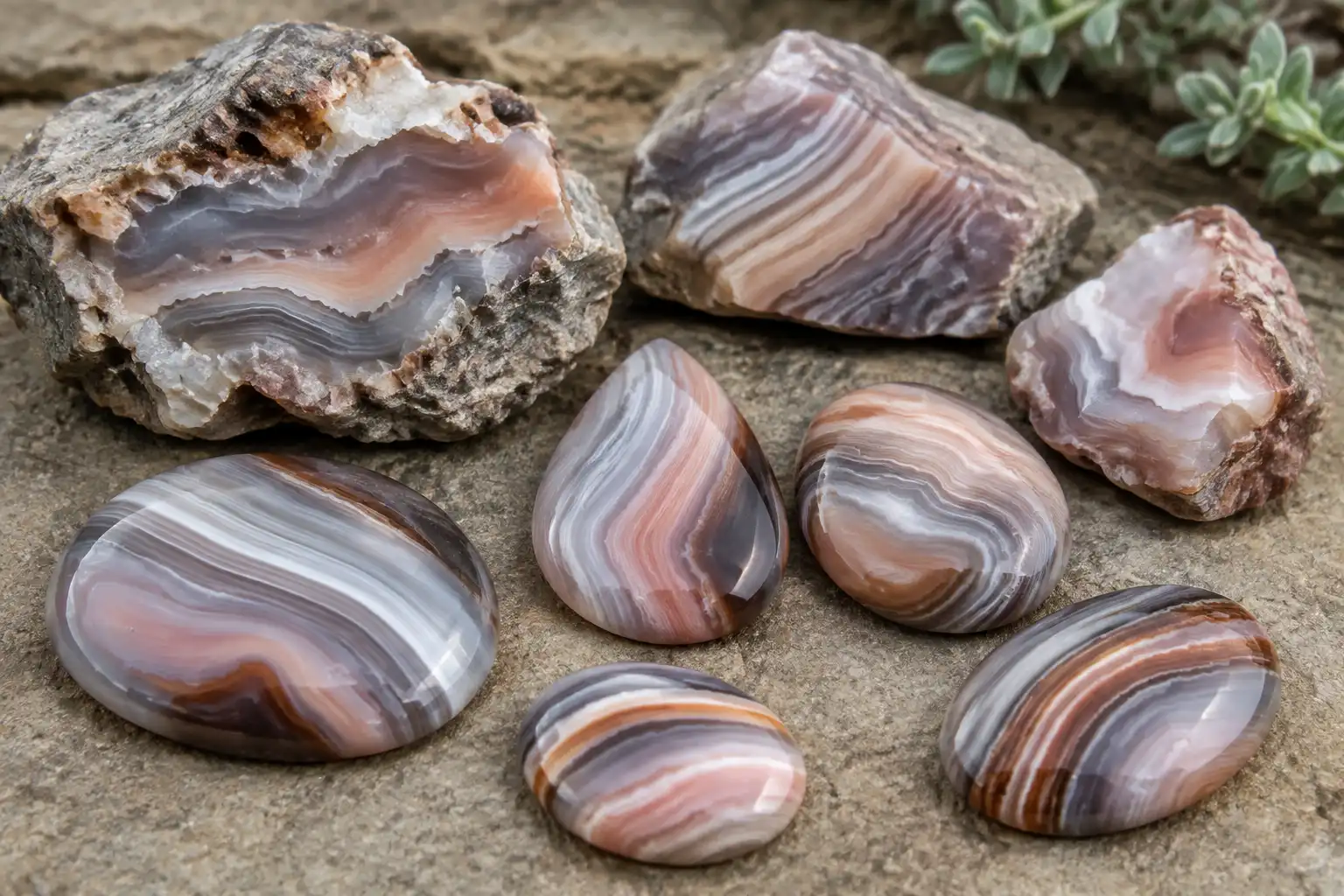
Botswana agate benefits begin with a visually distinctive form of banded chalcedony known for fine layers of gray, white, brown, pink, peach, and occasionally purplish color. Many specimens show delicate parallel bands, sweeping curves, fortification-like patterns, or small eye-shaped structures that become especially attractive after cutting and polishing. The name refers to agate associated with Botswana, although buyers should still distinguish documented provenance from a trade label used without supporting locality information.
As a chalcedony variety, Botswana agate belongs to the quartz family and generally combines useful hardness with good toughness. That makes it suitable for cabochons, beads, pendants, bracelets, carvings, polished stones, and display specimens. Its layered appearance also makes it valuable for studying how silica repeatedly filled cavities and fractures during geological formation, creating visible bands over long periods.
Modern crystal traditions add Botswana agate benefits involving comfort, emotional steadiness, resilience, transition, protection, or calmness. Those ideas may serve as personal symbolism, but they should not be confused with medical effects. The stone does not treat depression, anxiety disorders, smoking addiction, circulation problems, pregnancy complications, or neurological conditions simply because those claims appear in crystal folklore.
7 Botswana Agate Benefits at a Glance
- Fine natural banding gives each Botswana agate an individual pattern that works well in jewelry and collecting.
- Quartz-family hardness and chalcedony toughness make many pieces practical for regular wear.
- Dense microcrystalline structure allows smooth polishing, cabochon cutting, bead making, and carving.
- Layered patterns provide an accessible way to study agate formation and repeated silica deposition.
- Collectors can compare color zoning, fortification bands, eyes, translucency, and locality-related characteristics.
- Jewelry designers gain a neutral-to-warm gemstone that pairs easily with many metals and other gems.
- Modern symbolism can represent patience, resilience, or steadiness when kept separate from medical claims.
Natural Banding Is One of the Most Distinctive Botswana Agate Benefits
Pattern is central to Botswana agate. Rather than being valued for a single uniform color, the stone often contains repeated layers that may curve, intersect, or follow the shape of the cavity in which the agate developed. Gray, brown, cream, white, pink, and peach tones can occur within the same piece, producing an appearance that changes considerably from one cut surface to another.
These bands form through geological processes involving silica-rich fluids entering open spaces in rock and depositing chalcedony over repeated stages. Variations in microscopic structure, impurities, oxidation conditions, and growth episodes produce changes in color and translucency. A polished slice therefore preserves a visible record of mineral growth rather than merely providing decoration.
This is one of the most satisfying Botswana agate benefits because no two cut pieces need to look identical. A small cabochon may contain tight parallel bands, while a nearby section of the same rough could display larger curves or an eye-like formation.
The value of the pattern depends on personal preference and workmanship. Dense banding is not automatically superior to wide, subtle layers. What matters is how color, pattern, shape, polish, and proportion work together in the finished stone.
Chalcedony Durability Makes Botswana Agate Useful for Jewelry
Botswana agate inherits the practical physical properties of chalcedony. It generally falls around 6.5 to 7 on the Mohs hardness scale and has a fine intergrown structure that gives it good toughness compared with many cleavage-prone gemstones.
This durability creates several practical Botswana agate benefits. Cabochons can be set in rings, pendants, earrings, brooches, and bracelets, while beads work well in necklaces and strands. The stone can tolerate ordinary jewelry wear when protected from severe impact and abrasion.
Hardness should not be mistaken for indestructibility. A Botswana agate ring can still chip if struck against stone, metal, or concrete, while polished surfaces can be scratched by harder gemstones. Large carvings and thin decorative shapes also need protection from drops.
The relatively muted color palette makes the stone especially versatile. Silver-colored metals can emphasize gray and white bands, while yellow or rose gold can bring out peach, brown, or pink areas. Designers can also pair it with black stones, clear quartz, moonstone, chalcedony, or warmer-colored gems without overwhelming the pattern.
These jewelry-focused Botswana agate benefits come directly from durability, natural pattern, and craftsmanship rather than spiritual claims.
Lapidary Work Reveals Patterns Hidden Inside the Rough
Agate rough often gives only a partial indication of what lies beneath the surface. Cutting can reveal bands, eyes, color transitions, or geometric structures that were not obvious from the exterior. This makes lapidary work another important source of Botswana agate benefits.
A cutter must decide where to slice the rough and how to orient a cabochon so the strongest pattern falls in an attractive position. Cutting parallel to one direction may show broad stripes, while changing the angle can reveal curved fortification patterns or concentric structures.
Cabochons are especially effective because the broad polished face leaves the banding uninterrupted. Beads, freeforms, spheres, palm stones, and carvings can also display the layered structure effectively, although the pattern may change dramatically across curved surfaces.
Polishing quality matters as much as cutting direction. A smooth reflective finish increases contrast between adjacent bands, while poorly polished areas can make subtle layers look dull or cloudy.
The general agate benefits associated with toughness, carving, collecting, quartz mineralogy, and decorative use are particularly visible in Botswana agate because the intricate bands reward careful cutting.
Collectors Gain Geological Variety Rather Than Perfect Uniformity
Collecting is one of the more lasting Botswana agate benefits because variation is part of the attraction. Some specimens are dominated by gray and white, while others contain warm pink, apricot, reddish-brown, or lavender-gray tones. Band width, translucency, pattern density, and eye formation also vary.
Collectors may seek rough nodules, polished slices, cabochons, matched pairs, large decorative pieces, or specimens with reliable Botswana locality information. A stone with strong provenance can be more informative than an anonymous commercial piece because it connects visible features with a geological setting.
Locality should still be approached realistically. Once rough enters international cutting and wholesale markets, documentation can be lost. A label saying “Botswana agate” is more useful when a seller can support the origin rather than relying on appearance alone.
A person deciding where to buy Botswana agate should therefore look for honest provenance, natural-looking photographs, treatment disclosure, dimensions, and close views of the pattern.
One of the genuine Botswana agate benefits is that even modestly priced specimens can remain scientifically and aesthetically interesting because pattern and geological history do not depend entirely on market value.
Botswana Agate Helps Explain How Agates Form
The visible layering makes this stone an accessible teaching example for agate geology. Agates commonly develop inside cavities or fractures when silica-bearing fluids deposit chalcedony in repeated stages. Different growth episodes can produce changes in texture, color, and translucency, creating the bands seen after cutting.
The exact formation history of an individual agate can be complicated. Temperature, chemistry, surrounding rock, fluid movement, impurities, oxidation conditions, and time can all influence the final pattern. Not every band necessarily represents a simple annual or evenly timed growth event.
Understanding this complexity is one of the educational Botswana agate benefits. The stone demonstrates that mineral growth is rarely equivalent to pouring one uniform substance into an empty space. Natural systems change as fluids move and conditions evolve.
The result can look almost designed despite being geological. Tight parallel bands, eye structures, scalloped zones, and repeating color transitions create visual order without requiring human intervention.
For students and collectors, a polished Botswana agate can therefore become a compact record of silica deposition and mineral growth.
Neutral Colors Make Botswana Agate Easy to Use in Design
Botswana agate does not rely on intense saturation to create visual interest. Its palette often combines gray, white, cream, dusty pink, brown, and peach, giving it a subdued character that works well in many jewelry and decorative settings.
This versatility is another practical source of Botswana agate benefits. A gray-dominant cabochon can look minimalist in silver, while a warm pink-brown piece may suit yellow gold or copper. Beads with mixed natural tones can create visual variety without looking overly bright.
The bands also allow the stone to work as either a focal gem or a supporting element. A large patterned cabochon can dominate a pendant, while smaller beads can provide texture around more saturated stones.
Interior decorative pieces benefit from the same neutral palette. Spheres, polished freeforms, bookends, bowls, and display slices can fit into many environments without depending on fashion-driven colors.
Design appeal is subjective, but the combination of banding and restrained tones gives Botswana agate unusual flexibility across traditional and contemporary styles.
Modern Symbolism Often Emphasizes Patience and Steadiness
Contemporary crystal traditions commonly describe Botswana agate benefits in terms of stability, comfort, patience, transition, resilience, and emotional balance. The slow-looking layered bands make these ideas visually understandable because the stone appears to preserve repeated stages of growth.
Someone might keep a polished piece near a workspace as a reminder that complicated projects are completed gradually. Another person may associate the repeated layers with adapting to change one stage at a time rather than expecting immediate resolution.
This symbolic use does not require claiming that chalcedony changes brain chemistry or emotional health. Patience develops through behavior, circumstances, expectations, and practice. Resilience depends on many personal and environmental factors.
Beliefs surrounding Botswana agate healing properties sometimes extend into claims about anxiety, depression, addiction, pregnancy, circulation, or detoxification. Such ideas belong to spiritual or wellness traditions rather than established clinical evidence.
Botswana agate benefits remain meaningful when the stone symbolizes helpful intentions without becoming a substitute for appropriate medical or psychological support.
Important Limits Keep Botswana Agate Benefits Evidence-Based
Agate is a durable quartz-family gemstone, but it cannot perform many of the health functions sometimes assigned to it. Wearing Botswana agate does not medically remove toxins, alter oxygen levels, stop addictive behavior, regulate pregnancy, improve circulation, or treat a psychiatric condition.
The stone’s mineral chemistry does not provide a medicinal dose of silica or trace elements through skin contact. Geological composition and human nutrition are separate subjects.
Physical safety is much simpler. Stable polished stones are generally suitable for ordinary handling and jewelry wear. The main concerns are impact damage, possible undisclosed treatments, and silica dust during cutting or grinding.
Lapidaries should use wet methods, appropriate ventilation, eye protection, and effective dust control because respirable crystalline silica should not be inhaled. Finished jewelry does not present the same cutting-dust concern.
These limits do not reduce Botswana agate benefits. The stone remains durable, visually complex, geologically informative, useful for jewelry and carving, collectible, and capable of carrying personal symbolism without exaggerated promises.
Conclusion
Botswana agate benefits include distinctive natural banding, quartz-family durability, lapidary versatility, jewelry use, collecting value, geological education, and personal symbolism. Its gray, pink, white, brown, and peach layers give individual stones an appearance that rewards close observation and careful cutting.
Modern ideas about patience, resilience, comfort, or steadiness can remain meaningful when they are treated as symbolic interpretations rather than medical effects. The strongest Botswana agate benefits come from appreciating the stone’s chalcedony structure, natural pattern, honest provenance, workmanship, and real geological history.
FAQs
What are the main Botswana agate benefits?
The most verifiable Botswana agate benefits include jewelry durability, distinctive banding, collecting, carving, lapidary use, geological education, decorative versatility, and personal symbolism.
What is Botswana agate made of?
Botswana agate is a banded variety of chalcedony in the quartz family and consists primarily of silica arranged in extremely fine intergrown structures.
Is Botswana agate durable?
Yes. Chalcedony generally has a Mohs hardness around 6.5 to 7 and good toughness, making Botswana agate suitable for many jewelry styles with sensible care.
Why does Botswana agate have bands?
The bands developed through repeated stages of silica deposition in cavities or fractures, with changing chemistry and microscopic growth conditions producing visible layers.
Is all Botswana agate actually from Botswana?
The trade name refers to material associated with Botswana, but commercial provenance should still be verified when exact geographic origin matters.
Is Botswana agate good for jewelry?
Yes. Its hardness, toughness, smooth polish, and attractive banding make it suitable for cabochons, beads, pendants, bracelets, earrings, and rings.
What does Botswana agate symbolize?
Modern symbolism often connects it with patience, stability, resilience, gradual change, and emotional steadiness. These are personal or spiritual interpretations.
Does Botswana agate have medical benefits?
There is no established evidence that Botswana agate treats anxiety, depression, addiction, circulation problems, pregnancy concerns, or other medical conditions.
Botswana agate benefits associated with healing, emotional regulation, detoxification, or energetic effects remain spiritual and personal beliefs and should not replace qualified medical or mental-health care.