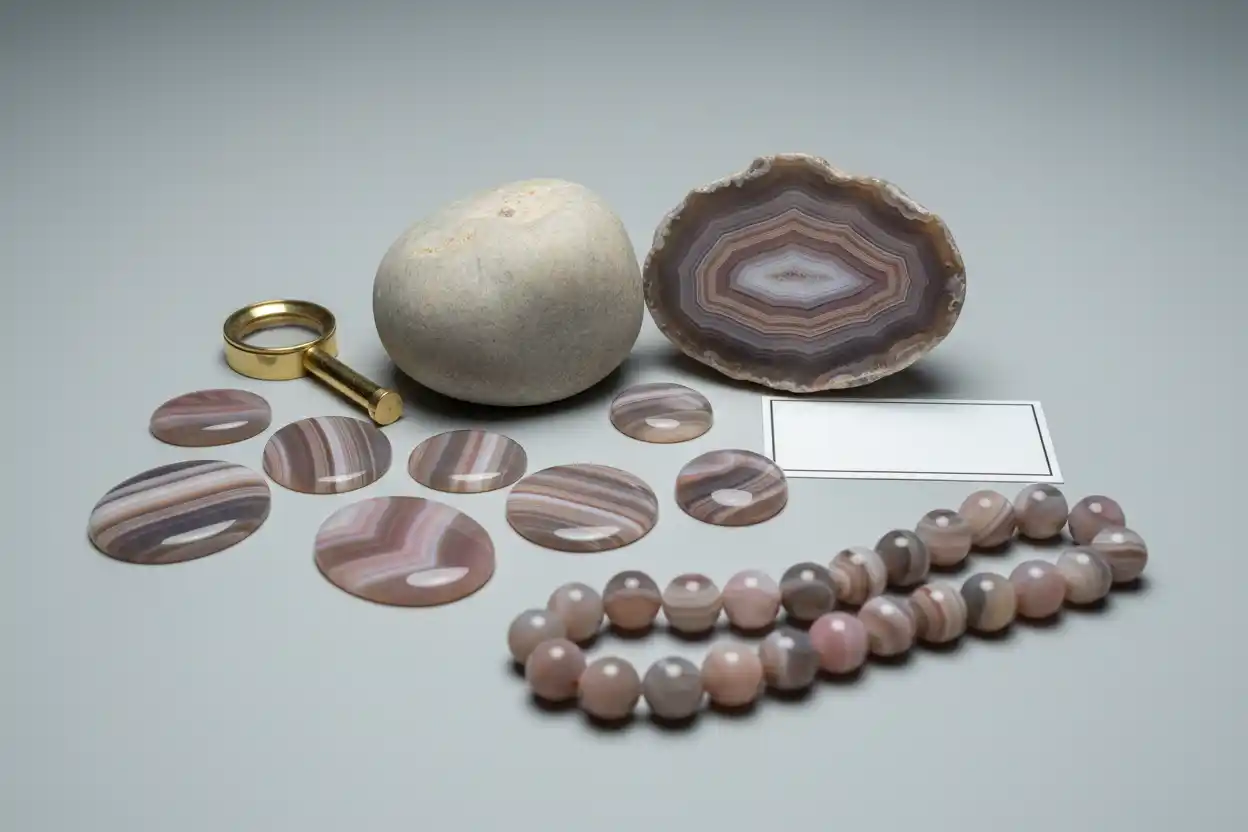
Where to Buy Real Botswana Agate and Avoid Dyed Fakes
Real Botswana agate is a naturally banded chalcedony known for fine parallel lines and subdued combinations of gray, white, brown, pink, peach, mauve and smoky tones. Although the material is not usually expensive enough to justify a sophisticated synthetic counterpart, inaccurate locality claims, dyed agate, generic banded chalcedony, resin composites and misleading “rare old-stock” descriptions are common enough to warrant care.
The strongest purchase is not necessarily the stone with the brightest colors. Botswana agate is often valued for restrained contrast, closely spaced bands and patterns that remain attractive under ordinary light. An electric-blue, purple or neon-pink stone may still be natural agate, but the color is unlikely to represent untreated traditional Botswana material without convincing evidence.
The Botswana agate meaning and properties guide covers the variety’s mineral identity and traditional symbolism. This page focuses on seller selection, locality documentation, treatment disclosure, pattern quality and choosing well-cut rough, cabochons, beads, carvings and jewelry.
Botswana Agate Is a Locality Variety
Botswana agate belongs to the broader agate and chalcedony family. Agate consists primarily of microcrystalline to cryptocrystalline silica arranged in bands, layers or related internal structures. Botswana agate is distinguished commercially by its source association and characteristic fine banding rather than by a separate mineral composition.
The agate guide explains the larger family, while the chalcedony guide covers the microcrystalline quartz parent material. The types of agate overview separates Botswana agate from lace, moss, dendritic, fire and other trade varieties.
Because the name carries a locality claim, sellers should not apply it to any gray or pink banded agate merely because the pattern looks similar. A piece may be genuine natural agate yet still lack evidence of Botswana origin.
Choose the Form Before Choosing the Seller
| Product form | Best buying source | Main concern |
|---|---|---|
| Natural nodule or rough | Mineral dealer or lapidary supplier | Source documentation, hidden fractures and misleading wet photographs |
| Slab | Lapidary supplier | Pattern depth, cutting yield, dye and resin-filled cavities |
| Cabochon | Gem dealer or independent lapidary | Pattern placement, polish, backing and treatment |
| Tumbled stone | Established crystal retailer | Generic agate substituted for Botswana material |
| Bead strand | Reputable bead supplier | Dyed agate, mixed materials and drill-hole fractures |
| Sphere or carving | Experienced lapidary retailer | Plain hidden areas, filler and artificial color |
| Jewelry | Jeweler with treatment disclosure | Closed backing, adhesive and weak pattern quality |
| Older collection specimen | Mineral dealer with historic labels | Unsupported “old stock” and altered labels |
Collectors should prioritize locality evidence and natural surfaces. Jewelry buyers should pay closer attention to cutting, setting and whether the pattern shown online belongs to the exact stone they will receive.
Where to Buy Genuine Botswana Agate
Specialist mineral dealers
A mineral dealer is the strongest source for natural nodules, partially polished specimens and pieces with retained locality labels. Good listings state the country, collection history, dimensions, weight and condition.
Ask whether the location came from an original specimen label, a trusted supplier or a visual assumption. A seller who says “Botswana agate–type banding; exact source unverified” is more credible than one who presents a precise mining story without records.
Natural rough should be shown from every side. One attractive sawn face may conceal a largely plain or fractured interior.
Lapidary suppliers
Lapidary suppliers are best for rough, slabs and cutting material. They should provide dry photographs as well as wet views when water is used to demonstrate potential polish.
Wet surfaces deepen color and conceal fine scratches. Therefore, compare a wet photograph with a dry image from the same angle before estimating the finished appearance.
Ask whether sample cabochons have been cut from the parcel. Their color, band continuity and polish quality reveal more than the outer rind of a nodule.
Gem and mineral shows
Shows let you compare Botswana agate with blue lace agate, crazy lace agate, sardonyx and ordinary banded chalcedony under the same light.
Place the stone over white paper and rotate it slowly. Fine bands should remain integrated within the chalcedony rather than appearing painted onto the surface.
Use a loupe to inspect cracks, drill holes, filled pits and color concentration. Do not scratch the stone or apply chemicals to test dye.
Established online gemstone stores
An online seller should provide exact-item photographs for cabochons, carvings and collector specimens. Batch photography may be acceptable for small tumbles, but the listing should disclose the range of patterns buyers can receive.
The online gemstone buying guide explains how to evaluate seller identity, payment protection and return terms.
For Botswana agate, request photographs against neutral gray and white backgrounds. Warm backgrounds can exaggerate peach and pink tones, while cool editing can make gray bands appear blue.
Independent jewelry makers
A maker who cuts and sets the stone can often explain its treatment and orientation more clearly than a high-volume reseller. Ask to see the loose cabochon before setting when buying an expensive custom piece.
The maker should state whether the stone is solid, backed, stabilized or glued. Closed settings can hide dye concentrations or a backing layer.
What Genuine Botswana Agate Usually Looks Like
Traditional Botswana agate commonly displays fine, orderly bands in gray, white, brown, peach, pink, mauve and muted reddish tones. Some pieces include translucent zones, small eyes, fortification-like lines or clouded areas.
The bands often run nearly parallel, although they may curve around the shape of the original cavity or nodule. Their thickness can vary from hairline layers to broader color zones.
Natural coloration generally looks subdued rather than fluorescent. Deep brown, smoky gray and soft pink can occur together without producing the high saturation seen in many dyed agates.
Under magnification, bands should continue beneath the polished surface. Small fractures, mineral inclusions and subtle changes in translucency may also appear.
A perfectly uniform pattern is not required. In fact, natural nodules often contain one exceptional area alongside plainer zones.
The agate color guide provides broader color context without replacing the locality and treatment checks needed for this purchase.
Botswana Agate Versus Blue Lace Agate
Blue lace agate usually shows pale blue and white lace-like bands and is strongly associated with southern Namibia rather than Botswana.
Botswana agate more commonly displays gray, brown, pink, peach and white bands. Some pieces may contain bluish-gray areas, but that does not automatically make them blue lace agate.
The completed guide to buying genuine blue lace agate covers Namibian locality claims, blue dye and lace-pattern quality. Sellers should not use the two locality names interchangeably.
Botswana Agate Versus Crazy Lace Agate
Crazy lace agate is known for intricate loops, eyes and energetic patterns, often in cream, red, yellow, gray and brown.
Botswana agate typically has finer, more orderly banding. Nevertheless, individual stones vary, and some Botswana pieces can show curved or complex patterns.
The planned guide to buying crazy lace agate will address that material’s Mexican source claims and treatment risks separately.
Botswana Agate Versus Blue Chalcedony
Blue chalcedony generally has a more uniform blue or gray-blue body without the characteristic close parallel banding of Botswana agate.
A pale blue-gray Botswana stone may resemble blue chalcedony from one angle. Edge views and magnification can reveal whether fine bands continue through the material.
The completed guide to buying blue chalcedony covers natural color, dye, backing and epoxy filling in that separate market.
Botswana Agate Versus Sardonyx and Onyx
Sardonyx and onyx are banded chalcedony varieties traditionally defined by relatively straight, contrasting layers. Their bands may be used for cameos, seals and layered carvings.
Botswana agate often has finer, softer and more numerous bands. However, trade usage can overlap when a stone has straight white, brown or reddish layers.
A seller should identify the material according to pattern and provenance rather than attaching several agate and onyx names to one product for search visibility.
Common Imitations and Misrepresentation
Dyed banded agate
Natural agate accepts dye readily because some layers and fractures are more porous than others. Bright blue, purple, green, hot pink and intense red are common treatment colors.
Dye may concentrate in cracks, porous bands, pits and drill holes. In a bead strand, the holes may appear much darker than the surrounding surface.
Dyed agate can remain attractive and wearable. The issue is whether the seller presents the color as natural Botswana material.
The treated-agate guide covers color enhancement and other treatments in greater depth.
Generic agate sold with a Botswana label
Natural banded chalcedony from another country may resemble Botswana agate. Without provenance, the material should be sold as banded agate or Botswana-style agate rather than carrying a firm geographic claim.
Resin or stone-powder composites
Ground stone can be mixed with polymer and molded into beads, carvings or decorative shapes. Bubbles, resin-rich seams, repeated patterns and molding marks may reveal the construction.
Printed or coated patterns
Some inexpensive decorative products place a printed banded image beneath clear resin or glass. The pattern may end sharply at the edge instead of continuing through the object.
Glass imitations
Glass can imitate translucent banded chalcedony through colored layers and internal swirls. Round bubbles, flow lines and mold seams support manufacture, although some glass requires professional testing.
Assembled slabs or doublets
A thin agate layer may be attached to a dark or reflective backing. Assembly can strengthen the piece or improve color, but it must be disclosed.
The real-versus-fake agate guide owns the broader identification comparison, while the fake-crystal buyer’s guide addresses resin, glass and coatings across many materials.
Treatments Beyond Dye
Botswana agate can be waxed, oiled, resin-filled, stabilized, coated or backed. Ordinary solid cabochons may be untreated, but buyers should not assume that every stone reaches the market in its natural condition.
Oil and wax can improve surface luster and deepen color. Clear resin may fill fractures or cavities, especially in large carvings and spheres.
Heat treatment can alter color in some agates, while combinations of chemical and thermal processes are used commercially for certain shades. A seller does not need to know the complete workshop recipe, but they should disclose whether the color is natural or treated.
The gemstone treatments guide explains why “genuine agate” and “untreated color” are separate claims.
How to Evaluate Rough and Nodules
A good rough purchase should show enough exposed interior to judge banding. Ask for at least one sawn face, an edge view and photographs of the natural rind.
Examine whether the fine bands continue beyond the display face. A thin patterned skin over a plain center reduces lapidary yield.
Fractures deserve equal attention. Agate is relatively tough, but a nodule can contain healed seams, open cracks and cavities that divide the usable material.
Weight alone does not establish value. A smaller nodule with dense continuous bands may produce more desirable cabochons than a large plain piece.
For a firm Botswana claim, request labels or supplier records. A pattern that looks correct still cannot prove geography.
How to Evaluate Slabs
A quality slab should display bands on both faces and along its edges. Pattern continuity helps determine where cabochons can be placed.
Hold the slab under transmitted light when it is thin enough. This reveals translucency, fractures and hidden cloudy zones.
Look for color accumulation along open cracks. Dye can enter a fracture more deeply than compact chalcedony, producing an unnaturally saturated line.
If resin has been used, it may show trapped bubbles or a slightly different luster. Ask whether stabilization occurred before or after sawing.
How to Judge Cabochons
The cutter should position the strongest banding face-up. In oval and pear shapes, bands may run lengthwise, across the width or diagonally depending on the desired design.
The dome should have a continuous polish without flat areas or deep scratches. A clean girdle makes setting easier and reduces edge chips.
Check the back. Natural banding should continue through the stone unless the cabochon was intentionally cut from a thin patterned layer.
A dark or reflective backing can strengthen contrast. That construction is not necessarily poor, but the price and description should reflect it.
Buying Beads and Bracelets
Natural bead strands should display related colors without repeating the same band pattern. Each bead comes from a different section of rough, so variation is expected.
Inspect drill holes for concentrated color, chips and radial fractures. A dark ring around every hole can indicate dye.
Ask whether the strand contains only Botswana agate or a mixture of gray, pink and banded agates selected for appearance.
Beads should have smooth hole edges and consistent sizing. High-quality sorting adds value, but perfect visual uniformity may indicate heavy treatment or manufactured material.
Buying Spheres and Carvings
A sphere should show attractive banding through more than one viewing direction. Request a full rotation because one dramatic area can hide a largely plain reverse side.
Large carvings should be inspected for epoxy-filled cavities and repaired breaks. Deep recesses can conceal polishing residue or colored filler.
Pattern placement matters. A skilled carver uses the bands to emphasize contours, while a low-quality object may cut across them without intention.
Buying Botswana Agate Jewelry
Chalcedony has useful durability for pendants, earrings, bracelets and many rings. The gemstone hardness chart places the material near the quartz range.
Even so, hardness does not make a thin cabochon unbreakable. The gemstone toughness-versus-hardness guide explains how edge thickness, fractures and setting design affect damage.
A bezel usually protects cabochon edges better than high prongs. Closed backs should be disclosed because they can hide backing, glue or treatment.
In matched earrings, look for comparable color and band density rather than identical patterns. Natural stones rarely mirror one another exactly.
Locality and Provenance
Botswana is the defining geographic association, and material is often linked commercially with areas in the country’s Central District. However, a polished stone’s pattern cannot establish its precise deposit.
Country-level provenance may be realistic for commercial beads and tumbles. Mine-level claims require stronger labels, invoices or collection history.
Be cautious with phrases such as “rare government stock,” “pre-ban material” or “old mine supply” when the seller offers no dates or documentation. Scarcity stories should not replace identification.
Price and Value
Botswana agate is usually affordable, although exceptional natural banding, large clean sizes, well-documented provenance and skilled cutting can command higher prices.
Value factors include:
- Fineness and continuity of bands
- Natural color and contrast
- Translucency
- Usable size
- Absence of open fractures
- Cut and polish
- Treatment disclosure
- Locality documentation
- Matching quality in bead strands or jewelry sets
A bright dyed stone may require more processing but should not receive a natural-color premium. Conversely, subtle untreated material can justify a higher price when its provenance and pattern are strong.
The gemstone pricing guide explains why cutting yield, labor, documentation and seller overhead matter alongside raw material.
Questions to Ask the Seller
Ask whether the stone is natural Botswana agate, agate believed to come from Botswana or simply Botswana-style banded chalcedony.
Request the source of the locality information. Then confirm whether the color has been dyed, heated, coated, waxed, oiled or otherwise altered.
For rough, ask for dry sawn-face and edge photographs. For cabochons, request the front, back and girdle. For beads, request close-ups of several drill holes.
Determine whether the exact pictured item will ship. Finally, obtain a return policy that allows normal visual and gemological inspection.
Professional Identification
A gemologist can confirm chalcedony through refractive properties, specific gravity, microscopy and Raman spectroscopy. Magnification can reveal dye concentration, glass bubbles, resin-filled fractures and composite construction.
Determining exact geographic origin is more difficult. Trace-element chemistry and comparisons with documented samples may assist specialist research, but ordinary retail testing rarely proves a Botswana locality conclusively.
Therefore, provenance records usually matter more than a generic authenticity certificate when the price depends on origin.
Responsible Buying and Care
Ask sellers to separate verified origin from wholesaler tradition. The ethical crystal sourcing guide provides practical questions about legal collection, labor and traceability.
Sound untreated Botswana agate can generally be cleaned with lukewarm water, mild soap and a soft cloth. Rinse briefly and dry thoroughly.
Avoid prolonged soaking if the stone is dyed, filled, backed or glued. Harsh chemicals may affect treatments and metal settings.
Store polished stones away from diamonds, sapphires and other harder gems. Although chalcedony is durable, repeated contact can dull its polish.
Frequently Asked Questions
1. Is Botswana agate a real natural stone?
Yes. It is a naturally occurring banded chalcedony variety associated with Botswana.
2. What colors are natural in Botswana agate?
Common natural colors include gray, white, brown, pink, peach, mauve and muted reddish tones.
3. Is brightly colored Botswana agate always dyed?
Not automatically, but neon blue, purple, green or hot-pink color is a strong reason to request treatment disclosure.
4. How can I tell whether the bands are natural?
Natural bands should continue beneath the surface and usually vary in thickness, curvature and spacing. Printed patterns may stop at the edge or repeat unnaturally.
5. Can another agate look like Botswana agate?
Yes. Banded chalcedony from other localities can have similar gray, pink and brown patterns. Provenance is needed for a confident geographic claim.
6. Is Botswana agate the same as blue lace agate?
No. Blue lace agate is a pale blue-and-white banded chalcedony strongly associated with southern Namibia.
7. Can Botswana agate contain resin?
Yes. Fractures or cavities may be filled, especially in carvings and large decorative pieces. Filling should be disclosed.
8. Is Botswana agate suitable for daily jewelry?
Sound chalcedony is reasonably durable. Protective settings and sensible care are still advisable for rings and bracelets.
9. Does “old stock” make a stone more valuable?
Only when the age and source are supported by credible labels or collection records. The phrase alone has little value.
10. Should bead patterns match exactly?
No. Natural beads should coordinate in color and band density without having identical internal patterns.
11. Do I need a laboratory certificate?
Usually not for ordinary tumbles or beads. Testing is more useful for expensive natural-color material, composites or disputed treatments.
12. What is the biggest warning sign in a listing?
Be cautious when a seller claims rare untreated Botswana origin but provides only saturated photographs, no back or edge views and no return policy.
Buy the Pattern That Remains Convincing in Neutral Light
Botswana agate is at its best when its bands are fine, continuous and naturally restrained. The stone does not need artificial saturation or a dramatic scarcity story to justify its appeal.
The B crystal directory, B gemstone directory and visual gemstone guide provide broader comparisons. Choose the piece whose pattern, treatment and provenance can be explained clearly from every side.