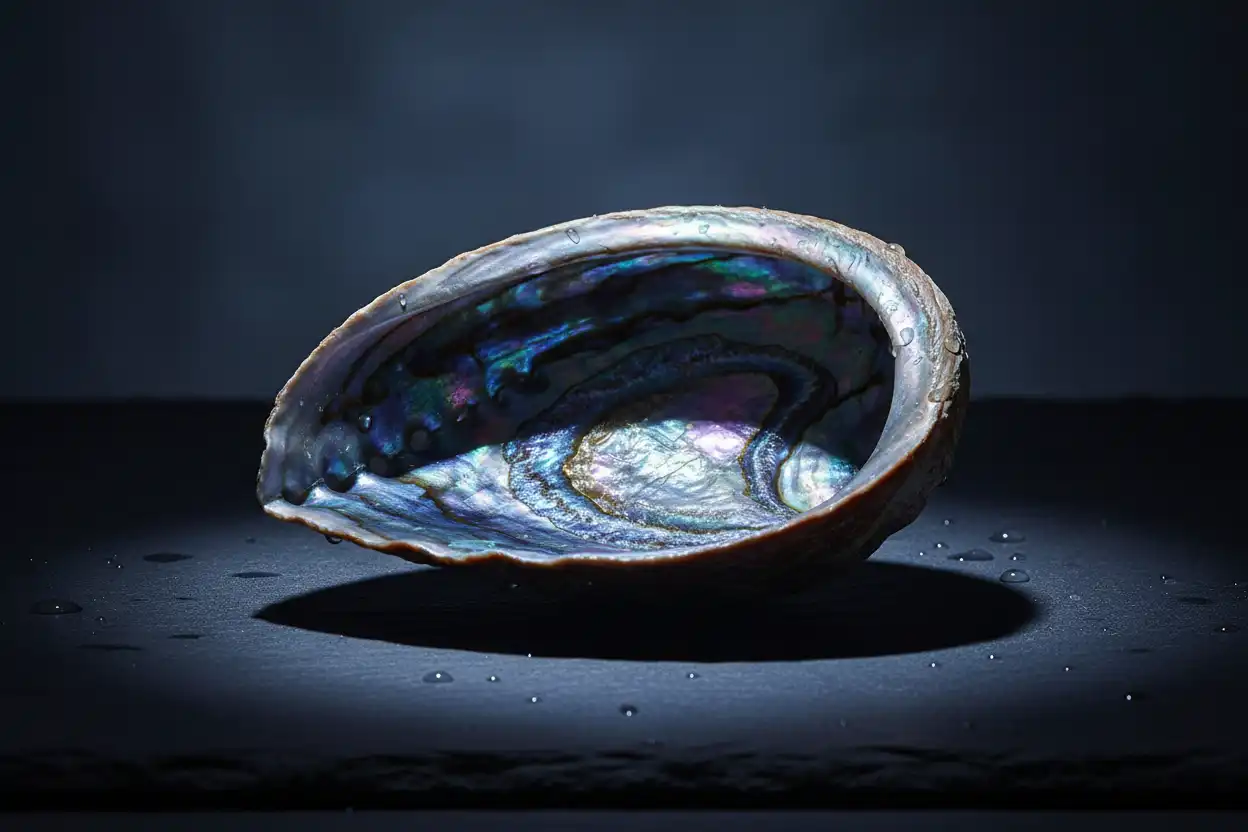
Abalone Shell Meaning: Formation, Traits and Recorded Lore
Abalone shell meaning is closely connected with the sea, changing color, protection, adaptability, and the beauty created when a living organism builds a durable structure one microscopic layer at a time. These associations help explain why polished abalone has appeared in ornaments, inlay, decorative objects, ceremonial pieces, and modern jewelry, yet its symbolism should not obscure what the material actually is. Abalone shell is the protective shell of a marine gastropod rather than a mineral crystal, and its luminous interior consists largely of nacre, the layered biological material commonly called mother-of-pearl.
Understanding abalone shell meaning therefore requires two separate perspectives. The gemological perspective examines biological formation, aragonite platelets, structural color, identification, treatments, durability, and responsible sourcing. The symbolic perspective records the meanings that different communities and modern users have associated with the shell. Gems Lore keeps those perspectives distinct so readers can appreciate traditional interpretations without mistaking them for measurable medical, psychological, or supernatural effects. Readers exploring other biogenic and mineral materials can continue through the broader Gemstone Guides collection.
Abalone Shell at a Glance
| Property | Abalone shell details |
|---|---|
| Material class | Biogenic or organic gem material |
| Biological source | Marine gastropods belonging to the genus Haliotis |
| Main iridescent material | Nacre, commonly called mother-of-pearl |
| Principal mineral component | Aragonite, a crystalline form of calcium carbonate |
| Supporting component | Thin organic layers that bind the aragonite structure |
| Optical effect | Strong shifting iridescence produced by interaction between light and microscopic structures |
| Common colors | Blue, green, violet, turquoise, silver, pink, bronze and mixed rainbow colors |
| Transparency | Opaque, although very thin sections may transmit some light |
| Luster | Pearly to highly iridescent |
| Typical uses | Inlay, cabochons, beads, pendants, earrings, mosaics and decorative objects |
| Durability | Relatively soft, layered, brittle and vulnerable to scratching, chipping, heat and chemicals |
| Common modifications | Polishing, backing, stabilization, coating, dyeing and assembly with resin or protective caps |
| Primary identification concern | Distinguishing natural shell from assembled material, reconstituted composites and plastic or foil imitations |
What Is Abalone Shell?
Abalone shell comes from marine snails whose flattened, ear-shaped shells protect a soft-bodied animal that lives attached to rocky surfaces. The shell’s exterior is usually rougher, duller and less colorful than the polished interior, while a row of natural openings along one side of a complete shell forms part of the animal’s respiratory and waste-removal system. Jewelry fragments may show none of these obvious shell features because cutters select and polish only the most attractive nacreous areas.
The brilliant interior is a type of mother-of-pearl, but the two terms are not interchangeable. Mother-of-pearl is a general name for nacre lining the shells of several mollusk groups, whereas abalone shell identifies nacre produced by abalone. Consequently, every nacreous abalone fragment can be described as mother-of-pearl, but mother-of-pearl from an oyster, mussel or another mollusk is not abalone. The types of mother-of-pearl guide explains how nacre from different biological sources can vary in color, structure and commercial use.
Abalone shell is also not a mineral species, even though its structure contains crystalline aragonite. A mineral species has a defined natural chemical composition and crystal structure independent of a living organism, while shell is a biological composite manufactured through biomineralization. Describing abalone simply as “aragonite” ignores the organic matrix, microscopic architecture, curved shell form and biological processes responsible for its appearance and performance.
How Abalone Builds Nacre
An abalone grows its shell by depositing mineral and organic material through tissues along the shell interior. Calcium carbonate crystallizes principally as aragonite platelets, while very thin organic layers help bind and organize those platelets. The resulting architecture is often compared with a brick wall: aragonite tablets function like bricks, and the organic material between them behaves like mortar. This arrangement is much tougher than a loose mass of brittle crystals because small structural interruptions can slow or redirect a developing crack.
The nacre produced by gastropods such as abalone has structural differences from the sheet nacre commonly associated with bivalves such as oysters and mussels. Abalone nacre is often described as columnar, with highly organized stacks of thin aragonite platelets. Their regularity and scale contribute to the intense color effects for which abalone is known, although the exact appearance also depends on species, growth conditions, surface texture, polishing, viewing angle and the thickness of the preserved layer.
Pearls and shell lining are related because both can be produced through molluscan biomineralization, but they are not the same object. A pearl develops as the mollusk deposits material around an internal irritant, tissue implant, nucleus or naturally occurring trigger, whereas the shell lining is part of the animal’s protective outer structure. The complete pearl meaning guide discusses this biological distinction, while the types of pearl reference separates natural, cultured, nacreous and non-nacreous pearl materials.
Why Abalone Shell Shows Rainbow Colors
The rainbow appearance of abalone is structural color rather than color produced solely by a conventional pigment. Light reaching the nacre interacts with microscopic aragonite layers and fine surface structures. Some wavelengths reinforce one another while others weaken, so the observed color changes as the shell, light source or viewer moves. Multilayer interference and surface diffraction can both contribute, which is why describing the effect as nothing more than “light reflecting from layers” is incomplete.
This shifting iridescence can include electric blue, turquoise, green, violet, pink, silver, gold and bronze, sometimes appearing together within a small fragment. A polished surface may reveal sweeping color bands, small flashes, cloud-like transitions or narrow directional streaks. Darker background material can increase the apparent contrast, while pale shell sections may look silver, green or softly opalescent. Strong color alone does not prove that a fragment is untreated because coatings, dyes, resin backing and photographic processing can intensify appearance.
Gemologists often use the word orient for multicolored iridescence seen over a nacreous body color, particularly in pearls and shell. Abalone can show exceptionally strong orient because its microscopic structure produces vivid, mobile color. This effect should not be confused with the play-of-color of precious opal, even though both materials can display changing spectral hues. Their structures and formation processes are different.
A Repeatable Abalone Color-Observation Method
Place the shell on a neutral gray or white background under broad, diffused daylight or a color-balanced lamp. View it straight on before slowly tilting it forward, backward and from side to side, keeping the light source fixed. Record the dominant body color, the secondary colors appearing during rotation, the direction in which flashes travel, and whether the effect seems to originate within the layered material or only from a glossy surface coating.
Repeat the observation under a second neutral light source rather than comparing a daylight photograph with a heavily processed seller image. Note whether the color remains mobile, whether identical patterns repeat unnaturally across separate pieces, and whether scratches interrupt only a clear surface layer. This procedure does not authenticate the material by itself, but it produces a more useful record than simply writing “rainbow shell.”
Abalone, Pāua and Mother-of-Pearl Names
Abalone is a broad common name covering multiple species within the genus Haliotis. Their shells vary in size, thickness, dominant color, pattern and intensity of iridescence. The dedicated types of abalone shell guide owns the detailed species and commercial-variety discussion rather than repeating a full catalog here.
Pāua is a New Zealand name applied to local abalone and is especially associated in the gem and jewelry trade with Haliotis iris. Pāua shell is widely recognized for intense blue, green and violet color, but sellers sometimes apply the name loosely to any highly colored abalone fragment. A responsible description should identify the material as abalone shell first and provide the species or geographic source only when that information is supported.
Mother-of-pearl is the broad material term, while abalone and pāua provide more specific biological or geographic context. A listing that says only “shell,” “rainbow shell,” or “ocean opal” leaves important questions unanswered. “Ocean opal” is a marketing expression and does not make abalone a variety of opal.
Abalone Shell Compared With Other Iridescent Materials
Abalone shell can resemble other organic or biogenic gem materials because several use layered structures to manipulate light. Pearls share nacreous construction, yet their rounded growth form, surface, internal structure and market classification are different. Readers evaluating pearl authenticity should use the dedicated real versus fake pearl guide, while possible bleaching, dyeing, irradiation, coating and other modifications are covered separately in the treated pearl reference.
Ammolite can also show intense red, green, blue and violet iridescence, but it comes from fossil ammonite shell rather than a living abalone. Much jewelry-grade ammolite is stabilized or assembled because the iridescent layer can be exceptionally thin and fragile. Anyone comparing commercial material should examine the separate ammolite buying guide and ammolite value factors rather than assuming every rainbow shell follows the same quality system.
Coral is another biologically produced jewelry material, although its structure, appearance and ecological concerns differ greatly from abalone. Amber is different again: the amber reference explains a fossilized organic resin rather than a calcium-carbonate shell. Grouping these materials as “organic gemstones” can be useful commercially, but it does not mean they share the same composition, durability, care requirements or legal considerations.
How to Identify Natural Abalone Shell
A natural abalone fragment commonly shows curved or irregular growth patterns, directional bands, uneven changes in iridescence and visible layering along an exposed edge. An unpolished reverse may retain chalky, rough, brown, greenish or gray shell material rather than displaying the same polished rainbow finish on every surface. Natural pores, fine lines, localized pits and differences in thickness are possible because the material was built by a living animal.
These observations are useful but not conclusive. Thin genuine shell can be laminated onto a dark backing, placed beneath a transparent cap or sealed in resin to improve strength and color. Such construction may be commercially sensible, particularly for inlay and delicate jewelry, and it should not be called fake when it is disclosed accurately. The problem arises when assembled, coated or composite material is represented as a solid untreated piece.
| Material | Useful observations | Important limitation |
|---|---|---|
| Natural solid shell | Irregular growth pattern, layered edge, curved form and natural-looking color transitions | Small polished pieces may hide the exterior and biological structure |
| Backed abalone | Genuine thin shell over a darker support, sometimes with a visible junction at the edge | Backing may improve appearance and strength but must be disclosed |
| Capped or coated shell | High surface gloss, protective transparent layer or color concentrated near the surface | A coating can be difficult to see without magnification |
| Reconstituted composite | Small shell fragments suspended or arranged within resin | Genuine shell content does not make the product solid natural shell |
| Printed or foil imitation | Repeated patterns, flat color effect, molded edges or a decorative film beneath plastic | High-quality imitations may appear convincing in photographs |
| Other mother-of-pearl | Genuine nacre with pearly iridescence but a different mollusk source | It is not fake nacre, although it is incorrectly described if sold as abalone |
Non-Destructive Inspection Checklist
Ask for clear photographs of the face, reverse and edges under neutral lighting. Look for a boundary between the iridescent layer and any backing, check whether the seller describes the piece as solid, inlaid, laminated, stabilized, coated or composite, and compare repeated components for suspiciously identical patterns. Under magnification, inspect exposed edges for natural layering, resin-filled areas, bubbles, a transparent cap or color concentrated in cracks.
Avoid burn, hot-needle, acid, scratch and destructive scraping tests. These methods can damage genuine material, release unpleasant or hazardous fumes from resin, destroy a protective coating, and still fail to provide a reliable identification. A valuable, historically important or unusually represented object deserves professional examination rather than an improvised home test.
Abalone Shell Treatments and Assemblies
Polishing is the most ordinary modification because the inner surface must be smoothed to display its strongest color and luster. Beyond polishing, abalone shell may be backed with resin or another material, stabilized, laminated, capped, dyed, bleached, filled or coated. Thin pieces are frequently used as inlay, so the finished object may contain genuine shell attached to wood, metal, stone, ceramic or polymer.
Treatment does not automatically make a piece undesirable. A disclosed backing can protect a delicate layer, while a clear cap can reduce abrasion. The buyer should judge whether the construction suits the intended use and whether the seller has described it accurately. Terms such as “natural abalone” should not be used to conceal resin content, a composite structure, an artificial coating or an unsupported species claim.
Abalone Shell Meaning and Symbolism
Abalone shell meaning is often associated with adaptability because its colors change as the viewing angle changes, while its hard exterior and luminous interior encourage symbolic connections with protection, hidden beauty and emotional depth. Ocean associations have also led people to connect the shell with movement, intuition, renewal, creativity and the ability to remain grounded while circumstances shift.
These meanings are not universal. Coastal communities have used shells in materially and culturally distinct ways, including ornament, inlay, exchange, tools, ceremony and artistic expression. A modern product description should not flatten those varied histories into one supposedly ancient spiritual definition. Whenever a cultural attribution matters, it should be supported by a reliable, community-specific source rather than repeated from generic crystal marketing.
Some contemporary practices use abalone shell as a dish for holding small objects, incense or ritual materials. Heat, flame and hot ash can discolor, fracture or weaken shell, however, and a shell should not be treated as automatically fireproof. Use a properly designed heat-resistant vessel instead of assuming that a natural shell is safe for burning materials.
Traditional or personal symbolism can support reflection, journaling or artistic ritual, but there is no established scientific evidence that abalone shell treats illness, changes hormones, removes measurable negative energy, predicts events or guarantees emotional healing. Review the Gems Lore content disclaimer whenever symbolic material could be mistaken for medical or professional guidance.
Abalone Shell in Jewelry
Abalone is especially effective in pendants, earrings, brooches, cuff links, mosaics and protected inlay because these formats can display broad areas of color while reducing direct impact. It may be cut into flat tablets, domed cabochons, beads or irregular mosaic pieces. Designers often place a thin iridescent layer over a dark backing to increase color contrast, although that construction should be disclosed.
Rings and bracelets expose the material to more frequent knocks, abrasion and chemicals, so a protected bezel, recessed inlay or covered assembly is generally more practical than a raised, thin fragment. Even in a protective design, abalone should not be treated like quartz, sapphire or another harder everyday-wear stone. The shell can scratch, chip along edges, separate at layers or detach from adhesive when subjected to impact, prolonged moisture or heat.
Matching is important for earrings and repeated inlay. Two pieces do not need identical patterns, but their dominant colors, brightness, direction of iridescence and thickness should form an intentional pair. Very flat color, a plastic-looking surface or exact repetition across multiple components deserves closer inspection.
What Determines Abalone Shell Quality and Value?
Abalone shell value depends less on a standardized grading scale than on usable color, pattern, surface quality, thickness, size, construction, workmanship and disclosure. Broad, vivid areas of mobile blue, green and violet may be especially attractive, although warm pink, bronze, silver and mixed-color pieces can be equally compelling when the pattern suits the design. Large uninterrupted sections may be harder to cut than small fragments because natural shell contains curves, pores, thin areas and surface defects.
Craftsmanship can contribute more to the finished price than the raw shell. Clean cutting, smooth edges, secure inlay, balanced color orientation, well-fitted backing and careful polishing require skill. A poorly finished piece can expose sharp edges, adhesive, gaps or lifting layers even when the shell itself is colorful.
There is no universal “AAA” abalone grade. Buyers should compare the actual material and construction rather than relying on unexplained superlatives. Similar caution applies when evaluating other nacreous materials through a pearl buying checklist or comparing how nacre, luster, matching and treatment affect pearl prices. Market labels are useful only when the seller explains what was inspected.
Responsible and Legal Sourcing
Abalone populations and harvest regulations vary by species and location. Some populations have suffered from overharvesting, disease, habitat pressure and illegal collection, while other material may come from regulated aquaculture, licensed harvests or shells retained as a by-product of food production. A seller should not use the vague word “sustainable” without explaining the species, source, production method or documentation behind the claim.
Ask whether the shell was farmed, legally harvested, reclaimed, vintage or obtained as a documented by-product. Request geographic origin only when the supply chain can support it, and be cautious with rare-species claims used to create artificial urgency. Local import, export, wildlife and harvest rules can change, so legality should be checked for the buyer’s jurisdiction before acquiring large quantities or restricted material.
The same evidence-first approach applies to other biologically produced gems. The discussion of coral ethics explains why attractive organic material should not be separated from ecological and sourcing questions, while the coral price guide shows why species, treatment, condition and documentation can affect commercial interpretation.
How to Clean Abalone Shell Safely
Begin by inspecting whether the shell is solid, backed, inlaid, coated or attached with adhesive. Wipe loose dust with a very soft, dry cloth, then use a second cloth lightly dampened with clean water if necessary. For stubborn ordinary residue, place a small amount of mild, neutral soap on the damp cloth rather than soaking the jewelry. Wipe gently, remove soap with another barely damp cloth and dry the piece immediately with a soft lint-free cloth.
Do not place abalone shell in an ultrasonic cleaner or steam cleaner. Avoid bleach, vinegar, acids, ammonia, alcohol, strong detergents, jewelry dips, toothpaste, baking soda, abrasive cloths and stiff brushes. Prolonged soaking can affect organic layers, adhesives, backing and surface coatings, while heat and rapid environmental changes can encourage cracking, warping or separation.
The care principles overlap with, but are not identical to, the procedures for cleaning mother-of-pearl jewelry and cleaning pearl jewelry. Delicate assembled materials such as ammolite require another treatment-aware routine, explained in the guide to cleaning ammolite jewelry.
Store abalone separately from harder gemstones and metal edges in a soft pouch or lined compartment. Put it on after cosmetics, perfume, hairspray and lotion, and remove it before swimming, showering, exercising, cleaning, gardening or sleeping. Do not leave the material on a hot windowsill, inside a vehicle, beside a heater or in persistent direct sunlight.
Cutting and sanding shell can generate fine particulate dust and should not be treated as a casual indoor craft. Use appropriate professional extraction, containment and protective equipment, or have the work performed by an experienced lapidary or shell worker. Wearing a simple nuisance mask without dust control is not a complete safety plan.
Practical Abalone Shell Buyer Checklist
Before purchasing abalone shell or jewelry, confirm:
- The material is identified specifically as abalone rather than simply “rainbow shell.”
- Any pāua, species or geographic-origin claim has supporting information.
- The listing states whether the piece is solid, inlaid, backed, capped or composite.
- Dye, coating, stabilization and resin content are disclosed.
- Photographs show the actual piece under neutral lighting.
- Face, edge and reverse photographs are available.
- The color shifts naturally when the piece is rotated.
- Repeated components do not show an identical printed pattern.
- Edges are smooth and securely protected.
- Inlay fits cleanly without lifting or excessive visible adhesive.
- The setting suits the shell’s limited scratch and impact resistance.
- Ecological or sustainability claims are specific rather than promotional.
- The return policy allows inspection under ordinary lighting.
- Care instructions acknowledge shell, backing and adhesive vulnerabilities.
- Expensive or historically significant objects can be professionally examined.
Frequently Asked Questions
Is abalone shell a gemstone?
Abalone is commonly used as an organic or biogenic gem material, although it is not a mineral gemstone. Its value comes from nacreous structure, natural iridescence and suitability for ornament and jewelry.
What is abalone shell made of?
The iridescent interior consists principally of microscopic aragonite platelets held together by thin organic layers. This biological composite is called nacre or mother-of-pearl.
Why does abalone shell change color?
Its microscopic layers and surface structures interfere with and diffract light. Different wavelengths become visible as the viewing angle, shell orientation or light direction changes.
Is abalone the same as mother-of-pearl?
Abalone shell contains mother-of-pearl, but mother-of-pearl is a broader term. Nacre from oysters, mussels and other mollusks is not automatically abalone.
Is pāua shell real abalone?
Yes, pāua is a New Zealand name for local abalone and is strongly associated in the gem trade with Haliotis iris. The name should not be applied loosely to unrelated nacre.
How can I tell if abalone shell is genuine?
Look for natural layering, irregular growth patterns, mobile iridescence, a shell-like reverse and non-repeating color transitions. These clues are not conclusive, especially when genuine shell is thin, backed or coated.
Can abalone shell get wet?
Brief contact with a lightly damp cloth is normally manageable for sound material, but prolonged soaking can affect shell layers, coatings, resin, adhesive and backing. Remove abalone jewelry before swimming or showering.
Is abalone suitable for everyday jewelry?
It works best in protected pendants, earrings, brooches and recessed inlay. Rings and bracelets require more protection because they receive greater abrasion and impact.
Does abalone shell have healing properties?
Abalone has traditional and modern symbolic associations, but there is no established scientific evidence that it treats or cures medical or psychological conditions.
Is abalone shell ethical?
The answer depends on species, geographic source, harvesting method, legality and supply-chain documentation. Farmed, legally harvested, reclaimed or documented by-product shell may offer clearer sourcing than unexplained wild material.
Abalone Shell Meaning Begins With the Real Material
Abalone shell meaning becomes more useful when its symbolism remains connected to the shell’s real structure. A living marine animal creates thousands of organized mineral and organic layers, and those layers transform ordinary light into color that changes with movement. That physical story naturally supports themes of adaptability, hidden beauty, protection and change without requiring medical or supernatural claims.
A responsible owner should look beyond rainbow color, ask whether the material is solid or assembled, verify treatments and sourcing, choose a protective design, and clean it as a delicate biological gem material. Gems Lore explains its wider evidence-led approach on About Gems Lore, where gemological facts, commercial claims and traditional beliefs are treated as different kinds of information rather than blended into one unsupported story.