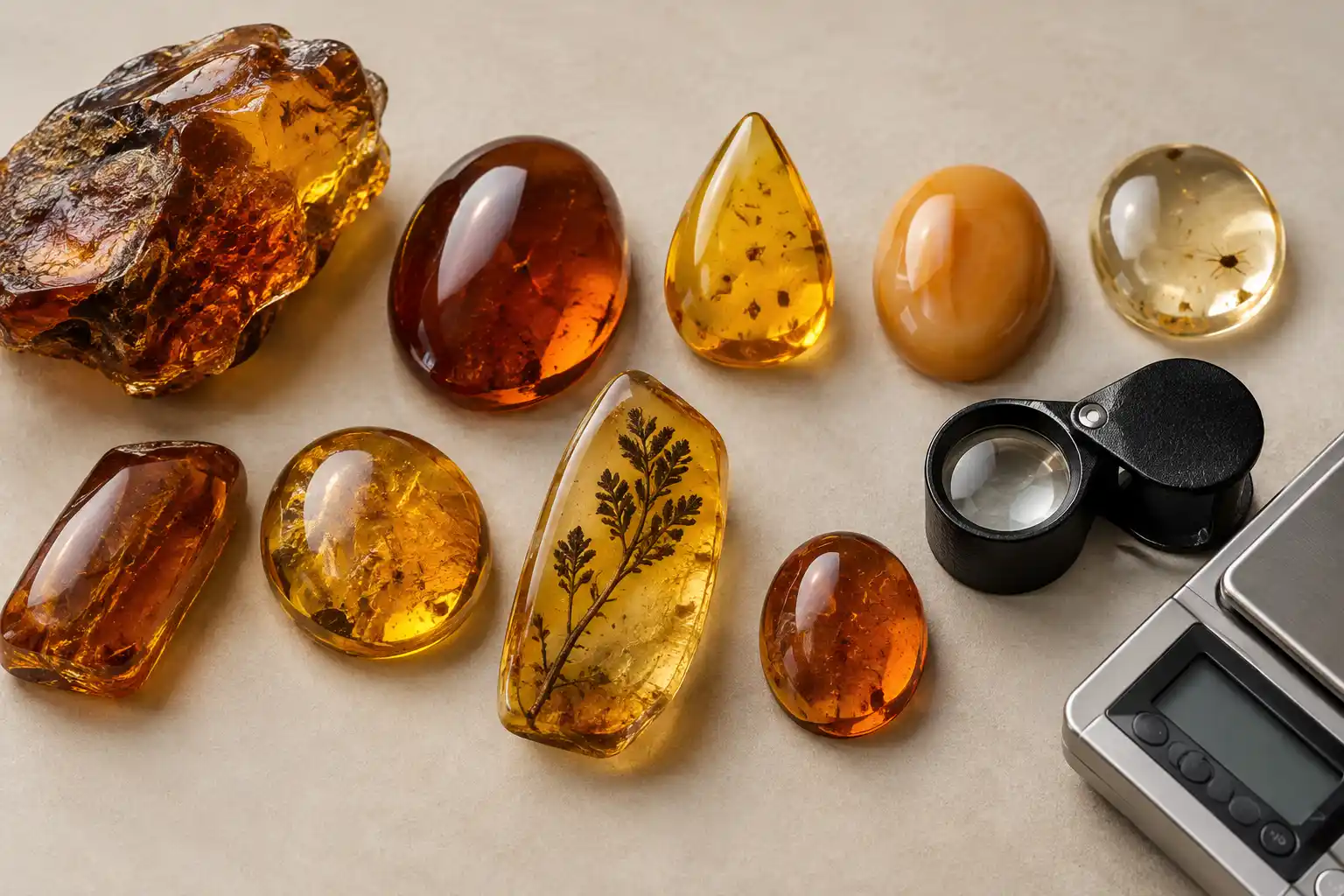
Amber Price Per Carat: 9 Cost Factors & Market Value Insights
Amber price per carat can range from well under a few dollars for ordinary, heavily processed, pressed, or low-grade pieces to several dollars or tens of dollars per carat for attractive natural amber with desirable color, transparency, provenance, or craftsmanship. Exceptional specimens containing important authentic biological inclusions may sell for far more, although those pieces are often valued individually rather than by a simple per-carat formula. Unlike diamond, amber does not have a standardized international pricing grid, and dealers commonly quote it by the gram, by the finished object, or by the specimen instead of strictly by carat.
Amber is fossilized plant resin, not a crystalline mineral. It is lightweight, relatively soft, and chemically organic, so its market behaves differently from that of sapphire, ruby, or diamond. One gram equals five carats, which means a piece offered at $25 per gram is effectively priced at $5 per carat before considering carving, mounting, provenance, or collector premiums. This conversion is useful for comparison, but weight alone is a poor measure of amber value because transparency, color, authenticity, inclusions, age, origin, treatment, and workmanship can matter much more.
Natural amber also needs to be separated from pressed amber, reconstructed amber, copal, plastic, glass, and resin imitations before The Price has much meaning. A clear piece containing a perfectly positioned insect may look valuable in a photograph, yet an artificial inclusion or a younger resin substitute can completely change the appropriate valuation. For expensive specimens, authenticity should therefore come before discussion of color or size.
9 Cost Factors That Drive Amber Price Per Carat
- Natural amber versus pressed amber, copal, and imitations
- Color and rarity of the body color
- Transparency, translucency, and visual clarity
- Natural plant, insect, and other biological inclusions
- Size, weight, and usable dimensions
- Geographic origin and reliable provenance
- Treatments, clarification, heating, and reconstruction
- Cutting, polishing, carving, and craftsmanship
- Certification, collector demand, and overall market context
These nine factors interact closely. A large amber piece does not automatically command a high Price if it has been pressed from fragments, heavily altered, poorly polished, or falsely represented. A smaller natural specimen with excellent transparency and an unusual authenticated inclusion may be worth substantially more.
Typical Amber Price Per Carat
Because amber is commonly sold by weight in grams or as individual pieces, any per-carat range should be treated as a practical conversion rather than a universal market standard.
| Amber Category | Approximate Price Per Carat | General Characteristics |
|---|---|---|
| Low-grade, heavily processed, or pressed amber | Under $1 to about $2 | Commercial appearance, reconstruction or strong processing may be involved |
| Common natural polished amber | About $1 to $5 | Typical honey, yellow, brown, or cognac color |
| Good jewelry-quality natural amber | About $3 to $10 | Attractive color, polish, transparency, or distinctive appearance |
| Fine natural amber | About $8 to $30+ | Desirable color, strong visual quality, larger clean pieces, good provenance |
| Fine inclusion-bearing amber | About $20 to $100+ | Genuine visible biological inclusions with collector appeal |
| Exceptional scientific or collector specimens | Can far exceed ordinary per-carat ranges | Rare organisms, unusual preservation, documented provenance, important specimen quality |
These ranges overlap because amber is not traded like a uniformly graded faceted gemstone. A beautifully carved piece may be priced mainly for craftsmanship, while a rare fossil inclusion can dominate the value of an otherwise modest piece of resin.
A seller quoting only a high per-carat Price without explaining whether the amber is natural, pressed, treated, inclusion-bearing, or carved is providing too little information for meaningful comparison.
1. Natural Amber Is Worth More Than Many Reconstructed or Imitation Products
Authenticity is the foundation of amber valuation. Natural amber formed from ancient plant resin that underwent burial, chemical change, polymerization, oxidation, and other processes over geological time. Its precise history differs among deposits, but true amber is much older and more chemically altered than fresh resin.
Pressed amber, sometimes called ambroid, is made by combining smaller amber fragments under heat and pressure. Because the starting substance can be genuine amber, pressed amber should not be confused with plastic, yet it does not have the same rarity as a single intact natural piece.
Reconstructed products may contain amber particles, resin binders, or combinations assembled into larger pieces. These can be decorative but belong to a lower value category than comparable natural amber.
Copal is younger resin that has not undergone the same degree of geological maturation as amber. The exact age boundary between copal and amber is not defined by one universally accepted number, so age alone should not be used as a simplistic test.
Plastics, synthetic resins, glass, and other simulants can also imitate amber’s yellow, orange, brown, or reddish colors. Some are lightweight enough to confuse buyers who rely on only one home test.
For valuable pieces, several observations and professional methods should be combined rather than depending on a single scratch, flame, saltwater, or solvent experiment that could damage the object.
2. Amber Color Can Significantly Affect Market Value
Amber occurs in far more colors than basic yellow. Honey, cognac, orange, reddish brown, lemon yellow, cream, butterscotch, white, greenish, and very dark brown appearances are all encountered in the market.
Color preference depends partly on region and fashion. Clear golden or cognac amber has broad jewelry appeal, while opaque cream and butterscotch pieces can command strong interest among collectors and buyers who appreciate Baltic amber styles.
White amber can be particularly distinctive because countless microscopic bubbles scatter light and create a pale creamy or bone-like appearance. Some pieces contain attractive swirls and transitions between opaque and transparent zones.
Green amber requires careful interpretation. Some natural pieces can show greenish appearances because of organic debris, weathering, optical effects, or geological conditions, but commercially intense green amber may also be modified through heating, backing, coating, or other processing.
Reddish amber can be visually striking as well. Heat, oxidation, surface alteration, or treatment may intensify red and cognac tones, so unusual color should not automatically be assumed naturally produced throughout the piece.
The most valuable color is therefore not simply the rarest advertised label. Buyers should consider whether the color is natural, stable, attractive, and supported by accurate disclosure.
3. Transparency and Clarity Influence The Price
Transparent amber allows light to pass through and may reveal internal inclusions clearly, making it especially desirable for certain jewelry and fossil specimens. Fine transparent pieces with strong golden color can command substantial premiums over dull or poorly processed amber.
Translucent amber can be equally attractive when the internal cloudiness creates depth. Opaque amber should not automatically be considered lower grade because cream, butterscotch, white, and patterned varieties have their own collector markets.
Cloudiness in amber can come from microscopic gas bubbles, internal structures, organic debris, weathering, or other natural features. Treatment can also alter clarity.
One important commercial process uses heat and pressure to clarify cloudy amber. Heating can also produce disc-like reflective features commonly called sun spangles. These glittering internal discs may look natural to inexperienced buyers, but they are frequently associated with treatment rather than original biological inclusions.
A transparent piece is valuable only when transparency is relevant to the intended product. For a carved opaque Baltic amber object, color pattern and craftsmanship may matter more than whether light passes through it.
4. Genuine Biological Inclusions Can Raise Amber Value Dramatically
Amber is famous for preserving fragments of ancient ecosystems. Insects, spiders, plant structures, pollen, hair-like fibers, feathers, and other biological inclusions can occasionally become trapped in resin before it fossilizes.
Not every inclusion is rare. Small plant fragments, unidentified debris, bubbles, and common insects may add visual interest without creating a large collector premium.
The highest values usually occur when the organism is genuine, well preserved, clearly visible, scientifically interesting, uncommon, and positioned so that important anatomical features can be observed.
A specimen containing an ordinary small fly may be interesting but should not automatically be valued like amber containing a rare and unusually complete organism.
Inclusion fraud is also a major concern. Modern insects can be inserted into resin-like substances, natural amber can be modified or assembled around inclusions, and imitations may be created specifically to attract collectors.
A suspiciously large, perfectly centered organism in flawless material should therefore encourage examination rather than immediate excitement. Authenticity and preservation quality matter much more than dramatic appearance alone.
5. Size Matters, but Amber Does Not Follow a Simple Carat Premium
Large intact natural amber pieces are less common than small fragments, so size can increase value when quality remains strong. However, amber does not show the same rigid size thresholds seen in some faceted gemstones.
Because amber has low density, a physically large piece may still weigh surprisingly little. Its specific gravity is only slightly above that of water, which is one reason amber can feel unexpectedly light in the hand.
A larger piece provides more room for carving, sculptural use, visible inclusions, or dramatic color zoning. Large transparent pieces without major fractures can therefore command a premium.
Weight alone can also be misleading when pieces have been pressed or reconstructed. A very large polished object is not necessarily rarer than a smaller intact natural specimen if it was produced from numerous fragments.
For carved amber, usable shape can be just as important as raw weight. A broad clean slab suitable for detailed carving may be more desirable than an irregular heavier piece with deep fractures.
6. Geographic Origin and Provenance Can Influence Amber Value
Baltic amber is among the best-known commercial types and is strongly associated with deposits around the Baltic region. Much Baltic amber is classified as succinite, a fossil resin type traditionally associated with measurable succinic acid content.
Dominican amber is also highly regarded, particularly for transparent specimens and biological inclusions. Some pieces can show blue fluorescence or a remarkable bluish appearance under certain lighting conditions, adding collector interest.
Mexican amber, particularly from Chiapas, can occur in attractive yellow, orange, reddish, and sometimes fluorescent varieties.
Amber from Myanmar is far older than most Baltic or Dominican amber and has yielded scientifically important Cretaceous inclusions. Age, however, does not automatically translate into a higher commercial Price. Provenance, authenticity, inclusion importance, condition, and legal or ethical considerations can all affect the market.
A seller should not infer origin from color alone. Geographic origin can sometimes be supported through spectroscopy, chemical characteristics, provenance records, or specialized analysis, but not every piece can be assigned confidently.
Collectors may pay more when locality is well documented, especially for scientifically interesting inclusion-bearing specimens.
7. Treatments Can Change Both Appearance and Value
Heating is one of the most important treatments in commercial amber. It can clarify cloudy pieces, deepen color, create reddish or cognac tones, and produce reflective internal discs.
Pressure treatment may also be used during clarification. These processes can improve visual appearance, but treated amber should not be represented as naturally transparent or naturally spangled if the effect was created deliberately.
Surface coatings, backing, dyeing, and other modifications can alter color as well. Green and red commercial amber deserve particular attention when the hue looks unusually strong.
Pressed amber is another processing category. Genuine amber fragments can be consolidated under pressure and heat, creating larger usable pieces with a different rarity and value profile from intact natural amber.
Treatments do not automatically make amber unattractive or unsuitable for jewelry. The key issue is disclosure. A beautiful heat-treated pendant can still be worth owning when The Price reflects what it actually is.
8. Carving and Craftsmanship Can Be Worth More Than Raw Amber
Amber has a Mohs hardness of only about 2 to 2.5, making it soft enough to carve and polish relatively easily. Skilled artisans can create beads, relief carvings, figurines, boxes, cameos, pendants, and intricate sculptural objects.
In a high-quality carving, workmanship may contribute more to the retail Price than the raw amber itself. Symmetry, polish, detail, artistic quality, waste during carving, and the reputation of the maker can all add value.
Poor craftsmanship can reduce value even when attractive natural amber was used. Deep scratches, uneven polishing, poorly drilled beads, unstable mounting holes, and careless repairs all affect desirability.
Antique objects may carry additional value based on age, cultural origin, maker, provenance, and historical importance. At that point, the object should not be valued only by dividing its sale Price by the number of carats.
9. Market Confidence, Documentation, and Collector Demand Matter
Ordinary amber jewelry usually does not require an expensive laboratory report, but documentation becomes increasingly useful when the seller makes major claims about natural origin, rare inclusions, unusual geographic provenance, or exceptional age.
For high-value inclusion specimens, authentication can protect buyers from some of the most serious forms of fraud. An expert assessment may also help determine whether the inclusion was naturally entombed or artificially introduced.
Collector demand is highly specific. One buyer may prioritize Baltic butterscotch amber, another may collect Dominican fluorescent specimens, while another may focus on fossil insects.
This specialization explains why identical weight does not produce identical value. Amber is often an object-driven market in which individual appearance and provenance matter more than a standardized per-carat rate.
Amber Versus Copal, Pressed Amber, and Plastic
| Product | What It Is | General Value Position |
|---|---|---|
| Natural amber | Fossilized ancient plant resin | Highest potential when quality is strong |
| Pressed amber | Genuine amber fragments consolidated with heat and pressure | Usually lower than comparable intact natural amber |
| Copal | Younger, less mature natural resin | Generally lower value than established fossil amber |
| Synthetic resin | Manufactured polymer | Decorative rather than natural-gem value |
| Plastic imitation | Amber-like manufactured substance | Low intrinsic gem value |
| Glass imitation | Glass made to resemble amber | Decorative only |
Identifying the category correctly prevents a buyer from comparing objects that may look similar but have completely different origins and rarity.
Does Older Amber Always Cost More?
Age alone does not determine amber quality or market value. Some Cretaceous amber is far older than Baltic amber, yet individual commercial value still depends on appearance, size, condition, provenance, and inclusions.
Baltic amber is generally associated with Eocene deposits and is already tens of millions of years old. Dominican amber is younger in geological terms but can be extremely desirable because of transparency, fluorescence, and beautifully preserved inclusions.
A visually unattractive old fragment is not automatically more valuable than a younger but exceptional specimen.
Age becomes particularly important when it adds scientific significance to an inclusion. An organism preserved in much older amber may provide information about an earlier ecosystem, but that importance has to be evaluated by specialists rather than inferred from the seller’s age claim alone.
How to Compare Amber Prices Correctly
Start by converting the units. Since one gram equals five carats, divide the Price per gram by five to obtain the approximate Price per carat.
Then compare similar categories. Natural transparent Baltic amber should not be compared directly with pressed amber, and a polished bead necklace should not be compared solely by weight with a scientifically interesting inclusion specimen.
Check treatment status and workmanship next. A clarified heat-treated piece may be visually attractive but should be compared with similarly treated amber rather than rare untreated specimens.
Finally, evaluate provenance. Reliable locality information, old collection records, expert identification, or documentation for important inclusions can justify premiums that raw weight cannot explain.
Amber Durability and Care Affect Long-Term Value
Amber is relatively soft at about 2 to 2.5 on the Mohs scale and can scratch much more easily than quartz, sapphire, or even many common metals and household surfaces.
It is also sensitive to heat and certain chemicals. Perfume, hairspray, solvents, household cleaners, and prolonged high temperatures can damage the surface or alter appearance.
Amber jewelry should be cleaned gently with a soft damp cloth rather than aggressive ultrasonic or steam methods. Extended soaking is unnecessary, and abrasive cleaners should be avoided.
Storage should separate amber from harder jewelry. A quartz, topaz, sapphire, or diamond piece can scratch amber quickly if they rub together in a box.
Well-preserved antique amber can retain substantial collector value, making proper storage particularly important for pieces with documented history.
Conclusion
Amber price per carat is influenced by far more than weight. Natural versus pressed origin, color, transparency, inclusions, size, provenance, treatment, craftsmanship, and collector demand can move The Price dramatically. Common amber may cost only a few dollars per carat, while fine inclusion-bearing or historically important specimens can rise far beyond ordinary jewelry ranges.
The most reliable way to judge amber value is to identify what the piece actually is before discussing rarity. Natural amber, copal, pressed amber, treated amber, plastic, and synthetic resin can look deceptively similar. Once authenticity is established, color, clarity, inclusions, workmanship, provenance, and market demand provide a much more useful picture of true value.
FAQs About Amber Price Per Carat
How much does natural amber cost per carat?
Common natural polished amber often falls within a few dollars per carat, while finer pieces can reach higher ranges. Exceptional inclusion-bearing or collector specimens may cost tens or hundreds of dollars per carat and sometimes much more when the specimen is valued individually.
Is amber normally sold by carat?
Not always. Amber is frequently sold by the gram, by the bead strand, by the carving, or by the individual specimen. One gram equals five carats, so gram pricing can be converted easily when comparison is useful.
Why can insect amber be so expensive?
Authentic biological inclusions can add rarity and scientific or collector interest. Value depends on whether the organism is genuine, uncommon, well preserved, clearly visible, and naturally enclosed rather than artificially inserted.
Is clear amber more valuable than cloudy amber?
Clear natural amber can command strong prices, particularly when it displays inclusions well, but opaque cream, white, or butterscotch amber can also be highly desirable. Transparency is only one factor.
Is Baltic amber more valuable than other amber?
Baltic amber has strong recognition and a large collector market, but origin alone does not determine value. Fine Dominican, Mexican, Burmese, and other amber can also be valuable depending on quality, provenance, and inclusions.
Does amber become more valuable as it gets older?
Not automatically. Geological age can add scientific interest, but appearance, authenticity, inclusions, condition, provenance, and market demand still determine commercial value.
Is pressed amber real amber?
Pressed amber is generally produced from genuine amber fragments consolidated through heat and pressure, so it can contain real amber substance. It is nevertheless a processed product and normally has a different rarity and value from a comparable intact natural piece.
Does heat treatment lower amber value?
Treatment can affect value depending on the market and the type of alteration. Clarified, heated, or color-modified amber may remain attractive, but fine untreated natural pieces can command premiums when their natural appearance is desirable.
Is amber with sun spangles natural?
Disc-like reflective features called sun spangles are commonly associated with heat treatment rather than being original biological inclusions. Their presence can be decorative, but sellers should not misrepresent treatment-created features as untouched natural structures.
Can amber be fake?
Yes. Plastic, synthetic resin, glass, copal, reconstructed products, and artificially inclusion-bearing pieces can imitate natural amber. Multiple gemological observations are safer than relying on one destructive home test.
Is blue amber expensive?
Amber showing a convincing blue or bluish optical appearance can be highly sought after, particularly from certain localities. The Price depends on authenticity, intensity of the effect, transparency, size, and provenance rather than the blue label alone.
Do amber carvings cost more than raw amber?
They can. Skilled carving may contribute more to the retail value than raw weight. Artistic quality, maker reputation, complexity, condition, and antique provenance can all influence The Price.
Is amber suitable for everyday jewelry?
Amber can be worn regularly with care, but its hardness is only around 2 to 2.5. Rings and bracelets can scratch quickly, while pendants and earrings are generally easier to protect.
Should expensive amber have documentation?
Documentation is particularly useful for costly inclusion-bearing specimens, rare provenance claims, antique pieces, or purchases where natural versus pressed origin materially affects value.
How do I convert amber price per gram to price per carat?
Because one gram equals five carats, divide the Price per gram by five. For example, amber offered at $30 per gram works out to about $6 per carat before considering other value factors.