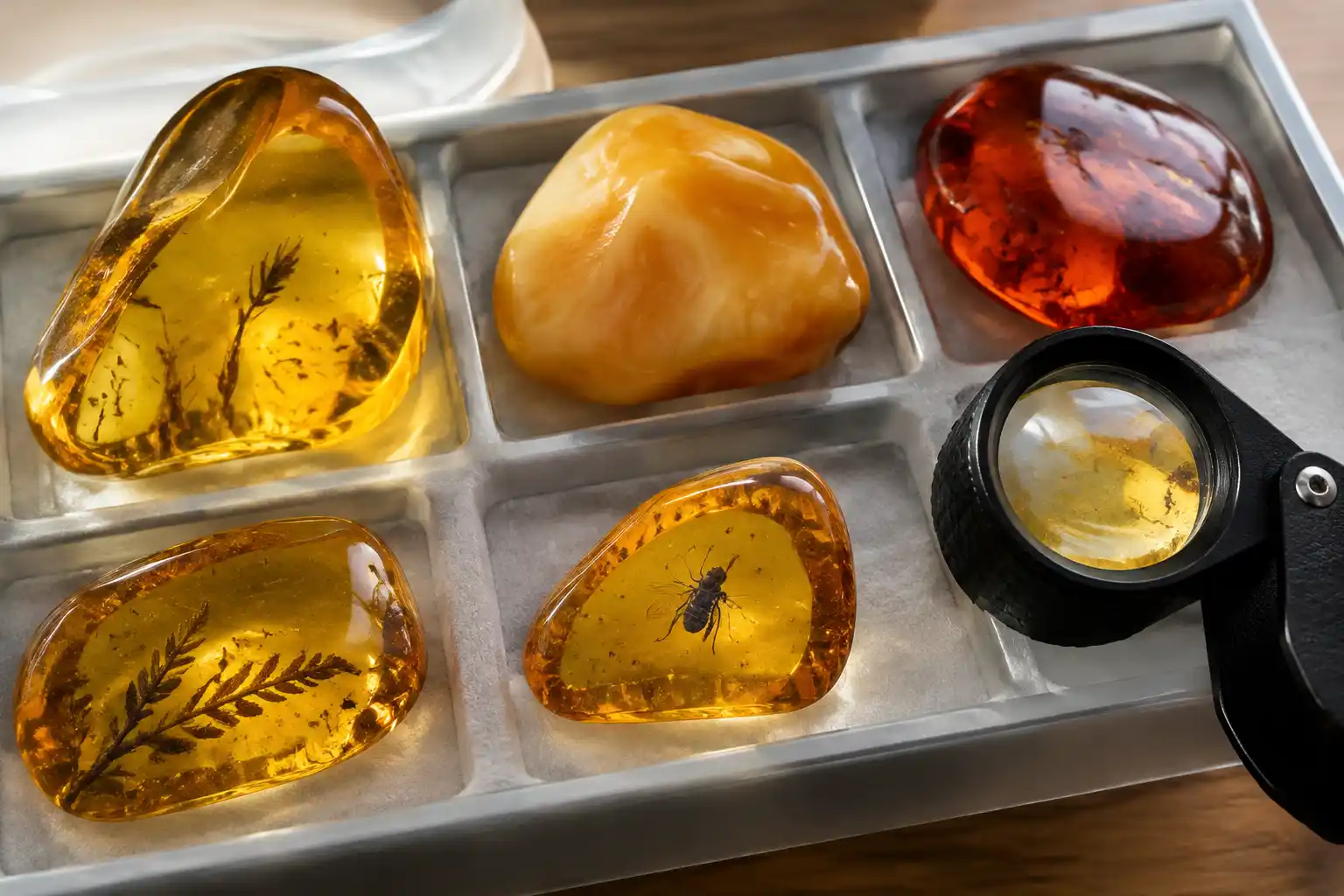
Amber Quality Grading: 7 Essential Rules to Assess Clarity, Inclusions & Age
Amber quality grading starts with authentication rather than color. A beautiful yellow or cognac object has little collector value as natural amber if it is actually plastic, young copal, heavily reconstructed resin, or an undisclosed pressed product. Once natural amber is established, quality can be assessed through color, transparency, inclusions, structural condition, treatment, workmanship, origin, age, and provenance. Unlike diamond, amber has no universally accepted international grading system that reduces these characteristics to a single standardized grade.
Amber is fossilized plant resin and therefore an organic gem rather than a mineral crystal. Its internal features record processes very different from those seen in quartz, sapphire, or beryl. Bubbles, plant debris, flow structures, weathering, cracks, and occasionally insects or other organisms may all occur. Some features increase visual or scientific interest, while others reduce stability or have been produced deliberately by heating and processing.
Age is another area where simplistic grading can become misleading. Older amber is not automatically higher quality, and a seller cannot establish geological age merely by looking at a yellow polished bead. Baltic, Dominican, Mexican, Burmese, and other amber deposits formed at different times and under different geological conditions. Age becomes commercially meaningful when origin is reliable, the specimen is scientifically important, or provenance contributes to collector confidence.
7 Essential Rules for Amber Quality Grading
- Verify natural amber before assigning quality
- Evaluate color and overall visual appeal
- Grade transparency, translucency, and internal clarity
- Examine inclusions for authenticity, rarity, and preservation
- Inspect structure, surface condition, and stability
- Assess treatment, origin, provenance, and geological age carefully
- Judge size, cutting, polish, carving, and overall craftsmanship
These seven rules work together. A transparent piece with an attractive insect inclusion can still be poor quality if the inclusion was artificially introduced, while an opaque butterscotch piece can be highly desirable when color, natural structure, size, provenance, and workmanship are excellent.
Rule 1: Verify Natural Amber Before Grading Anything Else
The first grading step is to determine whether the object is natural amber at all. Similar-looking substances include copal, pressed amber, reconstructed amber, synthetic resin, plastic, and glass.
Natural amber is ancient plant resin that underwent complex chemical alteration over geological time. Its chemistry varies by botanical source and deposit, so there is no single visual feature that identifies every amber variety with certainty.
Copal is younger natural resin that is less geologically mature. It can look extremely convincing, particularly when polished. The boundary between copal and amber is not defined by one universally accepted age threshold, so professional identification relies on chemical and physical characteristics rather than an arbitrary number alone.
Pressed amber is commonly made by consolidating genuine amber fragments under heat and pressure. It can contain true amber substance but differs from a single natural piece in structure and rarity.
Manufactured plastics and resins may imitate amber’s low density, warm color, transparency, bubbles, and even biological inclusions. Glass imitations tend to be denser but can still deceive when appearance alone is considered.
A valuable object should therefore be authenticated through appropriate gemological observation and, when necessary, laboratory analysis rather than destructive home methods.
Natural Amber, Pressed Amber, Copal, and Imitations
| Category | Origin | Quality Implication |
|---|---|---|
| Natural amber | Fossilized ancient plant resin | Highest grading potential |
| Pressed amber | Amber fragments consolidated by processing | Separate processed category |
| Copal | Younger, less mature resin | Not equivalent to established fossil amber |
| Synthetic resin | Manufactured polymer | Imitation or decorative product |
| Plastic | Manufactured polymer | No natural amber rarity |
| Glass | Manufactured glass | Visual imitation only |
This distinction needs to be established before clarity, color, inclusions, or age are used to justify value.
Rule 2: Evaluate Amber Color and Overall Visual Appeal
Amber is commonly associated with yellow and orange, but high-quality pieces can span honey, cognac, golden yellow, cream, butterscotch, reddish brown, lemon, near-white, very dark brown, and other appearances.
Color quality should be evaluated for attractiveness, evenness, pattern, depth, and naturalness. A uniform transparent golden piece may be desirable for jewelry, while swirling cream and yellow zones can make an opaque specimen more distinctive.
White amber is often created by dense concentrations of microscopic bubbles that scatter light. It may appear ivory, cream, or bone-like and can command collector interest despite low transparency.
Reddish and dark cognac colors can be attractive, but surface oxidation, heat treatment, or other processing may contribute to some commercial appearances.
Green amber requires particularly careful grading because natural greenish features can occur, but strong commercial green color may also be produced or intensified through treatment, backing, heating, or optical effects.
The goal is not to rank one color universally above all others. Grading should consider whether the appearance is attractive within its type and whether the color is naturally produced, altered, or dependent on artificial backing.
Rule 3: Grade Transparency, Translucency, and Internal Clarity
Amber may be transparent, translucent, or opaque. None of these states is automatically superior because each can produce desirable varieties.
Transparent amber is especially useful when internal inclusions are important. A clear body allows insects, plant fragments, bubbles, flow lines, and other internal structures to be examined without extensive obstruction.
High transparency can also enhance golden body color in cabochons, beads, and polished freeforms. Excessive internal cracking or cloudiness may reduce light transmission and visual appeal when transparency is the intended quality.
Translucent amber creates a softer appearance and can show internal depth that works well in carved objects and beads.
Opaque amber includes valued cream, butterscotch, and white varieties. In such pieces, clarity should not be graded as though transparency were required. Surface polish, color distribution, structural integrity, and pattern become more important.
Internal cloudiness must also be interpreted carefully because treatment can change it. Commercial clarification through controlled heat and pressure can make cloudy amber substantially more transparent.
A grader should therefore distinguish naturally clear amber from amber whose clarity was significantly altered after recovery.
Natural Cloudiness Versus Treatment-Created Features
Microscopic bubbles can make natural amber appear milky or opaque. These bubbles are part of the resin’s formation and burial history and can create valuable white or cream varieties.
Heating can reduce or modify cloudy appearance by changing internal structures. Heat treatment can also create round or disc-like reflective fractures commonly called sun spangles.
Sun spangles may be aesthetically attractive, but they should not be confused with untouched natural inclusions. Their abundance can provide clues that heating occurred.
This distinction is important because some sellers use internal sparkle as evidence of exceptional natural amber when it may actually indicate commercial treatment.
Treatment does not necessarily make the object poor quality. It simply changes how the amber should be described and compared.
Rule 4: Examine Biological Inclusions for Authenticity and Rarity
Inclusions are among amber’s most fascinating features, but they are also one of the easiest areas for grading errors.
Plant fragments, bark, pollen, fungal structures, insects, spiders, feathers, hair-like structures, bubbles, soil particles, and other debris can become enclosed in resin. Their presence can document ancient ecosystems and sometimes create strong collector demand.
A common small insect does not automatically make a piece extremely valuable. Quality depends on preservation, rarity, completeness, visibility, orientation, and scientific significance.
A fine inclusion should ideally be naturally enclosed, easy to observe, and sufficiently complete that meaningful features remain visible. Distortion can occur because trapped organisms struggled, decayed, collapsed, or were altered during burial.
Modern fakes may place insects into synthetic resin or into assembled amber-like objects. Suspiciously perfect large insects in flawless pieces require particularly careful examination.
Natural inclusions may also be surrounded by flow lines, bubbles, cracks, or other features related to resin movement and burial. Professional analysis can examine these relationships when authenticity has significant financial or scientific consequences.
How Inclusions Affect Amber Quality
| Inclusion Type | Possible Effect on Quality |
|---|---|
| Rare well-preserved insect | Can create a major collector premium |
| Common small insect | Adds interest, usually modest premium |
| Clearly preserved plant structure | Can increase scientific and visual interest |
| Random organic debris | Usually limited value effect |
| Natural bubble patterns | Can add texture or help characterize appearance |
| Heat-created spangles | Decorative but treatment-related |
| Artificially inserted inclusion | Major authenticity problem |
The inclusion should therefore be graded for what it actually is, not simply because something appears trapped inside.
Rule 5: Inspect Surface Condition, Structure, and Stability
Amber is soft, generally around 2 to 2.5 on the Mohs scale, so scratches and surface abrasion are common. A high-quality polished piece should display a smooth finish appropriate to its age and style.
Antique amber needs to be judged differently from newly polished jewelry. Minor wear may be consistent with age and provenance, while aggressive repolishing can remove historical surface features.
Cracks deserve close inspection. Some are shallow and stable, while others penetrate deeply enough to threaten the integrity of a bead, carving, or inclusion specimen.
Weathered amber can develop an oxidized outer crust that differs in color and texture from the interior. On rough specimens, this surface may be part of the geological history and should not automatically be treated as damage.
Crazing can occur with aging, heat, environmental exposure, or instability. Networks of fractures may reduce durability even if they create an interesting antique appearance.
Holes drilled for beads should also be inspected for chipping and cracking. Amber’s softness makes drilling possible, but careless workmanship can weaken the area around the hole.
Rule 6: Evaluate Treatment, Origin, Provenance, and Age Together
Treatment has a major influence on amber grading because it can alter color, transparency, internal appearance, and even apparent size.
Heating and pressure can clarify amber and produce internal spangles. Color may be darkened or shifted toward cognac and reddish tones. Surface coatings, backing, dyeing, and related processing can create appearances not present in the original piece.
Pressed amber needs separate classification because genuine amber fragments have been consolidated to make a new piece. Its appearance can be attractive, but it should not be graded as an untouched single natural mass.
Geographic origin can also contribute to quality and collector value when it is reliable. Baltic amber has a major historical jewelry market, Dominican amber is known for transparent inclusion-bearing pieces and interesting fluorescence, and Mexican amber has its own distinctive production traditions.
Some amber deposits are much older than others. Burmese amber, for example, belongs to a much older geological interval than Baltic or Dominican amber and has yielded remarkable biological inclusions.
Age itself is not a quality grade. A very old but visually poor fragment may be less desirable commercially than a younger, beautifully preserved transparent piece.
Age becomes particularly important when it supports scientific significance, geographic provenance, or the interpretation of a biological inclusion.
Can You Determine Amber Age by Appearance?
Exact geological age cannot be established simply by holding a piece to the light. Color, transparency, surface oxidation, and hardness do not provide a reliable universal clock.
Age estimates normally depend on the geological deposit from which the amber originated, supported by stratigraphy, associated fossils, scientific dating of surrounding formations, or well-documented provenance.
Once a loose polished object has lost its locality information, assigning an exact age can become much more difficult.
Claims such as “100-million-year-old amber” should therefore have provenance behind them, particularly when the age is being used to justify a significant premium.
A seller who gives a very precise age while providing no credible locality or supporting documentation deserves careful scrutiny.
Rule 7: Judge Size, Cut, Polish, Carving, and Craftsmanship
Amber is lightweight, so physical dimensions should be considered alongside carat weight. A large cabochon can weigh much less than a similarly sized quartz or sapphire because amber’s density is low.
For plain polished pieces, quality depends on symmetry, smoothness, polish, and how effectively the shape presents color or inclusions. A badly placed drill hole or poorly finished back can reduce value.
For inclusion specimens, cutting should expose the subject clearly without damaging it. Overpolishing may remove important surrounding structures, while an overly thick piece can make observation difficult.
Carvings require a different approach. Artistic quality, complexity, composition, polish, structural stability, and the skill of the maker may dominate value.
A fine carving should use the amber’s natural color zones and shape intelligently rather than forcing an unsuitable design into the rough.
Antique craftsmanship may also add historical significance, especially when maker, region, or period is documented.
A Practical Amber Quality Ranking Framework
Because no single global amber grading scale exists, buyers can use a descriptive framework.
| Quality Level | Typical Characteristics |
|---|---|
| Exceptional | Natural amber, excellent visual appeal, strong condition, important genuine inclusion or exceptional color, reliable provenance |
| Fine | Natural amber, attractive color, good clarity or desirable opacity, limited damage, good polish or workmanship |
| Good | Genuine amber with pleasing appearance but moderate inclusions, treatment, wear, or common color |
| Commercial | Ordinary color or clarity, heavy treatment, modest workmanship, small common pieces |
| Low | Poor condition, weak appearance, severe cracks, undisclosed reconstruction, or doubtful identity |
This framework is not an official laboratory scale. Its purpose is to keep evaluation organized and prevent one attractive feature from overshadowing major weaknesses.
How Baltic Amber Quality Is Commonly Judged
Baltic amber includes transparent, cloudy, opaque, cream, yellow, cognac, reddish, and other appearances. Succinite is the best-known Baltic fossil resin, but the region contains several fossil resin types.
Transparent pieces may be valued for color and inclusions, while opaque butterscotch or white pieces can be prized for texture and appearance.
Good Baltic amber should be evaluated for authenticity, whether it is intact or pressed, treatment, polish, structural condition, and provenance.
The term Baltic by itself should not be treated as a quality grade. A common heavily processed piece may be genuine Baltic amber but still have less value than a fine natural piece from another deposit.
How Dominican Amber Can Be Graded
Dominican amber often appears transparent and can preserve biological inclusions exceptionally well. Yellow, orange, reddish, and darker colors occur, and certain pieces display striking fluorescence or a bluish optical appearance.
Blue amber should be evaluated under appropriate lighting rather than judged only from photographs. The visible effect can change dramatically with background, illumination angle, and ultraviolet response.
A genuine strong blue effect can add collector appeal, but treatment, backing, coatings, and misrepresentation should be considered when the color looks unusually intense.
For inclusion-bearing Dominican amber, authenticity, preservation quality, locality, and clarity around the inclusion are major grading factors.
Amber Age Versus Amber Condition
Age and condition should never be confused. Amber can be tens of millions of years old and still preserve a glossy polished surface after cutting, while an antique jewelry piece may develop scratches and oxidation during only a few centuries or decades of human use.
Geological age concerns when the resin formed and fossilized. Condition concerns what happened to the actual object before and after mining, cutting, storage, and wear.
A younger geological amber piece can be in exceptional condition. An older amber specimen can be cracked, weathered, opaque, or structurally fragile.
Collectors may still value old weathered pieces when the geological or scientific importance is high, but that is a specialized assessment rather than ordinary jewelry grading.
Common Amber Grading Mistakes
One frequent mistake is assuming that the clearest amber is always the best. Opaque white and butterscotch amber can be highly desirable, and natural cloudiness may form part of the stone’s appeal.
Another is treating every insect as rare. Common flies, ants, and small arthropods may be interesting but do not automatically justify extraordinary prices.
Buyers also confuse treatment-created sun spangles with untouched natural inclusions. Heating can produce these reflective discs and modify color dramatically.
Age claims are another problem. An exact geological age should not be accepted merely because a piece looks old.
Finally, destructive home tests can damage genuine amber. Burning, aggressive solvent testing, scratching, and hot-needle methods are poor choices for valuable jewelry or specimens.
Natural Amber Inclusions Versus Artificial Inclusion Pieces
Artificial inclusion pieces can be surprisingly convincing in photographs. Modern resin can be poured around insects, leaves, flowers, or other objects to create a specimen that appears ancient.
Some composites may even incorporate genuine amber around an inserted object, making visual assessment more difficult.
Natural inclusions tend to show relationships with resin flow, surrounding bubbles, decay, distortion, and other internal features consistent with entrapment, but none of these should be used as a single absolute test.
Professional microscopic and spectroscopic examination becomes increasingly important as value rises.
The rarity of genuine fossil life preserved in amber is precisely why authentication matters so much.
Caring for High-Quality Amber
Amber’s softness means it should be stored separately from harder gemstones and metals. Even ordinary dust can contain quartz particles capable of producing fine scratches if rubbed aggressively over the surface.
Use a soft cloth for routine cleaning. Mild lukewarm water can be appropriate for many pieces, but prolonged soaking, strong detergents, solvents, alcohol, perfume, hairspray, and household cleaners should be avoided.
Steam and ultrasonic cleaning are unsuitable because heat, vibration, and chemicals may damage amber or its mounting.
Long exposure to strong heat and intense sunlight should also be avoided. Amber is organic and can oxidize or change over time.
Well-maintained amber can survive for generations, but it needs gentler treatment than most crystalline gemstones used in jewelry.
Conclusion
Amber quality grading requires more than judging how clear or golden a piece looks. Authenticity comes first, followed by color, transparency, inclusions, structural condition, treatment, origin, age, workmanship, and provenance. Natural amber can be transparent, cloudy, or opaque and still qualify as fine quality when its appearance is desirable within that category.
Age should be treated carefully because older does not automatically mean better. A fine amber specimen combines genuine fossil resin, attractive appearance, stable condition, honest treatment disclosure, and reliable provenance when geographic or geological claims matter. Inclusion-bearing pieces require especially careful authentication because rare fossils can create enormous value differences.
FAQs About Amber Quality Grading
What determines high-quality amber?
High-quality amber combines verified natural origin with attractive color, appropriate clarity or opacity, good structural condition, limited unwanted damage, honest treatment disclosure, and strong workmanship. Important genuine inclusions or reliable provenance can add substantial value.
Is clear amber the highest quality?
Not always. Transparent amber is desirable for viewing inclusions and can be highly attractive, but opaque white, cream, and butterscotch amber can also be excellent quality. Different varieties need to be judged according to their own visual characteristics.
How are inclusions graded in amber?
Inclusions are assessed for authenticity, rarity, completeness, preservation, visibility, and scientific or collector interest. A rare well-preserved organism can add major value, while ordinary debris or common insects usually have a smaller effect.
Are bubbles bad in amber?
Not necessarily. Natural microscopic bubbles can contribute to attractive cloudy, cream, or white amber. Large distracting cavities may reduce visual appeal in transparent pieces, but bubbles need to be interpreted according to the amber type.
What are sun spangles in amber?
Sun spangles are reflective disc-like internal features commonly associated with heating. They can be visually attractive but are generally considered treatment-related rather than untouched biological inclusions.
Does older amber mean better quality?
No. Geological age alone does not determine beauty, condition, transparency, inclusion quality, or market demand. Older amber can have scientific importance, but a younger specimen may be commercially finer.
How can amber age be determined?
Age is usually inferred from the geological deposit and reliable provenance, supported by stratigraphic or scientific information. Exact age cannot normally be determined from color or appearance alone.
Is pressed amber lower quality than natural amber?
Pressed amber is a separate processed category made by consolidating amber fragments. It can be attractive but generally lacks the rarity of an intact natural piece of comparable appearance and size.
Is cloudy amber low grade?
No. Natural cloudiness can create desirable butterscotch, cream, or white amber. Cloudy amber should be judged by color, pattern, condition, naturalness, and intended use rather than penalized simply for not being transparent.
Can amber inclusions be faked?
Yes. Modern insects or plants can be embedded in synthetic resin, and more sophisticated composites can imitate natural inclusion pieces. Expensive inclusion specimens deserve professional authentication.
Does amber hardness affect quality?
Amber’s hardness is naturally low, around 2 to 2.5 on the Mohs scale, so softness itself is not a quality defect. Scratches, chips, deep fractures, and poor surface condition can still reduce the quality of an individual piece.
How do I know whether amber has been heat treated?
Heat treatment may produce clarification, darker color, or disc-like internal spangles, but visual clues are not always conclusive. Professional gemological examination is more reliable when treatment status affects value.
Is Baltic amber automatically better than Dominican amber?
No. Baltic and Dominican amber have different geological histories and visual characteristics. Fine specimens occur in both categories, and actual quality depends on appearance, inclusions, condition, provenance, treatment, and authenticity.
What is the best color of amber?
There is no universally best color. Transparent golden, cognac, butterscotch, cream, white, reddish, and unusual fluorescent appearances all have collectors. Naturalness, beauty, rarity, and condition matter more than one color label.
Should high-value amber have laboratory documentation?
Documentation is especially useful for expensive inclusion specimens, unusual origin claims, rare colors, antique objects, or pieces whose value depends strongly on natural versus pressed or reconstructed status.