Ametrine Price Per Carat: 10 Essential Factors for Spotting True Value
Ametrine price per carat is usually accessible compared with rarer bicolor gemstones because ametrine is quartz and can occur in crystals large enough to produce sizable faceted gems. Commercial stones with pale color, weak separation, poor symmetry, or obvious windowing may sell for only a few dollars per carat, while attractive natural ametrine with strong violet and golden-yellow zones commonly moves into higher single-digit or low double-digit ranges. Fine stones with saturated complementary colors, sharp zoning, eye-clean transparency, excellent orientation, and precision cutting can command several tens of dollars per carat, with specialty designer cuts, unusually large fine gems, and documented collector pieces reaching higher individual prices.
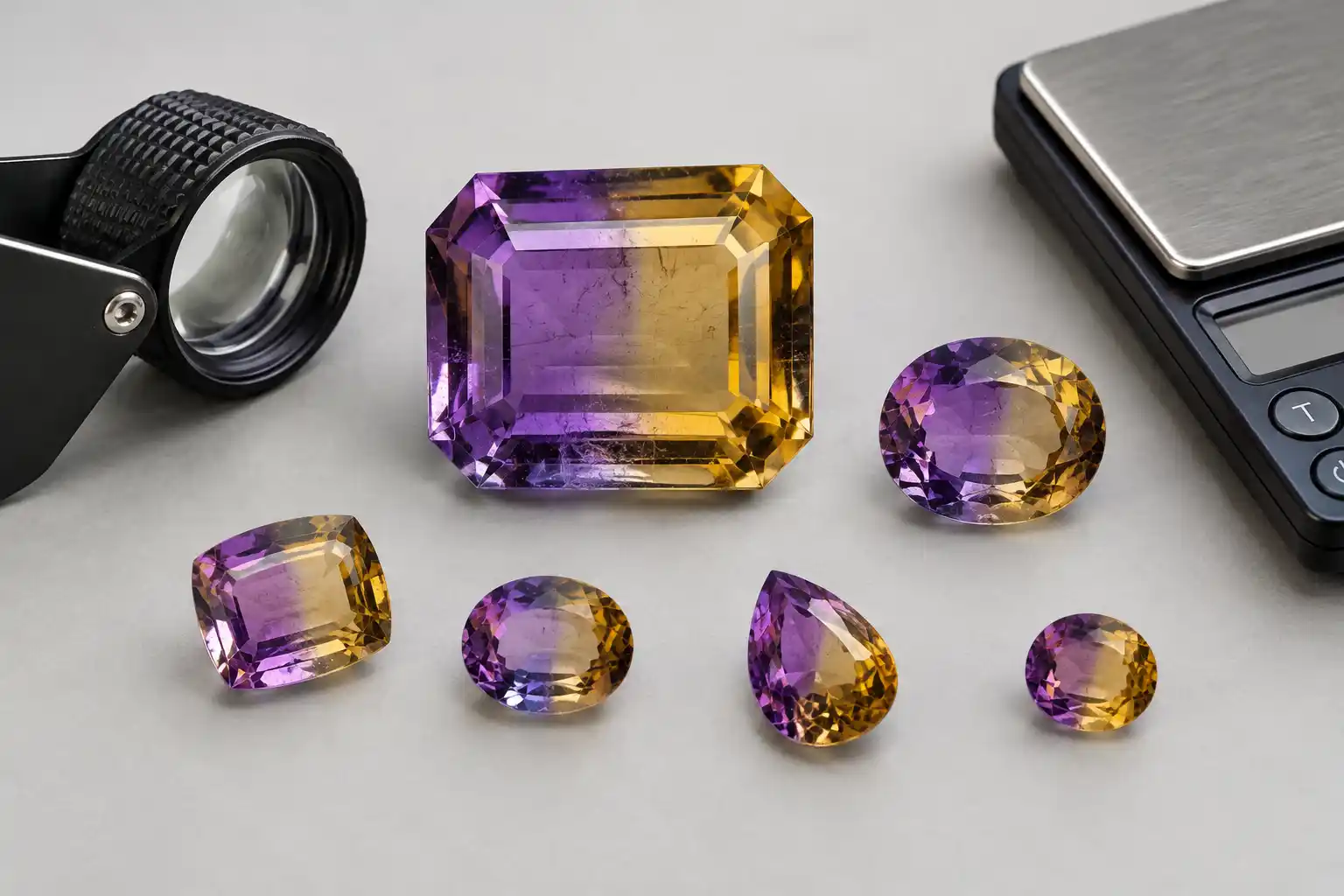
The defining feature is not simply that purple and yellow appear in the same stone. True ametrine is quartz displaying both amethyst and citrine coloration within one crystal. The most attractive gems make those two zones visually intentional, allowing the viewer to see a distinct violet region alongside yellow to golden citrine rather than a confusing mixture of pale brown, weak purple, and colorless quartz. Cutting has an unusually strong effect on value because the cutter determines whether the original zoning becomes a dramatic two-color composition or disappears into a poorly oriented blend.
Natural ametrine is strongly associated with Bolivia, particularly the Anahí deposit, which has supplied much of the world’s commercial natural ametrine. Geographic origin can add interest, but provenance should not override visible quality. A poorly cut Bolivian stone with weak zoning is still less desirable than a well-proportioned natural ametrine with vivid color separation. Buyers should also distinguish natural ametrine from synthetic bicolor quartz and treated products before paying a natural-origin premium.
10 Essential Factors That Determine Ametrine Price Per Carat
- Natural versus synthetic origin
- Strength of the violet amethyst color
- Quality of the yellow to golden citrine color
- Sharpness and attractiveness of color zoning
- Balance between the two color regions
- Clarity and transparency
- Cut orientation, symmetry, and brilliance
- Carat weight and face-up size
- Geographic origin and reliable provenance
- Treatment disclosure, craftsmanship, and market confidence
These ten factors should be considered together because ametrine does not gain value from size or clarity alone. A large crystal can be inexpensive when its colors are weak, while a smaller gem with vivid purple, bright yellow, precise zoning, and an intelligent cut can command a stronger The Price per carat.
Typical Ametrine Price Per Carat
Ametrine has no universally fixed market chart, and retail The Price varies according to cutting, seller, provenance, jewelry setting, and whether the gem is natural or synthetic. Broad loose-gem ranges are still useful for understanding the difference between commercial and fine material.
| Ametrine Quality | Approximate The Price Per Carat | Typical Appearance |
|---|---|---|
| Commercial quality | $3 to $8 | Pale colors, weak separation, ordinary cutting |
| Good jewelry quality | $7 to $15 | Visible purple and yellow, good transparency, acceptable zoning |
| Fine quality | $15 to $30 | Saturated colors, clear boundary, eye-clean, strong cut |
| Exceptional or precision-cut quality | $25 to $50+ | Rich violet and gold, balanced zoning, excellent symmetry and brilliance |
| Specialty collector or designer pieces | Highly variable | Unusual size, artistic cut, documented provenance, exceptional zoning |
These ranges are orientation rather than a guarantee of retail The Price. A custom-cut ametrine can sell well above ordinary per-carat levels because the buyer is paying for design, cutting labor, rough loss, and craftsmanship as well as the quartz itself.
Finished jewelry should also be separated from loose-gem valuation. Precious metal, diamonds, labor, designer branding, and retailer margins can raise the final The Price substantially even when the ametrine center stone is moderately priced.
1. Natural Ametrine Carries More Value Than Synthetic Bicolor Quartz
Natural ametrine forms when different areas within a quartz crystal develop amethyst and citrine coloration. Both colors involve iron-related defects within quartz, but the local structural and oxidation conditions differ enough for one region to appear violet while another becomes yellow or golden.
This natural partitioning is unusual enough to give ametrine a distinct identity within the quartz family. However, quartz can also be grown hydrothermally in laboratories, and synthetic bicolor material can be engineered to display attractive purple and yellow regions.
Synthetic ametrine can be chemically and structurally quartz, just as synthetic amethyst is still quartz, but its laboratory origin removes the geological rarity premium attached to natural stones.
Manufactured or treated quartz may also imitate ametrine-like effects. Some products use irradiation, heating, or combinations of treatment to develop or modify color zoning.
A buyer paying premium natural-ametrine rates should therefore establish whether the gem formed naturally. Visual inspection alone may not be enough for unusually clean or valuable stones because laboratory-grown quartz can be convincing.
2. The Violet Amethyst Zone Must Be Rich Enough to Matter
The purple half of an ametrine should display an attractive amethyst color rather than faint lavender that disappears under ordinary indoor lighting. Medium to strongly saturated violet generally creates stronger visual contrast against the yellow zone.
Tone needs balance. If the purple becomes excessively dark, it may produce extinction and look nearly black in portions of the stone. If it is too pale, the bicolor effect loses drama.
Reddish-purple or bluish-purple secondary impressions can both be attractive depending on the individual gem and lighting. Gray or brown modifiers usually reduce visual intensity when they become obvious.
The purple zone should also occupy enough of the visible face to contribute meaningfully. A large yellow gemstone containing only a tiny violet corner may technically contain both colors but will usually not display the balanced bicolor appearance collectors expect from fine ametrine.
3. Citrine Color Quality Matters Just as Much as Purple
The citrine portion can range from pale yellow through lemon, honey, golden yellow, and orange-yellow. A lively golden or clearly yellow zone generally creates stronger contrast with violet than an extremely pale or muddy brownish region.
The yellow should remain bright enough to transmit light. Very dark orange-brown areas may make the gem look heavy and reduce the clean complementary effect that makes ametrine distinctive.
Natural citrine coloration in ametrine forms within the same quartz crystal as the amethyst zone. The two colors are therefore not separate stones glued together when the gem is genuine natural ametrine.
Commercial treatments can complicate the picture. Heat can change amethyst into yellow, orange, brownish, greenish, or colorless quartz depending on its geological origin and defect structure. This is one reason treatment history matters when unusual color patterns are used to justify a premium.
4. Sharp Color Zoning Is One of the Biggest Value Factors
Ametrine becomes visually compelling when the violet and yellow regions are clearly distinguishable. A sharp or well-defined transition allows the viewer to appreciate both colors without needing to rotate the gem repeatedly to find them.
The boundary does not have to be perfectly straight. Natural crystals can show angular sectors, irregular interfaces, or multiple zones. What matters is whether the finished stone uses those zones attractively.
Weak, diffuse, or muddy transitions lower the visual impact. A gemstone that appears mainly brownish purple from normal viewing distance may be less desirable even when close inspection reveals separate yellow and violet sectors.
Cutters often study rough carefully before faceting because orientation determines whether the final crown displays a clean split, diagonal composition, checkerboard blend, or complex multi-zone pattern.
That makes color zoning both a natural feature and a cutting challenge, which is unusual compared with gemstones valued primarily for a single uniform color.
5. Balanced Purple and Yellow Areas Usually Command Stronger Demand
Many buyers prefer an ametrine in which both colors occupy substantial portions of the face. A roughly balanced composition gives the stone an obvious bicolor identity and can look especially effective in rectangular, emerald, cushion, fantasy, and custom cuts.
A perfect fifty-fifty division is not required. A sixty-forty composition can be equally attractive when the colors are strong and the cut uses the boundary intentionally.
Severely unbalanced stones tend to look more like amethyst with a small yellow patch or citrine with a purple corner. They may still be natural and beautiful but usually lose some of the characteristic visual appeal buyers expect.
Design can sometimes turn imbalance into an advantage. A skilled lapidary may use an asymmetric color boundary deliberately so the finished gem looks artistic rather than accidental.
This is one reason precision-cut ametrine can command a higher The Price than mass-produced stones even when both originated from comparable rough.
6. Eye-Clean Transparency Is Expected in Fine Faceted Ametrine
Ametrine is quartz, and clean quartz crystals are sufficiently available that fine faceted stones are generally expected to appear transparent and free from obvious distracting inclusions.
Natural features can include fluid inclusions, healed fractures, veils, crystals, growth structures, and internal stress features. Small inclusions visible only with magnification may have little effect on value.
Large fractures or clouds that interrupt the purple-yellow zoning are more significant because they reduce both transparency and color contrast.
Surface-reaching fractures deserve particular attention in jewelry. Quartz has a Mohs hardness of 7 and no cleavage, but strong impact can still cause damage, especially where fractures already weaken the stone.
Clarity should be judged face-up before magnification. A tiny internal feature that requires a loupe is generally less important than a large window caused by poor cutting or weak color visible immediately to the naked eye.
7. Cut Orientation Has an Exceptional Influence on Ametrine Value
Cut quality matters in every transparent gemstone, but ametrine presents an additional problem because the lapidary must display two different color regions simultaneously.
A stone cut perpendicular to an attractive natural boundary can create a clean side-by-side violet and yellow appearance. Different orientations can produce diagonal division, mixed flashes, or complex checkerboard patterns.
Poor orientation may hide one color almost entirely or blend both colors into a less attractive brownish or grayish impression.
Windowing is another common value problem. If pavilion angles are too shallow, the center may appear transparent and allow the background to show through. The effect reduces color intensity and can disrupt the bicolor composition.
Extinction can create overly dark sections, particularly in the purple area. A successful cut should return light from both zones rather than making one half lively and the other nearly black.
Symmetry, polish, facet junctions, and face-up proportions also matter. Precision cutters may deliberately position the dividing line as part of the design, giving high-end ametrine an artistic quality that ordinary commercial cutting lacks.
8. Carat Weight Matters Less Than Color Quality Until Size Becomes Exceptional
Quartz crystals can grow to substantial dimensions, so large ametrine is more accessible than large ruby, sapphire, or alexandrite. This limits the steep size premiums associated with scarcer gems.
A ten-carat ametrine can therefore remain affordable, particularly when the color is light or zoning is ordinary. The Price per carat may rise only modestly as weight increases.
Large fine stones become more valuable when strong violet and yellow zones remain saturated and balanced over the entire face. Producing a sizable stone without sacrificing clarity, color separation, or proportions requires more suitable rough.
Face-up dimensions should always be compared with carat weight. An overly deep stone can hide substantial weight beneath the girdle without appearing proportionately larger from the top.
For statement jewelry, this availability is one of ametrine’s advantages. Buyers can obtain a dramatic bicolor gemstone in substantial size without entering the price category of many rarer colored gems.
9. Bolivian Origin Can Add Interest When Provenance Is Reliable
Natural commercial ametrine is strongly associated with Bolivia, particularly the Anahí Mine. The deposit has produced quartz crystals containing naturally separated amethyst and citrine sectors and has played a major role in making ametrine widely available to the jewelry market.
Bolivian origin can therefore add provenance and collector interest. However, the word Bolivia should not be used as a substitute for evaluating the stone itself.
A poorly saturated or badly cut gem does not become fine quality simply because its origin is famous. Color strength, zoning, transparency, and cutting remain more important to everyday jewelry value.
Origin claims also need reasonable support when they are used to justify a premium. Loose quartz cannot always be assigned confidently to a mine by appearance alone.
Collector specimens with documented mine provenance can receive stronger origin premiums than ordinary faceted jewelry because locality is part of their scientific and collecting interest.
10. Treatment Disclosure and Craftsmanship Complete the Value Picture
Ametrine should be represented clearly as natural, synthetic, or treated when those categories are known. Hydrothermal synthetic quartz can display convincing bicolor zoning, while irradiation and heat may be used to alter the color of quartz.
Treatment does not necessarily make a gemstone unattractive. The problem arises when treated or synthetic material is represented as naturally zoned ametrine and priced accordingly.
Craftsmanship can create a separate premium. Fantasy cuts, precision faceting, concave designs, matched pairs, and expertly oriented stones may sell for substantially more than ordinary commercial ametrine.
The buyer is then paying for both the raw gemstone and the cutter’s ability to turn natural zoning into a deliberate visual composition.
For modest commercial stones, an expensive laboratory report may not be economically necessary. For high-value stones carrying strong natural-origin or provenance claims, independent gemological verification can provide greater confidence.
Natural Ametrine Versus Synthetic Ametrine
| Feature | Natural Ametrine | Synthetic Ametrine |
|---|---|---|
| Origin | Geological | Laboratory-grown |
| Mineral species | Quartz | Quartz when true synthetic ametrine |
| Color pattern | Naturally developed amethyst and citrine sectors | Color zoning produced during or after laboratory growth |
| Typical rarity | Limited natural sources | More controllable supply |
| Large clean stones | Available but dependent on suitable rough | Easier to produce |
| Collector value | Higher when natural and well documented | Generally lower |
| Identification | May require professional testing | May require advanced gemological examination |
Both can be attractive jewelry stones. Their value categories differ primarily because natural geological formation is much less controllable and more limited.
Does a Perfect 50/50 Color Split Make Ametrine More Valuable?
Not automatically. A balanced division is desirable, but exact numerical symmetry does not compensate for weak color, poor transparency, or bad cutting.
A gem with a sixty-forty split and vivid violet against bright golden yellow may be substantially more attractive than a mathematically perfect half-and-half stone whose colors are pale.
The boundary also needs to work with the facet pattern. A cut that interrupts the division in an awkward way can make the stone look less deliberate.
The strongest gems combine balance with saturation, brightness, clean transparency, and an effective design.
How to Compare Two Ametrines Before Buying
Place both gems under the same neutral lighting and look first at the color relationship. Determine whether both purple and yellow are attractive independently, then judge whether the transition is visually distinct.
Examine face-up transparency and search for large windows or extinction. Rotate the stones gently to see whether both colors remain visible or one disappears at ordinary viewing angles.
Compare dimensions rather than weight alone. A lighter but better-proportioned stone may appear larger than a deeper, heavier gem.
Only then consider origin, seller grades, or trade names. Visible beauty should justify The Price before provenance premiums are added.
Is Ametrine Rare Enough to Be an Investment?
Natural ametrine is geologically interesting and has limited important sources, but ordinary jewelry-quality stones are available enough that buyers should not treat them as guaranteed investments.
Retail The Price includes cutting, design, seller margin, and sometimes branding, none of which is guaranteed to be recovered during resale.
Exceptional precision-cut stones, important mineral specimens, documented provenance, and unusually fine large gems may develop stronger collector interest.
For most buyers, ametrine’s best value lies in obtaining a natural bicolor gemstone with dramatic appearance at a relatively accessible cost.
Caring for Ametrine Jewelry
Ametrine has the durability of quartz, with a Mohs hardness of 7 and no cleavage. It performs well in pendants, earrings, bracelets, and rings worn with reasonable care.
Strong impacts can still chip facet edges or damage stones containing significant fractures. Rings should be removed during heavy manual work, exercise involving equipment, or activities where the gem may strike hard surfaces.
High heat should be avoided because quartz color can be altered permanently under sufficient temperature. Prolonged exposure to intense sunlight may also affect some colored quartz.
Gentle cleaning with mild soap, lukewarm water, and a soft brush is normally sufficient for intact stones. Separate storage protects the surface from harder gems such as sapphire, topaz, and diamond.
Conclusion
Ametrine price per carat depends primarily on natural origin, the strength of both violet and yellow colors, zoning quality, color balance, transparency, cutting, size, provenance, and treatment disclosure. Commercial stones can remain inexpensive, while vivid eye-clean gems with a strong natural color boundary and precision cutting can command a much higher The Price per carat.
The best value is found by judging the entire bicolor composition rather than chasing carat weight. Fine ametrine should make both amethyst and citrine clearly visible, use the boundary intentionally, remain bright across the face, and be represented honestly as natural, synthetic, or treated. Those qualities explain why two stones of identical weight can belong to very different price categories.
FAQs About Ametrine Price Per Carat
How much does ametrine cost per carat?
Commercial ametrine may cost only a few dollars per carat, while good jewelry-quality stones often sell in higher single-digit or low double-digit ranges. Fine or precision-cut stones with strong color separation can reach several tens of dollars per carat or more.
Why is ametrine not as expensive as alexandrite?
Ametrine is quartz and can occur in relatively large crystals, while fine natural alexandrite is much rarer, especially at larger sizes. Alexandrite’s scarcity and dramatic light-dependent color change create a much stronger rarity premium.
What color ametrine is most valuable?
Fine stones usually combine saturated violet amethyst with lively yellow to golden citrine. Both colors should be attractive, and the transition between them should be easy to see.
Does a 50/50 purple and yellow split increase value?
Balanced zoning is desirable, but exact fifty-fifty division is not required. Saturation, brightness, clarity, and cutting are more important than mathematical symmetry alone.
Does larger ametrine cost more per carat?
Sometimes, but not dramatically in ordinary qualities. Quartz can occur in large crystals, so the per-carat premium for size is usually much smaller than it is for rare stones such as ruby or alexandrite.
Is Bolivian ametrine valuable?
Bolivia, especially the Anahí deposit, is strongly associated with natural ametrine. Reliable provenance can add interest, but visible color, zoning, clarity, and cut still determine most jewelry value.
Can ametrine be synthetic?
Yes. Hydrothermal synthetic quartz can be produced with amethyst and citrine-like zoning. Synthetic ametrine can be attractive but generally commands less value than comparable natural material.
Can ametrine be treated?
Quartz color can be altered by heating, irradiation, or combinations of processing. Buyers paying for naturally zoned ametrine should seek accurate disclosure when treatment status materially affects The Price.
Is ametrine valuable if the colors are pale?
Pale ametrine can still be attractive, but weak saturation generally lowers The Price compared with stones showing rich violet and strong yellow or golden coloration.
Does clarity matter in ametrine?
Yes. Fine faceted ametrine is generally expected to be eye-clean because clean quartz is available. Large fractures, clouds, or inclusions that disrupt the bicolor effect reduce quality.
Why are precision-cut ametrines more expensive?
Precision cutting can improve symmetry, brilliance, color balance, and the placement of the natural boundary. The cutter may sacrifice substantial rough to produce the design, so craftsmanship contributes directly to The Price.
Is ametrine good for everyday jewelry?
Ametrine has a Mohs hardness of 7 and no cleavage, making it suitable for many jewelry types with sensible care. Rings should still be protected from severe impacts and harder gemstones.
How can I tell natural ametrine from synthetic ametrine?
Appearance alone may not be enough, particularly in exceptionally clean stones. Microscopic growth features and advanced gemological testing may be needed when natural origin has significant value.
Is ametrine a good investment?
Ordinary ametrine should not be treated as a guaranteed financial investment. Exceptional natural stones, precision-cut gems, and documented collector specimens may have stronger specialized demand, but most buyers should choose ametrine primarily for beauty.
What makes an ametrine worth more?
Strong complementary color, a clear and attractive boundary, balanced zoning, eye-clean transparency, effective cut orientation, natural origin, good face-up dimensions, and reliable provenance can all increase value.