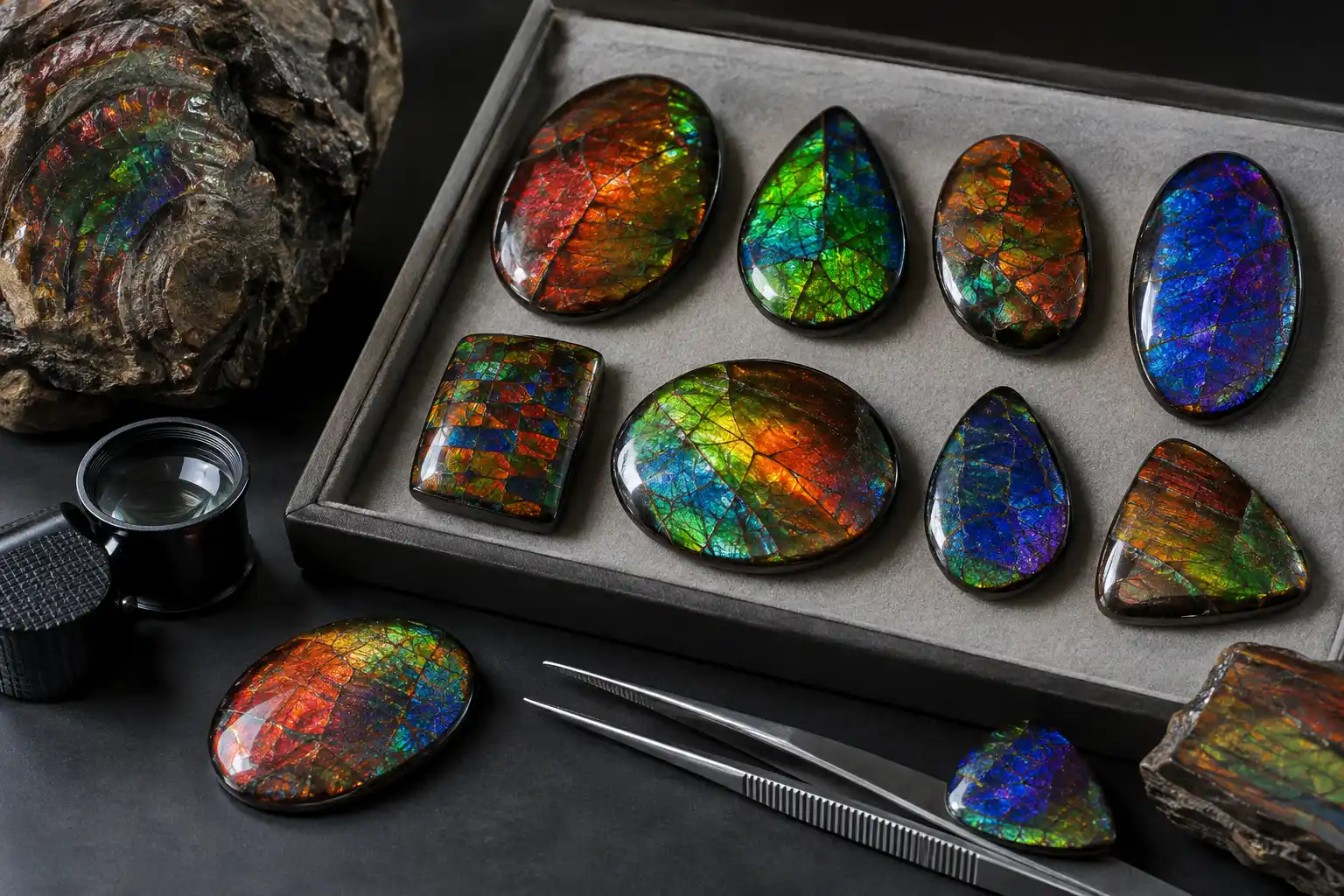
Ammolite Quality Grading: 7 Essential Criteria for Iridescent Gems
Ammolite quality grading is centered on iridescence rather than conventional transparency or faceted-gem clarity. Fine ammolite should display bright spectral colors across a substantial portion of its face, react attractively as the viewing angle changes, show a visually compelling pattern, and remain structurally stable enough for its intended use. Blue and violet can contribute substantial rarity, but a vivid red-green stone with exceptional brightness may still outrank a dull piece containing technically rarer colors.
Ammolite is an organic gemstone formed from preserved ammonite shell, with the iridescent layer consisting largely of aragonitic shell structure. Commercial gem-quality material is most strongly associated with southern Alberta, Canada. The layers responsible for color can be extremely thin and fragile, which is why stabilization, backing, doublet construction, and protective triplets are common. Quality grading therefore needs to consider both optical beauty and the engineering used to make the gem wearable.
There is no single globally standardized ammolite scale comparable with diamond’s formal grading systems. Sellers may use letter grades such as A, AA, AAA, premium, extra fine, or investment quality, but definitions can vary. A more reliable assessment examines brightness, visible color range, chromatic shift, color coverage, pattern, structural condition, and construction separately.
7 Essential Criteria for Ammolite Quality Grading
- Verify natural ammolite and identify its construction
- Grade brightness and intensity of iridescence
- Evaluate the range and quality of visible colors
- Assess chromatic shift through changing viewing angles
- Judge color distribution, coverage, and pattern
- Inspect cracking, thickness, stability, and surface condition
- Evaluate treatment, craftsmanship, size, and provenance
These seven criteria should be considered together. Ammolite can be visually spectacular while structurally delicate, so the best grade is not merely the stone with the greatest number of colors. It also needs a stable, attractive, accurately represented form.
Criterion 1: Confirm Natural Ammolite and Identify the Construction
Quality grading begins with identity. Genuine ammolite contains iridescent fossil ammonite shell, but jewelry may present that natural layer in several forms.
A solid stone contains the natural fossil shell layer and its natural supporting structure without an added transparent protective cap. Fine solid ammolite is relatively uncommon because the iridescent layer can be thin and fragile.
Stabilized ammolite has been strengthened by impregnation with resin or a similar substance. Stabilization allows otherwise vulnerable natural shell to survive cutting and normal jewelry use.
A doublet combines natural ammolite with a backing that supports the thin shell. A triplet goes further by adding a transparent protective cap above the iridescent layer.
These constructions should not be treated as defects when disclosed honestly. They solve a genuine durability problem inherent to the gem.
They do, however, belong to different rarity categories. A premium solid gem and a visually similar triplet may display equally strong color, yet the quantity and structural form of natural ammolite differ substantially.
Imitations using films, painted surfaces, resin, coated glass, or synthetic iridescent products must be separated before any natural-ammonite rarity grade is assigned.
Ammolite Construction and Quality Interpretation
| Construction | What the Buyer Sees | Grading Consideration |
|---|---|---|
| Solid ammolite | Natural shell surface | Highest natural rarity potential, more vulnerable |
| Stabilized ammolite | Natural shell strengthened internally | Good compromise between authenticity and durability |
| Doublet | Natural ammolite on backing | Durable support, disclose construction |
| Triplet | Backing, ammolite, transparent cap | Strong protection, total weight includes other substances |
| Imitation | Manufactured iridescent appearance | Not graded as natural ammolite |
Construction should be identified before comparing weight, durability, or The Price.
Criterion 2: Brightness Is the Foundation of Fine Ammolite
Brightness describes how strongly the spectral colors appear when illuminated. Top-quality ammolite should look vivid and lively rather than muted or obscured.
The effect changes with direction, so brightness needs to be examined while the stone is tilted. A piece that shows exceptional fire from one angle but becomes almost colorless immediately afterward should be considered differently from one that remains bright through a wider range.
Surface condition also influences brightness. Scratches on uncapped ammolite, deteriorated resin, poor polishing, or a damaged transparent cap can reduce the apparent intensity.
A dark backing is often used deliberately because it improves contrast and makes thin iridescent colors more visible. This does not mean the color itself is painted or artificial when the construction is properly disclosed.
The grader should evaluate whether brightness originates from a genuine natural ammolite layer and whether the visual result remains convincing in realistic lighting rather than only under intense directional display lamps.
Criterion 3: Grade the Number and Quality of Visible Colors
Ammolite can display red, orange, yellow, green, blue, violet, and transitional hues. Stones showing a broad range of vivid colors are generally more desirable than pieces limited to one ordinary hue.
Color count should not become a simplistic checklist. The quality of each visible color matters.
Bright blue and violet can be particularly desirable because large vivid regions of these colors are less commonly encountered than red and green. Their presence can therefore raise a stone’s grade when brightness and coverage are strong.
Red, orange, and green remain highly attractive and can create exceptional stones when saturation is intense and pattern is compelling.
A dull rainbow does not automatically outrank a brilliant two-color stone. The best evaluation considers saturation, brightness, rarity, and how harmoniously the colors interact.
A Practical Ammolite Color-Range Framework
| Visible Color Display | General Quality Tendency |
|---|---|
| Bright red, orange, yellow, green, blue and violet | Exceptional multicolor potential |
| Several vivid colors including blue or violet | Fine to exceptional |
| Strong red, orange and green | Fine when bright and well distributed |
| One or two moderate colors | Good to commercial |
| Dull, brownish or weakly visible colors | Lower quality |
This framework is descriptive rather than a universal laboratory grading system.
Criterion 4: Chromatic Shift Should Be Judged Through Movement
Ammolite’s beauty is dynamic. As the viewing angle changes, interference conditions within the thin shell layers change as well, which can cause visible hues to shift.
Some stones show dramatic transformations through several colors. Others display similar colors over a wide angle with only subtle change.
Both behaviors can be attractive, but strong controlled chromatic shift usually increases visual interest.
The grader should move the stone through horizontal and vertical angles under a stable light source. This reveals how long each color remains visible and whether new colors emerge smoothly.
Photographs cannot capture this quality completely because they freeze one orientation. Short videos are more useful but can still be affected by camera processing and artificial saturation.
In person, fine ammolite should feel animated as it moves without requiring the observer to hunt constantly for a single perfect flash.
Criterion 5: Color Coverage and Pattern Determine the Face-Up Composition
The amount of surface carrying bright color strongly influences grade. A fine stone should generally show iridescence across most of the visible face rather than only along a narrow edge.
Natural matrix, fracture lines, and dark regions are not automatically undesirable. They can create distinctive patterns that give each gem individuality.
Some ammolite shows broad uninterrupted color fields, while other pieces display mosaics, scale-like networks, ribbons, flames, feather-like areas, or fractured stained-glass appearances.
Pattern names are not universally standardized and should not be mistaken for formal grades. What matters is whether the visual structure is balanced, distinctive, and attractive.
A stone with complex natural cracking can be excellent if the individual regions remain stable and brilliantly colored. A similar crack network becomes a durability problem if layers are lifting or separating.
The best pattern integrates the fossil structure into the design rather than looking damaged or chaotic.
Pattern Should Be Graded With Color, Not Separately
A dramatic pattern cannot rescue weak color completely. Likewise, brilliant color may still be highly valuable even when the pattern is simple.
Broad-flash stones can look exceptionally intense because large areas reflect one color simultaneously. Mosaic patterns can create greater complexity because each small region interacts with light differently.
Fine-quality evaluation asks how pattern affects the overall movement of color. Does it create depth and visual rhythm, or does it break the surface into dull fragments?
Pattern also influences cutting decisions. A good lapidary positions the strongest visual area in the center of the finished cabochon and removes unstable margins without unnecessarily sacrificing valuable color.
Criterion 6: Structural Stability Is Essential in a Thin Fossil Gem
Ammolite’s iridescent layer is composed largely of aragonitic shell structure and is relatively soft, roughly around 3.5 to 4 on the Mohs scale. The usable layer may also be extremely thin.
As a result, structural quality deserves more attention than it would in many tougher gemstones.
The grader should examine open fractures, delamination, lifting edges, flaking, weak matrix, and damage around the girdle. Fine natural crack patterns are acceptable when stable, but loose layers create a real durability concern.
Thickness also matters. A thicker intact layer can be more resistant to damage and may permit polishing without immediately cutting through the iridescent surface.
Stabilization can strengthen fragile natural ammolite. It should be disclosed, but a professionally stabilized stone may be more practical for jewelry than an untreated piece at constant risk of flaking.
Triplets protect the surface especially well because a transparent cap separates the soft fossil layer from routine abrasion.
Surface Condition Changes With Construction
An uncapped solid gem should be inspected directly for scratches, polish quality, abrasion, pits, and surface fractures.
A triplet requires a slightly different approach because the observer is looking through a transparent cap. Scratches on that cap affect appearance even when the natural ammolite below remains intact.
Adhesive layers should also be examined for bubbles, separation, cloudiness, or discoloration.
A well-made assembled gem should look integrated. Poorly fitted layers or visible adhesive problems lower quality even when the natural ammolite itself is beautiful.
This is why craftsmanship needs to be considered alongside fossil rarity.
Criterion 7: Treatment, Craftsmanship, Size, and Provenance Complete the Grade
Stabilization, backing, and capping are practical responses to ammolite’s fragility. They should not be hidden.
A quality description should state whether the stone is solid, stabilized, a doublet, or a triplet. Buyers can then decide whether natural rarity or jewelry durability is more important for their purpose.
Cut quality matters because the usable color layer is so thin. The lapidary must preserve color, remove unstable sections, shape the gem symmetrically, and create a secure edge without cutting through the valuable shell.
Face-up dimensions are generally more useful than carat weight when evaluating assembled stones because backing and caps contribute additional mass.
Provenance can add confidence. Fine gem ammolite is particularly associated with southern Alberta, Canada, and reliable mine or supplier documentation can strengthen collector interest.
For fossil specimens rather than jewelry cabochons, provenance becomes even more important because geological locality and completeness of the ammonite can form part of the object’s value.
Ammolite Color Versus Opal Play-of-Color
Ammolite and precious opal can both display vivid spectral colors, but they produce those colors through different structures.
Ammolite’s iridescence comes from interference within thin layers of fossil shell structure, largely associated with aragonite. The effect can shift dramatically with viewing direction.
Precious opal produces play-of-color through diffraction involving ordered arrays of microscopic silica spheres.
The visual resemblance can be striking, but the gemstones are compositionally and structurally different.
Using the general phrase color play to describe ammolite’s appearance is understandable in ordinary language, but gemologically its defining effect is more precisely described as iridescence.
How Blue and Violet Influence Ammolite Quality Grades
Blue and violet are highly sought after because strong areas of these colors are comparatively uncommon in commercial ammolite.
Their presence is particularly valuable when they are bright and occur across a useful portion of the gem.
A tiny violet flash visible only at an extreme angle should not receive the same grading importance as a broad vivid violet region that remains visible during normal movement.
Color rarity also needs to be balanced against overall beauty. An exceptional red-green-orange stone can outperform a weak blue specimen in practical quality.
The finest multicolor pieces combine rarity and brightness rather than sacrificing one for the other.
Does More Cracking Mean Lower-Quality Ammolite?
Not necessarily. Natural fracture networks can create some of ammolite’s most distinctive patterns.
The question is whether the cracks are stable. Sealed or naturally stable pattern boundaries can divide the surface into brilliant colored regions without threatening the integrity of the stone.
Open fractures, lifting flakes, loose shell, or delamination are different because they can lead to physical loss.
A triplet or stabilization process may secure a cracked but visually exceptional layer, making it suitable for jewelry while preserving the pattern.
The grader should therefore distinguish aesthetic cracking from structural failure.
Why Carat Weight Is a Weak Standalone Grading Tool
Carat weight measures mass, but ammolite’s valuable layer can be very thin. In doublets and triplets, much of the total weight may come from the backing or cap.
Two stones of identical dimensions can therefore have very different weights without one containing substantially more visible ammolite.
Quality grading should prioritize face-up dimensions, brightness, colors, shift, pattern, and stability.
Carat weight becomes more meaningful when comparing two solid stones of similar construction, but even then it should not override optical quality.
This is one reason professional ammolite descriptions often emphasize millimeter dimensions alongside weight.
Common Ammolite Grading Mistakes
A frequent mistake is treating every rainbow-colored piece as top quality. Brightness and usable face-up coverage matter just as much as the number of colors.
Another is assuming that cracks automatically indicate low quality. Stable natural patterns can be highly attractive, while hidden delamination is far more serious.
Buyers may also compare a triplet and a solid gem solely by carat weight, even though the triplet includes non-ammolite components.
Seller-defined letter grades create another source of confusion. An AA stone from one company may not match an AA stone from another because there is no single universally enforced standard.
Finally, static photographs can exaggerate quality by capturing the one angle where every color appears strongest.
A Practical Overall Ammolite Quality Framework
| Quality Level | Typical Characteristics |
|---|---|
| Exceptional | Very bright, broad spectral range, strong shift, excellent coverage, compelling pattern, stable structure |
| Fine | Strong brightness, several vivid colors, attractive movement, good pattern and workmanship |
| Good | Attractive red-green or multicolor display, moderate brightness, some matrix or structural limitations |
| Commercial | Limited color range, moderate or weak brightness, simple pattern, heavy backing or treatment |
| Low | Dull color, unstable shell, poor surface condition, weak coverage, questionable construction |
This framework is descriptive rather than an official global scale. It is useful because every judgment can be connected to visible qualities rather than an unexplained marketing letter.
Ammolite Jewelry Suitability and Care
Ammolite is softer and structurally more delicate than quartz, topaz, sapphire, or diamond. Solid uncapped stones need particularly careful use.
Pendants and earrings generally experience less impact than rings. A ring can still be practical when the ammolite is stabilized or capped and protected by a well-designed bezel or similar setting.
Harsh chemicals, steam, prolonged soaking, and high heat should be avoided because ammolite jewelry may contain resin, adhesive, backing, or a protective cap in addition to natural fossil shell.
A soft damp cloth is generally the safest routine approach. Separate storage is essential because harder gemstones can scratch exposed ammolite quickly.
The construction should be understood before any cleaning method is chosen.
Conclusion
Ammolite quality grading depends on natural identity, construction, brightness, visible color range, chromatic shift, surface coverage, pattern, structural stability, craftsmanship, treatment, size, and provenance. The most impressive gems remain vivid as they move, display several attractive spectral colors, and use natural fossil structures as part of a stable visual design.
No single seller-defined AAA or premium label can replace those observations. Buyers who determine whether the stone is solid, stabilized, a doublet, or a triplet and then evaluate brightness, color movement, pattern, and condition can judge ammolite far more consistently. That approach separates genuine high-quality iridescent fossil gems from pieces whose apparent grade depends mostly on marketing.
FAQs About Ammolite Quality Grading
What is the most important ammolite quality factor?
Brightness is one of the most important factors because vivid iridescence defines the gemstone’s visual appeal. Color range, chromatic shift, coverage, pattern, and structural stability then refine the grade.
What colors are best in ammolite?
Bright multicolor stones are highly desirable, particularly when blue or violet appears alongside red, orange, yellow, and green. Strong red-green stones can also be excellent when brightness and pattern are exceptional.
Is blue ammolite automatically top grade?
No. Blue is relatively uncommon and desirable, but a dull blue stone can grade below an intensely bright red-green piece. Brightness, coverage, pattern, shift, and stability must all be considered.
Is AAA ammolite an official grade?
No single universally standardized AAA system governs the entire ammolite market. Individual sellers and producers may define letter grades differently, so observable quality should be examined directly.
Are cracks bad in ammolite?
Not always. Stable natural fracture patterns can produce attractive mosaic or scale-like designs. Open fractures, delamination, flaking, and unstable layers are the more serious quality problems.
What is the difference between solid and stabilized ammolite?
Solid ammolite uses the natural fossil shell structure without resin impregnation, while stabilized ammolite has been strengthened with resin or a similar substance. Stabilization improves durability and should be disclosed.
Is an ammolite triplet lower quality than a solid stone?
It belongs to a different construction category rather than being automatically poor quality. A triplet can show exceptional color and provide excellent durability, but fine solid ammolite has a stronger natural-rarity premium.
What is chromatic shift in ammolite?
Chromatic shift is the visible change in color as the stone or viewing angle moves. Strong, attractive shifts through several colors can increase visual quality.
Should ammolite be transparent?
No. Ammolite is generally valued for iridescent surface color rather than transparency. Applying a diamond-like clarity standard would be inappropriate.
What causes ammolite’s iridescence?
The colors arise from interference of light within extremely thin layers of preserved ammonite shell structure, largely composed of aragonitic layers.
Does carat weight matter in ammolite grading?
Only to a limited extent. In doublets and triplets, backing and caps contribute to total weight, making face-up dimensions and optical quality more useful than carat weight alone.
How should I inspect ammolite before buying?
View it under stable lighting while tilting it through several angles. Check brightness, number of colors, chromatic shift, face-up coverage, pattern, cracks, surface condition, construction, and treatment disclosure.
Can ammolite be imitated?
Yes. Coatings, synthetic films, resin, painted layers, glass, and other manufactured products can imitate its colorful appearance. Valuable purchases should establish that the iridescent layer is genuine fossil ammolite.
Is Canadian origin important for ammolite?
Yes, particularly because southern Alberta is the major commercial source associated with gem-quality ammolite. Reliable provenance can add collector confidence, although visible quality still determines much of the gem’s desirability.
Is ammolite durable enough for daily wear?
Capped or stabilized ammolite can perform well in carefully designed jewelry, but exposed natural shell is relatively soft. Rings need more protection than pendants or earrings.
How should high-quality ammolite be stored?
Store it separately from harder gemstones in a padded compartment or pouch. Avoid high heat, harsh chemicals, steam cleaning, abrasion, and conditions that could damage resin, adhesive, backing, caps, or exposed fossil shell.