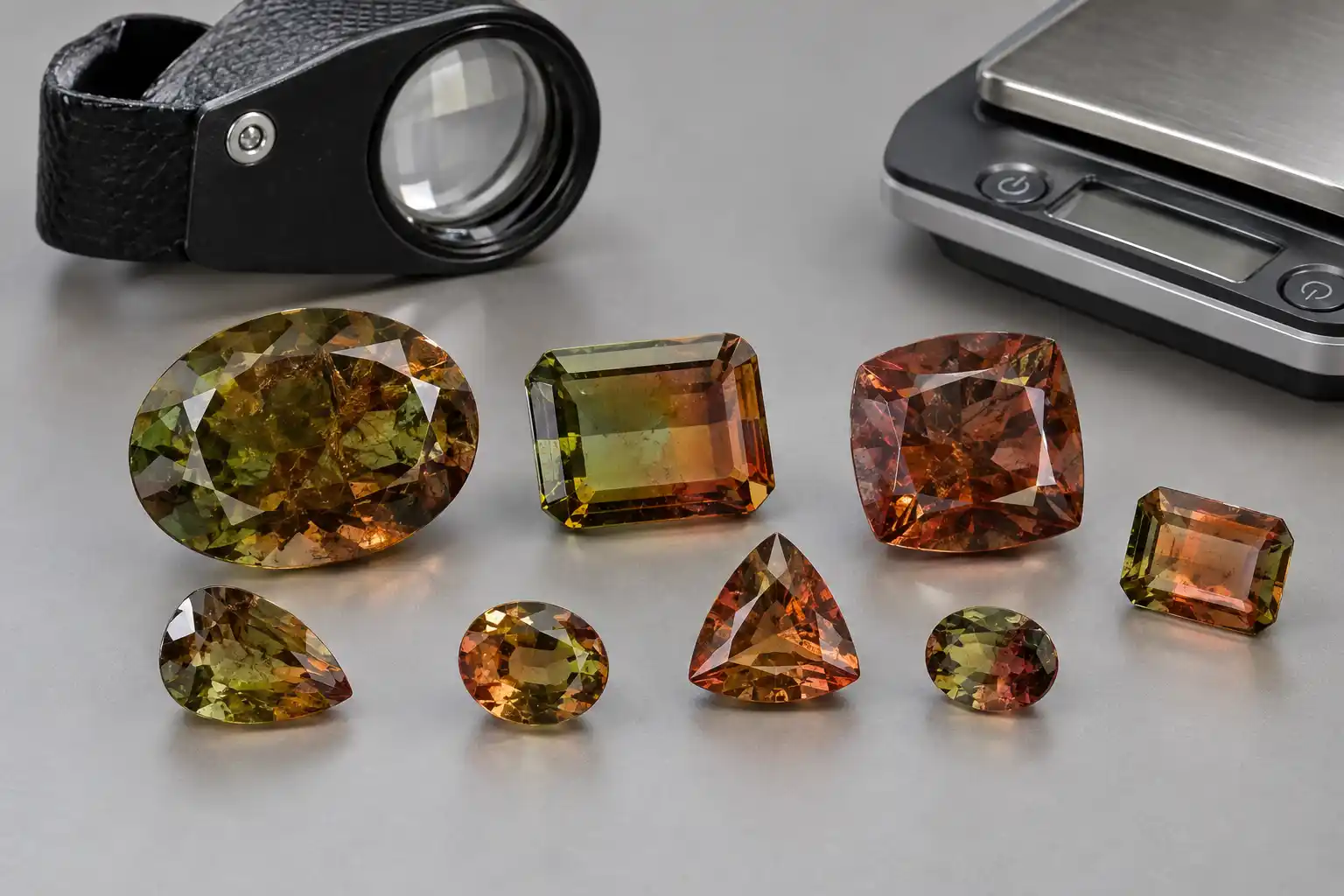
Andalusite Price Per Carat: 8 Value Drivers for This Pleochroic Gem
Andalusite Price per carat is generally moderate compared with ruby, sapphire, emerald, or alexandrite, but attractive faceted stones can become considerably more valuable when they combine strong pleochroism, appealing green and reddish-brown colors, high transparency, good cutting, and a size that is difficult to obtain in clean gem quality. Commercial stones may sell for roughly $10 to $30 per carat, while stronger jewelry-quality gems often fall around $30 to $80 per carat. Fine stones with vivid multicolor appearance, good clarity, and skilled orientation may reach roughly $80 to $200 per carat or higher, particularly when larger sizes retain excellent color and transparency.
The unusual appeal of andalusite comes from pleochroism. A single crystal can transmit noticeably different colors along different crystallographic directions, commonly including green, yellow-green, reddish brown, orange-brown, and brown. A skilled cutter can orient the rough so several of these colors appear simultaneously in the face-up gem. This effect is different from the light-source-dependent color change seen in alexandrite and different again from the play-of-color seen in precious opal.
Carat weight alone therefore tells very little about andalusite value. A large brown stone with weak visible pleochroism can be worth less per carat than a smaller gem that shows a lively mixture of green and reddish tones. Color orientation, brightness, clarity, cut, size, origin, treatment status, and market demand all influence the final Price.
8 Value Drivers Behind Andalusite Price Per Carat
- Strength and attractiveness of pleochroic colors
- Face-up balance between green, brown, orange, and red tones
- Transparency and clarity
- Cut orientation and brilliance
- Carat weight and rarity of larger clean stones
- Geographic origin and reliable provenance
- Treatment status and natural identity
- Craftsmanship, setting quality, and market demand
These eight factors should be evaluated together because andalusite is primarily a visual gemstone. A gem that displays several attractive pleochroic colors across the crown can command a stronger Price than a larger stone whose orientation hides most of the optical effect.
Typical Andalusite Price Per Carat
Andalusite does not have a universally standardized Price chart, and retail figures vary with location, seller margins, cutting quality, jewelry setting, and whether the stone is sold loose or mounted. Broad ranges are still useful for understanding how ordinary stones differ from fine examples.
| Andalusite Quality | Approximate Price Per Carat | Typical Characteristics |
|---|---|---|
| Commercial quality | $10 to $30 | Brown-dominant color, moderate clarity, ordinary cut |
| Good jewelry quality | $30 to $80 | Visible pleochroism, attractive green-brown mix, good transparency |
| Fine quality | $80 to $150 | Strong multicolor face-up effect, eye-clean appearance, skilled cut |
| Exceptional larger stones | $150 to $250+ | Strong green and reddish tones, high transparency, larger clean size |
| Specialty precision-cut gems | Highly variable | Exceptional orientation, custom faceting, artistic design, provenance |
These ranges are most useful when comparing natural loose stones of similar type. Finished jewelry can cost much more because the Price also includes metal, labor, side stones, designer branding, and retailer margin. A precision-cut andalusite may also exceed ordinary per-carat levels because part of the Price reflects skilled lapidary work rather than rarity of the rough alone.
Strong Pleochroism Is the Main Reason Fine Andalusite Costs More
Pleochroism occurs when an anisotropic crystal absorbs light differently along different crystallographic directions. Andalusite can show distinct green, yellow-green, orange, reddish brown, and brown components depending on orientation. Because several colors can appear within one faceted stone at the same time, the effect creates a complex visual appearance without requiring treatment or a change in illumination.
Fine andalusite should reveal more than a flat brown body color. The most desirable stones often display a visible interplay between green and warmer red-brown or orange-brown regions, especially when those colors remain bright enough to distinguish easily. If the stone is dominated by muddy brown with only tiny green flashes near the edges, the pleochroic effect contributes much less to value.
Cutting orientation determines how much of this natural optical property is visible. The cutter must study the rough before faceting because positioning the table incorrectly can suppress the green direction or allow one dark brown component to dominate. A smaller stone sacrificed from the rough to obtain superior orientation may therefore be more valuable than a heavier stone cut primarily for weight retention.
Green and Reddish Tones Usually Create the Most Desirable Face-Up Appearance
Many andalusites contain brown, and brown itself is not a defect. The question is how the warmer brown, red-brown, and orange tones interact with green or yellow-green. Stones that show several distinct colors tend to be more visually interesting and can command stronger demand than gems that appear uniformly brown.
Green is particularly important because a recognizable green component creates greater contrast with reddish or brownish areas. A well-cut stone can produce an almost mosaic-like distribution of colors through its facets, even though the effect comes from directional absorption rather than separate color zones in the crystal.
Very dark stones can lose much of this distinction. When tone becomes too deep, large areas may appear nearly black, especially in indoor lighting. Conversely, extremely pale stones can lack enough saturation to produce a dramatic multicolor face-up effect. Fine quality usually sits between those extremes, preserving both identifiable color and useful light return.
Lighting also changes how the colors are perceived even though andalusite is not classically a color-change gemstone. Warm indoor illumination may emphasize orange and red-brown components, while cooler daylight can make green more apparent. Buyers should therefore inspect the stone in more than one realistic lighting environment before judging value.
Clarity Matters Because Fine Faceted Andalusite Should Remain Transparent
Andalusite can contain mineral crystals, needles, fractures, veils, and other inclusions. Some inclusions are useful to gemologists because they provide information about natural origin, but they can lower jewelry value when they interrupt transparency or dominate the center of the stone.
Fine faceted andalusite is generally expected to appear reasonably clean to the unaided eye. Minor inclusions visible only with magnification are far less important than a large central fracture or cloudy area that interferes with brilliance.
Clarity becomes especially important because the pleochroic effect depends on light passing through the gem and returning from multiple directions. Heavy inclusions can mask the interaction between green and warmer colors, making the stone look dull even when the underlying crystal orientation is favorable.
Andalusite has a Mohs hardness of about 7 to 7.5, giving it useful resistance to scratching, but hardness should not be confused with invulnerability. A stone containing significant fractures can still chip or break under impact. Surface-reaching fractures deserve additional attention when the gem is intended for a frequently worn ring.
Cut Quality Has an Unusually Strong Effect on Andalusite Value
A good andalusite cut needs to accomplish more than basic symmetry. It must orient the pleochroic directions so the most attractive colors contribute to the face-up design while still maintaining adequate brilliance.
Rectangular cushions, emerald-style shapes, ovals, rounds, and specialty cuts can all work, but different shapes emphasize the colors differently. Some cutters deliberately use complex facet patterns to create a patchwork of green, orange, and reddish-brown reflections.
Windowing lowers value because a shallow pavilion can create a transparent central area through which the background becomes visible. This weakens both brilliance and apparent saturation. Excessive extinction creates the opposite problem, producing large dark areas that conceal the pleochroic display.
Symmetry and polish also matter. Crisp facet junctions and smooth polishing allow light to move cleanly through the gem. Because andalusite is less commonly encountered in mainstream jewelry than amethyst or topaz, fine precision cutting can make a noticeable difference to both appearance and Price.
Larger Clean Andalusite Can Command a Real Size Premium
Andalusite is not extraordinarily rare as a mineral, but transparent gem-quality rough suitable for attractive faceting is much less common. Larger stones that retain high clarity and strong pleochroic color become increasingly difficult to obtain.
Small and medium jewelry stones can therefore remain affordable, while larger clean gems with desirable orientation may carry a stronger Price per carat. The increase is not necessarily as steep as it is for alexandrite or fine ruby, but size becomes meaningful when all other qualities remain high.
A large stone should still be judged by face-up dimensions rather than weight alone. Excessive pavilion depth can hide weight below the girdle, creating a five-carat gem that looks surprisingly small compared with a well-proportioned four-carat stone.
For buyers seeking value, a slightly smaller gem with stronger green-red contrast and better proportions can be a better purchase than a larger brown-dominant stone.
Geographic Origin Can Add Interest Without Replacing Visible Quality
Gem-quality andalusite has been found in several regions, including Brazil, Sri Lanka, East Africa, and other localities. Different deposits can produce variations in color, clarity, crystal habit, and inclusions, but origin is rarely the primary Price driver for ordinary jewelry.
A well-cut andalusite should be judged first by visible pleochroism, transparency, brightness, and craftsmanship. A famous or interesting locality cannot transform a dark, heavily included stone into fine gem quality.
Provenance matters more strongly for collectors. A crystal specimen from a documented mine may be valued for its locality, crystal form, associated minerals, or geological importance even if it is not suitable for cutting.
For faceted gemstones carrying a meaningful origin premium, sellers should provide reasonable evidence rather than inferring locality solely from color.
Treatments Are Not a Major Feature of the Andalusite Market
Andalusite is generally valued for its natural pleochroic appearance, and routine treatments are not as central to its market as heat treatment is for sapphire or aquamarine.
This relative lack of common enhancement can be appealing to buyers who want a natural-color gemstone. It does not eliminate the need for accurate identification, however, because other brown, green, or pleochroic stones can resemble aspects of andalusite.
Cordierite, tourmaline, certain garnets, glass, and other substances can produce superficially similar colors. Gemological properties such as refractive index, birefringence, specific gravity, optical character, and spectrum can help separate them.
Synthetic andalusite is not a major mainstream jewelry product, but an expensive stone should still be sold with clear natural identity. A seller should not rely only on the unusual color mix as proof.
Andalusite Price Versus Other Brown and Green Gemstones
Andalusite occupies an interesting position because it offers several natural colors within one stone without requiring the high Price of fine alexandrite or rare multicolor sapphire. It can therefore appeal to buyers who want something unusual but still wearable.
Compared with smoky quartz, andalusite usually carries a stronger rarity and optical premium when pleochroism is attractive. Compared with tourmaline, pricing can overlap widely because both groups contain many quality levels and colors.
Fine green garnets are usually more expensive, while ordinary brown zircon or quartz may be less expensive. The key distinction is that andalusite’s identity is closely connected with its directional multicolor effect.
A buyer should therefore compare andalusite primarily with other well-cut andalusites rather than assuming that all brown-green gems belong to the same market category.
How to Compare Two Andalusites Before Buying
Begin by placing both stones under the same neutral lighting and view them face-up without magnification. Look at how much green, red-brown, orange, and yellow appears and whether those colors create an attractive pattern across most of the crown. A stone that looks lively immediately is usually more desirable than one whose green component appears only when tilted to an unusual angle.
Next compare transparency and brilliance. Large windows, black extinction areas, cloudy inclusions, or surface-reaching fractures should be easy to identify before a loupe is used. Then examine cut symmetry and face-up dimensions to determine whether the carat weight has been used efficiently.
Finally, consider origin, documentation, and seller descriptions. Terms such as top pleochroism, collector color, or premium grade have no universal standard. The visible gemstone needs to justify the Price before marketing terminology is given much weight.
Is Andalusite Rare Enough to Collect?
Transparent andalusite is uncommon enough to interest colored-gem collectors, particularly in larger sizes with strong multicolor appearance. It is not among the rarest gemstones overall, but its distinctive pleochroism gives fine stones a specialized appeal.
Collector value becomes stronger when a faceted gem combines unusual size, high transparency, attractive color separation, precision cutting, and documented provenance. Natural crystals with good form and locality can also have mineral-specimen value independent of their suitability for jewelry.
Most commercial andalusite should still be purchased for visual appeal rather than as a guaranteed financial investment. Secondary-market liquidity is limited compared with diamond, ruby, or sapphire, and retail margins may not be recovered during resale.
Its strongest advantage is the ability to obtain a naturally multicolored gemstone with good durability at a relatively approachable Price.
Andalusite Durability and Long-Term Jewelry Value
With a Mohs hardness around 7 to 7.5, andalusite can perform well in earrings, pendants, brooches, bracelets, and carefully worn rings. It resists ordinary scratching better than softer gems such as opal, pearl, or fluorite.
The stone should still be protected from sharp impacts, especially when it contains fractures or has exposed corners. Protective ring settings can reduce the risk of chipping.
Cleaning with lukewarm water, mild soap, and a soft brush is generally appropriate for intact natural stones. High heat and aggressive cleaning are unnecessary, and heavily fractured gems deserve gentler treatment.
Separate storage is advisable because harder gems such as sapphire, topaz, and diamond can scratch andalusite. Good care preserves both polish and the crisp facet edges that help the pleochroic colors remain visually sharp.
Conclusion
Andalusite Price per carat is determined less by weight alone than by the quality of its pleochroic display. Fine stones combine visible green, reddish-brown, orange, and yellow components with good transparency, balanced tone, effective cutting, and enough size to showcase the optical effect without becoming overly dark. Commercial stones can remain inexpensive, while larger clean gems with strong multicolor appearance and precision faceting can command substantially higher Prices.
The best value comes from examining the finished gem rather than relying on carat size or seller grade. A well-oriented andalusite should reveal its unusual directional colors easily, remain bright across most of the face, and show enough clarity for the pleochroism to be appreciated. Those qualities explain why two stones of identical weight can sit in very different Price categories.
FAQs About Andalusite Price Per Carat
How much does andalusite cost per carat?
Commercial andalusite may sell for roughly $10 to $30 per carat, while attractive jewelry-quality stones often fall around $30 to $80 per carat. Fine clean stones with strong pleochroism and skilled cutting can reach roughly $80 to $200 per carat or more, particularly in larger sizes.
Why is fine andalusite more expensive than ordinary brown stones?
Fine andalusite displays clearly visible pleochroic colors rather than a flat brown appearance. Strong green, reddish-brown, orange, and yellow components combined with transparency and effective cutting create substantially greater visual appeal.
Does larger andalusite cost more per carat?
Larger clean stones can carry a premium because transparent gem-quality rough becomes less common as size increases. The premium is strongest when the larger stone also maintains rich color, good pleochroism, and strong clarity.
What color andalusite is most valuable?
There is no single best color because andalusite is valued for the interaction of several pleochroic colors. Gems displaying a strong contrast between green and reddish or orange-brown tones are often especially attractive.
Is green andalusite rare?
A clearly visible green component can be highly desirable, particularly when combined with warm red-brown or orange colors. Value depends on the complete face-up effect rather than green alone.
Does clarity affect andalusite Price?
Yes. Fine faceted stones should generally be transparent enough for the pleochroic effect to remain visible. Large fractures, clouds, or obvious central inclusions reduce brilliance and usually lower value.
Is andalusite treated?
Routine treatment is not a dominant feature of the andalusite market, and natural color is generally expected. Accurate identification remains important because other gemstones can resemble its brown-green appearance.
Is andalusite a color-change gemstone?
Not in the same sense as alexandrite. Andalusite is strongly pleochroic, meaning different crystallographic directions display different colors. Its appearance can also vary with lighting, but the defining optical property is directional color rather than classic light-source color change.
Does precision cutting increase andalusite value?
Yes. Skilled orientation can reveal several pleochroic colors simultaneously, while poor cutting may hide green or create large dark areas. Precision cutting can therefore contribute significantly to the Price.
Is andalusite suitable for an engagement ring?
Its hardness around 7 to 7.5 makes it usable in rings with sensible care, although sapphire, ruby, or diamond resist abrasion more strongly. A protective setting is advisable for frequent wear.
Is andalusite a good investment?
Ordinary andalusite should not be treated as a guaranteed investment. Fine large stones, precision-cut gems, and documented collector specimens can have specialist appeal, but resale demand is narrower than for mainstream precious gemstones.
How can I tell whether an andalusite is worth a higher Price?
Look for strong face-up pleochroism, good green and warm-color contrast, transparency, limited extinction, minimal windowing, efficient proportions, and a well-polished cut. Those visible qualities matter more than marketing labels.