Andalusite Quality Grading: 9 Ways to Assess Color Play & Clarity
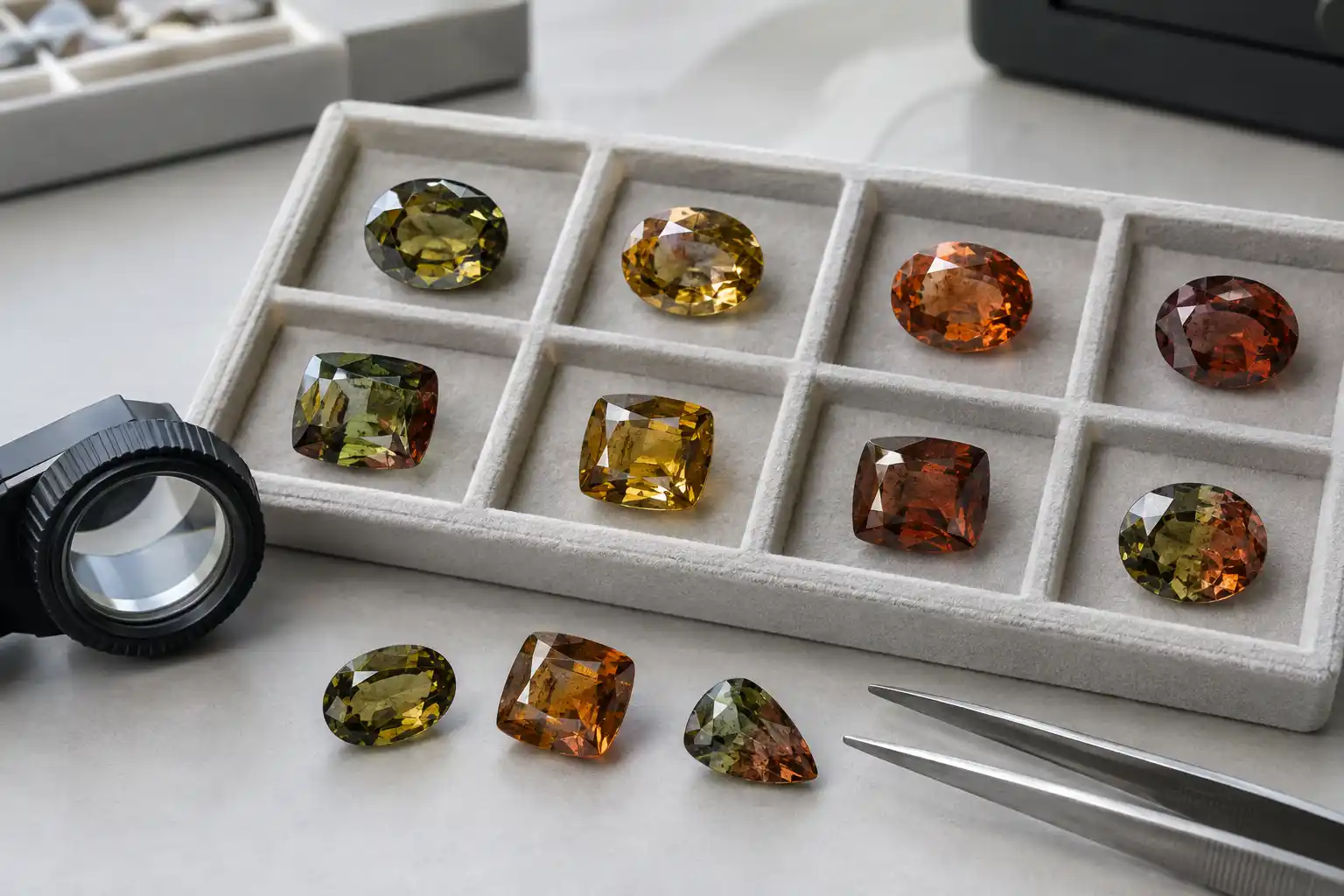
Andalusite quality grading should focus first on pleochroism, color balance, transparency, and cut orientation. Fine stones display more than one attractive face-up color, commonly mixing green or yellow-green with reddish brown, orange, golden brown, or yellow. The best examples use those directional colors as part of the gem’s design, allowing several tones to appear across the crown without becoming muddy, excessively dark, or dominated by a single brown component.
The phrase color play is often used casually for this multicolored appearance, but gemologically andalusite does not show play-of-color in the opal sense. Its defining feature is strong pleochroism, which arises because the crystal absorbs light differently along different crystallographic directions. A cutter can orient the rough so these directional colors interact through the facet pattern, creating the visual impression of multiple colors appearing together.
There is no universal andalusite grading system equivalent to standardized diamond grading. Commercial terms such as AAA, top quality, premium pleochroic, or collector grade may vary from one seller to another. A dependable assessment therefore needs to examine natural identity, pleochroism, hue, tone, saturation, clarity, cutting, size, durability, origin, and treatment as observable characteristics rather than relying on a marketing label.
9 Ways to Assess Andalusite Color Play and Clarity
- Confirm that the gemstone is natural andalusite
- Evaluate the strength of pleochroism
- Judge the quality of the green component
- Assess red, orange, yellow, and brown tones
- Evaluate tone, saturation, and overall color balance
- Grade clarity, transparency, and inclusions
- Judge cut orientation, windowing, and extinction
- Consider carat weight, face-up size, and durability
- Evaluate origin, treatment status, craftsmanship, and provenance
These nine standards work best as a combined framework. A stone with exceptional clarity but weak directional color can grade below a slightly included gem whose green and reddish tones create a much stronger andalusite appearance.
Natural Identity Comes Before Quality Grading
Andalusite is an aluminum silicate mineral with the chemical formula Al₂SiO₅. It belongs to the same chemical system as kyanite and sillimanite, although those minerals form under different pressure and temperature conditions and have distinct crystal structures.
Transparent gem-quality andalusite is considerably less common than the opaque or translucent crystals familiar to mineral collectors. The faceted gemstone can be confused with other brown, green, or yellow gems if identification relies only on color.
Gemological testing may include refractive index, birefringence, specific gravity, optical character, spectrum, pleochroism, and microscopic features. Strong pleochroism is characteristic, but it should be interpreted alongside the other properties rather than treated as a standalone proof.
Chiastolite is an opaque variety of andalusite containing dark carbonaceous inclusions arranged in a cross-like pattern. It is normally cut as cabochons or polished slices and belongs to a different appearance category from transparent faceted andalusite. Applying transparent-gem clarity standards to chiastolite would therefore be inappropriate.
Pleochroism Is the Central Quality Characteristic
Andalusite’s most distinctive feature is the ability to show different colors in different crystallographic directions. Depending on the individual crystal, these may include green, yellow-green, yellow, orange, reddish brown, and brown.
The strongest grading question is not simply whether pleochroism exists, because most gem andalusite shows it. The more important question is how effectively those directional colors appear in the finished stone.
A fine gem may show green through one group of facets and reddish or orange-brown through another, producing an attractive multicolored face-up pattern. A lower-quality stone may possess the same physical property but be cut so that one dark brown direction dominates.
Pleochroism should be examined while the stone is rotated under stable lighting. Different facets will reveal the directional colors at different angles, and a well-cut gem should remain interesting through normal movement rather than displaying its best effect only from an awkward side view.
The Green Component Often Separates Fine Stones From Ordinary Brown Andalusite
Green is one of the most desirable components because it creates a stronger contrast with the warm brown, orange, or reddish areas. A stone in which green is clearly visible face-up often looks more complex and lively than one dominated almost entirely by brown.
The best green need not resemble emerald. Andalusite commonly produces olive, yellow-green, mossy, or muted green rather than highly saturated pure green. What matters is that the hue remains identifiable and works attractively with the warmer pleochroic colors.
If the green component appears only around a narrow edge, the cutter may not have oriented the rough optimally. A broader distribution through several crown facets generally produces greater visual interest.
Very dark green can also create extinction. Fine grading therefore looks for a balance between visible color and brightness rather than maximizing saturation at the expense of light return.
Warm Red, Orange, Yellow, and Brown Colors Need to Work With the Green
Warm tones are an essential part of andalusite’s identity. Reddish brown, orange-brown, golden brown, and yellow can create a distinctive earthy palette that differs markedly from the appearance of emerald, peridot, or green tourmaline.
Brown should not automatically be treated as low quality. Rich red-brown or golden-brown areas can look excellent when they remain transparent and bright. The problem arises when brown becomes muddy, gray, or so dark that it overwhelms the rest of the stone.
Orange and red flashes can add significant visual interest, especially when they appear adjacent to green. Yellow may help bridge the cool and warm regions and create a more complex pattern.
The grader should evaluate the entire face rather than trying to assign isolated color scores. In andalusite, the relationship among the pleochroic colors is often more important than the absolute intensity of any one hue.
Tone and Saturation Determine Whether Pleochroism Looks Lively or Muddy
Tone describes how light or dark the stone appears, while saturation describes the strength of the colors. Fine andalusite needs enough saturation for green, orange, red-brown, and yellow components to remain distinct without becoming too dark.
Overly deep tone can suppress the effect by creating black-looking areas. This is especially problematic in large stones or deep cuts, where the light path through the crystal is longer.
Very light stones may show several colors but lack enough strength to create an impressive face-up appearance. Medium to moderately dark stones often provide a better compromise, although the ideal balance depends on the actual hue distribution.
Lighting should remain realistic. Extremely bright gemological lamps can make a dark stone appear more lively than it will during normal wear. A good grade should hold up under daylight-equivalent light and ordinary indoor illumination.
Clarity and Transparency Should Support the Optical Effect
Natural andalusite can contain mineral crystals, needles, fluid inclusions, fractures, and internal veils. Fine faceted gems should generally be transparent enough for light to travel through the stone and reveal the directional colors effectively.
Eye-clean appearance is desirable but does not require microscopic perfection. A few small inclusions visible only through magnification have limited impact when color and brilliance are strong.
Large central inclusions reduce transparency and can interrupt the pleochroic pattern. Surface-reaching fractures deserve particular attention because they may also affect durability.
A useful clarity assessment starts without a loupe. If an inclusion is immediately visible and distracting from normal viewing distance, it has a stronger effect on grade than a microscopic feature that requires careful searching.
Natural inclusions should not be confused with treatment. Andalusite is generally not a heavily treated gemstone, and its inclusions can provide useful evidence of geological formation.
A Practical Andalusite Clarity Framework
| Face-Up Clarity | Practical Interpretation |
|---|---|
| Eye-clean with high transparency | Fine to exceptional |
| Minor inclusions visible only under magnification | Very good |
| Small visible inclusions without major brilliance loss | Good |
| Obvious fractures or clouds affecting color display | Commercial |
| Heavy inclusions or poor transparency | Lower faceting quality |
This framework is descriptive rather than an official laboratory system. It works best when clarity is judged alongside color because a clean but visually dull gemstone may still rank below a slightly included stone with exceptional pleochroic balance.
Cut Orientation Can Improve or Ruin an Excellent Crystal
Andalusite is unusually sensitive to orientation because the cutter is selecting which pleochroic directions will be most visible from the crown. A poorly oriented stone may hide green almost completely even if the original crystal contained a strong green direction.
Good cutting uses facet placement to distribute multiple colors attractively. Rectangular cushions, ovals, rounds, emerald-style cuts, and custom designs can all work when they are adapted to the individual rough.
Windowing reduces quality because a shallow pavilion allows the viewer to see through the central portion. The resulting transparent area weakens color concentration and makes the gem appear less lively.
Extinction creates broad dark areas where little light returns. Because andalusite often contains naturally deep colors, excessive extinction can easily make a stone look almost black in sections.
The best cut balances pleochroic orientation with ordinary optical performance. Strong directional color is not enough if the stone is badly windowed, asymmetrical, poorly polished, or excessively deep.
Carat Weight Should Be Considered Only After Color and Cut
Transparent gem-quality andalusite is not extremely abundant, and larger clean stones become more difficult to find. Size can therefore contribute to rarity, particularly when the gem remains transparent and displays a strong green-red or green-orange interaction.
Carat weight should not be used as a shortcut for grade. A larger stone may be overly dark or badly oriented, while a smaller gem can show far more attractive color.
Face-up dimensions also matter because deep cutting can preserve weight without improving visual size. A well-proportioned stone can appear larger than a heavier gem with unnecessary depth.
Larger fine stones have particular collector appeal because maintaining clarity, color balance, and brightness across a substantial face becomes increasingly difficult. The size premium is therefore strongest when the quality factors remain intact.
Andalusite Durability Is Good but Not Unlimited
Andalusite has a Mohs hardness around 7 to 7.5, making it suitable for many jewelry uses. It resists ordinary scratching better than softer gems such as fluorite, apatite, opal, or pearl.
Hardness does not protect the stone from every type of damage. Sharp impacts can chip facet edges, and existing fractures can increase vulnerability.
Rings require more care than pendants or earrings because they encounter desks, door frames, tools, and other hard surfaces. A protective bezel or well-designed prong setting can reduce impact exposure.
Clarity grading should therefore include a practical assessment of structural condition. An eye-catching stone with a large surface-reaching fracture may be less suitable for everyday wear than another gem with a small internal inclusion but stronger integrity.
Origin and Provenance Can Add Collector Interest
Andalusite occurs in several geological environments and has been recovered from localities in Brazil, Sri Lanka, East Africa, and elsewhere. Individual deposits may produce characteristic trends in color or inclusions, but origin is rarely the dominant factor in ordinary faceted-gem quality.
A documented locality becomes more meaningful in specimen collecting. Well-formed crystals, association with other minerals, unusual crystal habit, and mine history can create value independent of faceting potential.
For jewelry, visible quality should come first. A seller should not use an origin name to justify a premium when the stone itself is dark, poorly cut, or heavily included.
If geographic provenance materially affects the Price, the claim should be supported by reliable documentation rather than inferred from color alone.
Treatments and Imitations Should Be Considered Before Final Grading
Routine heat treatment is not a major part of the andalusite market, which means buyers often encounter stones with naturally produced colors.
This does not eliminate identification risks. Other gems can resemble brown-green andalusite, and manufactured glass can be colored to mimic earthy tones.
Pleochroism provides a useful clue because genuine andalusite can show strong directional colors, but professional identification should consider several properties together.
Treatment and natural identity become especially important when a seller asks a premium for an unusually large or vividly colored specimen. An accurate description is part of quality because a beautiful stone presented under the wrong identity cannot be graded reliably.
Andalusite Pleochroism Versus Alexandrite Color Change
These two optical phenomena are often confused because both can make a gemstone appear to show more than one color.
Andalusite pleochroism depends mainly on viewing direction within the crystal. Under the same light source, rotating the stone can reveal different colors associated with different crystallographic axes.
Alexandrite color change depends primarily on changing the spectral composition of the illumination. A stone may look green under daylight-like light and red under a warmer source even when viewed from the same direction.
Andalusite can also look somewhat different under various lights, as most colored gems do, but that is not its defining feature. The correct quality language centers on pleochroism rather than classic color change.
Common Andalusite Grading Mistakes
One common mistake is assuming that the brownest or darkest stone is the richest. Excessive darkness can suppress both brilliance and visible pleochroism, leaving the gem with less visual complexity.
Another mistake is grading clarity before color. Eye-clean appearance is desirable, but an extremely clean brown stone with weak green response may be less attractive than a slightly included gem showing vivid green and reddish-orange facets.
Buyers also sometimes treat all multicolor effects as color change. Recognizing pleochroism correctly helps explain why cut orientation has such a large influence on andalusite quality.
Carat weight can also be overemphasized. Large size adds rarity only when transparency, cut, and attractive directional colors remain strong.
Finally, seller-defined AAA ratings should not replace direct inspection because no universal standard controls those labels.
Practical Andalusite Quality Comparison
| Quality Level | Typical Characteristics |
|---|---|
| Exceptional | Strong green and warm-color pleochroism, eye-clean transparency, excellent orientation and brilliance |
| Fine | Clear multicolor appearance, good transparency, limited extinction, strong cut |
| Good | Visible pleochroism, moderate saturation, minor inclusions or cut compromises |
| Commercial | Brown-dominant color, weak green response, obvious windowing or inclusions |
| Low | Muddy color, poor transparency, severe extinction, heavy fractures or poor cutting |
This descriptive framework is more useful than a single promotional grade because it explains which visible properties actually separate fine andalusite from ordinary material.
Conclusion
Andalusite quality grading depends on natural identity, strength of pleochroism, green and warm-color balance, tone, saturation, clarity, transparency, cutting, size, durability, and accurate provenance. The finest faceted stones make several directional colors visible at once while remaining bright, transparent, and well proportioned.
The central grading mistake is to treat andalusite like a single-color brown gemstone. Its value lies in how successfully the cutter reveals the crystal’s natural green, yellow, orange, and reddish-brown directions. A buyer who evaluates that full face-up interaction, rather than relying on size or seller-defined AAA labels, can distinguish an ordinary stone from a genuinely exceptional pleochroic gem.
FAQs About Andalusite Quality Grading
What is the most important quality factor in andalusite?
Pleochroic color quality is usually the most important factor. Fine stones show several attractive directional colors face-up, often including green together with reddish-brown, orange, yellow, or golden tones, while still maintaining strong transparency and brightness.
Does andalusite show play-of-color?
Not in the gemological sense used for precious opal. Andalusite is strongly pleochroic, meaning different crystallographic directions display different colors. Faceting can make several of those directional colors visible at the same time.
What is the best andalusite color?
There is no single ideal hue because the gem is valued for its multicolor appearance. Strong green combined with lively red-brown, orange, or golden tones is often especially desirable because the contrast makes the pleochroism obvious.
Should high-quality andalusite be eye-clean?
Fine faceted stones should generally look clean or nearly clean to the unaided eye. Small inclusions visible only under magnification are usually less important than large fractures or clouds that interfere with transparency and brilliance.
Does darker andalusite mean higher quality?
No. Strong color is desirable, but excessive darkness can create large extinction zones and conceal the pleochroic effect. A slightly lighter stone with better light return may grade substantially higher.
Why is cutting so important in andalusite?
The crystal’s colors depend on direction, so orientation determines which hues appear through the crown. Skilled cutting can show green and warm colors together, while poor orientation may leave the gemstone predominantly brown.
Is andalusite a color-change stone like alexandrite?
No. Alexandrite changes primarily when the light source changes, while andalusite displays different colors according to crystallographic direction. Its defining optical property is pleochroism.
Does carat weight determine andalusite quality?
No. Size can add rarity, especially in clean transparent stones, but a large poorly colored gem can grade below a smaller stone with stronger pleochroism, better proportions, and greater brilliance.
Is andalusite suitable for everyday rings?
Its hardness of about 7 to 7.5 gives it useful jewelry durability, but rings still need sensible care. Protective settings and avoidance of severe impacts help preserve facet edges and reduce the risk of chipping.
Is andalusite commonly treated?
Routine treatment is not a major feature of the andalusite market. Natural color is generally expected, although proper identification remains important because other gemstones and imitations can resemble its earthy color range.
What inclusions can occur in natural andalusite?
Natural stones may contain mineral crystals, needles, fluid features, fractures, veils, and growth-related structures. Their effect on quality depends on size, position, visibility, and whether they compromise structural integrity.
What is chiastolite?
Chiastolite is an opaque to translucent variety of andalusite known for cross-like dark carbonaceous inclusions. It is normally polished or cut as a cabochon and should not be graded by the same transparency standards used for faceted gem andalusite.
Does geographic origin determine andalusite quality?
No. Origin may add collector interest, especially in mineral specimens, but visible color, pleochroism, transparency, cut, and condition remain more important for ordinary faceted gems.
How can I compare two andalusites accurately?
View them under the same neutral lighting, compare the amount and balance of green and warm colors, inspect face-up transparency, look for windowing and extinction, compare dimensions with carat weight, and then consider provenance or seller terminology.
Are AAA andalusite grades standardized?
No. AAA, premium, top grade, and similar labels are usually seller-defined. They should be replaced by direct assessment of pleochroism, color balance, clarity, cut, size, and structural condition.
Can a slightly included andalusite still be exceptional?
Yes. If the inclusions are minor and do not interfere with transparency, a stone with exceptionally attractive pleochroism and superior cutting can rank above a perfectly clean but visually dull example.
What causes the different colors in andalusite?
Andalusite is optically anisotropic, so light traveling through different crystallographic directions experiences different absorption. This directional behavior creates its characteristic pleochroism.
What makes an andalusite exceptional?
Exceptional andalusite combines clearly visible green and warm pleochroic colors, balanced tone and saturation, eye-clean or nearly eye-clean transparency, minimal windowing and extinction, precise cutting, efficient face-up size, and strong structural condition.