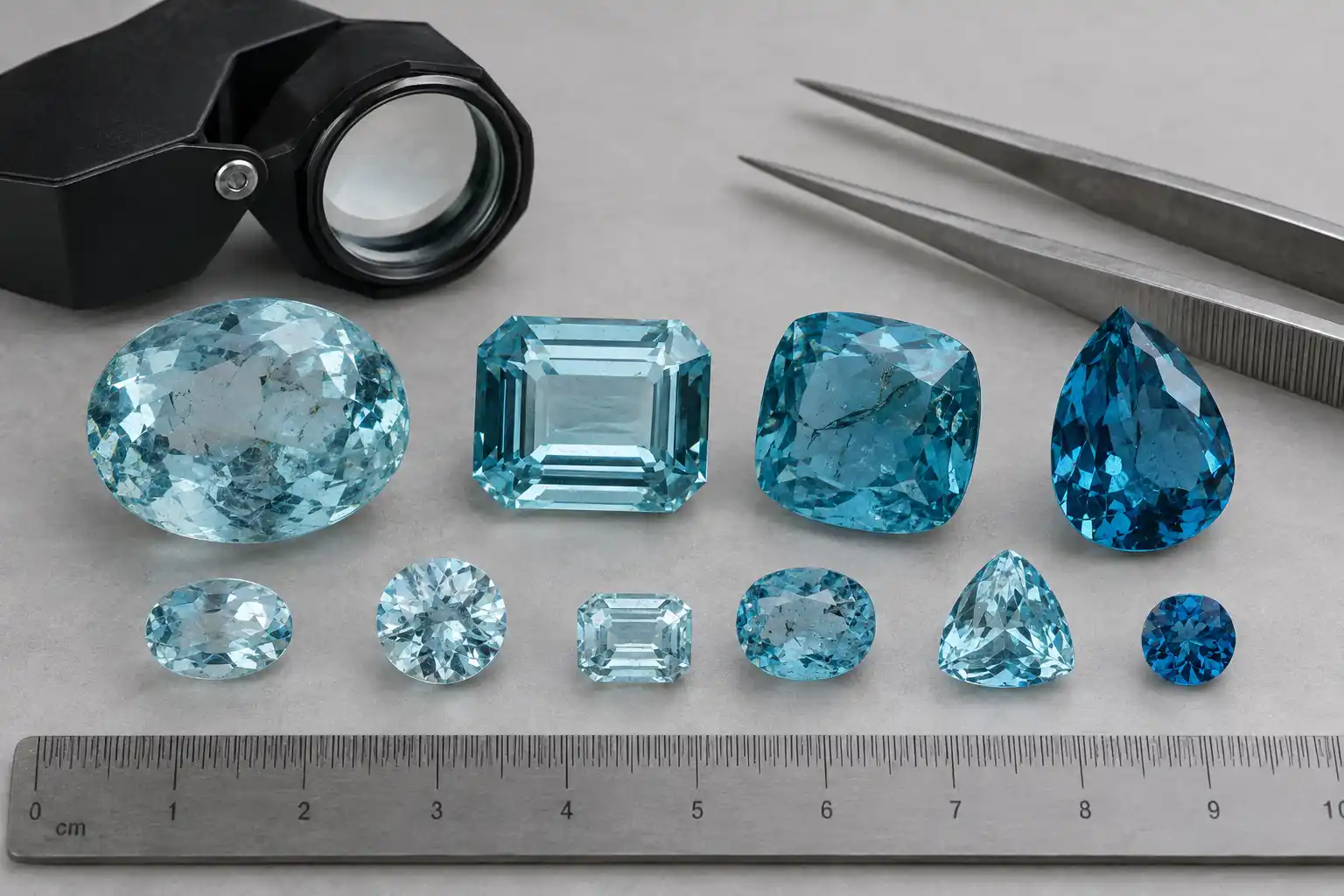
Aquamarine Price Per Carat: 10 Key Factors Affecting True Value
Aquamarine Price per carat varies mainly with color rather than clarity alone. Pale commercial stones can sell for roughly $20 to $80 per carat, while attractive medium-blue jewelry-quality aquamarine may fall around $80 to $200 per carat. Fine saturated blue stones with excellent transparency, skilled cutting, and good face-up color can move into roughly $200 to $500 per carat, while exceptional deep-blue gems, specialty provenance, and unusually fine larger stones can rise beyond $500 per carat and sometimes considerably higher. These are practical orientation ranges rather than a fixed market schedule because dealer margins, geographic market, cutting quality, certification, and jewelry craftsmanship all affect The Price.
Aquamarine is the blue to greenish-blue variety of beryl, Be₃Al₂Si₆O₁₈, the same mineral species that includes emerald, morganite, and golden beryl. Iron is responsible for aquamarine’s coloration, with different oxidation states and their interaction influencing the balance between blue and green. The market usually favors stronger blue with enough saturation to remain clearly visible in ordinary lighting, while very pale stones typically command lower The Price even if they are exceptionally clean.
One of aquamarine’s important market characteristics is that large transparent crystals occur more readily than large fine ruby, sapphire, or emerald. Size still matters, but the Price per carat does not necessarily rise dramatically at every weight threshold. A large pale stone may cost less per carat than a smaller richly saturated gem, while a large aquamarine that preserves intense blue, eye-clean transparency, excellent proportions, and attractive brilliance can earn a meaningful premium.
10 Key Factors Affecting Aquamarine Price Per Carat
- Strength and attractiveness of blue color
- Greenish versus purer blue hue
- Tone and saturation
- Clarity and transparency
- Cut quality and face-up brilliance
- Carat weight and face-up dimensions
- Heat treatment and disclosure
- Geographic origin and provenance
- Natural versus synthetic or imitation identity
- Craftsmanship, certification, and overall market demand
These ten factors work together. A five-carat aquamarine with weak color, deep cutting, and a large window can be worth less per carat than a two-carat stone showing stronger blue, excellent brilliance, and better proportions. Color quality remains the first feature most buyers should compare.
Typical Aquamarine Price Per Carat
Aquamarine has no universal Price grid, but broad loose-gem categories help explain the difference between pale commercial stones and highly saturated fine gems.
| Aquamarine Quality | Approximate Price Per Carat | Typical Characteristics |
|---|---|---|
| Commercial quality | $20 to $80 | Pale blue, greenish blue, ordinary cutting |
| Good jewelry quality | $80 to $200 | Clear medium blue, eye-clean appearance, competent cut |
| Fine quality | $200 to $500 | Stronger blue, excellent transparency, balanced cut |
| Exceptional deep-blue quality | $500 to $1,000+ | Saturated blue, strong brilliance, fine clarity and cutting |
| Specialty collector or designer stones | Highly variable | Exceptional color, precision cutting, provenance or unusual size |
The Price of finished jewelry can be much higher than the loose gemstone figure because gold or platinum, accent diamonds, manufacturing labor, setting quality, design, branding, and retailer margin are added. Buyers comparing loose stones with finished rings should separate the aquamarine’s value from the total jewelry Price.
Strong Blue Color Is the Biggest Aquamarine Value Driver
Fine aquamarine should look recognizably blue without requiring intensely bright showroom lighting. Very pale stones can be attractive and elegant, particularly in large cuts, but they usually belong to lower Price categories because the defining sea-blue color is weaker.
Saturation refers to the strength of the hue. As saturation improves, the blue becomes more noticeable and the gem generally becomes more valuable, provided the stone does not become excessively dark. Most aquamarine remains relatively light compared with blue sapphire, so a deeply saturated but still bright stone can attract substantial demand.
The market also tends to prefer blue over noticeably greenish blue. Natural aquamarine often begins with some green component, and heat treatment may be used to reduce that greenish contribution. The result is often a cleaner blue that many buyers prefer.
This preference does not mean that every greenish aquamarine is low quality. Some collectors appreciate natural blue-green color, especially when untreated appearance is part of the appeal. Value ultimately reflects what the market finds attractive as well as treatment status.
Tone Must Support Color Without Making Aquamarine Look Gray or Dark
Tone describes how light or dark the gemstone appears. Aquamarine is often light to medium in tone, and larger stones can sometimes show stronger apparent color because light travels through a greater depth of blue beryl.
A very pale aquamarine may look almost colorless in small sizes. This is one reason tiny stones can struggle to display the saturated appearance seen in larger gems cut from comparable rough.
Extremely dark aquamarine is uncommon in natural untreated form, but poor cutting can still create black-looking extinction areas. A stone with excessive depth or badly chosen facet angles may appear darker without actually possessing better body color.
Grayish appearance also lowers desirability when it dulls the blue. Fine gems balance hue, saturation, tone, and brightness so that the blue remains clean and lively rather than washed out or closed.
Heat Treatment Is Common and Usually Targets the Green Component
Heating aquamarine is a widely used treatment intended mainly to reduce greenish or yellowish components and leave a purer blue appearance. The treatment is generally stable under normal jewelry conditions.
A heat-treated aquamarine remains aquamarine. Treatment does not transform it into a different mineral species, and heated stones can be beautiful, durable, and valuable.
The key issue is disclosure. Buyers who specifically want untreated natural color may pay a premium when that status can be supported, particularly if the stone already displays fine blue without heating.
It is also important not to assume that every blue aquamarine has definitely been heated. In many cases treatment history may not be established with certainty from ordinary visual examination, especially once a stone is cut.
For mainstream jewelry, color quality often has a stronger effect on The Price than whether conventional heat treatment occurred. For collectors, treatment status can carry greater significance.
Clarity Expectations Are High Because Clean Aquamarine Is Available
Aquamarine commonly forms large, transparent crystals, so eye-clean faceted gems are widely available. As a result, obvious inclusions usually reduce value more strongly than they might in emerald, where inclusions are expected.
Natural aquamarine can contain liquid inclusions, hollow or partially filled tubes, crystals, fractures, and other growth-related features. Fine stones may contain tiny inclusions visible under magnification while still appearing completely clean without a loupe.
Large central inclusions, obvious clouds, and surface-reaching fractures can reduce brilliance and durability. Because transparent clean aquamarine is available, buyers do not usually need to accept heavily included stones unless the specimen has unusual collector interest or another exceptional feature.
Certain aligned inclusions can occasionally produce chatoyancy when aquamarine is cut as a cabochon. Fine cat’s-eye aquamarine belongs to a specialized phenomenon category and should not be graded by ordinary transparent-faceted standards.
Cut Quality Has a Direct Effect on Aquamarine Color and Price
Aquamarine is often cut into emerald cuts, rectangles, ovals, cushions, rounds, pears, and elongated shapes because its crystals can form as long hexagonal prisms. A skilled cutter considers color orientation, weight retention, face-up size, and brilliance simultaneously.
Windowing is one of the most common weaknesses in inexpensive stones. When pavilion angles are too shallow, the center becomes transparent and the observer can see through the gem. This reduces apparent color saturation and brilliance, making a pale aquamarine look even weaker.
Extinction creates the opposite problem, with dark areas returning too little light. Some dark facets are normal, but broad black zones make the gemstone appear less lively.
A good cut also distributes color evenly. If a pale stone is unnecessarily shallow, the color may become difficult to see, while a well-proportioned pavilion can help build sufficient optical path length for the blue to appear stronger.
Precision cutting can therefore justify a premium even though aquamarine rough itself is not among the rarest gem substances. The buyer is paying for better optical performance, symmetry, polish, and efficient face-up dimensions.
Carat Weight Matters Differently in Aquamarine Than in Rare Colored Gems
Large aquamarine is far more available than large alexandrite or fine ruby. This availability means that the Price per carat does not always climb sharply as weight increases.
A ten-carat pale aquamarine may remain relatively affordable, while a three-carat gem with significantly stronger saturation may command more per carat.
The situation changes when large size and exceptional color occur together. Strong blue saturation in a large transparent gem is harder to obtain, particularly when clarity and cut are also excellent. Those combinations can produce meaningful premiums.
Face-up dimensions should always be compared with weight. A deep ten-carat stone may look smaller than a shallower but properly proportioned eight-carat gem because much of its mass is hidden beneath the girdle.
For jewelry buyers, millimeter dimensions and visual spread often matter more than carat weight alone.
Santa Maria Aquamarine and Other Origin-Related Trade Terms
Santa Maria is one of the most famous names associated with deeply saturated aquamarine. Historically, the term is connected with fine stones from Brazil’s Santa Maria de Itabira area, but similar color descriptions have also been used more loosely in the trade.
A stone described as Santa Maria color should not automatically be assumed to have Brazilian geographic origin. Color terminology and origin terminology need to be separated.
Other sources, including several African deposits, have produced richly colored aquamarine capable of rivaling famous Brazilian stones visually. Some trade descriptions reference particular deposits or regions, but such labels should not replace direct grading of the gemstone.
If geographic provenance is being used to justify a significant premium, reliable documentation is preferable to assumptions based on hue alone.
For most jewelry buyers, visible color, cut, clarity, and durability are more important than locality.
Natural Aquamarine, Synthetic Beryl, and Imitations
Synthetic beryl can be produced in laboratories, and blue synthetic beryl may resemble natural aquamarine. Laboratory-grown material shares the basic crystal structure and chemistry of beryl but lacks natural geological origin.
Blue glass, synthetic spinel, topaz, and other transparent blue substances can also be mistaken for aquamarine by buyers relying only on color.
Professional identification uses gemological properties such as refractive index, birefringence, specific gravity, optical character, inclusions, and spectroscopy rather than visual color alone.
Natural aquamarine generally commands a stronger rarity premium than laboratory-grown equivalents. Imitations belong to a different category entirely because they are not beryl.
An expensive stone should therefore be identified accurately before origin or color labels are used to justify The Price.
Does Aquamarine Origin Change The Price Significantly?
Origin can influence collector interest, particularly when a gem comes from a famous historical mine or has strong documented provenance. For ordinary jewelry, however, geographic source is usually secondary to visible quality.
A weakly colored stone from a famous region does not become superior to a strongly saturated, beautifully cut gem from another locality.
Brazil, Pakistan, Nigeria, Mozambique, Madagascar, Zambia, and other regions have produced aquamarine in various qualities. Individual deposits differ in crystal size, color tendencies, inclusions, and geological associations.
Mineral specimens can receive stronger locality premiums because natural crystal form, matrix, associated minerals, and mine provenance are central to specimen collecting.
For a faceted gem, buyers should treat origin as an additional characteristic rather than the foundation of quality.
How to Compare Two Aquamarines Before Buying
Place both stones under identical neutral lighting and compare blue saturation first. Determine whether one appears noticeably gray, pale, or greenish before looking at the carat labels.
Then examine face-up brilliance. A large central window, excessive extinction, or a badly proportioned outline can reduce beauty even when the stone has good color.
Clarity should be judged without magnification before using a loupe. If both gems appear eye-clean, tiny microscopic differences are unlikely to matter as much as superior color or cut.
Finally, compare dimensions with weight. A lighter aquamarine that spreads well can look substantially larger in jewelry than a heavier deep-cut stone.
This sequence keeps visible quality ahead of marketing terms, origin claims, and impressive carat numbers.
Is Aquamarine Worth Buying as an Investment?
Fine aquamarine can be valuable, but ordinary jewelry-grade stones should not be treated as guaranteed investments. Large gem-quality crystals are available, which limits the scarcity premium for pale and medium-color stones.
Exceptional deep-blue gems, unusual collector specimens, important provenance, and precision-cut stones may hold stronger specialized demand. Even then, resale depends on market conditions, dealer margins, auction exposure, documentation, and finding the right buyer.
For most people, aquamarine’s strongest value is aesthetic. It provides attractive natural blue, useful durability, and substantial size at a Price well below many similarly sized sapphires.
That combination makes aquamarine particularly attractive for statement jewelry rather than purely speculative buying.
Aquamarine Durability and Long-Term Jewelry Value
Aquamarine has a Mohs hardness of 7.5 to 8 and generally good toughness, making it suitable for rings, pendants, earrings, bracelets, and other jewelry.
Hardness does not make it impossible to damage. Strong impacts can chip corners or girdles, especially in emerald cuts or stones with internal fractures.
Gentle cleaning with lukewarm water, mild soap, and a soft brush is generally appropriate for intact aquamarine. Extreme heat should be avoided, particularly when treatment status or inclusions are uncertain.
Separate storage protects the gem from harder substances such as sapphire and diamond and prevents aquamarine from scratching softer stones.
Well-made settings and periodic prong inspection are especially important for larger gems because replacing a fine saturated aquamarine can be considerably more expensive than securing the setting before damage occurs.
Conclusion
Aquamarine Price per carat is controlled mainly by blue color quality, saturation, tone, clarity, cut, size, treatment, origin, natural identity, and craftsmanship. Pale commercial stones can remain relatively inexpensive, while richly saturated eye-clean gems with excellent cutting can reach several hundred dollars per carat or more.
The most expensive aquamarine is not automatically the largest or darkest. Fine value comes from a clean sea-blue appearance that remains lively in ordinary lighting, strong transparency, an efficient cut, and honest treatment disclosure. Buyers who compare visible color and face-up performance before carat weight are much more likely to understand why one aquamarine commands several times The Price of another.
FAQs About Aquamarine Price Per Carat
How much does aquamarine cost per carat?
Pale commercial aquamarine may sell for roughly $20 to $80 per carat, while good jewelry-quality stones commonly move into roughly $80 to $200 per carat. Fine saturated gems can reach around $200 to $500 per carat, with exceptional deep-blue stones rising above that range.
What color aquamarine is most valuable?
Strong clean blue with good saturation is generally the most desirable. Very pale, grayish, or strongly greenish stones usually command less unless untreated blue-green color is specifically sought by a collector.
Is darker aquamarine always more expensive?
No. Stronger saturation helps, but an overly dark or badly cut stone can show too much extinction. Fine aquamarine should remain bright enough for the blue to be clearly visible.
Does heat treatment reduce aquamarine value?
Conventional heating is widely accepted and is commonly used to reduce greenish tones. Untreated fine-color stones may receive a premium from some collectors, but visual color remains a major factor in mainstream jewelry value.
Why can large aquamarine be relatively affordable?
Aquamarine can form in large transparent crystals, making sizable faceted stones more available than equally large ruby, alexandrite, or emerald. Large size alone therefore does not create an extreme scarcity premium.
Does aquamarine get more expensive above five carats?
The Price per carat may increase when a larger gem maintains rich color, eye-clean clarity, and excellent cutting. Pale commercial stones may show little increase simply because they cross a carat threshold.
Is Santa Maria aquamarine the most valuable?
Fine deeply saturated stones associated with Santa Maria-type color are highly sought after, but the term should not automatically be treated as proof of geographic origin. Actual color, clarity, cut, and documentation still determine value.
Is Brazilian aquamarine worth more than African aquamarine?
Not automatically. Fine aquamarine comes from several regions, and a beautifully colored African stone can be more valuable than a pale Brazilian gem. Provenance matters most when it is reliable and commercially meaningful.
Does clarity affect aquamarine Price?
Yes. Fine aquamarine is generally expected to appear eye-clean because transparent crystals are relatively available. Large visible inclusions or fractures usually reduce value.
Is synthetic aquamarine cheaper?
Laboratory-grown blue beryl generally belongs to a lower rarity category than natural aquamarine. Accurate disclosure is essential because natural and synthetic stones can sometimes look very similar.
Does precision cutting increase aquamarine value?
Yes. Precision cutting can improve brilliance, face-up dimensions, symmetry, and apparent color while reducing windowing and extinction. Craftsmanship can therefore add substantially to The Price.
Is aquamarine suitable for daily rings?
Aquamarine’s hardness of 7.5 to 8 and generally good toughness make it suitable for rings with sensible care. Protective settings are useful for large stones or cuts with exposed corners.
Can aquamarine fade in sunlight?
Normal wear is generally not associated with rapid fading, but prolonged intense heat and unnecessary extreme exposure should be avoided. Proper storage remains sensible for any fine colored gemstone.
What makes an aquamarine worth a premium?
A premium stone combines saturated clean blue, balanced tone, eye-clean transparency, excellent cutting, good face-up spread, significant size, accurate treatment disclosure, and reliable natural identity.