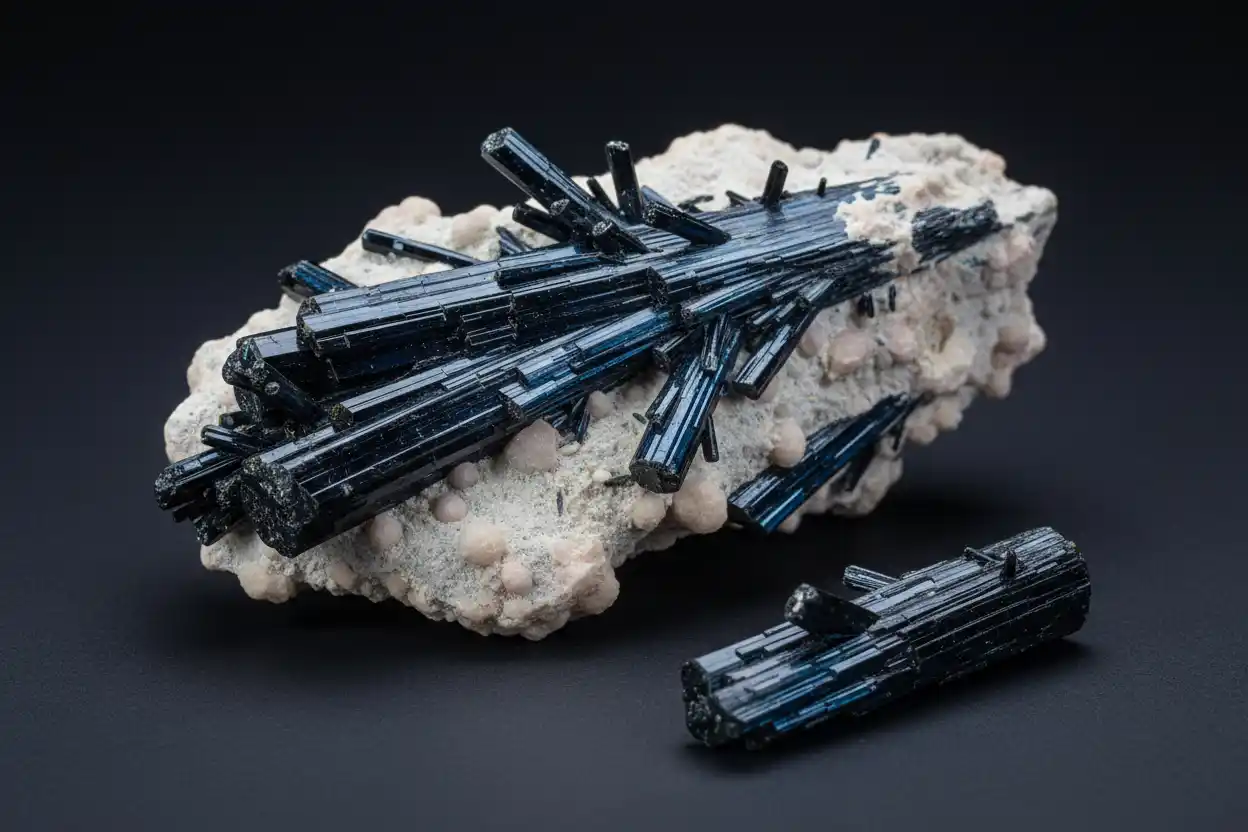
Arfvedsonite Meaning: Mineral Identity, History & Symbolism
Arfvedsonite meaning begins with an iron-rich sodium amphibole rather than the polished “black crystal” identity often emphasized in retail descriptions. Arfvedsonite is a recognized amphibole species with the idealized composition NaNa₂(Fe²⁺₄Fe³⁺)Si₈O₂₂(OH)₂. It belongs to the sodium amphibole subgroup, crystallizes in the monoclinic system, and commonly appears bluish-black to black. Fresh crystals can have a vitreous luster, while thin edges or favorable orientations may reveal dark blue-green, green-gray, brownish, or related tones because the mineral is strongly pleochroic. Typical hardness is about 5–6 on the Mohs scale, with specific gravity commonly around 3.3–3.5 and well-developed amphibole cleavage.
Those characteristics place arfvedsonite firmly within mineralogy rather than within a separate class of “energy stones.” Its iron-rich chemistry, double-chain silicate structure, characteristic cleavage, dark color, and occurrence in unusual alkaline rocks provide a substantial material story before symbolism is considered. Modern crystal traditions often associate arfvedsonite with focus, protection, insight, manifestation, personal direction, or spiritual awareness, but these themes are symbolic interpretations rather than measurable effects of sodium-iron amphibole.
Readers exploring other mineral identity references can browse the broader Gemstone Guides.
Arfvedsonite Identity at a Glance
| Property | Arfvedsonite |
|---|---|
| Mineral species | Arfvedsonite |
| Mineral family | Amphibole supergroup |
| Subgroup | Sodium amphibole |
| Idealized formula | NaNa₂(Fe²⁺₄Fe³⁺)Si₈O₂₂(OH)₂ |
| Mineral class | Inosilicate, double-chain silicate |
| Crystal system | Monoclinic |
| Common habit | Prismatic, elongated, columnar, radiating, massive |
| Typical color | Bluish-black to black |
| Thin-edge or directional colors | Dark blue-green, green-gray, brownish or related tones may appear |
| Transparency | Commonly opaque to translucent |
| Luster | Vitreous |
| Mohs hardness | Approximately 5–6 |
| Specific gravity | Approximately 3.3–3.5 |
| Cleavage | Perfect amphibole cleavage |
| Tenacity | Brittle |
| Optical character | Biaxial negative |
| Pleochroism | Strong |
| Typical geological association | Alkali-rich and peralkaline igneous rocks |
| Important identification limit | Black color and blue-green reflections alone do not prove arfvedsonite |
Arfvedsonite is therefore neither a generic name for every black amphibole nor a trade category for every dark stone showing blue reflections. Species identification depends on structural and chemical evidence, particularly because several iron-rich amphiboles and pyroxenes can resemble one another in hand specimens.
Arfvedsonite Is an Iron-Rich Sodium Amphibole
Amphiboles are structurally complex double-chain silicates that accommodate numerous combinations of sodium, calcium, magnesium, iron, aluminium, fluorine, hydroxyl, and other constituents. Small changes in which elements dominate particular structural sites can change the correct species name, which is why amphibole identification can become considerably more technical than simply recognizing a dark prismatic crystal.
Arfvedsonite occupies an iron-rich, sodium-dominant part of that system. Its ideal formula contains both ferrous and ferric iron, and natural analyses may deviate from the ideal composition through substitutions involving potassium, magnesium, manganese, titanium, fluorine, and other constituents. Closely related members such as fluoro-arfvedsonite and potassic-arfvedsonite illustrate how changes in structural dominance can produce distinct accepted names while preserving an obvious mineralogical relationship.
A specimen can therefore look convincingly “arfvedsonite-like” without its exact amphibole name being certain from photographs. This is particularly relevant to commercial material sold simply as arfvedsonite without analytical documentation.
How Arfvedsonite Forms
Arfvedsonite is strongly associated with alkaline and peralkaline igneous systems, especially sodium-rich environments where unusual mineral assemblages can develop. It occurs in rocks such as alkali-rich syenites, nepheline syenites, peralkaline granites, related pegmatites, and late-magmatic or hydrothermal mineral assemblages. In these systems, evolving magma and fluids can become enriched in sodium, iron, zirconium, rare-earth elements, fluorine, and other constituents that are less easily accommodated by common early-forming minerals.
As crystallization proceeds, arfvedsonite may grow as a rock-forming amphibole, discrete prismatic crystals, radiating aggregates, or late-stage crystals associated with feldspar, aegirine, quartz, eudialyte-group minerals, astrophyllite, zirconium-bearing species, and other minerals characteristic of chemically evolved alkaline systems. The exact association varies considerably between localities, so a single universal list of companion minerals would be misleading.
The Ilímaussaq alkaline complex in Greenland is especially important in arfvedsonite’s mineralogical history and contains highly unusual alkaline rocks in which sodium-rich amphiboles are major constituents. Other notable occurrences demonstrate that arfvedsonite is not restricted to one deposit type or geographic region.
A fuller treatment of magma evolution, host-rock chemistry, late-stage fluids, pegmatites, mineral associations, and deposit-specific interpretation belongs in Arfvedsonite formation and deposit geology.
Why Arfvedsonite Looks Black
Arfvedsonite’s dark appearance is strongly connected with its iron-rich composition and optical absorption. In thick crystals or massive material, so much visible light can be absorbed that the specimen looks essentially black. This can conceal the strong directional color behavior that becomes much easier to observe in thin sections, narrow edges, microscopic grains, or appropriately illuminated fragments.
The mineral can show deep blue-green, greenish, gray-violet, yellow-brown, or related directional tones depending on composition and viewing orientation. Strong pleochroism means that changing the direction of light through the crystal can alter the apparent color because absorption is not identical along every crystallographic direction.
This distinction is useful when evaluating polished material. A black stone that shows green-blue internal reflections may be compatible with arfvedsonite, but the visual effect does not function as a unique fingerprint. Color can also be influenced by associated minerals, surface polish, internal fractures, grain orientation, and the amount of light transmitted through thinner areas.
Detailed absorption behavior, refractive indices, pleochroism, birefringence, and directional color belong in Arfvedsonite optical properties and color behavior.
Blue “Flash” Is Not a Separate Arfvedsonite Variety
Retail descriptions frequently emphasize “blue flash arfvedsonite.” The expression can be useful for describing appearance, but it is not a separate mineral species or standardized gemological variety.
Reflective blue-green areas can result from favorable crystal orientation, pleochroic transmission, reflective cleavage or fracture surfaces, intergrown minerals, or combinations of these features. A polished piece containing several differently oriented grains can look much more optically active than a single uniform crystal because each grain interacts with light differently.
An intense photographed flash should therefore be treated cautiously. Strong directional lighting, exposure changes, wet surfaces, dark backgrounds, and image processing can exaggerate reflections that appear more restrained under ordinary viewing.
“Arfvedsonite with blue-green reflections” describes what an observer sees. “Rare high-vibration blue-flash arfvedsonite variety” combines appearance with an unsupported mineralogical and metaphysical classification.
Arfvedsonite Has Characteristic Amphibole Cleavage
Amphibole cleavage is one of the useful structural clues when naturally exposed. Arfvedsonite can split along two prominent directions that intersect at the characteristic oblique angles associated with amphiboles. Fresh cleavage surfaces may be reflective and can create stepped or splintery-looking broken areas.
This property helps distinguish amphiboles from some visually similar dark minerals, but valuable specimens should not be broken deliberately to reveal it. Existing fractures and cleavage surfaces can be examined without destroying intact crystal terminations.
Cleavage also influences durability. Hardness around 5–6 offers moderate resistance to scratching, yet hardness does not prevent a brittle crystal from splitting or chipping when force follows a favorable structural plane. This becomes relevant when arfvedsonite is fashioned into cabochons, freeforms, beads, or other ornamental objects.
Diagnostic Traits of Arfvedsonite
A convincing identification begins with several compatible observations rather than one dramatic color effect. Dark bluish-black color, prismatic amphibole habit, vitreous luster, hardness around 5–6, relatively high density, characteristic cleavage, strong pleochroism, and appropriate alkaline-rock associations can collectively support arfvedsonite.
Confusion remains possible. Riebeckite is another sodium-rich iron amphibole with overlapping dark blue-black appearance and related chemistry. Aegirine is a sodium-iron pyroxene that commonly occurs in the same alkaline environments and may form dark green-black prisms. Schorl, the common black tourmaline, can also look superficially similar when crystal habit is incomplete or specimens have been polished.
The strongest separation depends on crystallography, optical properties, chemistry, Raman spectroscopy, X-ray diffraction, or other appropriate mineralogical methods rather than black color alone. Microscopic features, intergrowths, alteration, cleavage, inclusions, and possible repairs are explored more closely in the Arfvedsonite microscope inclusion notebook.
Original Arfvedsonite Specimen and Photo Checklist
A specimen photograph can support useful observations without proving every claim attached to a product listing.
| Observation | What it may reasonably support | What it cannot prove alone |
|---|---|---|
| Black to bluish-black prismatic crystal | Appearance compatible with arfvedsonite | Exact amphibole species |
| Dark blue-green appearance at thin edges | Compatible with strong pleochroism | Chemical composition |
| Vitreous crystal faces | Common arfvedsonite appearance | Geographic origin |
| Oblique amphibole-like cleavage | Strong structural clue | Exact sodium amphibole species |
| Pale alkali feldspar matrix | Geologically plausible association | Specific alkaline complex |
| Intergrowth with aegirine | Plausible alkaline-rock association | Arfvedsonite identity by itself |
| Radiating or fibrous-looking aggregate | Known amphibole habit can occur | Asbestiform character or health risk classification |
| Polished stone with blue reflective streaks | Compatible commercial appearance | Species identity or “energy” level |
| Seller calls material “rare Greenland arfvedsonite” | Provenance claim worth documenting | Greenland origin |
| Seller calls material untreated | Disclosure claim | Independent proof |
| Raman or XRD result consistent with arfvedsonite | Strong mineral identity evidence | Exact locality |
| Chemical analysis matching arfvedsonite dominance | Strong species-level evidence | Treatment, repair, or provenance |
| Old specimen label with locality | Valuable provenance evidence | Chemical confirmation |
The most important limitation concerns photographs of polished material. Once a stone is cut and polished, much of the original crystal habit and matrix context disappears. Identification should become more conservative, not more confident.
Locality labels, dealer records, collection history, and species-specific claims can be evaluated through the Arfvedsonite provenance and disclosure checklist.
Arfvedsonite Claims: Observation Versus Evidence
| Claim | Evidence-based interpretation |
|---|---|
| “Arfvedsonite is a black crystal” | It is a dark sodium-iron amphibole that commonly appears bluish-black to black |
| “Every black amphibole is arfvedsonite” | False; several amphibole species can appear dark |
| “Every arfvedsonite shows bright blue flash” | False; visible reflections and pleochroism vary with specimen, orientation, thickness, and lighting |
| “Blue flash proves arfvedsonite” | False; reflective appearance is not species-level identification |
| “Arfvedsonite is the same as aegirine” | False; aegirine is a pyroxene rather than an amphibole |
| “Arfvedsonite is always fibrous asbestos” | Incorrect; amphibole habit varies, and species name alone does not establish an asbestiform material |
| “Arfvedsonite attracts opportunities” | Modern symbolic belief rather than a demonstrated mineral effect |
| “Arfvedsonite protects against negative energy” | Spiritual interpretation, not a measurable shielding property |
| “Arfvedsonite improves psychic ability” | No established scientific mechanism |
| “Iron in arfvedsonite improves blood or energy” | Mineral iron is not a therapeutic dose delivered through skin |
| “Black color makes it a grounding mineral scientifically” | Grounding is metaphorical or spiritual language in this context |
| “A famous locality guarantees authenticity” | Locality claims and mineral identity require separate evidence |
This distinction is particularly important for arfvedsonite because dramatic photographs can easily encourage claims that exceed what appearance alone demonstrates.
The Name Arfvedsonite Honors a Chemist
Arfvedsonite was named for Swedish chemist Johan August Arfwedson, whose scientific work included the discovery of lithium. The historical name therefore reflects mineralogical scholarship and chemistry rather than an ancient spiritual term.
The mineral’s type locality is associated with the Ilímaussaq alkaline complex in southern Greenland, an area famous for extraordinary sodium-rich and rare-element mineralogy. Arfvedsonite is an important mineral within this geological setting and occurs alongside a diverse assemblage produced by highly evolved alkaline magmatism.
This documented scientific history is more specific than generic claims that arfvedsonite was used universally by ancient healers, shamans, or civilizations. Such stories should not be added without traceable evidence.
Arfvedsonite’s genuine history already includes unusual magma chemistry, amphibole classification, rare-element geology, mineral nomenclature, and the development of increasingly precise analytical definitions.
Arfvedsonite and Riebeckite Are Closely Related but Not Interchangeable
Riebeckite and arfvedsonite belong to the broader sodium-amphibole family and can overlap strongly in appearance. Both may be extremely dark and can show blue, green, or bluish-black optical tones.
Their distinction depends on how iron and other elements occupy structural sites rather than on a simple color rule. Natural compositions can also approach boundaries between related amphibole species, making precise chemical analysis important when exact nomenclature matters.
For ordinary collecting, a reputable historic label identifying arfvedsonite can be valuable evidence. For scientific work, chemical and crystallographic confirmation provides the stronger basis.
This is an example of why amphibole terminology can become more precise than commercial gemstone terminology: two specimens that look almost identical may deserve different species names after analysis.
Arfvedsonite and Aegirine Can Grow Together
Aegirine is a dark sodium-iron pyroxene common in many of the same alkaline rocks that host arfvedsonite. The two can occur on the same specimen, sometimes as intergrown black or dark green prismatic crystals.
Their coexistence creates obvious identification problems in photographs. A collector may assume that every black prism on a matrix is the same mineral even when multiple species are present.
Pyroxenes and amphiboles differ structurally, have different cleavage relationships, and show different optical behavior. A specimen containing both can therefore be scientifically more interesting than a visually uniform piece, but it requires careful description.
Matrix should be preserved when practical because the relationship between the minerals may contain information lost when all dark material is removed and polished together.
Arfvedsonite and Astrophyllite Are Different Minerals
Arfvedsonite sometimes occurs in alkaline-rock assemblages that also contain astrophyllite, encouraging confusion in polished stones or mixed mineral pieces. The minerals are unrelated at the species level and have visibly different habits when good crystals are available.
Astrophyllite meaning concerns a complex titanium-bearing sheet silicate known for bladed or radiating bronze-to-golden crystals. Arfvedsonite is a sodium-iron amphibole typically dominated visually by black or dark blue-green prismatic material.
A polished object can contain both. In such cases, naming the whole piece after whichever mineral is more commercially recognizable can hide the actual multi-mineral nature of the material.
Arfvedsonite, Aragonite, and Apophyllite Share Little Beyond Their Names
Alphabetical proximity can create the mistaken impression that similarly named minerals are related. They are not.
Aragonite meaning concerns orthorhombic calcium carbonate, CaCO₃. Apophyllite meaning concerns a group of hydrated calcium silicates often forming transparent or pale tetragonal crystals. Arfvedsonite is a dark sodium-iron amphibole with completely different chemistry, structure, density, and geological context.
The comparison illustrates why mineral names should be learned through chemistry and structure rather than visual association or alphabetical grouping.
Arfvedsonite as a Collector Mineral
Natural arfvedsonite specimens can be valued for crystal form, matrix relationships, locality, associated rare minerals, historical labels, unusual pleochroism, or their significance within alkaline igneous petrology. A sharp black crystal on contrasting pale feldspar may have more collector interest than a much larger anonymous polished piece because the natural specimen retains information about its geological context.
Large crystals can also show longitudinal striations, distinctive amphibole cross-sections, stepped cleavage, and intergrowths that disappear after cutting. These features make unmodified specimens particularly useful for teaching mineral identification.
Collectors should preserve original labels and avoid removing matrix automatically. Provenance can become impossible to reconstruct once documentation has been discarded.
Long-term matrix support, repairs, labeling, environmental storage, and specimen condition are covered in the Arfvedsonite specimen conservation record.
Is Arfvedsonite a Gemstone?
Arfvedsonite is much better known as a mineral specimen and ornamental material than as a conventional faceted gemstone. Its dark color means most material does not transmit enough light for traditional transparent faceting, although thin areas and unusual crystals can show attractive blue-green optical tones.
Massive or intergrown material may instead be cut into cabochons, beads, polished slabs, freeforms, spheres, or decorative objects. These forms emphasize luster, reflective internal structures, grain patterns, and contrast with associated minerals.
Lapidary use introduces questions about cleavage, grain orientation, brittle areas, mixed-mineral hardness, polishing response, and dust generation. Those technical decisions belong in Arfvedsonite cutting, orientation and polish.
Jewelry Wear Requires Attention to Cleavage and Mixed Material
A hardness of roughly 5–6 makes arfvedsonite more resistant to scratching than calcite or fluorite but noticeably softer than quartz, beryl, topaz, and corundum. Repeated contact with harder materials can therefore dull polished surfaces.
Cleavage and brittleness add another limitation. A solid cabochon may perform reasonably in a pendant or occasional-wear piece, while a thin slab, fractured bead, or exposed ring stone can be more vulnerable. Mixed material containing feldspar, quartz, aegirine, or other minerals may also wear unevenly because each component has different hardness and cleavage behavior.
Mounting pressure, ring exposure, edge protection, drill holes, and long-term wear are covered in Arfvedsonite setting and wear engineering.
Safe Ownership Without Amphibole Alarmism
Arfvedsonite belongs to the amphibole supergroup, but that fact should not be turned automatically into the statement that every arfvedsonite specimen is asbestos.
“Asbestos” describes particular fibrous habits and material properties rather than functioning as a synonym for every amphibole mineral. Arfvedsonite can occur as normal prismatic, massive, radiating, or fibrous material, and a specimen’s habit matters when considering physical exposure.
An intact, non-friable collector specimen does not create the same exposure as deliberately grinding, crushing, drilling, or dry-sanding amphibole-bearing rock. Lapidary work can generate respirable mineral dust regardless of whether visible fibers are present, so wet methods where appropriate, local extraction, eye protection, suitable respiratory controls, and careful cleanup are sensible precautions.
Unknown fibrous or easily crumbling material deserves more conservative handling. Avoid dry brushing, sanding, or pulverizing such specimens merely to test their identity.
Normal mineral ownership and industrial dust exposure are different situations.
Do Not Ingest Arfvedsonite
Arfvedsonite contains substantial iron as part of a complex silicate structure. That does not make it an iron supplement.
Wearing or holding the mineral does not provide a controlled nutritional dose, and its chemistry should not be translated into claims about blood health, anemia, energy, circulation, or iron deficiency.
Do not grind arfvedsonite into powders for ingestion or prepare drinking-water remedies with rough mineral specimens. Natural specimens can contain additional minerals and trace constituents that have not been assessed for food or medical use.
Mineral chemistry is useful for identification. It is not a prescription.
Modern Arfvedsonite Symbolism
Contemporary metaphysical descriptions commonly associate arfvedsonite with focus, personal direction, manifestation, protection, intuition, self-discipline, and recognizing future possibilities. Its dark appearance contributes naturally to grounding and protection symbolism, while blue-green reflections are often interpreted as signs of insight, communication, or hidden potential.
These associations can function as metaphors without requiring a physical energy mechanism.
A person could keep an arfvedsonite stone near a workspace as a reminder to finish difficult tasks, review long-term plans, or distinguish ambition from action. Someone might use the contrast between its black body color and occasional blue-green reflections as a personal metaphor for finding information that is not obvious at first glance.
The stone does not independently create those outcomes.
Arfvedsonite and Manifestation Claims
Arfvedsonite is frequently marketed as a manifestation stone. The usefulness of that description depends on what manifestation is understood to mean.
If manifestation involves identifying a goal, writing down concrete steps, directing attention toward useful opportunities, and acting consistently, a physical object can serve as a reminder within the process. Its function is comparable to a written note, meaningful piece of jewelry, or object placed deliberately on a desk.
If the claim is that arfvedsonite itself causes money, employment, relationships, property, or other external events through an invisible force, there is no established evidence for that mechanism.
A symbolic object can reinforce intention; it does not replace action, skill, circumstance, or other people’s choices.
Protection and Grounding Claims
Dark minerals are frequently assigned protective symbolism, and arfvedsonite is no exception. It may be described as shielding the owner from negativity, unwanted energy, emotional influence, or spiritual harm.
There is no demonstrated physical field around arfvedsonite that provides this type of protection.
A more practical symbolic interpretation is possible. Someone can use the mineral as a cue to establish boundaries, reduce distractions, assess risks carefully, or step away from harmful situations. The protective action then comes from human decisions rather than from the stone.
The distinction between spiritual symbolism and scientific evidence is described more broadly in the Gems Lore disclaimer.
Claims About Psychic Ability and Intuition
Blue-green reflective features and the mineral’s contemporary metaphysical reputation have also produced claims involving clairvoyance, intuition, dreams, psychic awareness, or access to hidden information.
Mineralogical testing cannot establish such effects.
Optical measurements can document pleochroism, refractive indices, absorption, and crystallographic orientation. They cannot show that a stone transmits supernatural information or improves extrasensory perception.
A person may still use arfvedsonite during meditation or reflective practices. Any resulting insights should be understood as part of the person’s experience rather than as an analytically demonstrated property of the amphibole.
Arfvedsonite Does Not Need an Invented Ancient Tradition
Arfvedsonite is named through modern mineralogical history and is strongly tied to scientific investigation of unusual alkaline rocks. Claims that ancient cultures universally used it for prophecy, protection, manifestation, or healing require evidence that is rarely supplied.
Dark minerals found in historical sites cannot automatically be identified as arfvedsonite after the fact. Similar-looking amphiboles, pyroxenes, tourmalines, and other black minerals can be difficult to separate even with modern examination.
The absence of a documented ancient spiritual tradition does not diminish arfvedsonite. Its actual history is specific, scientifically rich, and connected with one of mineralogy’s most chemically unusual igneous environments.
Original Evidence Ladder for Arfvedsonite Claims
Arfvedsonite is particularly well suited to an evidence ladder because the transition from black polished stone to exact amphibole species can require increasingly precise information.
Direct observation can establish black or bluish-black color, crystal form, visible cleavage, matrix, reflective areas, weathering, fractures, and surface polish.
Basic mineral examination can add hardness context, density, streak, cleavage geometry, and optical behavior where suitable.
Microscopy can document pleochroism, grain boundaries, amphibole cleavage, inclusions, intergrowths, alteration, repairs, fibers, and associated minerals.
Spectroscopic or diffraction analysis can provide strong mineral identity evidence and distinguish arfvedsonite from many visually similar materials.
Chemical analysis becomes important when exact amphibole nomenclature is required because closely related species are distinguished partly by which elements dominate specific structural sites.
Geological interpretation requires matrix relationships, host rock, mineral associations, texture, and deposit context rather than simply recognizing a black crystal.
Provenance requires labels, collection history, supplier documentation, or reliable field records.
Historical symbolism requires traceable cultural documentation showing that a belief actually existed. Evidence that people believed something is different from evidence that the claimed supernatural effect occurs.
A polished black stone photograph operates near the beginning of this ladder. It cannot establish every later conclusion.
Provenance and Ethical Context
Arfvedsonite is collected from several regions with alkaline igneous rocks, and some localities carry much stronger collector reputations than others. Exact origin can influence mineralogical interest because localities differ in associated minerals, crystal habit, chemistry, and geological context.
Color does not establish origin.
A black crystal with green reflections cannot be assigned to Greenland, Malawi, Canada, or another locality simply by matching photographs online. Original labels and traceable records are far more useful.
The human context of mineral extraction also matters. Small-scale and informal mineral recovery can support local livelihoods while raising questions about land access, worker safety, environmental impact, supply-chain transparency, and how much information survives between collector and final buyer. Readers interested in that wider context can explore artisanal gemstone mining.
What Arfvedsonite Meaning Can Responsibly Represent
Arfvedsonite’s real mineral properties offer several natural metaphors. Its near-black appearance can represent focus or restraint. Strong pleochroism can symbolize how perspective changes what becomes visible. Its occurrence in chemically unusual alkaline rocks can symbolize difference without requiring mystical rarity. Its close relationship with other sodium amphiboles can represent the importance of fine distinctions that are invisible at first glance.
These meanings arise from human interpretation, not from a measurable force emitted by the crystal.
That boundary makes the symbolism more coherent rather than less meaningful. Someone can choose arfvedsonite as a reminder to look beyond first impressions, clarify long-term goals, or recognize complexity without claiming that an iron-rich amphibole changes destiny.
The evidence-focused principles used across Gems Lore are described on About Gems Lore.
Frequently Asked Questions
What is arfvedsonite?
Arfvedsonite is a sodium-iron amphibole mineral with an idealized formula of NaNa₂(Fe²⁺₄Fe³⁺)Si₈O₂₂(OH)₂. It commonly appears bluish-black to black.
Is arfvedsonite a real mineral species?
Yes. Arfvedsonite is a recognized mineral species within the sodium amphibole subgroup of the amphibole supergroup.
What color is natural arfvedsonite?
It is commonly bluish-black to black. Thin areas and favorable optical directions can show blue-green, greenish, grayish, brownish, or related tones.
Why does arfvedsonite sometimes look blue?
Its strong directional absorption and pleochroism can reveal blue-green tones in thinner or suitably oriented areas. Reflections from cleavage, fractures, grain boundaries, or associated minerals can also affect polished appearance.
Is blue-flash arfvedsonite a separate variety?
No standardized mineral species or formal variety called blue-flash arfvedsonite exists. The term describes appearance in some commercial material.
How hard is arfvedsonite?
Arfvedsonite is approximately 5–6 on the Mohs hardness scale.
Is arfvedsonite heavy?
It is relatively dense for a silicate mineral, commonly with a specific gravity around 3.3–3.5.
Does arfvedsonite have cleavage?
Yes. It has well-developed amphibole cleavage and is brittle, so crystals can split or chip after impact.
Where does arfvedsonite form?
It is especially associated with sodium-rich alkaline and peralkaline igneous rocks, including syenitic and granitic systems and their late-stage mineral assemblages.
Where was arfvedsonite first identified?
Its type locality is associated with the Ilímaussaq alkaline complex in southern Greenland.
Who was arfvedsonite named after?
The mineral honors Swedish chemist Johan August Arfwedson, whose scientific work included the discovery of lithium.
Is arfvedsonite the same as aegirine?
No. Arfvedsonite is an amphibole, whereas aegirine is a sodium-iron pyroxene. They can occur together in alkaline rocks and may look similar.
Is arfvedsonite the same as riebeckite?
No. They are closely related sodium amphiboles but are distinct mineral species defined by compositional and structural criteria.
Is arfvedsonite the same as black tourmaline?
No. Black tourmaline commonly refers to schorl, which belongs to the tourmaline group and has different chemistry, crystal structure, density, cleavage behavior, and optical properties.
How can arfvedsonite be identified?
Crystal habit, cleavage, hardness, density, pleochroism, microscopy, Raman spectroscopy, X-ray diffraction, and chemical analysis can provide progressively stronger evidence.
Can a photo prove a stone is arfvedsonite?
No. Photographs can show color, habit, reflections, matrix, and visible cleavage, but exact amphibole identification can require analytical evidence.
Is arfvedsonite an asbestos mineral?
Arfvedsonite is an amphibole species, but the word asbestos refers to particular fibrous habits and properties rather than to every specimen of every amphibole. Normal prismatic specimens should not automatically be labeled asbestos.
Is arfvedsonite safe to handle?
An intact, non-friable specimen can generally be handled with normal mineral-collection precautions. Cutting, grinding, drilling, or handling easily crumbling fibrous material requires stronger dust controls.
Can arfvedsonite be polished?
Yes. Massive or intergrown material can be fashioned into cabochons, beads, slabs, spheres, and other polished objects, although cleavage and mixed-mineral textures can complicate finishing.
Is arfvedsonite suitable for rings?
It can be used in jewelry, but moderate hardness, brittleness, and cleavage make protected or occasional-wear designs more sensible than assuming the material will behave like quartz or sapphire.
What does arfvedsonite symbolize?
Modern symbolism commonly connects arfvedsonite with focus, protection, manifestation, intuition, personal direction, grounding, and recognizing opportunities.
Does arfvedsonite have healing properties?
There is no established scientific evidence that arfvedsonite treats disease or produces physiological healing.
Does arfvedsonite help manifestation?
It can be used as a personal reminder of goals or intended actions. There is no demonstrated evidence that the mineral itself causes desired external events.
Does arfvedsonite protect against negative energy?
Protection is a metaphysical interpretation rather than a measured physical property. A stone can serve as a symbolic reminder to maintain boundaries without functioning as a demonstrated energy shield.
Does arfvedsonite improve psychic abilities?
There is no established scientific evidence that arfvedsonite increases clairvoyance, extrasensory perception, or supernatural communication.
Does the iron in arfvedsonite benefit the body?
Wearing the mineral does not provide a controlled nutritional iron dose. It should not be used as a substitute for dietary or medical treatment.
Should arfvedsonite be put in drinking water?
No medicinal or nutritional benefit has been established for preparing drinking-water remedies with arfvedsonite. Raw mineral specimens should not be treated as food or medicine.
How should an important specimen be preserved?
Protect it from impact, harder minerals, unstable matrix, and unnecessary destructive testing. Keep original labels and document repairs or restoration rather than discarding provenance information.
How can I evaluate a locality claim?
Preserve original labels, invoices, collection history, dealer records, and any supporting geological documentation. Visual similarity alone cannot prove provenance.
Where can I ask about a particular arfvedsonite specimen?
Clear photographs, dimensions, known locality information, existing labels, and the exact identification question can be submitted through Contact Gems Lore.
Arfvedsonite meaning becomes more substantial when the mineral is understood before its symbolism. It is a dense, iron-rich sodium amphibole whose black appearance can conceal strong blue-green pleochroism, whose cleavage records the double-chain amphibole structure, and whose occurrence in unusual alkaline rocks connects it with some of the most chemically evolved igneous environments known in mineral collections.
Its modern symbolism can reflect focus, perspective, discipline, boundaries, or personal direction without turning those associations into scientific claims. Arfvedsonite does not need an invented ancient tradition, guaranteed manifestation power, or exaggerated blue optical effect to be interesting. Its chemistry, crystal structure, geological setting, documented naming history, and complex relationship with closely related amphiboles already give the mineral a distinctive identity.