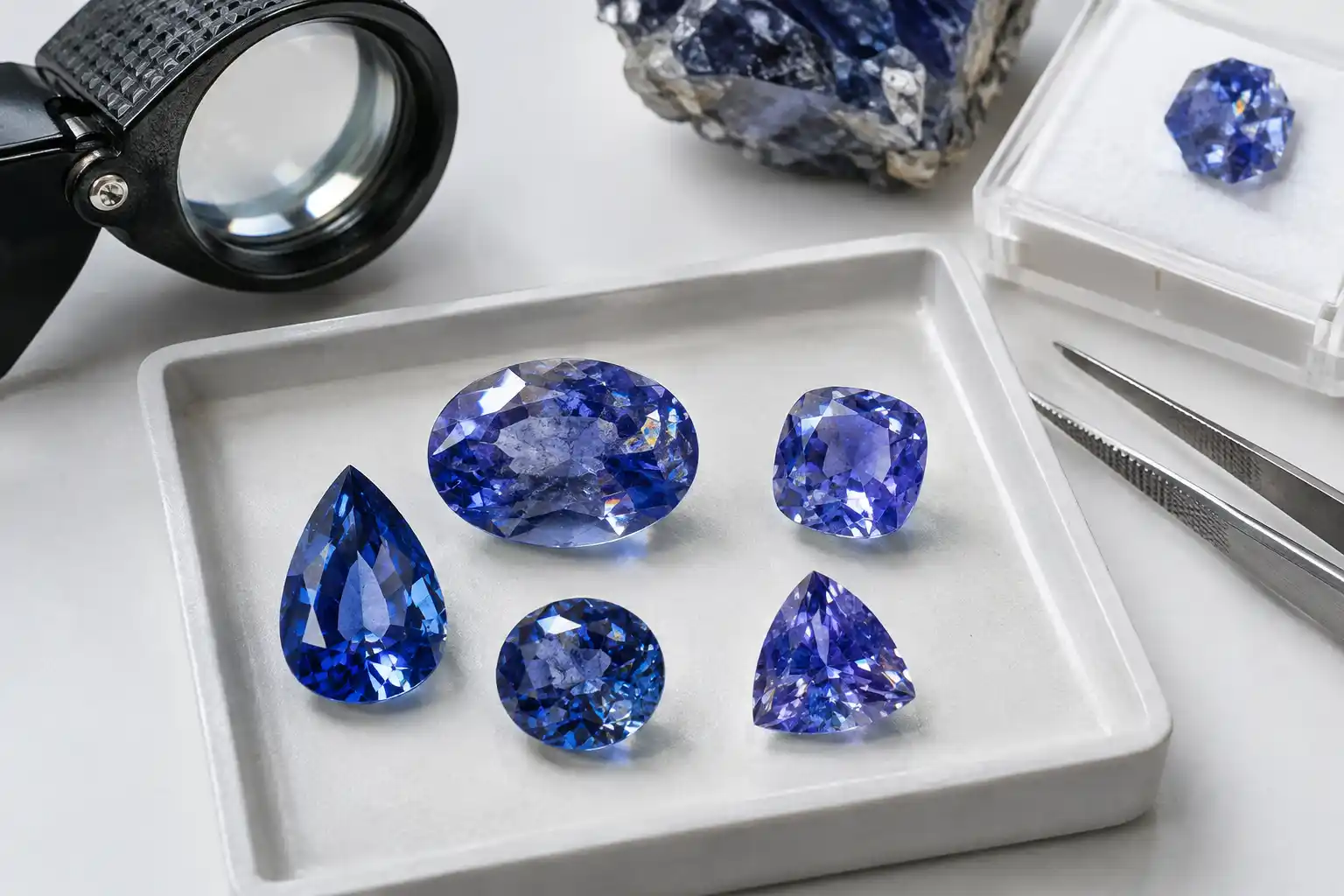
Benitoite Quality Grading: 7 Key Criteria for Rare California Gems
Benitoite quality grading begins with natural identity and blue color, then moves through tone, saturation, transparency, clarity, cut, size, provenance, and condition. Fine stones show vivid blue to violet-blue color with sufficient brightness to remain lively, while precision cutting reveals the gem’s unusually strong dispersion as spectral flashes across the crown. Because transparent facetable benitoite is genuinely scarce, particularly above one carat, size becomes an important rarity factor only after visible quality has been established.
Benitoite is barium titanium silicate, BaTiSi₃O₉, and belongs to the trigonal crystal system. Natural crystals often develop distinctive triangular or tabular forms and can occur with minerals such as neptunite and natrolite in their California geological setting. The gemstone has a Mohs hardness around 6 to 6.5, which is sufficient for carefully worn jewelry but significantly lower than sapphire’s hardness of 9.
There is no universal benitoite grading system equivalent to the formal scales used for diamond. Terms such as AAA, museum quality, collector grade, premium California blue, or investment grade may mean different things to different sellers. A reliable quality assessment therefore needs to examine the actual gemstone systematically rather than accepting a promotional label as a substitute for color, clarity, cut, size, and provenance.
7 Key Criteria for Benitoite Quality Grading
- Confirm natural benitoite identity
- Grade blue hue, tone, and saturation
- Evaluate transparency, clarity, and inclusions
- Judge cut quality, brilliance, and dispersion
- Consider carat weight and face-up dimensions
- Assess California provenance and collector significance
- Evaluate condition, treatment status, and overall durability
These seven criteria provide a practical framework for comparing faceted gems. They also help separate jewelry quality from mineral-specimen quality, since an important crystal on matrix can be exceptionally collectible even when its inclusions or fractures would make it unsuitable for faceting.
Natural Benitoite Identity Must Be Established Before Quality
A blue gemstone cannot be graded as benitoite until its mineral identity is reasonably secure. Sapphire, zircon, spinel, kyanite, blue glass, and other substances can overlap visually enough to mislead buyers who rely only on color photographs.
Benitoite has distinctive optical properties that professional testing can recognize. It is strongly birefringent, has characteristic refractive behavior, and often shows notable dispersion. Many natural stones and crystals also display strong fluorescence under shortwave ultraviolet illumination, although fluorescence should be treated as supporting evidence rather than a complete identification method.
The crystal system and morphology provide additional clues in rough specimens. Natural crystals can form striking triangular shapes that are highly recognizable to experienced mineral collectors, particularly when they occur on contrasting matrix with associated minerals.
Faceted stones lose much of that external crystal morphology, which makes standard gemological measurements even more important. An expensive blue gem should not receive a benitoite rarity premium simply because its color looks convincing.
Blue Hue Is the Most Important Visible Quality Criterion
Fine benitoite is usually prized for blue to violet-blue color. The strongest stones show a clearly saturated blue that remains visible under realistic lighting rather than becoming gray or nearly colorless away from strong display lamps.
Hue should be judged together with tone. A blue that is slightly violet can be attractive and characteristic, while an excessive gray modifier reduces the sense of richness. Very pale stones may still be beautiful and brilliant, particularly in smaller sizes, but conventional grading generally rewards stronger saturation.
Color also interacts with dispersion. A richly saturated but extremely dark stone may hide the spectral flashes that make benitoite visually distinctive, while a moderately saturated gem with excellent cutting can show a livelier balance of blue body color and fire.
The grader should therefore seek intensity without excessive darkness. Fine quality is achieved when the blue remains strong and the gemstone still returns enough white and dispersed light to appear animated.
Tone and Saturation Need to Be Evaluated Under Realistic Lighting
Jewelry-counter illumination can make many blue gems appear stronger than they do in everyday conditions. Benitoite should therefore be examined under neutral daylight-equivalent light and ordinary indoor illumination before a final color grade is assigned.
Medium to medium-dark tone often works well because it gives enough depth to the blue without creating excessive extinction. Very dark areas that remain black during normal movement should be considered a cut or tone weakness rather than evidence of superior saturation.
Small benitoites may naturally appear somewhat lighter because there is less optical path length through the colored crystal. This means a vivid half-carat stone can be genuinely fine even if it does not display the depth seen in a larger gem.
A quality assessment should compare stones within realistic size categories instead of assuming that the deepest blue specimen is always the highest grade.
Transparency and Clarity Should Support Brilliance Without Ignoring Rarity
Natural benitoite can contain crystals, fractures, internal veils, growth features, and other inclusions. Fine faceted stones are most desirable when they remain transparent and the inclusions do not interrupt the blue color or brilliance.
Eye-clean clarity is excellent, but absolute perfection should not be demanded mechanically in a rare gem. A small inclusion visible under magnification may have little practical effect, particularly in a stone whose size and color are difficult to replace.
Large fractures, opaque inclusions, or centrally located features that break up light return have a stronger negative effect. Surface-reaching fractures deserve particular attention because they can affect durability in a gemstone that is already softer than sapphire or spinel.
The rarity of larger benitoite means clarity tolerance may increase somewhat as size rises. A lightly included two-carat gem can still be extraordinary because transparent stones of that weight are exceptionally scarce.
A Practical Benitoite Clarity Framework
| Face-Up Appearance | Practical Quality Interpretation |
|---|---|
| Eye-clean with high transparency | Exceptional clarity |
| Minor inclusions visible only under magnification | Fine |
| Small visible inclusions with little brilliance loss | Good |
| Obvious central fractures or clouds | Commercial |
| Heavy inclusions or serious structural weakness | Lower faceting quality |
This framework is descriptive rather than an official laboratory system. The purpose is to keep clarity proportional to visual effect and rarity instead of allowing microscopic perfection to dominate the grade.
Cut Quality Determines Whether Benitoite Displays Its Full Optical Potential
Benitoite has strong dispersion, giving well-cut stones the ability to separate light into flashes of spectral color. This fire is especially attractive because it appears against a blue body color, creating a visual combination not commonly seen in other gemstones.
Dispersion alone does not guarantee beauty. A shallow stone with a large central window can leak light through the pavilion, while an excessively deep cut can create heavy extinction and hide both blue color and fire.
Cutters face difficult decisions because rough is rare and expensive. Weight retention can be economically important, particularly when a crystal might yield a stone near or above a psychologically important carat threshold.
As a result, some natural benitoites may show outlines or proportions that would be considered less than ideal in abundant gemstones. Moderate compromise can be understandable when it preserves rare weight, but severe windowing, poor polish, or lifeless appearance still reduces quality.
Precision cutting earns a premium because it deliberately sacrifices more rough to produce stronger light return, better symmetry, and a more visible combination of blue color and spectral fire.
Dispersion Should Be Judged Separately From Body Color
Benitoite’s dispersion is a physical optical property rather than a separate colored inclusion or coating. When white light enters a well-proportioned stone, different wavelengths can be separated enough to produce visible flashes of red, orange, yellow, green, and other colors.
The effect is easiest to appreciate under lighting that contains distinct bright sources. Diffuse flat lighting may make the stone look beautifully blue while revealing less fire.
A strong quality grade should not require maximum dispersion under every lighting condition. Instead, the cutter should allow the gemstone’s natural fire to appear without sacrificing the richness of the blue body color.
An overly pale stone may show strong spectral flashes but lack desirable blue saturation. A dark stone may display excellent color but hide much of the dispersion. Exceptional quality achieves a convincing balance between both.
Carat Weight Becomes a Major Quality and Rarity Consideration
Most faceted benitoite is small, and the scarcity of clean rough becomes increasingly severe as desired finished weight rises. Stones around one carat already attract substantial attention when their color and clarity are fine.
Gems above one carat become much more difficult to replace, and fine examples approaching two carats or more can enter an elite collector category. This makes size much more important in benitoite grading than it is in abundant stones such as amethyst.
Weight should still be separated conceptually from color and clarity. A large stone may be extraordinarily rare without being top visual quality.
Face-up dimensions help reveal whether weight has been used efficiently. An excessively deep stone can retain a high carat figure while presenting less visible surface area than a lighter, better-proportioned gem.
A strong overall grade therefore rewards size only when the finished stone remains attractive and structurally sound.
California Provenance Adds an Important Collector Dimension
Benitoite has an unusually close association with California, particularly San Benito County, where the most famous gem-quality deposits occur. That geographic identity is part of the gemstone’s history and contributes substantially to collector interest.
California’s designation of benitoite as the state gemstone further reinforces the relationship between mineral species and locality.
For faceted stones, provenance becomes more valuable when it is documented rather than merely assumed. Old receipts, collection labels, mine records, or reliable dealer history can strengthen confidence that a stone belongs to a known California production period or locality.
Mineral specimens depend even more heavily on provenance because the combination of benitoite crystals, matrix, associated minerals, crystal habit, and mine history can determine much of their collector value.
Origin should still remain separate from visible quality. A documented locality does not make a dull or badly damaged stone visually exceptional, but it can add significant historical and collecting importance.
Mineral Specimens Require a Different Grading Approach
A natural benitoite specimen should not be judged by the same standards as a faceted gem. Transparency and absence of inclusions may matter less than crystal shape, termination quality, matrix aesthetics, crystal grouping, associated minerals, fluorescence, and provenance.
Sharp triangular crystals arranged attractively on pale natrolite or contrasting matrix can be highly desirable even when the crystals are too fractured or included for cutting.
Damage becomes important when crystal points are broken, major faces are chipped, or repairs alter the specimen significantly. Restoration may be acceptable in some collecting circles when disclosed, but hidden repair can undermine trust and value.
This distinction is important because cutting a fine intact crystal specimen can destroy more collector value than the resulting faceted gemstone creates.
Treatment Status and Condition Should Be Checked Before Final Grading
Routine color enhancement is not central to benitoite, so natural blue is generally expected. Buyers should nevertheless consider fracture filling, coatings, composite construction, repairs, recutting, or other interventions when evaluating expensive pieces.
Condition is particularly important because benitoite is moderately hard rather than exceptionally hard. Worn facet junctions, chips, scratches, abrasions, and damaged girdles can reduce both beauty and long-term durability.
An older mounted gemstone may show wear that is consistent with age, but severe repolishing can reduce weight. For rare stones, even small weight losses can affect value noticeably if the recut crosses an important carat threshold.
Quality grading should therefore examine the present gemstone and its history together. A beautiful stone that has been heavily altered may belong to a different collector category from an equally attractive example retaining original documented condition.
Benitoite Fluorescence as a Collector and Identification Feature
Benitoite is famous for striking ultraviolet fluorescence, particularly under shortwave UV. This response can make natural specimens exceptionally impressive in mineral displays and provides an additional feature beyond ordinary visible-light color.
Fluorescence strength can vary among individual stones and specimens. Its presence does not automatically establish a top quality grade, since visible blue color, transparency, cut, size, and condition remain more important for faceted jewelry.
For fluorescent-mineral collectors, however, an exceptional response combined with attractive natural crystal form can add significant desirability.
The best grading approach therefore treats fluorescence as a specialized supporting feature rather than forcing it into the same hierarchy as blue saturation or carat weight.
Common Benitoite Grading Mistakes
A frequent mistake is assuming that the darkest blue stone must be the finest. If the gem becomes too dark, extinction can hide both brilliance and the colorful dispersion that makes benitoite distinctive.
Another error is ignoring cutting because the mineral itself is rare. Rarity cannot compensate completely for a large window, poor polish, or severe asymmetry that harms the face-up appearance.
Carat weight can also dominate buyer attention. Large stones deserve scarcity premiums, but a heavier grayish or heavily fractured gem should not automatically receive a higher visual grade than a smaller vivid stone.
Collectors sometimes treat fluorescence as proof of exceptional value without considering visible-light quality. Fluorescence is important and fascinating, but it occupies a different role from body color, clarity, and size.
Finally, seller terms such as museum grade or AAA should never replace direct assessment because no universal body enforces those descriptions.
A Practical Overall Benitoite Quality Framework
| Quality Level | Typical Characteristics |
|---|---|
| Exceptional | Vivid saturated blue, strong transparency, lively dispersion, excellent cut, rare size and strong provenance |
| Fine | Strong blue, eye-clean or nearly clean, good brilliance, limited cut compromise |
| Good | Attractive blue, moderate inclusions, competent cut, smaller size |
| Commercial | Pale or grayish color, visible inclusions, windowing or modest brilliance |
| Low | Weak color, heavy fracturing, poor transparency, significant damage or poor cutting |
This framework is descriptive rather than an official universal scale. Its value lies in making each judgment understandable instead of reducing a rare gemstone to an unexplained marketing letter.
Benitoite Durability Should Influence the Final Quality Judgment
A Mohs hardness around 6 to 6.5 means benitoite is suitable for jewelry but requires more care than sapphire, ruby, chrysoberyl, spinel, or diamond.
Earrings and pendants are particularly sensible because they receive less abrasion and impact than rings. A ring can still be worn when the setting protects the gemstone and the owner accepts the need for careful use.
Structural fractures deserve more attention in rings because impact can propagate existing weaknesses. Secure prongs or protective bezels also reduce the risk of losing a rare stone.
Separate storage is essential because many common jewelry gemstones are harder and can scratch benitoite. Preserving polish and facet edges is part of preserving long-term quality.
Conclusion
Benitoite quality grading should focus on natural identity, saturated blue color, balanced tone, transparency, clarity, cutting, dispersion, carat weight, California provenance, condition, and accurate treatment disclosure. Fine stones combine these features rather than excelling in only one category.
The defining challenge is rarity. Larger transparent benitoite is difficult to replace, but scarcity should never excuse poor visible quality completely. The finest examples remain vividly blue, return light effectively, show attractive spectral fire, retain good structural condition, and carry provenance appropriate to a gemstone so closely associated with California.
FAQs About Benitoite Quality Grading
What is the most important quality factor in benitoite?
Blue color is usually the most important visible factor, especially when strong saturation is combined with brightness. Clarity, cutting, dispersion, carat weight, and provenance then refine the overall grade.
What color benitoite is considered the best?
Vivid blue to violet-blue with good saturation and limited gray is generally most desirable. The stone should remain bright enough to show brilliance and spectral dispersion rather than becoming excessively dark.
Should fine benitoite be eye-clean?
Eye-clean clarity is highly desirable, but minor inclusions can be acceptable because natural benitoite is exceptionally scarce, especially in larger sizes. Inclusions become more serious when they interrupt transparency or weaken the stone structurally.
Does benitoite have more fire than sapphire?
Benitoite has stronger dispersion than sapphire and can show conspicuous spectral flashes when well cut. The visibility of that fire depends on lighting, body color, proportions, and facet arrangement.
Is one-carat benitoite rare?
Yes. Fine transparent stones around one carat are significantly scarcer than small benitoite gems, and rarity rises rapidly as weight increases while good color and clarity are retained.
Is California origin important in grading?
California provenance is an important collector factor because the gemstone is strongly associated with San Benito County. For faceted jewelry, visible color and cut remain essential, while documented provenance adds historical and rarity value.
Is benitoite a durable everyday gemstone?
It is moderately durable at about 6 to 6.5 on the Mohs scale but is softer than sapphire and many other common jewelry gems. Pendants and earrings are easier to protect, while rings benefit from secure settings and careful wear.
Is fluorescence part of benitoite quality grading?
Fluorescence adds collector and identification interest but is normally secondary to visible blue color, transparency, cut, size, and condition when grading a faceted gem.
Are dark benitoites better than lighter stones?
Not automatically. Deep saturation can be desirable, but excessive darkness creates extinction and hides brilliance. A somewhat lighter stone with stronger light return can grade higher.
Can benitoite be treated?
Routine color treatment is not a major feature of the market, and natural color is normally expected. Any filling, coating, repair, or other modification should still be disclosed when relevant.
Is benitoite harder than quartz?
No. Quartz has a Mohs hardness of 7, while benitoite is approximately 6 to 6.5. Quartz can therefore scratch benitoite under the right conditions.
What inclusions occur in natural benitoite?
Natural stones can contain mineral crystals, fractures, veils, growth features, and other inclusions associated with geological formation. Their effect on grade depends on visibility, location, and structural significance.
Why is cut orientation important in benitoite?
Good orientation and proportions help balance blue color with brilliance and dispersion. Poor cutting can create a large window, excessive darkness, or insufficient fire even when the rough was attractive.
Can a mineral specimen be higher quality than a faceted stone?
They are judged by different standards. A rare crystal on attractive matrix can be an exceptional mineral specimen even when it is unsuitable for faceting, while a fragment lacking crystal form can produce a fine gemstone.
Are AAA benitoite grades standardized?
No. AAA, museum grade, premium, and similar descriptions are seller-defined. Quality should be assessed through observable color, clarity, cut, size, condition, and provenance.
What makes benitoite exceptional?
Exceptional benitoite combines vivid blue or violet-blue color, excellent transparency, limited distracting inclusions, strong brilliance and dispersion, skilled cutting, significant natural size, excellent condition, and trustworthy California provenance.