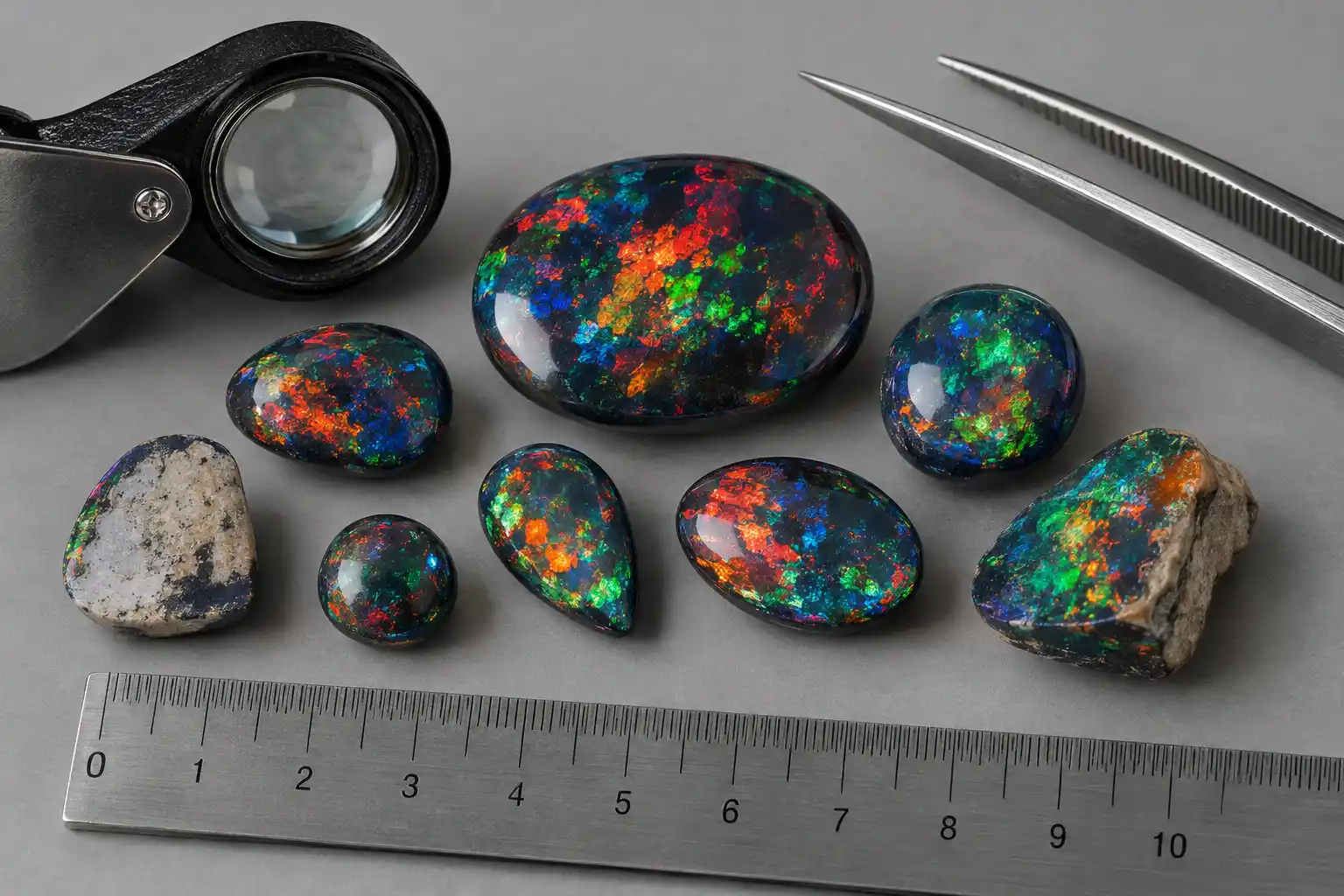
Black Opal Price Per Carat: 11 Critical Factors Determining True Worth
Black opal price per carat can range from well under a few hundred dollars for commercial stones with subdued play-of-color to several thousand dollars per carat for fine gems with a dark body tone, exceptional brightness, broad color coverage, and desirable patterns. Exceptional solid black opal displaying vivid red, orange, green, and blue against an N1 to N4 dark body can rise beyond $10,000 per carat, while unusually important stones with exceptional pattern, provenance, size, and color can exceed ordinary retail ranges by a substantial margin. Unlike diamond, black opal does not have a single standardized price chart, so two stones of identical weight can differ enormously in value.
The reason is that black opal is judged primarily by visual performance rather than carat weight alone. Its dark body creates a dramatic background against which microscopic silica structures can produce play-of-color through diffraction. Bright red flashes across a dark face may carry far more market demand than weak blue-green pinfire in a lighter stone, while a rare pattern such as well-defined harlequin can command a premium beyond what color alone would suggest. Brightness, pattern, body tone, dominant color, face-up coverage, size, shape, stability, origin, and treatment all interact.
Buyers also need to establish whether the stone is solid natural black opal rather than a doublet, triplet, smoked hydrophane opal, dyed product, or another assembled or treated stone. Doublets and triplets can make attractive jewelry, but their total carat weight includes backing or capping that is not solid precious opal. A meaningful valuation therefore begins with identity and construction before any per-carat comparison is attempted.
11 Critical Factors Determining Black Opal Worth
- Natural solid opal versus doublet, triplet, or imitation
- Body tone and darkness
- Brightness of the play-of-color
- Dominant spectral colors
- Range of visible colors
- Pattern rarity and definition
- Face-up play-of-color coverage
- Carat weight, dimensions, and shape
- Transparency, thickness, and natural backing
- Origin, treatment, and long-term stability
- Cut quality, provenance, certification, and market demand
These factors should be considered as one visual and gemological system rather than separate checkboxes. A three-carat stone with intense red-orange broad flash may be worth substantially more per carat than a six-carat gem with weak blue pinfire, while a beautifully patterned but unstable stone can lose value because durability affects its usefulness as jewelry.
Typical Black Opal Price Per Carat
Black opal prices are unusually variable, so broad ranges are more useful than a rigid chart. The following figures are intended as practical orientation for natural solid stones rather than assembled doublets and triplets.
| Black Opal Quality | Approximate Price Per Carat | Typical Characteristics |
|---|---|---|
| Commercial quality | $50 to $300 | Dark to medium-dark body, subdued brightness, limited color |
| Good jewelry quality | $300 to $1,000 | Stronger brightness, useful green-blue or multicolor coverage |
| Fine quality | $1,000 to $5,000 | Dark body, vivid play-of-color, strong coverage, attractive pattern |
| Exceptional quality | $5,000 to $10,000+ | Intense multicolor display, red present, high brightness, fine pattern |
| Rare collector-grade stones | Can exceed $10,000 per carat substantially | Exceptional red-on-black, rare pattern, major size, provenance and outstanding stability |
These ranges overlap because the market does not value black opal mechanically. A highly desirable one-carat gem can command more per carat than a larger stone if its brightness, pattern, dominant color, and body tone are stronger. Finished jewelry also includes metal, craftsmanship, accent gemstones, designer attribution, antique interest, and retail margin, so the total price of a ring should not be interpreted as the center stone’s loose per-carat value.
Natural Solid Black Opal Carries the Strongest Rarity Premium
A solid black opal is cut from one natural piece of opal-bearing rough rather than assembled from multiple layers. The back may include natural potch or host structure that formed with the stone, which is very different from an artificially attached backing.
A doublet typically uses a thin layer of precious opal cemented to a dark backing. The backing intensifies contrast and gives fragile thin opal additional support. A triplet adds a transparent protective cap above the opal layer, producing a three-part construction.
Both can be visually attractive and useful for jewelry, but they contain much less natural precious opal than an equivalent-looking solid stone. Their total weight therefore should not be compared directly with the carat weight of solid black opal.
Imitations introduce another category. Glass, synthetic opal, polymer products, and composite constructions can reproduce colorful effects without possessing the same geological rarity. The first valuation question should therefore be what the object actually is, not how dramatic it appears under a display light.
Body Tone Creates the Dark Background That Defines Black Opal
Black opal is defined by body tone rather than simply by having black color somewhere in the stone. The body tone refers to the underlying darkness of the opal when the play-of-color is mentally separated from it.
A commonly used body-tone scale runs from N1, the darkest black, through progressively lighter tones to N9, which represents very light or white opal. Stones generally classified as black opal occupy the darkest part of that scale, while somewhat lighter stones may be called dark or semi-black opal depending on the grading system being used.
A dark body can increase contrast dramatically. Bright green, blue, orange, or red appears more vivid when placed against an N1 or N2 background than against pale common opal.
Darkness alone does not create value, however. An almost black stone with weak play-of-color can be much less desirable than a slightly lighter gem whose color is brilliant and covers the entire face. Body tone provides the stage, while brightness and pattern determine what happens on it.
Brightness Is One of the Strongest Price Drivers
The brilliance of the spectral colors often matters more than the sheer number of colors present. Fine black opal should display play-of-color that looks vivid and distinct rather than faint, smoky, or difficult to see.
Brightness is strongly affected by lighting. Direct sunlight, diffuse daylight, warm indoor lamps, and cool LEDs can make the same stone look quite different. A serious comparison should therefore examine stones under the same light rather than comparing unrelated photographs.
A bright gem generally remains impressive through a useful range of movement instead of producing one intense flash at a single narrow angle. The strongest stones seem visually active as the opal turns, with color appearing repeatedly across the face.
Some sellers use brightness grades such as B1 through B5, but conventions and direction of numbering can vary. Buyers should therefore rely on the actual visible intensity rather than assuming a seller’s brightness label is universally standardized.
Red Play-of-Color Often Commands the Highest Premium
Red is generally the most prized play-of-color in black opal because the optical structures required to diffract longer red wavelengths are less common than those producing blue and green. A vivid red display against a dark body can therefore create a substantial premium.
Orange and yellow also add value, especially when combined with red. Green is common enough to appear frequently in good jewelry stones but can still be spectacular when exceptionally bright. Blue and violet can be beautiful, particularly in distinctive patterns, though they generally receive a lower market premium than equally strong red.
This hierarchy should not be applied blindly. A dull reddish stone is not automatically more valuable than a breathtaking electric blue-green gem. Brightness, coverage, pattern, and overall beauty remain essential.
The finest multicolor stones may show red, orange, yellow, green, blue, and violet as the viewing angle changes. When those colors are both intense and well distributed, the stone can enter a much higher value category.
Pattern Can Transform an Attractive Opal Into a Collector Gem
Black opal patterns vary enormously because play-of-color patches differ in size, geometry, orientation, and movement. Common descriptions include pinfire, broad flash, rolling flash, ribbon, floral, flagstone, straw, Chinese writing, and other visually descriptive terms.
Harlequin is one of the most famous premium patterns. True high-quality harlequin should display relatively distinct angular or mosaic-like color patches with enough organization to be immediately recognizable. The term is sometimes used too loosely in sales descriptions, so the actual pattern should be examined rather than accepted from a label.
A rare pattern earns its premium only when brightness is also strong. An unusually organized pattern with weak gray color may be less desirable than a simpler broad-flash gem whose colors are exceptionally vivid.
Movement also matters. Some stones reveal a pattern continuously across several angles, while others lose it quickly. Fine pattern and strong directional performance together can create substantial collector value.
Face-Up Color Coverage Determines How Much of the Stone Performs
A black opal may have superb color in only one small corner while the rest of the face remains dark potch or low-brightness opal. Such a stone can still be attractive, but it generally does not command the same price as a gem whose play-of-color covers most of the visible surface.
Near-full face coverage is especially desirable when brightness is high. A stone in which vivid color reaches from edge to edge provides a larger visual experience without requiring extra carat weight.
Coverage also interacts with pattern. Large black areas can sometimes improve design by creating contrast and separating individual color patches. The question is whether the dark areas enhance the composition or simply represent inactive space.
This is why percentage estimates should be used carefully. Two stones may both show 80 percent color coverage, but one can appear far finer because the active area contains stronger red and a more distinctive pattern.
Carat Weight Matters Most When Exceptional Quality Survives at Larger Sizes
Large solid black opals with high brightness and fine pattern become significantly harder to find as weight increases. A five-carat gem with exceptional red multicolor play can therefore receive a meaningful size premium over a comparable one-carat stone.
The relationship is not linear. A ten-carat stone of fine quality may be worth more than ten times the total value of a similar one-carat gem because replacing a large high-quality stone is much more difficult.
Carat weight must still be considered alongside dimensions. Opal cabochons can be cut with high domes, thick backs, or substantial natural potch, so two five-carat stones may have very different face-up sizes.
A buyer should therefore compare length, width, dome shape, thickness, and visible color area rather than choosing purely by weight.
Symmetry also contributes to value. Ovals and freeforms can both be desirable, but balanced outlines generally make setting easier and improve jewelry versatility. An irregular shape may still command a premium when it preserves an exceptional natural pattern that would have been destroyed by conventional cutting.
Opal Thickness and Natural Potch Influence Both Beauty and Durability
Black opal rough often contains precious opal associated with darker common opal or potch. Cutters may retain natural potch on the back because it supports the color-bearing layer and provides structural thickness.
A thin color bar can still produce extraordinary play-of-color, but durability becomes more important when the precious layer is close to the surface or follows an irregular boundary.
A high dome can intensify some optical effects and create a pleasing cabochon shape, but excessive thickness should not be mistaken for superior quality when the extra weight consists largely of inactive backing.
Transparency also varies. Some black opals are relatively opaque, while black crystal opal has greater transparency or translucency combined with dark appearance and play-of-color. Both can be valuable when brightness and color are exceptional.
The correct valuation depends on how these physical characteristics contribute to the face-up appearance rather than rewarding one structural style automatically.
Lightning Ridge Origin Carries Strong Market Recognition
Lightning Ridge in New South Wales, Australia, is the locality most strongly associated with fine natural black opal. The region has produced many historically important dark-bodied opals with intense play-of-color and remains central to the gemstone’s identity.
Reliable Lightning Ridge provenance can increase confidence and collector appeal, particularly for exceptional stones accompanied by documentation or an established chain of ownership.
Origin should not replace quality. A weak or cracked Lightning Ridge opal is not automatically worth more than a beautiful stable dark opal simply because the locality is famous.
Buyers should also be cautious when black opal terminology is applied to darkened hydrophane opal from other regions. Ethiopian hydrophane opal, for example, can be smoked or treated so the body becomes dark. Such products can be visually attractive but should not be represented as naturally dark Australian black opal.
Treatment Can Dramatically Change Apparent Black Opal Value
Natural black body tone carries a strong rarity premium because it formed geologically. Artificial darkening can mimic the contrast that makes black opal desirable, which is why treatment disclosure is essential.
Smoking can darken certain hydrophane opals by introducing carbon-like material into their porous structure. Sugar-and-acid treatments have also historically been used to darken some opal by creating carbon within the stone. Dyeing or surface coatings can create other deceptive appearances.
Hydrophane opal has a porous structure capable of absorbing water and other substances. When wet, its transparency and apparent color can change significantly, which also makes certain treatments possible.
A treated black-looking opal is not the same market product as naturally dark Lightning Ridge black opal. The stone should be described according to its true origin and treatment rather than being valued from appearance alone.
Stability Is Part of Black Opal Value
Opal contains water within its hydrated silica structure and can be sensitive to environmental stress. Some stones remain stable for generations, while others develop crazing, a network of cracks that can severely reduce durability and value.
Existing crazing is a major condition issue. A beautiful pattern cannot compensate fully for a stone already showing structural failure.
Drying history and mining locality can influence stability, but no simple home test guarantees that an opal will never craze. Proper cutting, gradual drying of rough, experienced handling, and appropriate storage all contribute to long-term performance.
Extreme heat and rapid temperature changes should be avoided. Opal should also be protected from strong impact because its hardness is only about 5.5 to 6.5 and its toughness varies.
A stable older opal that has remained intact for decades can provide useful confidence, particularly when provenance and condition are well documented.
How Black Opal Differs From Boulder Opal and Matrix Opal
Black opal usually refers to solid opal with a naturally dark body tone. Boulder opal remains attached to its ironstone host, with precious opal occurring as seams or patches across the natural rock. Matrix opal contains precious opal dispersed through pores or structures within the host rock.
These categories can all display exceptional play-of-color, but their weight cannot be compared directly because boulder and matrix opal include substantial host rock.
A ten-carat boulder opal may contain only a thin precious opal seam, while a ten-carat solid black opal consists much more substantially of opal. Per-carat valuation therefore needs to stay within comparable categories.
Visual beauty can still make fine boulder opal extremely valuable. The distinction is about construction and geology, not whether one category is automatically attractive and another is not.
How to Compare Two Black Opals Before Buying
Begin with body tone and brightness under the same neutral light. Ignore carat weight initially and decide which stone produces the stronger immediate visual response. Then move both stones slowly and observe whether the play-of-color remains active through several viewing angles.
Next evaluate dominant colors, pattern, and coverage. A vivid red-orange-green broad flash extending across most of the face generally carries stronger market demand than sparse blue-green pinfire, assuming other factors are similar.
Inspect the stone from the side and back to confirm whether it is solid, doublet, or triplet and to understand the thickness of the color layer and natural backing. Look for crazing, chips, open fractures, poorly polished areas, or evidence of assembly.
Only after those observations should weight, origin, and documentation be used to refine the valuation. This sequence prevents an impressive carat figure or famous locality name from overshadowing the characteristics that actually create beauty.
Is Black Opal a Good Investment?
Exceptional natural black opal is scarce and has a long-standing collector market, but no individual stone should be treated as a guaranteed investment. Retail and resale markets differ, and value depends on quality, provenance, condition, documentation, market fashion, and access to specialist buyers.
The strongest collector candidates are usually stones that would remain difficult to replace even in a strong market. Intense red or multicolor play, dark natural body tone, exceptional pattern, large size, stability, solid construction, and credible Lightning Ridge provenance can all contribute.
Ordinary commercial stones purchased at high retail margins may not perform the same way. A buyer who also appreciates the gem aesthetically is in a stronger position because ownership provides value even when future resale is uncertain.
Caring for Valuable Black Opal
Black opal should be protected from hard impact, prolonged extreme heat, and abrupt temperature changes. Its hardness is lower than quartz, sapphire, or diamond, so loose storage beside harder jewelry can scratch the polished surface.
A soft damp cloth and mild cleaning are generally safer than aggressive mechanical methods. Ultrasonic and steam cleaning should be avoided because fractures, water content, treatments, adhesives, or assembled construction can make those methods risky.
Doublets and triplets should not be soaked because prolonged moisture may affect adhesive layers. Solid natural opal does not need to be stored permanently in water, and routine jewelry care should focus on stable moderate conditions rather than dramatic moisture treatments.
Periodic examination of a ring setting is also sensible because a loose prong or hard impact can endanger a stone that may be difficult to replace.
Conclusion
Black opal price per carat depends on a tightly connected combination of natural solid construction, dark body tone, brightness, dominant spectral color, pattern, face-up coverage, size, thickness, origin, treatment, stability, and craftsmanship. Commercial stones may cost only a fraction of what fine red-on-black opal commands, while exceptional collector gems can rise far beyond ordinary per-carat ranges.
The most reliable valuation starts with the visible stone rather than its weight. A fine black opal should remain vividly colorful as it moves, show strong contrast against a naturally dark body, possess an attractive and recognizable pattern, and remain structurally stable. When those qualities occur together in a sizeable solid gem with reliable provenance, scarcity can drive value to extraordinary levels.
FAQs About Black Opal Price Per Carat
How much does black opal cost per carat?
Commercial natural black opal may begin around tens to a few hundred dollars per carat, while fine stones can move into roughly $1,000 to $5,000 per carat. Exceptional red or multicolor stones with dark body tone, rare pattern, and strong brightness can exceed $10,000 per carat substantially.
Why is black opal so expensive?
Fine natural black opal combines a naturally dark body with vivid play-of-color, and large stable stones showing exceptional brightness and red spectral color are difficult to find. Rarity increases further when the pattern is unusual and most of the face remains active with color.
Is red black opal more valuable than blue black opal?
Red generally commands the strongest market premium because red play-of-color is less common than blue and green. Brightness, pattern, coverage, body tone, and size still matter, so an exceptional blue-green gem can be more valuable than a weak red stone.
Does darker body tone always mean higher value?
No. A very dark N1 or N2 body can improve contrast, but weak play-of-color will still limit value. A slightly lighter stone with brilliant multicolor fire can be far more desirable than a nearly black gem with little visible color.
What is the most valuable black opal pattern?
Well-defined harlequin is among the most famous premium patterns, but broad flash, ribbon, flagstone, floral, and other rare organized patterns can also be highly valuable when brightness and spectral color are strong.
Does black opal become more expensive as carat weight increases?
Fine larger stones often gain a substantial per-carat premium because maintaining vivid color, strong pattern, stability, and dark natural body tone becomes increasingly difficult as size rises. Weight alone does not create the premium if quality is weak.
Is Lightning Ridge black opal more valuable?
Lightning Ridge has exceptional recognition as the classic source of fine natural black opal. Reliable provenance can add confidence and collector interest, although individual quality still determines most of the stone’s visual value.
Are black opal doublets valuable?
Doublets can make attractive jewelry and may contain genuine natural precious opal, but they generally command less than comparable solid black opal because the visible layer is thin and attached to a backing. Their weight should not be compared directly with solid stones.
Is smoked Ethiopian opal the same as natural black opal?
No. Smoking can darken porous hydrophane opal and create strong contrast, but the dark body is treatment-produced. It belongs to a different market category from naturally dark solid black opal and should be disclosed accordingly.
Can black opal be treated?
Yes. Some opals may be smoked, dyed, sugar-treated, coated, impregnated, assembled, or otherwise modified. Treatment type can have a major effect on value, particularly when the appearance imitates naturally dark opal.
What is black crystal opal?
Black crystal opal combines a dark or sufficiently deep body appearance with greater transparency or translucency than ordinary opaque black opal. Fine examples can show exceptional depth and play-of-color and may be highly valuable.
Does crazing reduce black opal value?
Yes. Crazing is a network of fractures that indicates structural deterioration and can reduce both durability and market value significantly. A stone with exceptional color but active crazing is not equivalent to a stable gem.
How important is brightness in black opal valuation?
Brightness is one of the strongest value factors because vivid play-of-color is immediately visible and gives the gem its impact. A bright stone with a simpler pattern can outperform a rare-pattern stone whose colors are weak.
How do I know whether a black opal is solid?
Examine the side and back for glued layers, abrupt interfaces, protective caps, or attached backing. Valuable purchases should be described clearly as solid, doublet, or triplet rather than leaving construction uncertain.
Can a small black opal be more valuable than a larger one?
Yes. A small gem with brilliant red multicolor play, excellent pattern, and full coverage can command a much higher price per carat than a large dull stone with limited blue-green color.
Is black opal suitable for everyday rings?
It can be worn in rings, but its hardness and variable toughness require more care than sapphire or diamond. Protective settings, avoidance of severe impact, and sensible cleaning help preserve valuable stones.
Does black opal need to be stored in water?
Solid black opal does not ordinarily need permanent water storage. Stable moderate conditions and protection from extreme heat or rapid environmental changes are more appropriate for normal finished jewelry.
What makes black opal collector grade?
Collector-grade black opal typically combines natural solid construction, dark body tone, exceptional brightness, rare or strongly defined pattern, vivid multicolor play that may include red, substantial size, stable condition, and reliable provenance.