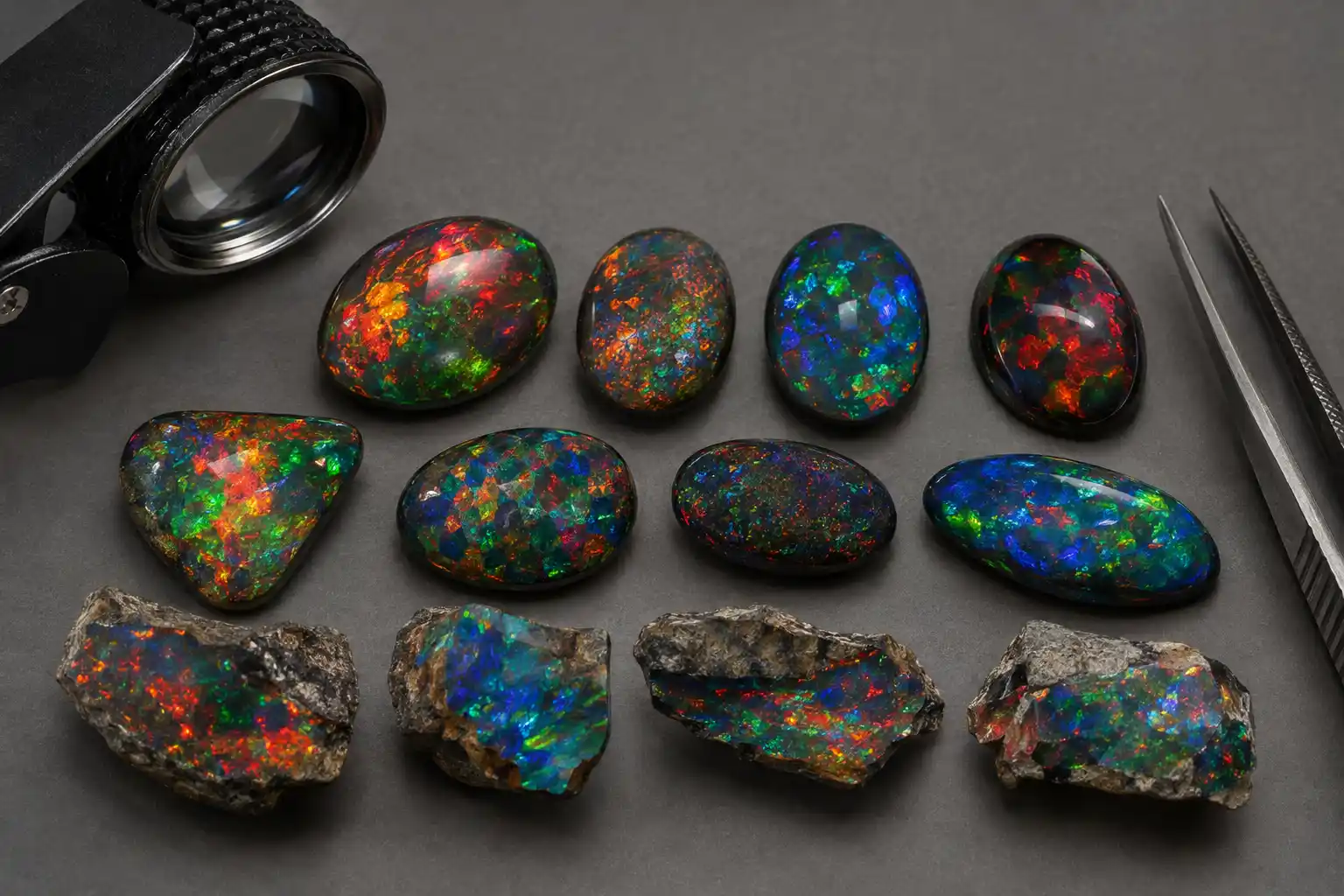
Black Opal Quality Grading: 8 Ways to Evaluate Body Tone & Fire
Black opal quality grading begins with two separate observations: how dark the underlying body is and how strongly the play-of-color performs above that body. The finest stones combine a naturally dark background with brilliant spectral colors, broad face-up coverage, attractive movement, an identifiable pattern, good structural stability, and enough thickness for secure cutting. A stone can have an excellent black body tone but remain commercial quality if the fire is weak, while a somewhat lighter dark opal can be exceptional if its play-of-color is intensely bright and visually complex.
The term fire is often used informally for opal’s spectral display, but the more precise gemological term is play-of-color. Precious opal produces this phenomenon when ordered microscopic silica structures diffract visible light into different wavelengths. As the observer, light, or stone moves, the apparent colors can change because the viewing geometry changes. This mechanism is different from the dispersion seen in diamond or benitoite and different from pleochroism in stones such as andalusite.
There is no single universally enforced grading system that converts all black opal characteristics into one official letter. Sellers may use terms such as gem grade, AAA, investment quality, N1 black, B5 brightness, or collector grade, but brightness conventions and commercial labels can differ. Reliable grading therefore requires direct assessment of body tone, brightness, spectral colors, pattern, coverage, construction, condition, size, and treatment.
8 Ways to Evaluate Black Opal Body Tone and Fire
- Confirm natural solid opal and identify construction
- Grade body tone independently from play-of-color
- Evaluate brightness under consistent lighting
- Assess dominant colors and spectral range
- Judge pattern rarity, definition, and movement
- Evaluate face-up color coverage and directionality
- Inspect thickness, cut, condition, and structural stability
- Verify origin, treatment, provenance, and overall rarity
These eight criteria work together. A high black-opal grade should describe the finished gem rather than rewarding one isolated feature, since rare color is far less valuable when hidden by poor cutting or threatened by structural instability.
Natural Identity and Construction Must Be Established First
A grading system for solid black opal cannot be applied directly to every dark opal-looking product. A natural solid stone is fundamentally different from a doublet or triplet even when the face-up appearance is similar.
A doublet typically consists of a thin precious opal layer attached to a darker backing. A triplet uses a similar thin opal layer but adds a transparent cap to protect the surface and often intensify the finished appearance. These constructions are legitimate jewelry products when accurately disclosed.
Natural solid black opal may also retain potch on the back. Potch is common opal that does not show valuable play-of-color, but when it formed naturally with the precious opal it is part of the same rough rather than an artificially attached backing.
This distinction can often be investigated by examining the stone from the side. A perfectly flat junction, adhesive line, transparent dome, or abrupt backing interface may indicate assembled construction.
Imitations and synthetic opals require separate consideration. Their patterns can sometimes appear convincing, but they do not receive a natural black-opal rarity grade.
Body Tone Should Be Graded Before the Colors Distract the Eye
Body tone describes the underlying darkness of the opal when its spectral flashes are disregarded. A commonly used scale ranges from N1, representing very black body tone, through progressively lighter values to N9, representing white body tone.
Black opal generally occupies the darkest range of this scale, while somewhat lighter dark-bodied material may be classified separately as dark or semi-black opal depending on the grading convention.
Evaluating body tone can be difficult when a stone has intense play-of-color because the spectral display dominates the visual impression. The grader should examine inactive portions, the back where appropriate, and angles at which play-of-color is reduced.
A darker N1 or N2 body can create excellent contrast, but body tone alone is not a final quality grade. A nearly black stone with dim green pinfire can grade below an N3 or N4 gem whose vivid red and orange cover the entire face.
Brightness Determines Whether the Play-of-Color Looks Alive
Brightness is the intensity of the spectral display. Fine black opal should produce strong, distinct colors that are readily visible rather than faint flashes requiring careful searching.
Evaluation needs controlled lighting because opal is highly responsive to illumination. A stone photographed in direct sunlight may appear dramatically brighter than it does under soft indoor light, while some LED spectra emphasize different colors.
The most useful approach compares several stones side by side under identical conditions. This removes much of the subjective uncertainty and makes differences in brightness obvious.
Movement should also be included. A stone that maintains strong color through several angles is generally more compelling than one with a single bright flash visible only at a narrow orientation.
Some commercial systems express brightness through numbered grades, but these are not always used identically. The grader should therefore record visible brightness descriptively rather than assuming the number alone has universal meaning.
Dominant Color and Spectral Range Need Separate Evaluation
The colors visible in precious opal are not equally common. Red generally receives the strongest market premium, followed by orange and yellow, while green and blue are encountered more frequently.
The hierarchy reflects the structural conditions required to diffract longer wavelengths. Red play-of-color therefore contributes strongly to high-end black opal grading when it is bright, stable through movement, and present over a meaningful area.
Spectral range is a second consideration. A stone displaying red, orange, yellow, green, blue, and violet can be more desirable than a single-color gem when the colors are equally bright.
A broad color range does not automatically produce higher quality. Weak rainbow pinfire can look less impressive than powerful green-blue rolling flash, and a vivid pure red pattern can be extraordinarily valuable even when fewer colors are visible.
The correct grading decision balances rarity of hue with brightness, area, and aesthetic cohesion.
Pattern Quality Is More Important Than a Marketing Name
Black opal patterns describe how the play-of-color is organized across the face. Pinfire consists of many small points, while broad flash presents larger fields of color. Rolling flash moves across the stone as it tilts, and flagstone can form larger separated blocks.
Harlequin is one of the most desirable and most overused pattern names. Fine harlequin should show an organized mosaic of distinctive angular color patches rather than simply any multicolored broken pattern.
Other descriptive names such as floral, ribbon, straw, mackerel, Chinese writing, and related terms may be used by dealers and miners. These terms can help communicate appearance, but they are not always defined identically.
Pattern should therefore be judged visually. The grader should ask whether it is clear, attractive, persistent during movement, and sufficiently unusual to justify a premium.
A rare pattern with poor brightness should not outrank an intensely bright stone solely because its label sounds more prestigious.
A Practical Black Opal Pattern Comparison
| Pattern Character | Grading Consideration |
|---|---|
| Well-defined harlequin or rare geometric pattern | Very strong premium when bright |
| Broad flash or rolling flash | High impact when coverage is extensive |
| Flagstone or organized patch pattern | Strong appeal with vivid color |
| Floral, ribbon or distinctive directional pattern | Variable premium depending on brightness |
| Pinfire | Attractive but generally more common |
| Random weak color | Lower pattern contribution |
The table is a practical comparison rather than an official universal hierarchy because every pattern still needs to be evaluated together with color, brightness, body tone, and coverage.
Face-Up Coverage Shows How Much of the Gem Actually Performs
Color coverage is the proportion of the visible face that shows active play-of-color. Full or near-full coverage is generally desirable, especially when brightness remains strong across the surface.
Large inactive dark areas can reduce quality when they simply represent portions with no spectral display. They can also improve a design when they create deliberate contrast around bright pattern, so coverage should not be converted into an automatic percentage grade.
The position of the strongest color matters as well. A bright red area centered in the gem usually contributes more to face-up impact than the same amount of red confined to an edge hidden by a setting.
Directionality is another important issue. Some opals display excellent color only when viewed from one side, while others remain active from many directions. Jewelry stones generally benefit from a wider viewing range because they continue to perform as the wearer moves naturally.
A grader should therefore tilt the stone slowly in multiple directions and observe not only how much color appears, but where and for how long it remains visible.
Thickness and Cut Affect Both Appearance and Structural Security
Black opal is normally cut as a cabochon because the rounded surface displays play-of-color effectively and preserves the valuable color bar. Dome height varies depending on rough structure and pattern.
A high dome can produce attractive movement and additional visual depth, but excessive thickness should not receive automatic credit if the added weight consists mainly of inactive potch.
Very thin precious opal can create superb face-up color but may require greater care during setting. Adequate supporting thickness helps reduce the risk of damage.
Symmetry and polish also matter. An oval should generally appear balanced unless an irregular shape was intentionally retained to preserve rare color. Scratches, pits, poor edges, and uneven polishing reduce quality because they interfere with the optical surface.
Freeform cuts can be excellent when they preserve an exceptional natural pattern. Fine black opal is valuable enough that sacrificing rare color simply to achieve a conventional oval can be economically and aesthetically unnecessary.
Crazing, Cracks, and Stability Must Be Part of the Grade
Crazing is one of the most serious condition issues in opal. It appears as a network of cracks caused by internal stress or changes in the stone’s physical state and can significantly reduce both durability and value.
A stone should be examined under magnification for fine fracture networks, particularly near edges and areas of strong color. Surface-reaching cracks that remain isolated are different from progressive crazing, but both need to be understood.
Opal stability varies according to geological formation, water content, mining source, and drying history. No simple test can guarantee permanent stability, so provenance and time can become useful information.
An older polished opal that has remained stable for decades can provide greater confidence than freshly mined material with an unknown drying history, although age alone is not proof that future cracking is impossible.
Condition should never be separated from visual quality. An extraordinary pattern in a seriously crazed stone belongs to a different grade from the same visual quality in stable opal.
Lightning Ridge Provenance Adds Rarity and Historical Interest
Lightning Ridge in Australia is internationally associated with natural black opal and has produced many of the gemstone’s most famous examples. Reliable provenance from the region can increase confidence when a stone also displays appropriate natural characteristics.
The locality name should not become a substitute for grading. Lightning Ridge produces a range of qualities, from low-value potch and subdued opal to extraordinary red multicolor gems.
Documented provenance becomes especially important for rare collector stones, historic jewelry, unusually large gems, and specimens tied to well-known mining areas or collections.
For an ordinary jewelry purchase, visible body tone, brightness, pattern, coverage, stability, and construction remain more important than the locality name printed on a sales card.
Treatment and Hydrophane Behavior Need Careful Separation
Naturally dark Australian black opal should be distinguished from opal that has been artificially darkened to imitate the same contrast.
Hydrophane opal can absorb water and other liquids because of its porous structure. Ethiopian hydrophane opal may be smoked to darken its body, intensifying the contrast of the play-of-color. Sugar-and-acid treatment can also produce darkening in susceptible material by generating carbon within the pore network.
Dyed, coated, impregnated, or otherwise treated stones may also enter the market. These treatments do not necessarily make the product unattractive, but they change how the gem should be represented and valued.
A naturally dark body tone deserves a different rarity assessment from a body made dark through treatment. Professional testing becomes increasingly worthwhile as the purchase price rises.
Black Opal, Dark Opal, and Black Crystal Opal Are Not Identical Terms
Body tone terminology can vary slightly among sellers, but black opal normally refers to stones in the darkest body-tone range. Dark opal is somewhat lighter, although it can still provide excellent contrast.
Black crystal opal combines dark appearance with greater transparency or translucency. The play-of-color can appear suspended within the stone, creating unusual depth.
Crystal appearance does not automatically increase quality. A highly transparent dark opal with weak color may be less desirable than an opaque black opal with brilliant red broad flash.
Each category needs to be judged through the same core characteristics: body tone, brightness, spectral colors, pattern, coverage, stability, and cut.
Common Black Opal Grading Mistakes
One of the most frequent mistakes is choosing the darkest stone without evaluating its brightness. Dark potch creates contrast, but without strong play-of-color it does not produce fine black opal.
Another error is assuming that every red flash guarantees top quality. The red needs to be bright, well positioned, visible through useful viewing angles, and integrated into an attractive pattern.
Pattern names can also be overused. A dealer calling a stone harlequin does not make it true harlequin, and buyers should compare the actual geometry and definition.
Weight creates another trap because a thick backing can add carats without adding visible precious opal. Face-up dimensions and color coverage should therefore accompany every weight comparison.
Finally, buyers sometimes judge stones entirely from photographs. Opal is exceptionally difficult to capture accurately because directionality, exposure, white balance, and lighting angle can exaggerate or suppress the real play-of-color.
A Practical Overall Black Opal Quality Framework
| Quality Level | Typical Characteristics |
|---|---|
| Exceptional | N1 to N4 dark body, extremely bright play-of-color, red or full spectrum, rare pattern, broad coverage, stable solid construction |
| Fine | Dark body, strong multicolor brightness, attractive defined pattern, good coverage and condition |
| Good | Useful dark body, visible bright color, moderate coverage, simpler pattern |
| Commercial | Weak or limited color, substantial inactive areas, ordinary pattern, lower brightness |
| Low | Dull play-of-color, serious crazing, poor polish, uncertain construction or significant treatment issues |
This framework is descriptive rather than a universal laboratory standard. Its purpose is to connect the grade with characteristics that a buyer can actually observe and discuss.
Jewelry Durability Should Influence the Final Quality Decision
Opal has a Mohs hardness around 5.5 to 6.5, so it scratches more readily than quartz, topaz, sapphire, or diamond. Its toughness also varies according to internal structure and condition.
Pendants and earrings generally provide safer everyday environments than exposed rings. Rings can still be worn successfully when the stone is stable and the setting protects the perimeter from direct impact.
Harsh temperature changes, severe heat, steam, and ultrasonic cleaning are unnecessary risks. Doublets and triplets should also be protected from prolonged soaking because moisture can affect adhesive layers.
Separate padded storage prevents harder gemstones from scratching the polished surface. Good care preserves not only physical condition but also the smooth optical surface necessary for strong play-of-color.
Conclusion
Black opal quality grading requires much more than deciding whether a stone looks dark. Fine gems combine naturally dark body tone with vivid play-of-color, strong brightness, desirable spectral colors, distinctive pattern, broad face-up coverage, effective cutting, stable condition, and accurate disclosure of construction and treatment.
The most dependable grading process separates each of those properties before combining them into an overall judgment. Body tone creates contrast, but brightness gives the stone life. Rare colors and patterns create scarcity, but stability determines whether that beauty can endure. When all of these characteristics occur together in a natural solid black opal, the result can rank among the most valuable and visually distinctive forms of precious opal.
FAQs About Black Opal Quality Grading
What is the most important factor in grading black opal?
Brightness is among the strongest quality factors because intense play-of-color gives black opal its visual impact. Body tone, dominant colors, pattern, coverage, stability, and construction then determine how exceptional the stone is overall.
What does N1 mean in black opal?
N1 refers to the darkest end of a commonly used opal body-tone scale. Progressively higher numbers indicate lighter body tones, although exact commercial classification terminology can vary among grading systems and sellers.
Is N1 always better than N2 or N3?
No. N1 provides excellent contrast, but brightness and pattern matter more than darkness alone. An N3 gem with brilliant red multicolor play can grade far above an N1 stone whose color is weak.
What is the best play-of-color in black opal?
Vivid red is especially valuable, and strong full-spectrum color can be exceptional. The best display combines rare colors with high brightness, attractive pattern, broad coverage, and useful movement across viewing angles.
What is harlequin black opal?
Harlequin describes a rare organized pattern of distinct angular or mosaic-like color patches. The term is sometimes used too freely, so genuine quality should be judged from how clearly the geometric pattern is developed.
Is red fire always the highest grade?
Red generally receives the strongest color premium, but it still needs brightness, useful area, pattern, and stability. A tiny weak red flash does not automatically make a stone finer than a spectacular blue-green gem.
What does brightness mean in black opal grading?
Brightness describes the intensity of the play-of-color. High-brightness stones show strong, easily visible spectral colors, while low-brightness stones appear subdued even when several hues are technically present.
Should black opal have color across the whole face?
Broad coverage is usually desirable, but some inactive dark space can enhance pattern by creating contrast. The overall composition matters more than reaching an exact percentage.
How can I tell a solid black opal from a doublet?
Examine the edge and back for an attached backing layer, adhesive interface, or transparent cap. A solid stone may have natural potch on the back, but it will not show the manufactured layered construction of a doublet or triplet.
Is black crystal opal high quality?
It can be. Fine black crystal opal combines a dark appearance with transparency or translucency and strong play-of-color. Its quality still depends on brightness, pattern, spectral colors, coverage, and stability.
Does Lightning Ridge origin guarantee high quality?
No. Lightning Ridge is the classic source of black opal, but stones from the region occur in many quality levels. The actual gem must still be judged for body tone, brightness, pattern, coverage, condition, and construction.
Can Ethiopian opal be naturally black?
Dark opal can occur from different sources, but buyers should be aware that porous hydrophane opal may be smoked or otherwise treated to create a dark body. Treatment status needs to be established rather than inferred from appearance.
What is crazing in black opal?
Crazing is a network of cracks caused by structural stress within the opal. It can substantially reduce durability and value, especially when the cracking is extensive or continuing.
Are black opal brightness grades standardized?
Not universally. Numbered brightness systems are used within the trade, but conventions may differ. Side-by-side visual comparison under controlled lighting is more reliable than assuming every seller uses the same scale.
Does a high dome increase black opal quality?
A well-shaped dome can enhance appearance and movement, but extra thickness alone does not create higher quality. Color, pattern, brightness, symmetry, and the amount of inactive backing still need to be considered.
How should black opal be graded from photographs?
Photographs should be treated cautiously because lighting angle, exposure, white balance, saturation, and editing can change the apparent fire dramatically. Videos and in-person inspection under several lights provide a more reliable assessment.
What makes a black opal exceptional?
An exceptional stone combines naturally dark body tone, extraordinary brightness, vivid red or broad spectral color, rare or highly attractive pattern, extensive face-up coverage, stable solid construction, excellent polish, useful size, and reliable provenance.