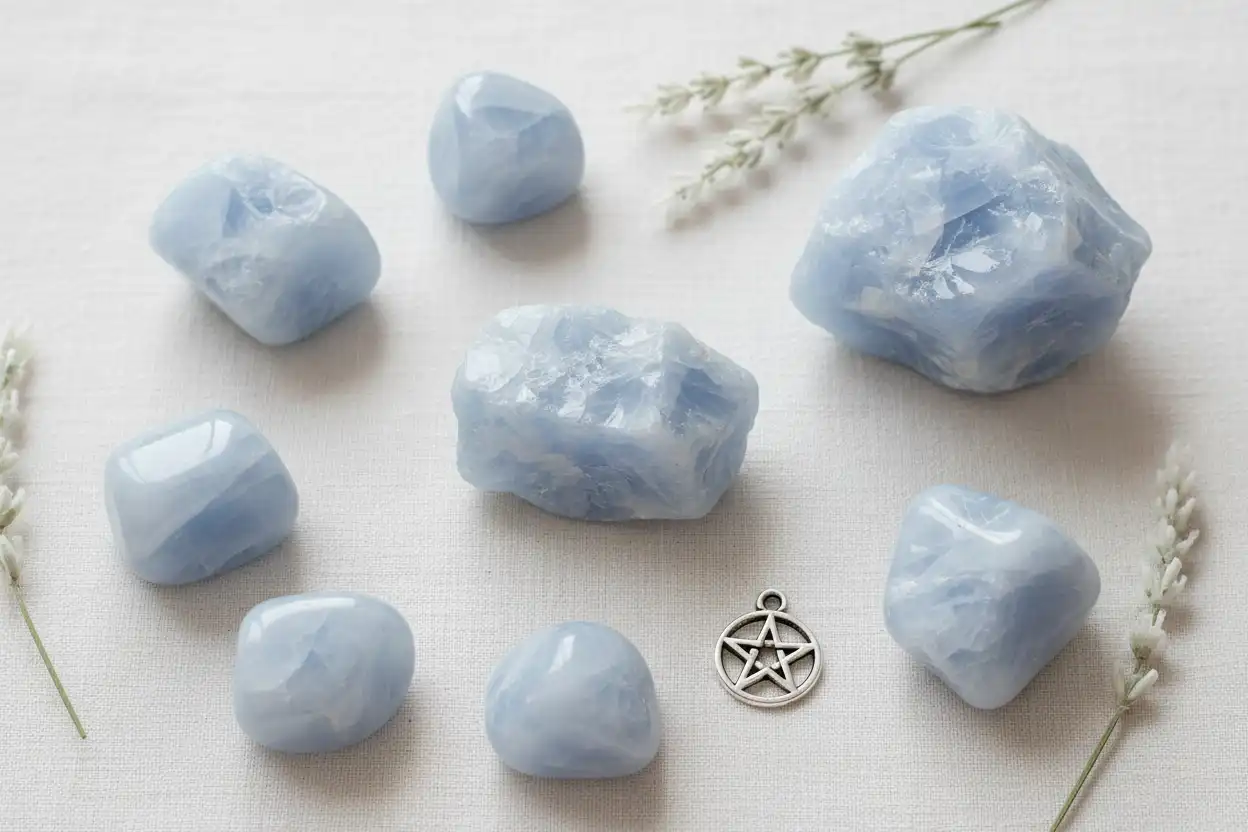
Blue Calcite Meaning: Mineral Facts, History & Symbolism
Blue calcite meaning is commonly described through ideas such as calmness, communication, emotional reflection, rest, and gentle self-expression, but those interpretations belong to symbolism rather than to the mineral’s measurable physical properties. Mineralogically, blue calcite is calcite—calcium carbonate, CaCO₃—with a blue to blue-gray appearance produced by characteristics of the individual material rather than by membership in a separate mineral species.
That distinction is important because “blue calcite” is a descriptive variety name, not a formally separate mineral. Its chemistry, trigonal crystal structure, strong cleavage, low hardness, relatively high birefringence, and reaction with suitable acids are properties of calcite. The blue color may arise from specimen-specific impurities, structural effects, inclusions, or combinations of optical factors, so assigning one universal coloring element to every blue calcite specimen is not justified without analytical evidence.
Readers exploring other mineral-first references can browse the Gemstone Guides, where color names are treated as descriptions rather than substitutes for material identification.
What Is Blue Calcite?
Blue calcite is a blue-colored variety of the mineral calcite. Calcite is calcium carbonate and belongs to the trigonal crystal system. It is one of the most widespread carbonate minerals and occurs in sedimentary, hydrothermal, metamorphic, and cavity-forming geological environments. It is also a major mineral component of limestone and marble.
Pure calcite can be colorless or white, but natural specimens occur in a wide range of colors because of trace constituents, inclusions, lattice defects, associated minerals, and other geological variables. Blue calcite typically ranges from very pale blue and blue-gray to more saturated medium blue, often with cloudy white areas, veins, cleavage reflections, or uneven color distribution.
| Property | Blue calcite characteristics |
|---|---|
| Material identity | Blue-colored variety of calcite |
| Mineral species | Calcite |
| Chemical formula | CaCO₃ |
| Crystal system | Trigonal |
| Typical color | Pale blue, blue-gray to medium blue |
| Mohs hardness | About 3 |
| Specific gravity | Approximately 2.7 |
| Cleavage | Perfect in three directions, producing rhombohedral forms |
| Fracture | Uneven to conchoidal where cleavage does not dominate |
| Luster | Vitreous, sometimes pearly on cleavage surfaces |
| Streak | White |
| Transparency | Transparent to translucent or locally opaque |
| Optical character | Strongly birefringent |
| Common forms | Crystals, cleavage fragments, massive material, carvings, cabochons and polished pieces |
The low hardness and excellent cleavage distinguish calcite from many blue quartz-family materials. A blue object can therefore look similar to blue calcite in a photograph while behaving very differently when examined physically.
Blue Calcite Is a Variety, Not a Separate Mineral
Commercial mineral names often combine a color with a mineral name: blue calcite, green calcite, orange calcite, pink calcite. These labels are useful when the underlying material has already been identified, but the color adjective does not create a new mineral species.
A specimen described as blue calcite should still display properties consistent with calcite. If its hardness, density, optical response, cleavage, or spectroscopy contradict calcite, the blue color cannot rescue the identification.
This is particularly important when comparing blue calcite with visually overlapping materials such as blue chalcedony or blue aventurine. Both are silica-rich materials and are substantially harder than calcite despite potentially sharing a soft blue appearance.
What Causes Blue Calcite to Be Blue?
The safest answer is that the cause can be specimen-dependent.
Color in minerals can arise from trace elements, structural defects, microscopic inclusions, dispersed particles, radiation-related effects, or combinations of these mechanisms. In natural blue calcite, a visually attractive blue body color does not by itself reveal which mechanism is operating.
That creates a useful evidence boundary. A retailer may state that a particular trace element “causes all blue calcite,” but without analytical evidence tied to that specimen or material population, such certainty is stronger than the observation supports.
The detailed relationship among transmitted light, scattering, transparency, birefringence, color zoning, and inclusions belongs in the dedicated blue calcite optical properties and color behavior guide.
How Blue Calcite Forms
Calcite can crystallize whenever geological conditions allow calcium- and carbonate-bearing fluids or melts to precipitate calcium carbonate. It occurs in sedimentary carbonate rocks, hydrothermal veins, cavities, metamorphosed limestone, mineralized fractures, caves, and many other environments.
Blue calcite therefore does not have one universal geological origin. One specimen may have formed as massive carbonate material, another as crystals lining a cavity, and another through hydrothermal deposition associated with additional minerals. Its color and texture may reflect local chemistry and growth conditions rather than a single globally uniform formation process.
The more detailed discussion of host rocks, mineral associations, deposit environments, and what geological features can actually support a locality interpretation is covered in blue calcite formation and deposit geology.
The Most Recognizable Calcite Trait: Cleavage
One of calcite’s strongest physical clues is its perfect cleavage. Calcite cleaves readily in three directions that do not meet at right angles, creating rhombohedral fragments. A broken specimen can therefore expose smooth, reflective planar surfaces that repeat at characteristic angles.
This behavior differs from quartz, which lacks cleavage and normally breaks with conchoidal to irregular fracture. A piece sold as blue calcite that behaves mechanically like quartz deserves closer examination.
Cleavage also explains why a mineral with Mohs hardness around 3 requires more careful handling than the hardness number alone might suggest. A blow delivered in an unfavorable direction can propagate along a cleavage plane even when the surrounding surface appears sound.
Double Refraction and Birefringence
Calcite is famous for strong birefringence. In sufficiently transparent material, light entering the crystal can be split into two rays traveling at different velocities through the anisotropic structure. A clear calcite rhomb placed over a printed line can produce a visibly doubled image.
Opaque or heavily included blue calcite may not provide a dramatic textbook demonstration because transparency limits observation, yet the underlying optical property remains characteristic of calcite.
This phenomenon should not be confused with metaphysical statements about the mineral “doubling energy,” “amplifying intentions,” or creating spiritual frequencies. Double refraction is an optical consequence of crystal structure, not evidence of an invisible healing mechanism.
How to Examine an Unknown Blue Calcite Specimen
A useful examination begins with features that can be documented without damaging the piece. Color should be recorded, but it should not dominate the identification.
Original Blue Calcite Specimen and Photo Checklist
Photograph the specimen under neutral daylight-equivalent lighting before making identification assumptions.
Record whether the color is pale blue, blue-gray, unevenly zoned, cloudy, or concentrated along fractures.
Look for broad planar cleavage surfaces rather than expecting conchoidal quartz-like breaks.
Examine edges for rhombohedral cleavage geometry where natural breakage exposes it.
Observe whether the polished surface has vitreous luster while cleavage surfaces appear more pearly.
Check thin areas for translucency rather than assuming every specimen should be transparent.
Look for white carbonate zones, veins, cloudy inclusions, fractures, and associated matrix.
Under magnification, inspect suspiciously intense color along cracks that might indicate introduced dye.
Check whether the object has a molded seam, bubbles, or highly uniform glassy texture inconsistent with natural calcite.
Do not rely on the word “calcite” printed on a retailer label as independent evidence.
Avoid scratch testing a polished or collectible piece unless identification genuinely requires it.
Do not use household acid directly on an important specimen simply because calcite is acid-reactive.
Record weight and dimensions if comparison with expected density is necessary.
Treat a locality designation as a provenance claim requiring documentation.
Separate observations about mineral identity from statements about healing, energy, or chakra associations.
Magnification can reveal cleavage microfractures, inclusions, polishing features, coatings, dye concentrations, or other details, but it rarely establishes an exact color-causing impurity by itself. Those diagnostic limits are explored in the blue calcite microscope inclusion notebook.
A Claim-versus-Evidence Guide to Blue Calcite
Blue calcite is surrounded by statements that range from ordinary mineralogy to highly specific spiritual or medical promises. Treating them all as though they have the same evidentiary basis creates confusion.
| Claim | Evidence status | More accurate interpretation |
|---|---|---|
| Blue calcite is calcium carbonate | Supported | It is the blue variety of calcite, CaCO₃ |
| Blue calcite is a separate mineral species | Incorrect | “Blue” describes color within calcite |
| Calcite has perfect rhombohedral cleavage | Supported | This is an important diagnostic property |
| Calcite is about Mohs 3 | Supported | It is considerably softer than quartz |
| Blue calcite must contain one specific coloring element | Too absolute | Color mechanisms can vary and require specimen-specific evidence |
| Stronger blue always means better quality | Unsupported as a universal rule | Color preference, texture, condition, size, transparency and intended use all matter |
| Blue calcite improves communication | Symbolic interpretation | It can serve as a personal reminder for thoughtful communication |
| Blue calcite heals anxiety | Medical claim | Not established by mineralogical evidence |
| Blue calcite activates the throat chakra | Spiritual framework | A metaphysical association, not a measurable mineral property |
| Calcite’s birefringence proves energy amplification | Unsupported inference | Optical double refraction does not demonstrate spiritual energy effects |
| Blue calcite detoxifies the body | Medical/metaphysical claim | Unsupported |
| A photographed blue stone can always be identified as calcite | Incorrect | Visual examination alone may be insufficient |
This framework does not require dismissing symbolism. It simply identifies where measurable mineral evidence ends and personal interpretation begins.
What Blue Calcite Is Not
Blue calcite should not be confused automatically with every soft-looking blue ornamental stone. Blue chalcedony, blue quartz, dyed howlite, fluorite, celestine, aragonite-bearing materials, glass, and manufactured composites can overlap visually depending on lighting and finish.
Hardness can eliminate some possibilities because calcite is substantially softer than quartz. Cleavage behavior can provide another strong clue, while refractive properties, specific gravity, microscopy, and spectroscopy may become necessary when a piece is polished or lacks natural fracture surfaces.
A blue color match is therefore an invitation to test a hypothesis, not an identification result.
“Caribbean Calcite” and Other Commercial Names
Some commercially sold blue-and-white carbonate material is marketed under names that contain the word calcite but do not necessarily describe a single homogeneous mineral throughout the object. Mixed carbonate material can contain calcite alongside aragonite or other associated phases.
The important lesson is broader than any one trade name: commercial labels can describe an appearance, locality story, or product category rather than a rigorously established mineral composition. When exact identity matters, each component should be examined rather than assuming that a marketing name functions as a laboratory report.
This is especially relevant for collectors because mixed mineral specimens can be completely natural while still being inaccurately simplified by retail terminology.
Documented History Versus Modern Blue Calcite Lore
Calcite has a long history of human use because calcium-carbonate rocks and minerals are abundant, workable, and technologically important. Limestone and marble have been used in construction, sculpture, lime production, architecture, pigments, and decorative objects across many cultures.
The specific phrase “blue calcite,” however, should not automatically be assigned an ancient metaphysical tradition. Historical societies certainly used calcite-bearing stones and carbonate rocks, but that does not prove they recognized the modern retail category of blue calcite or attributed today’s chakra and energy meanings to it.
When a modern source states that an ancient civilization used blue calcite for a very specific spiritual purpose, the claim requires evidence identifying the actual material, object, terminology, cultural context, and historical record. Repeated internet wording is not a substitute for that documentation.
Blue Calcite Meaning in Modern Symbolism
Modern blue calcite meaning commonly emphasizes calmness, communication, emotional reflection, rest, patience, and gentle self-expression. The pale blue appearance contributes strongly to these associations because blue is widely used as a visual metaphor for quiet, openness, air, sky, water, and measured communication.
A person might keep a blue calcite specimen near a desk as a reminder to respond thoughtfully rather than impulsively, use it during journaling about communication habits, or associate its soft color with creating a quieter physical environment. These are legitimate symbolic practices because they describe what the object represents to the individual.
They do not establish that calcium carbonate emits a calming frequency or chemically changes emotional states through ordinary contact.
Throat Chakra Associations
Blue calcite is commonly linked with the throat chakra in contemporary crystal traditions because blue stones are often symbolically connected with speech, expression, listening, and communication.
A chakra association belongs to a spiritual framework. There is no gemological measurement for an opened, balanced, blocked, or activated chakra, and identifying a specimen conclusively as calcite would not demonstrate such an effect.
Someone may still use blue calcite as a meditation object while focusing on careful speech or listening. The practice can be described as intentional symbolism without converting it into anatomy or medicine.
Does Blue Calcite Have Healing Properties?
Blue calcite should not be presented as a medical treatment. Holding, wearing, or placing the mineral nearby has not been established as a treatment for anxiety disorders, insomnia, neurological disease, inflammation, blood pressure conditions, throat disorders, respiratory illness, or other medical problems.
The mineral has real physical properties: hardness, cleavage, density, birefringence, chemical reactivity, crystal structure, and composition. None of these properties demonstrates that ordinary contact with a polished specimen provides a therapeutic effect.
If someone finds a familiar stone useful as part of meditation, breathing, journaling, or a personal calming ritual, that experience can be discussed as an individual practice. Symptoms requiring diagnosis or treatment should be addressed through appropriate healthcare rather than mineral claims.
Do Calcite’s Calcium and Carbonate Have Health Benefits Through Touch?
No conclusion of that kind follows from the chemistry.
Calcite contains calcium as part of the crystalline compound calcium carbonate. The fact that calcium is an essential nutrient does not mean that holding a piece of calcite delivers biologically useful calcium through the skin. Chemical composition should not be translated automatically into physiological benefits.
The same reasoning applies to carbonate. A mineral formula describes the material’s atomic composition and structure; it is not a list of therapeutic ingredients released during ordinary handling.
Cutting Blue Calcite Requires Respect for Cleavage
Calcite’s softness makes it comparatively easy to shape, but its perfect cleavage creates significant lapidary constraints. Pressure, vibration, or an unfavorable cutting direction can open existing cleavage planes or create chips.
The orientation of color zoning, transparency, fractures, and cleavage therefore matters when planning cabochons, carvings, tablets, spheres, or decorative forms. A thicker design may survive handling better than a thin sharp-edged form made from heavily cleaved material.
Those practical lapidary decisions are treated separately in blue calcite cutting, orientation and polish.
Blue Calcite in Jewelry
Blue calcite can be made into jewelry, but it is not an ideal material for every setting. Mohs hardness around 3 means ordinary dust, harder gemstones, metal edges, and many everyday objects can scratch a polished surface. Perfect cleavage adds another vulnerability to impact.
Pendants, protected beads, earrings, brooches, and occasional-wear pieces generally present less mechanical risk than highly exposed everyday rings. A ring can still be made successfully, but protective setting design and realistic expectations about wear become more important.
The engineering tradeoffs for bezel protection, exposed edges, impact zones, thickness, and mounting are covered in blue calcite setting and wear engineering.
Safe Cleaning and Chemical Sensitivity
Calcite is acid-sensitive because calcium carbonate reacts with acids. Acidic household cleaners, vinegar, some descaling products, and similar chemicals can etch or dull the surface.
This reaction is useful in geological identification when carried out appropriately, but it is undesirable on a polished collectible or finished piece of jewelry. Chemical testing should not be performed casually on a valuable specimen.
Conservative care generally means avoiding acids, abrasive cleaners, prolonged soaking when construction is uncertain, harsh brushes, and unnecessary impact. Unknown jewelry may contain adhesives or other materials that impose additional limitations.
Provenance Cannot Be Proven From Color
Blue calcite occurs in more than one geological setting and commercial supply chain. A pale blue specimen cannot be assigned confidently to a mine or country merely because it resembles material commonly marketed from that location.
Useful provenance evidence can include original mine labels, collection records, supplier documentation, specimen numbers, acquisition history, and a traceable chain connecting the object with the claimed source.
A detailed framework for assessing such claims appears in the blue calcite provenance disclosure checklist.
Treatment and Artificial Color
Because calcite is relatively soft, cleaved, and potentially fractured, color-modifying substances can sometimes enter surface-reaching cracks or porous areas. Dyed or otherwise modified carbonate materials therefore deserve consideration when color appears unusually intense, highly concentrated along fractures, or inconsistent with the rest of the material.
None of these observations proves treatment by itself. Natural minerals can show vivid color and irregular zoning, while some treatments are subtle enough to require analytical testing.
The correct description is proportional to the evidence: observed color concentration can justify further investigation, but it does not justify declaring a specimen dyed without support.
Buying Blue Calcite: Identity Before Story
A buying decision should begin with what the object is rather than what the seller promises it will do. Useful descriptions include dimensions, weight, natural or treated status when known, condition, photographs under representative lighting, locality documentation where claimed, and whether the specimen is calcite alone or a mixed mineral material.
Statements such as “high vibration,” “rare healing grade,” “powerful throat chakra stone,” or “guaranteed calming crystal” provide no independent evidence of mineral identity or quality.
Readers evaluating an actual seller or purchase can use where to buy blue calcite rather than treating this meaning reference as a seller-selection guide.
Safe Ownership
An intact blue calcite specimen can normally be handled without treating it as hazardous merely because it contains calcium or carbonate. Safety concerns depend on physical form, exposure route, associated minerals, treatments, and what is being done to the specimen.
Lapidary operations such as sawing, drilling, grinding, and polishing generate mineral dust and should use suitable wet methods, extraction, eye protection, and appropriate respiratory controls. Mixed specimens can contain additional minerals whose hazards differ from calcite itself.
Blue calcite should not be ground for ingestion or placed into drinking water as a crystal elixir. Symbolic practice does not require consuming mineral material.
Important specimens can benefit from baseline photographs that document fractures, chips, cleavage surfaces, and storage condition. A structured record is available in the blue calcite specimen conservation record.
An Evidence Ladder for Blue Calcite Claims
A practical way to evaluate blue calcite meaning is to match each claim with the kind of evidence capable of supporting it.
Direct observation can document color, transparency, cleavage surfaces, fractures, luster, dimensions, associated minerals, and visible zoning.
Basic gemological testing can examine hardness, specific gravity, refractive behavior, and other properties consistent with calcite.
Microscopy can reveal coatings, fracture filling, inclusions, polishing features, dye concentrations, and textural clues.
Spectroscopy or diffraction can provide stronger confirmation of mineral identity when visual and physical evidence remain ambiguous.
Chemical analysis may be needed when a specific trace element or inclusion is claimed as the cause of blue color.
Provenance documentation is required for mine, locality, collection, and ownership claims that laboratory identification alone cannot establish.
Historical documentation is necessary before attributing a particular blue calcite belief to an ancient culture.
Symbolic interpretation describes what the stone represents to a person or spiritual tradition; additional mineral testing cannot transform that subjective meaning into a laboratory property.
This evidence ladder protects both sides of the subject. It allows calcite’s real mineralogy to remain precise while leaving room for cultural or personal symbolism without presenting it as science.
What Blue Calcite Meaning Can Reasonably Mean
A fact-first interpretation of blue calcite meaning has three distinct layers. Materially, it is blue-colored calcite: a soft calcium-carbonate mineral with trigonal structure, perfect rhombohedral cleavage, strong birefringence, and a color whose detailed cause should not be generalized beyond the evidence for a particular specimen.
Historically, calcite and calcite-rich materials have played extensive roles in human technology, architecture, ornament, and mineral study, but those documented uses should not be confused with unsupported claims that today’s specific blue calcite metaphysical vocabulary has existed unchanged since antiquity.
Symbolically, people may choose blue calcite to represent calm communication, patience, reflection, or measured expression. Those meanings can make the object personally significant without requiring claims about healing energy, chakra physiology, detoxification, or medical treatment.
Gems Lore explains its fact-versus-symbolism approach on the About page. Health, spiritual, and informational limitations are described in the Disclaimer, factual corrections can be submitted through Contact, and site data practices are detailed in the Privacy Policy.
Blue calcite becomes more interesting, not less, when those boundaries are maintained. Its soft blue appearance belongs to a mineral with unusually strong cleavage and optical behavior, while the meanings people assign to that appearance belong to culture and personal interpretation. Understanding which layer is being discussed is the key to using blue calcite meaning accurately.