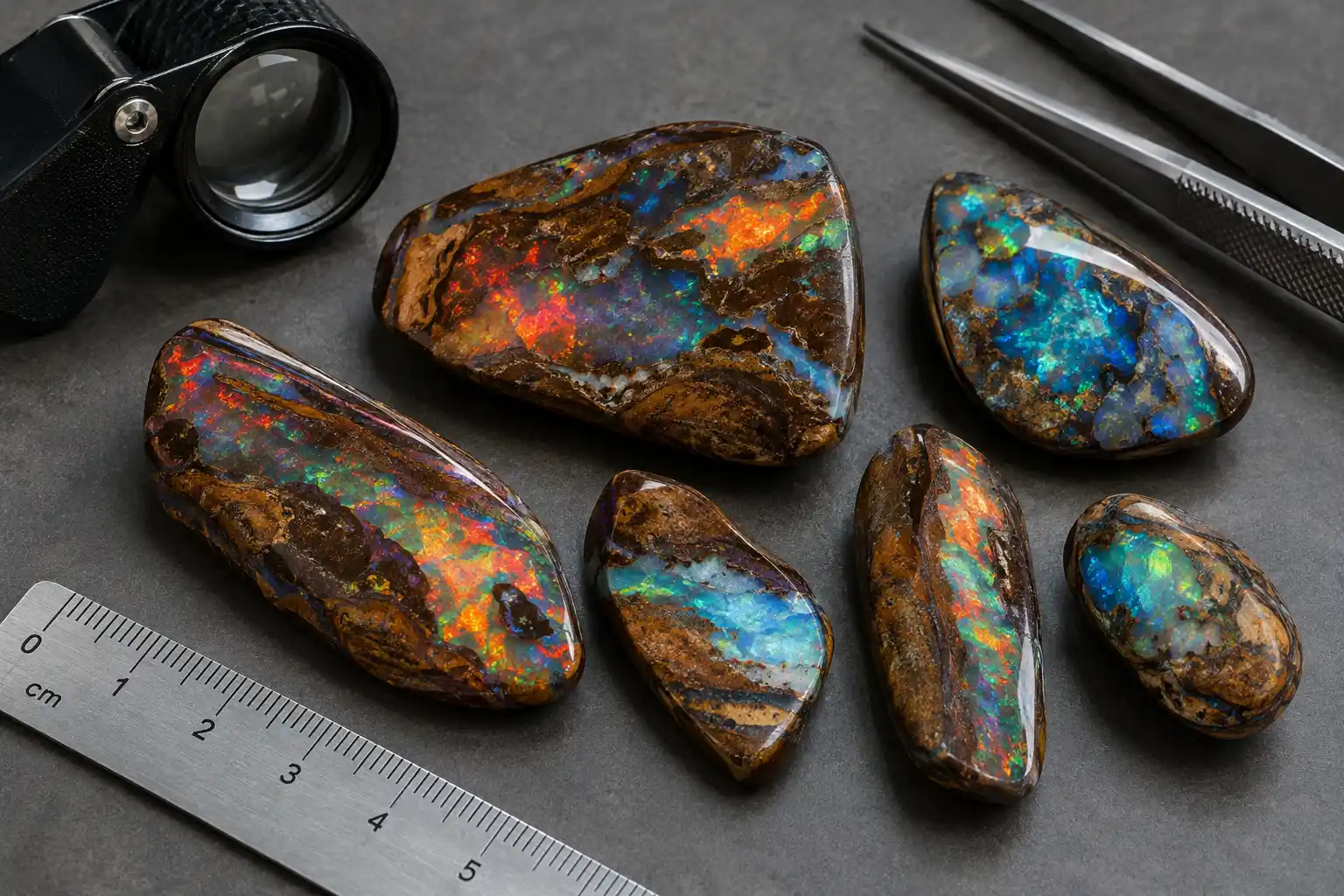
Boulder Opal Price Per Carat: 10 Essential Value Drivers
Boulder opal Price per carat can range from modest amounts for commercial stones with weak color to hundreds or several thousand dollars per carat for exceptional gems displaying intense brightness, rare red or multicolor play-of-color, attractive natural ironstone patterning, broad face-up coverage, and strong stability. Commercial pieces may fall around $20 to $100 per carat, while attractive jewelry-quality stones can reach roughly $100 to $500 per carat. Fine boulder opal may move into the $500 to $1,500 per-carat range, while exceptional collector pieces with vivid spectral color, unusual pattern, important size, and desirable provenance can exceed $1,500 to $3,000 per carat and sometimes rise substantially higher.
Those figures require more caution than Price-per-carat ranges for transparent gemstones because boulder opal naturally includes its host rock. The precious opal commonly occurs as thin seams or patches attached to brown ironstone, and that ironstone contributes to the total carat weight. A 20-carat boulder opal therefore does not contain 20 carats of precious opal in the same sense that a 20-carat aquamarine consists essentially of aquamarine throughout. Face-up dimensions, brightness, pattern, color coverage, and overall beauty are often more meaningful than weight alone.
Boulder opal is a natural geological combination rather than an assembled doublet. The opal and ironstone formed together, and cutters intentionally preserve the host rock because separating an extremely thin precious seam could destroy the gem. This natural backing can deepen contrast and produce dramatic patterns that differ completely from conventional solid black or white opal. Buyers should therefore value boulder opal as its own category rather than treating the ironstone as unwanted weight that automatically reduces quality.
10 Essential Value Drivers Behind Boulder Opal Price Per Carat
- Brightness of the play-of-color
- Dominant spectral colors
- Range of visible colors
- Pattern rarity and definition
- Face-up color coverage
- Quality and aesthetics of the ironstone matrix
- Precious opal seam thickness and stability
- Carat weight, face-up size, and shape
- Queensland origin, provenance, and natural construction
- Cut quality, treatment status, condition, and market demand
These ten factors explain why two boulder opals with identical weights can differ by several multiples in Price. The most valuable pieces use the natural relationship between precious opal and ironstone to create a vivid composition rather than simply carrying the greatest number of carats.
Typical Boulder Opal Price Per Carat
Because natural ironstone forms part of the gem, per-carat valuation is most useful when comparing boulder opals of similar construction, quality, and proportions. Broad market ranges can still provide a useful starting point.
| Boulder Opal Quality | Approximate Price Per Carat | Typical Characteristics |
|---|---|---|
| Commercial quality | $20 to $100 | Weak color, limited coverage, ordinary pattern, substantial inactive ironstone |
| Good jewelry quality | $100 to $500 | Bright green-blue or multicolor display, attractive natural matrix |
| Fine quality | $500 to $1,500 | Strong brightness, broad color coverage, desirable pattern, good stability |
| Exceptional quality | $1,500 to $3,000+ | Vivid red or full-spectrum color, rare pattern, excellent face-up composition |
| Important collector stones | Highly variable | Exceptional pattern, provenance, large size, remarkable color and stability |
A beautifully balanced freeform stone can be worth more than a conventionally shaped oval if cutting the oval would have removed important color. Boulder opal is therefore one of the gemstone categories in which natural shape and artistic cutting can contribute substantially to value.
Brightness Usually Matters More Than Weight
The most immediate quality factor in boulder opal is how strongly its spectral colors appear. Bright play-of-color creates the visual impact that makes the gem desirable, while subdued color can leave even a large piece commercially ordinary.
Brightness should be judged under consistent lighting and through several viewing angles. A stone photographed under a concentrated spotlight can appear much more intense than it does under ordinary indoor light, so direct comparison needs similar illumination.
Fine boulder opal should remain visually active as the stone moves. The color does not need to remain identical at every angle, because directional change is part of opal’s appeal, but a valuable stone should not require an extremely precise orientation to reveal all of its beauty.
A smaller boulder opal with powerful red, orange, and green flashes across most of the surface can therefore command a higher Price per carat than a much heavier stone whose color is faint or restricted to narrow veins.
Red, Orange, and Full-Spectrum Color Can Create Major Premiums
Precious opal produces play-of-color because ordered microscopic silica structures diffract visible light. Different structural spacing favors different wavelengths, which is why opal can display blue, green, yellow, orange, red, and violet.
Red generally carries the strongest market premium because structural conditions capable of producing bright longer-wavelength color are less commonly encountered than those producing blue and green. Intense red against dark brown ironstone can be particularly dramatic.
Orange and yellow are also desirable, especially when combined with red. Green and blue are more common but can still produce very valuable stones when saturation, brightness, coverage, and pattern are exceptional.
The finest multicolor boulder opal can display much of the visible spectrum as it moves. A stone showing vivid red, orange, green, and blue across several viewing angles can command a much stronger Price than one containing only weak pinpoints of rare color.
Color rarity should never be separated from brightness. A barely visible red spot does not automatically make a stone superior to a brilliant blue-green broad-flash gem.
Pattern Gives Boulder Opal Much of Its Individual Character
Boulder opal often develops in thin seams, cavities, fractures, and irregular areas within ironstone. Once cut and polished, these geological structures can create visual patterns that are impossible to reproduce precisely from one stone to another.
Broad flash, rolling flash, ribbon-like color, pinfire, patchwork, floral-looking structures, and matrix patterns may all occur. Pattern terminology varies within the trade, so the actual visual organization matters more than the sales name attached to it.
Some stones present large uninterrupted areas of precious opal, while others show narrow rivers of color crossing dark ironstone. Both can be valuable when the natural composition looks balanced and the color remains bright.
The most desirable pattern is one that uses the host rock as part of the design rather than making the surface appear mostly inactive. A dark ironstone field can create extraordinary contrast when bright spectral seams cross it deliberately, but excessive barren rock with only tiny isolated flashes generally lowers jewelry value.
Face-Up Color Coverage Is More Important Than the Amount of Hidden Opal
When assessing boulder opal, buyers should focus on what is visible from the front rather than trying to estimate how much precious opal exists inside the stone.
A thin seam covering most of the face can create much greater value than a thicker seam hidden along an edge. The eye experiences surface color, pattern, and movement, not internal volume.
Near-full coverage is particularly desirable when brightness is strong. Stones that appear almost entirely covered in vivid play-of-color can rival the visual impact of solid black opal even though substantial ironstone remains underneath.
Partial coverage is not automatically poor. A dramatic natural composition containing dark matrix beside concentrated red and green can have tremendous artistic appeal.
The important question is whether inactive areas strengthen or weaken the overall design. Natural contrast can add character, while random blank areas that interrupt otherwise fine color usually reduce value.
Ironstone Matrix Is an Essential Part of Boulder Opal, Not an Artificial Backing
Boulder opal forms with its natural host rock, commonly ironstone. The brown to dark brown matrix may remain on the back, along the edges, or visibly integrated into the face.
This natural association is one of the defining differences between boulder opal and an opal doublet. In a doublet, a thin precious opal layer is artificially attached to a separate backing after mining. In boulder opal, the opal and ironstone are naturally connected geologically.
A fine matrix can enhance value by creating contrast, recognizable natural patterns, and structural support. Dark ironstone can intensify bright green, blue, orange, and red colors visually.
Matrix quality should therefore be graded aesthetically rather than simply penalized by percentage. Attractive veins, islands, or geometric divisions can become part of the design, while poorly positioned or overwhelmingly dominant host rock may reduce appeal.
Matrix opal deserves separate terminology because precious opal can permeate or occur throughout host rock rather than forming a relatively discrete seam. Boulder opal and matrix opal can overlap visually, but their structures should be described accurately.
Seam Thickness Influences Durability and Cutting Possibilities
Many boulder opal color bars are extremely thin. Cutters may have only fractions of a millimeter of precious opal between ironstone layers, which makes cutting both technically demanding and economically risky.
A thick, stable opal seam gives the cutter more freedom to polish the surface, create a pleasing dome, and remove small imperfections without immediately cutting through the color.
Thin seams can still produce exceptional gemstones when the color is bright and the underlying ironstone provides strong support. In such stones, a flatter surface may be necessary to preserve the precious layer.
Open cracks, delamination, unstable seams, or areas where the opal is lifting from the matrix deserve careful inspection. A visually spectacular stone that is structurally insecure should not be valued like a stable piece with comparable color.
The natural ironstone backing can actually improve practical durability by supporting a fragile seam, which is one reason boulder opal works successfully in jewelry despite opal’s moderate hardness.
Carat Weight Needs to Be Interpreted Differently in Boulder Opal
Carat weight includes both precious opal and natural ironstone, so simply dividing total Price by total weight can create misleading comparisons.
A broad 25-carat freeform with a relatively thin profile may offer far more visible color than a compact 30-carat stone whose back contains thick ironstone. The lighter stone could reasonably command a higher total Price and a higher Price per carat.
Face-up dimensions therefore deserve attention alongside weight. Length, width, visible color area, and shape tell the buyer how large the gemstone will actually appear in a setting.
Large stones can earn substantial premiums when bright play-of-color covers a large proportion of the surface. Finding a broad natural boulder seam with exceptional color is much harder than finding a large piece whose extra weight consists mainly of inactive matrix.
Shape also affects yield. Freeforms are common because cutters follow the natural color seam rather than sacrificing valuable opal merely to produce a calibrated oval or rectangle.
Queensland Provenance Adds Authenticity and Collector Interest
Fine boulder opal is strongly associated with Queensland, Australia, where opal-bearing ironstone occurs across extensive fields. Areas around Winton, Quilpie, Yowah, Koroit, and other Queensland localities have become closely associated with distinctive forms of boulder and matrix opal.
Locality can affect the style of rough, matrix appearance, seam structure, pattern, and collector interest. Certain fields are especially known for matrix patterns, while others are associated with vivid seam opal or unusual geological structures.
Origin should not replace direct quality assessment. A dull stone from a famous field remains lower quality than a brilliant stable gem from another Queensland source.
Reliable provenance becomes more important for exceptional specimens, large natural pieces, old mining material, and collector stones where locality contributes to the story and geological significance.
Treatment and Construction Should Be Disclosed Clearly
Natural boulder opal is normally valued for its untreated relationship between precious opal and ironstone. Because the natural backing already provides contrast, it does not require the artificial dark backing used in an opal doublet.
Treatments can nevertheless occur in the wider opal market. Coatings, impregnation, filling, dyeing, smoking, and other modifications should be disclosed when present.
A polished boulder opal should also be distinguished from an assembled product made by attaching opal to ironstone after cutting. The visual result can resemble natural boulder opal, particularly in photographs, but the geological construction is different.
Side and back examination can reveal whether the matrix relationship appears natural or whether a clean adhesive interface suggests assembly.
For valuable purchases, accurate description of natural construction is more important than a seller’s generic statement that the stone is simply “real opal.”
Stability and Condition Can Change the Value of an Otherwise Fine Stone
Opal is hydrated amorphous silica and typically falls around 5.5 to 6.5 on the Mohs scale. It is softer than quartz, topaz, sapphire, and diamond, and its toughness varies according to internal structure.
Crazing, open fractures, chips, and unstable seams can reduce boulder opal value significantly. Crazing refers to a network of cracks caused by internal stress and can threaten the long-term survival of the polished surface.
Australian boulder opal is widely appreciated for practical stability, but no individual stone should be assumed immune from damage. Condition still needs to be examined directly.
The ironstone backing provides physical support, yet sharp impacts can chip exposed opal or fracture narrow color bars. Rings need greater protection than pendants and earrings because they encounter more frequent contact with hard surfaces.
Boulder Opal Versus Black Opal Price Per Carat
Black opal and boulder opal can both reach very high values, but their carat weights represent different physical structures. Solid black opal consists predominantly of opal, while boulder opal naturally includes ironstone host rock.
This makes direct per-carat comparison imperfect. A fine boulder opal may appear larger face-up than a black opal of similar Price because a substantial portion of its weight comes from matrix.
Black opal commonly receives particularly high premiums for intense red play against an N1 to N4 dark body, while boulder opal gains additional appeal from the artistic interaction between color and natural host rock.
Neither category is automatically superior. The finest stones in both groups are judged by brightness, spectral color, pattern, stability, size, and overall beauty.
How to Compare Two Boulder Opals Before Buying
A reliable comparison begins with the face rather than the scale. Place both stones under the same neutral lighting and evaluate brightness, dominant colors, pattern, and how much of the visible surface is active with play-of-color. Move the stones through several angles and note whether the colors continue to perform or disappear quickly.
After evaluating visual quality, inspect the sides and backs. Compare ironstone thickness, seam structure, cracks, overall proportions, and whether the relationship between opal and matrix appears natural. Then examine dimensions and total weight to determine whether one stone carries excessive hidden matrix.
Only after those observations should provenance, seller grade, and Price per carat be considered. This order keeps natural beauty and structural quality ahead of an impressive carat number that may largely represent ironstone.
Is Boulder Opal Worth Buying as an Investment?
Fine natural boulder opal is scarce and has an established collector market, particularly for stones displaying exceptional brightness, red or multicolor play, unusual pattern, important size, and documented Australian provenance. Those characteristics can make exceptional pieces difficult to replace.
That scarcity does not guarantee financial appreciation. Retail margins, dealer specialization, auction conditions, jewelry craftsmanship, fashion, and access to knowledgeable collectors all influence resale.
Commercial stones with limited color should not be treated as investments merely because they are Australian natural opal. Rarity is meaningful only when the individual stone possesses qualities that collectors actively seek.
For most buyers, boulder opal is strongest as a combination of natural geological art and wearable gemstone rather than as a short-term financial product.
Caring for Boulder Opal Jewelry
Boulder opal should be protected from sharp impact and abrasion because the precious opal surface is softer than many common gemstones. Rings benefit from protective bezels or settings that reduce exposed edges.
Gentle cleaning with a soft damp cloth or mild soap and lukewarm water is generally appropriate for intact untreated stones. Steam and ultrasonic cleaning are unnecessary and can place stress on cracks or fragile seams.
Rapid temperature changes and prolonged extreme heat should also be avoided. The natural ironstone backing does not eliminate the physical properties of the opal layer.
Separate storage prevents harder jewelry from scratching the polished surface. With sensible care, stable boulder opal can remain attractive for many years while preserving the natural relationship between iridescent opal and ironstone that gives the gemstone its distinctive appearance.
Conclusion
Boulder opal Price per carat depends primarily on brightness, spectral color, pattern, face-up coverage, matrix aesthetics, seam quality, stability, size, provenance, construction, and craftsmanship. Commercial stones can remain accessible, while exceptional multicolor gems with vivid red, broad coverage, desirable natural ironstone patterns, and strong Queensland provenance can reach thousands of dollars per carat.
Carat weight must always be interpreted carefully because natural ironstone forms part of the gem. A lighter stone with stronger color and a larger active face can easily be worth more than a heavier piece containing substantial inactive matrix. The most reliable valuation therefore begins with visible beauty and structural integrity, then uses dimensions, weight, origin, and documentation to refine the final judgment.
FAQs About Boulder Opal Price Per Carat
How much does boulder opal cost per carat?
Commercial boulder opal may sell for roughly $20 to $100 per carat, while good jewelry-quality pieces can reach around $100 to $500 per carat. Fine gems may move into the $500 to $1,500 range, while exceptional collector-quality stones can exceed $1,500 to $3,000 per carat and sometimes rise higher.
Why does boulder opal Price per carat vary so much?
Brightness, dominant colors, pattern, coverage, seam thickness, natural matrix, stability, size, cut, and provenance can all change value dramatically. Carat weight also includes ironstone, making simple weight comparisons less reliable than they are for many transparent gemstones.
Is red boulder opal the most valuable?
Bright red play-of-color usually receives a strong premium because it is less common than blue or green. A stone still needs good brightness, pattern, coverage, stability, and overall beauty to achieve exceptional value.
Does the ironstone lower boulder opal value?
Not automatically. Natural ironstone is an essential part of boulder opal and can improve contrast, create attractive patterns, and support thin precious opal seams. Excessive inactive matrix may reduce value when it adds weight without contributing to face-up beauty.
Is boulder opal a doublet?
No. Genuine boulder opal remains naturally attached to the ironstone in which it formed. A doublet is an assembled product in which a precious opal layer is artificially bonded to a separate backing.
Why is face-up size important when buying boulder opal?
The ironstone backing can add substantial weight, so carat size does not always correspond with visible dimensions. Length, width, active color area, and profile help show how large the gemstone will actually appear in jewelry.
Is Queensland boulder opal more valuable?
Queensland is the classic source of Australian boulder opal and reliable provenance can add collector interest. Individual quality still matters more than locality alone, so weak color from a famous field does not automatically create high value.
Does boulder opal need a thick color seam to be valuable?
No. A very thin seam can produce exceptional color when the ironstone supports it securely. Greater thickness can provide additional cutting flexibility and durability, but brightness and face-up beauty remain more important.
Is Koroit opal boulder opal?
Koroit is famous for opal occurring with ironstone, often in intricate matrix-style patterns. Individual pieces may be described according to their structure as boulder or matrix opal, and accurate terminology should reflect how the precious opal occurs within the host rock.
Is Yowah opal valuable?
Yowah can produce distinctive boulder and matrix opal, including famous nut-like ironstone formations containing precious opal. Fine examples with vivid color, artistic pattern, and good stability can be highly collectible.
Does a larger boulder opal always cost more?
No. A large stone dominated by inactive ironstone can be less valuable than a smaller piece with exceptional red multicolor play and near-full face coverage. Quality must be evaluated before weight.
Can boulder opal craze?
Yes. Although many Australian boulder opals are stable, individual stones can contain fractures or develop crazing. Existing structural problems should be examined carefully before purchase.
Is boulder opal suitable for a ring?
Yes, with sensible care. The natural ironstone backing can provide support, but exposed precious opal remains relatively soft. Protective settings help reduce impact and abrasion.
How should I compare boulder opal prices?
Compare stones with similar construction and quality, then evaluate brightness, color range, pattern, face-up coverage, dimensions, seam stability, matrix thickness, and provenance. Price per carat should be considered only after those characteristics are understood.
What makes boulder opal collector quality?
Collector-quality stones typically combine very strong brightness, rare red or broad-spectrum color, distinctive natural pattern, substantial active face-up area, stable seams, excellent cutting, meaningful size, and reliable Australian provenance.