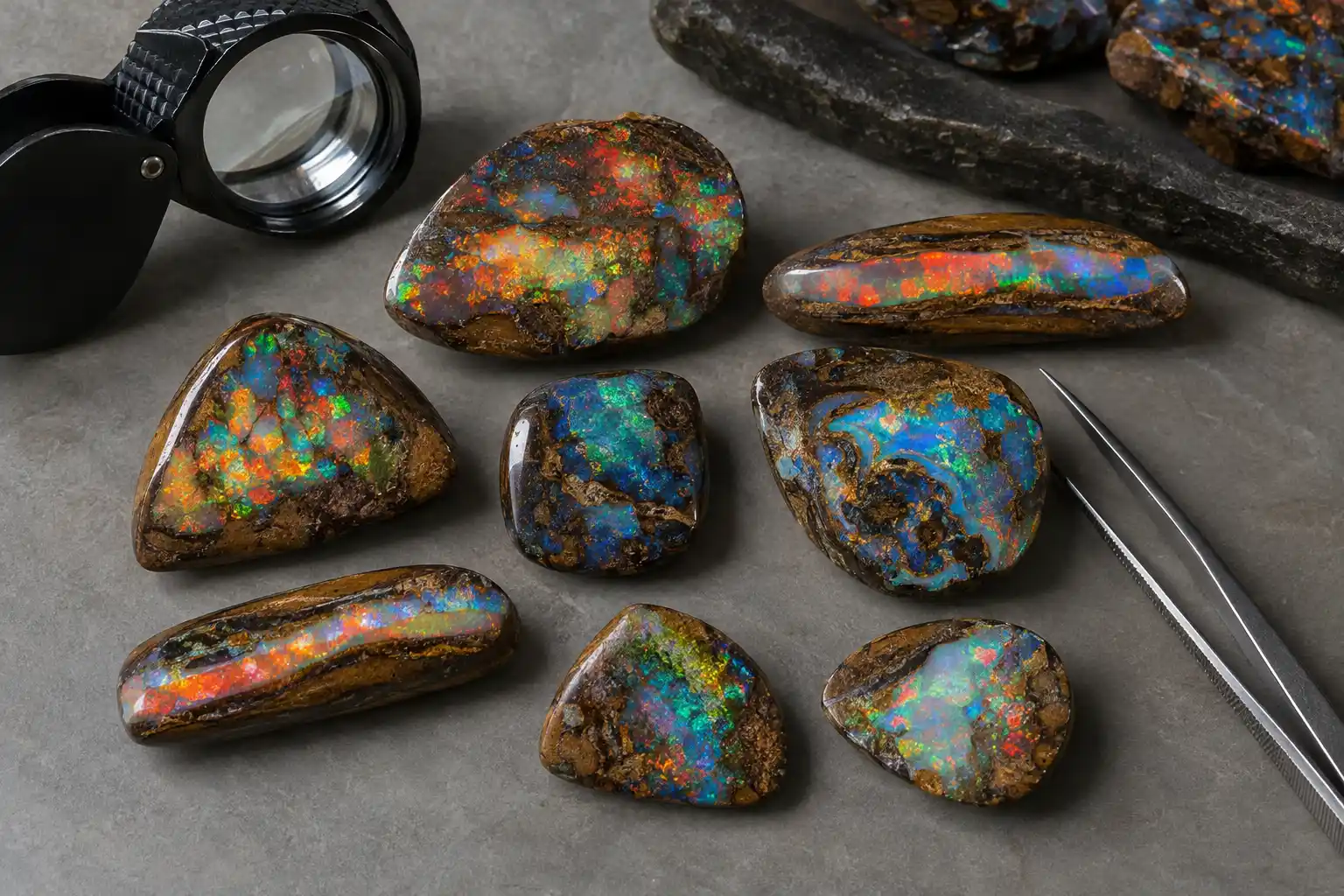
Boulder Opal Quality Grading: 9 Key Ways to Rate Matrix & Color Play
Boulder opal quality grading needs to evaluate precious opal and natural ironstone as a single geological composition rather than treating the host rock as an unwanted impurity. Fine stones combine intense play-of-color with an attractive distribution of natural matrix, strong face-up coverage, an interesting pattern, stable opal seams, good cutting, and enough structural support for practical jewelry use. A thin seam of brilliant red, green, and blue can be far finer than a much thicker opal layer whose colors are weak or poorly positioned.
The term color play is often used conversationally, but play-of-color is the more precise gemological description. Precious opal produces this effect when microscopic silica structures diffract light into spectral colors. As a boulder opal moves, different wavelengths may become visible across the natural surface, creating red, orange, yellow, green, blue, and violet flashes against brown to dark brown ironstone.
Unlike transparent gemstones, boulder opal cannot be graded effectively through color and clarity alone. Its natural matrix is part of the design, and total carat weight includes host rock. A useful quality assessment therefore needs to consider brightness, spectral range, pattern, active surface coverage, matrix aesthetics, seam structure, stability, cut, dimensions, provenance, and treatment before assigning an overall grade.
9 Key Ways to Rate Boulder Opal Matrix and Color Play
- Confirm natural boulder opal construction
- Grade brightness of the play-of-color
- Evaluate dominant spectral colors
- Assess the range of visible colors
- Judge pattern rarity and movement
- Evaluate face-up color coverage
- Grade ironstone matrix aesthetics and balance
- Inspect seam thickness, stability, cut, and condition
- Consider size, Queensland provenance, treatment, and craftsmanship
These nine standards provide a practical framework without reducing the gemstone to an arbitrary AAA label. The highest grades result when the precious opal and ironstone work together visually and structurally rather than when one isolated characteristic dominates the assessment.
Natural Boulder Opal Construction Must Be Confirmed First
Genuine boulder opal consists of precious opal naturally attached to or occurring within the ironstone host in which it formed. The physical connection is geological, not created by a jeweler after mining.
This distinguishes boulder opal from doublets and triplets. A doublet uses a thin precious opal layer artificially bonded to a separate backing, while a triplet adds a transparent protective cap over a thin opal layer and backing.
Both assembled products can be attractive, but they belong to different construction and value categories. Applying a solid boulder-opal grade to them would be misleading.
The sides and back of a loose stone provide useful evidence. Natural boulder opal usually shows an irregular geological relationship between ironstone and opal rather than a perfectly flat adhesive plane.
Matrix opal can also appear similar. In matrix material, precious opal may occur through pores, veins, or networks within the host rock rather than primarily as a discrete seam on the surface. Accurate terminology should reflect the actual structure.
Brightness Is the Strongest Immediate Indicator of Quality
A high-quality boulder opal should show play-of-color that appears vivid without requiring extreme lighting or a single exact viewing position. Brightness creates the immediate visual effect that attracts the eye before pattern terminology or locality information is considered.
Evaluation is most reliable when several stones are placed under the same light. Direct sunlight may make almost any precious opal look more intense, while soft indoor illumination can reveal which stones retain useful brightness in realistic wear.
Movement is important because opal is dynamic. A fine stone may shift from green to orange or reveal red as it turns, while another remains bright but relatively stable in hue across several angles.
Neither behavior is automatically superior. The crucial issue is whether the color remains visually strong and attractive through ordinary movement.
Seller-defined brightness numbers should be interpreted cautiously because there is no universally enforced international black- or boulder-opal brightness scale used identically by every dealer.
Red and Orange Can Strengthen a Grade, but Brightness Comes First
Red play-of-color is highly desirable because it is generally less common than blue and green. Orange and yellow can also add value, particularly when they form strong transitions between vivid red and cooler colors.
Green and blue are encountered more frequently, but frequency should not be confused with low quality. An intense electric green-blue stone with broad movement can grade much higher than a dull gem containing a small amount of red.
Fine grading therefore combines color rarity with intensity. A high-quality spectral display should look saturated, distinct, and well integrated into the overall surface.
Brownish areas caused by ironstone should not be confused with weak spectral color. The matrix is part of the host rock, while play-of-color exists within the opal seam itself.
The strongest gems create dramatic contrast between earthy ironstone and luminous spectral color without allowing either component to make the surface look visually confused.
A Broad Spectral Range Can Add Complexity and Rarity
Boulder opal may show only one or two dominant hues or reveal much of the visible spectrum. Stones displaying red, orange, yellow, green, and blue can be especially desirable when all of those colors remain bright.
Color range should be evaluated while the stone moves. Some hues may appear only from certain angles, while others dominate from the normal face-up position.
A multicolor stone that repeatedly reveals several hues during ordinary movement generally has stronger visual complexity than one requiring extreme tilting.
The number of colors alone should not determine the grade. A weak rainbow with low brightness can still be commercial quality, while a vivid two-color broad flash can be genuinely fine.
The grader should therefore describe both spectral range and the strength of each component rather than assigning a high grade merely because several color names can be listed.
Pattern Quality Can Make Boulder Opal Uniquely Collectible
Pattern describes how the precious color is distributed through the natural opal seam. Boulder opal can show broad flash, rolling flash, narrow ribbons, pinfire, floral-looking patches, geometric divisions, and complex matrix-related designs.
The ironstone geology often contributes directly to those patterns. Thin fractures or channels filled with opal can create bright rivers of color, while larger seams can produce broad areas of uninterrupted spectral display.
Pattern names are useful for description but are not universal quality grades. A dealer’s unusual trade name does not automatically make a pattern rare or valuable.
Fine patterns tend to be visually recognizable, balanced, and persistent through movement. The viewer should be able to understand the design rather than seeing random scattered fragments without cohesion.
An unusual pattern becomes especially valuable when combined with high brightness and desirable spectral colors. Rare geometry without strong color generally has less impact.
Face-Up Coverage Shows How Effectively the Rough Was Used
Face-up color coverage refers to how much of the visible polished surface contains precious opal capable of producing play-of-color.
High coverage can be exceptionally desirable because a large proportion of the gemstone remains visually active. Some of the finest boulder opals appear almost fully covered with bright precious opal despite retaining natural ironstone underneath.
Partial coverage can still be excellent. A concentrated ribbon of vivid red and green crossing dark ironstone can create a stronger composition than a full surface of weak blue haze.
The grader therefore needs to judge whether inactive matrix areas contribute intentional contrast or merely reduce the amount of visible beauty.
Cutters often follow the irregular natural seam, producing freeform shapes that preserve the best color. Penalizing such a stone merely because it is not a calibrated oval can ignore the realities of boulder-opal cutting.
Ironstone Matrix Should Be Graded as Part of the Design
The brown ironstone in boulder opal is not the equivalent of an artificial backing. It is the natural rock in which the precious opal formed, and its appearance can be central to the finished stone.
Dark matrix can improve contrast and make spectral colors appear more saturated. Warm brown ironstone can also create an attractive earthy background that complements red, orange, and green flashes.
Matrix becomes less desirable when it overwhelms the active opal without creating a coherent composition. Large rough areas, distracting pits, or poorly polished surfaces can reduce quality if they dominate the face.
Fine matrix patterns may resemble landscapes, rivers, islands, abstract paintings, or complex natural mosaics. These descriptions are subjective, but they illustrate why boulder opal often appeals to buyers who value unique geological patterns as much as conventional gemstone symmetry.
The best matrix grade therefore considers balance rather than percentage alone.
A Practical Boulder Opal Quality Comparison
| Quality Characteristic | Fine to Exceptional Tendency | Lower-Quality Tendency |
|---|---|---|
| Brightness | Vivid and easily visible | Weak or subdued |
| Spectral color | Red, orange, strong multicolor or brilliant green-blue | Dull limited color |
| Pattern | Distinct, balanced and attractive | Random or visually weak |
| Coverage | Broad active surface or purposeful contrast | Mostly inactive matrix |
| Ironstone | Attractive contrast and stable support | Distracting, rough or excessive |
| Seam | Stable and well supported | Open, lifting or fractured |
| Cut | Preserves color effectively | Wastes face-up potential |
This descriptive framework is more useful than relying on seller-defined letter grades because every component can be examined directly.
Seam Thickness and Structural Stability Are Essential to the Final Grade
Boulder opal seams may range from extremely thin films to thicker areas that permit a more pronounced cabochon. Thickness influences cutting flexibility, but it does not automatically determine beauty.
A thin seam supported firmly by ironstone can be durable enough for jewelry and may display exceptional color. The natural host rock reduces the need to separate a fragile opal layer from its support.
Thicker precious opal gives the cutter more freedom to shape and polish the gem. It may also produce greater optical depth, although visual quality still depends on the microscopic structures responsible for play-of-color.
Open cracks, lifting seams, cavities at vulnerable edges, and delamination deserve close attention. Structural instability should lower the overall grade even when color is exceptional.
Crazing is another serious issue. Fine fracture networks within the opal can indicate deterioration and may continue to compromise durability. A stable gem with slightly less spectacular color may therefore be the better long-term jewelry choice.
Cutting Should Follow the Color Rather Than a Standard Shape
Boulder opal rough rarely provides the uniform geometry found in many transparent crystal gems. Valuable color follows irregular seams through ironstone, so the cutter often needs to create a freeform outline that preserves the natural pattern.
A symmetrical oval may be desirable when the rough allows it, but forcing every boulder opal into a calibrated shape can waste rare color and reduce total beauty.
The face should nevertheless be polished smoothly and proportioned intelligently. Lumpy domes, badly undercut edges, deep scratches, pits, and unstable thin corners reduce workmanship quality.
A well-executed freeform can be a sign of skill rather than compromise when each curve follows the valuable opal seam.
The back also deserves examination. Excessive ironstone thickness can add unnecessary carat weight, while removing too much can weaken the support beneath a thin seam. Fine cutting balances visual spread, durability, and sensible weight retention.
Carat Weight Is Secondary to Dimensions and Surface Quality
Boulder opal grading cannot rely heavily on weight because ironstone contributes to every carat. Two 20-carat stones can contain very different amounts of visible precious opal.
Face-up dimensions provide a more practical measure of visual presence. A broad 15-carat freeform can look considerably larger than a thick 25-carat stone despite weighing much less.
Weight becomes more meaningful when two stones have similar proportions, matrix thickness, and color coverage. Even then, brightness and pattern should remain more important.
Large fine boulder opals are genuinely impressive when they maintain exceptional color over a substantial surface. The difficulty of finding large natural seams with high brightness can create strong collector premiums.
Size should therefore strengthen an already fine grade rather than substitute for one.
Queensland Origin Adds Geological and Collector Context
Boulder opal is particularly associated with Queensland, Australia, where extensive ironstone formations host precious opal. Different mining districts can produce recognizable tendencies in matrix structure, seam style, and appearance.
Winton and Quilpie are widely associated with boulder-opal production, while Yowah and Koroit are especially familiar to collectors of distinctive ironstone and matrix patterns.
Locality information can enrich the gemstone’s geological identity and become meaningful for collectors, particularly when mine provenance is reliable.
A locality name should not override the actual grade. Every mining field produces a range of qualities, and a famous source cannot turn weak color or serious cracking into an exceptional gem.
For ordinary jewelry, visible beauty and stability remain more important than precise mine attribution.
Treatment Disclosure Completes a Reliable Quality Grade
Natural boulder opal usually needs no artificial dark backing because ironstone already provides support and contrast. This makes natural construction an important part of the gemstone’s appeal.
Treatments and assembled imitations can still occur. Coatings, filling, artificial bonding, dyeing, or other modifications should be disclosed when they affect appearance or durability.
The most important authenticity distinction is between natural ironstone attachment and an artificially glued backing. A manufactured interface can transform the correct product description from boulder opal to an assembled opal product.
Professional examination may be appropriate when a valuable stone’s construction is uncertain. Accurate terminology protects both buyer confidence and market value.
Boulder Opal Versus Matrix Opal Quality
Boulder opal usually features precious opal as seams or patches attached to the host ironstone, while matrix opal commonly shows opal dispersed through pores, veins, or networks within the host rock.
Matrix patterns can be extremely intricate and highly collectible, especially when polished ironstone reveals numerous small areas of bright spectral color.
The two categories should not be graded through an assumption that more continuous precious opal is always superior. A dramatic matrix piece can be more valuable than a weak seam opal when the pattern, brightness, and craftsmanship are exceptional.
The correct description simply helps buyers compare similar geological structures and understand why the matrix occupies so much of the finished surface.
Common Boulder Opal Grading Mistakes
A frequent mistake is penalizing every visible piece of ironstone. The natural host is one of the defining characteristics of boulder opal and can add substantial aesthetic value when it provides contrast or pattern.
Another mistake is choosing by carat weight. Heavy backing can increase weight without improving face-up color, making dimensions and active surface area more useful.
Buyers may also assume red automatically guarantees top quality. Red helps only when it is bright, visible over useful angles, integrated into a desirable pattern, and supported by good condition.
Freeform cutting is sometimes treated as inferior to calibrated shapes, yet a skilled freeform can preserve far more valuable natural color.
Finally, photographs can exaggerate brightness and hide inactive angles. Movement under controlled light is essential when assigning a serious grade.
Boulder Opal Durability and Jewelry Suitability
Precious opal has a Mohs hardness around 5.5 to 6.5, making it softer than quartz and substantially softer than sapphire or diamond. The ironstone backing can provide physical support but does not protect the exposed polished opal from scratching.
Pendants and earrings receive less impact than rings, but boulder opal can still work well in rings when the setting protects the vulnerable perimeter.
Cleaning should remain gentle. A soft damp cloth or mild soap and lukewarm water is usually sufficient for stable untreated stones, while steam and aggressive ultrasonic cleaning are unnecessary risks.
Extreme heat and rapid temperature changes should also be avoided. Separate storage protects the polished opal surface from harder jewelry and helps preserve the smooth finish needed for strong play-of-color.
Conclusion
Boulder opal quality grading depends on natural construction, brightness, spectral colors, pattern, face-up coverage, matrix aesthetics, seam stability, cutting, dimensions, provenance, and treatment disclosure. The best stones turn the natural relationship between opal and ironstone into a visual strength rather than trying to imitate the appearance of a conventional solid opal.
A fine grade should therefore reward harmony. Bright precious color needs an attractive matrix, the pattern needs enough coverage to command attention, and thin seams need secure structural support. When these characteristics occur together in a stable Queensland boulder opal, the result can be both a fine gemstone and a unique piece of geological art.
FAQs About Boulder Opal Quality Grading
What is the most important boulder opal quality factor?
Brightness is one of the strongest factors because vivid play-of-color gives the stone its immediate visual impact. Pattern, spectral colors, coverage, matrix balance, stability, and craftsmanship then determine the complete grade.
Does red play-of-color make boulder opal top grade?
Bright red can create a major premium, but red alone does not guarantee exceptional quality. The stone also needs strong brightness, attractive pattern, useful coverage, stability, and effective cutting.
Is ironstone considered a defect in boulder opal?
No. Natural ironstone is an essential part of boulder opal and can improve contrast, support thin seams, and create distinctive patterns. It becomes a grading weakness only when it overwhelms the design or adds excessive inactive weight.
Is boulder opal the same as a doublet?
No. Genuine boulder opal has precious opal naturally attached to its ironstone host. A doublet is artificially assembled by bonding a thin opal layer to a separate backing.
How should boulder opal brightness be judged?
Compare stones under the same lighting and move them through several angles. Fine brightness should remain obvious without requiring one extremely precise viewing position or unusually intense display light.
Does a thicker opal seam mean higher quality?
Not necessarily. Greater thickness can improve cutting options and durability, but a thin seam with exceptional bright color can be much finer than a thick seam with weak play-of-color.
Does carat weight determine boulder opal quality?
No. Ironstone contributes substantially to total weight, so face-up dimensions, color coverage, brightness, pattern, and stability are more important indicators of quality.
What is matrix opal?
Matrix opal contains precious opal distributed through pores, fractures, or networks within a host rock. It can produce intricate natural patterns and should be judged according to brightness, pattern, coverage, stability, and craftsmanship rather than by demanding a continuous solid color bar.
Is freeform boulder opal lower quality than an oval?
No. Freeform cutting often preserves natural color seams that would be lost if the stone were forced into a calibrated shape. A well-polished freeform with exceptional color can be much more valuable than an ordinary oval.
What does full color coverage mean?
Full or near-full coverage means most of the visible polished face shows precious play-of-color. It is generally desirable, although strategic ironstone areas can create attractive contrast in partially covered stones.
Can boulder opal craze?
Yes. Individual stones can develop or contain crazing and fractures. Stability should be evaluated carefully because cracking can substantially reduce both durability and value.
Is Queensland origin important?
Queensland is the classic source of boulder opal and reliable locality information can add collector interest. The visible quality and structural stability of the individual stone remain more important than the source name alone.
What patterns are valuable in boulder opal?
Broad flash, rolling color, ribbons, floral structures, geometric divisions, and complex matrix patterns can all be desirable when they are bright and visually coherent. Pattern rarity matters most when combined with strong color.
How can I tell natural boulder opal from an assembled stone?
Examine the sides and back for a natural irregular transition between ironstone and opal. A perfectly flat glue line or artificial backing interface can indicate a doublet or another assembled construction.
Does blue-green boulder opal count as fine quality?
Yes. Although red receives a rarity premium, exceptionally bright electric blue and green with strong pattern and coverage can qualify as fine or exceptional boulder opal.
How important is polish in boulder opal grading?
Polish is important because scratches, pits, and uneven surfaces interrupt light and reduce the clarity of the play-of-color. High-quality cutting should preserve the natural pattern while producing a smooth stable face.
What makes a boulder opal exceptional?
Exceptional boulder opal combines intense brightness, rare or broad-spectrum colors, a distinctive natural pattern, strong face-up coverage, attractive ironstone contrast, stable opal seams, skilled cutting, substantial visual size, and reliable provenance.