11 Bronzite Healing Properties: Popular Claims, Clear Evidence Limits & Safe Use
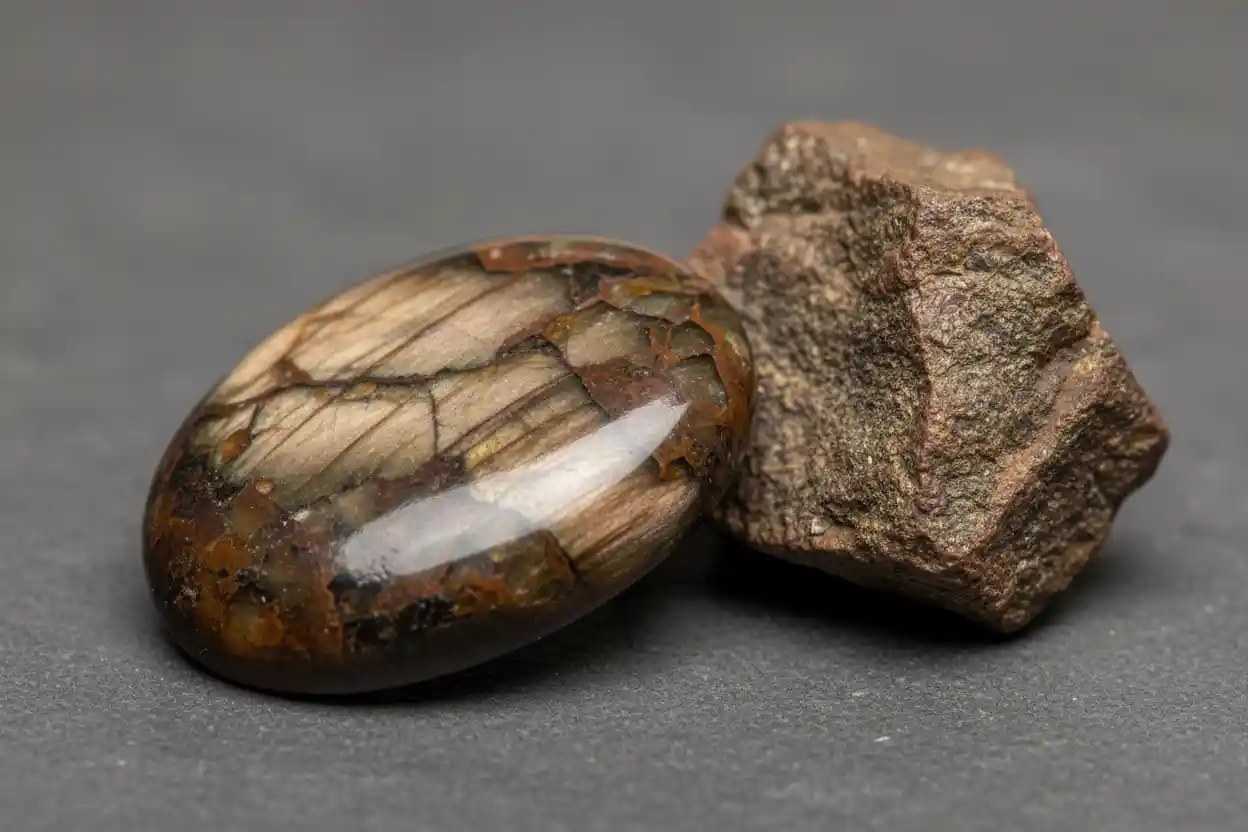
Bronzite healing properties are commonly described in contemporary crystal practice through themes of grounding, emotional steadiness, confidence, clearer decisions, stronger personal boundaries, focus, motivation, and spiritual reflection. These ideas belong to personal belief and symbolic practice rather than established mineral therapy. Bronzite has not been shown to treat anxiety or depression, change brain chemistry, protect the body from illness, or emit a measurable force that controls emotions or behavior. Its real identity is mineralogical: bronzite is an iron-bearing variety of enstatite in the pyroxene group, while the bronzite meaning used in crystal practice comes from the symbolism people attach to its bronze-brown color, reflective sheen, weight, and appearance.
Bronzite Healing Properties: 11 Popular Claims
The recurring claims can be separated into eleven useful themes rather than treating “healing” as one undefined effect:
- Grounding and feeling present
- Calm during pressure
- Emotional balance
- Confidence and courage
- Clearer decision-making
- Protection and personal boundaries
- Thoughtful communication
- Focus and concentration
- Motivation and follow-through
- Resilience during change
- Chakra and spiritual reflection
These themes can have personal value when bronzite is used as a reminder, ritual object, or visual cue. The behaviors built around the stone remain under the user’s control.
Iron-Bearing Enstatite With a Bronze Sheen
Bronzite belongs to the orthopyroxene branch of the pyroxene group and is generally treated as an iron-bearing variety of enstatite rather than a separate mineral species. Its composition is commonly expressed approximately as (Mg,Fe²⁺)₂Si₂O₆, reflecting magnesium and iron within a silicate structure. The proportion of iron contributes to the deeper brown and greenish-brown appearance that distinguishes bronzite from pale magnesium-rich enstatite.
Its crystal structure is orthorhombic, although collectors often encounter bronzite as massive or granular pieces rather than sharply formed display crystals. Colors range through bronze-brown, dark brown, greenish brown, gray-brown, and occasionally nearly black areas. A bronze-like or pearly to submetallic sheen can appear across suitable surfaces, especially where the internal structure reflects light strongly. That optical effect explains both its name and much of the visual symbolism behind bronzite color meaning.
Bronzite typically falls around 5 to 6 on the Mohs hardness scale. That makes it softer than quartz and many common jewelry gems. It is also brittle and has good cleavage characteristic of pyroxenes, so a hard strike can cause chipping or splitting even when the polished surface looks sturdy. These physical properties matter more to daily handling than the stone’s heavy appearance might suggest.
Some polished bronzite can be confused visually with hypersthene, dark enstatite, certain brown feldspars, or other gems with metallic-looking reflections. Hypersthene is especially relevant because older mineralogical terminology divided iron-bearing orthopyroxenes into names that are treated differently in current classification. A correct identification therefore depends on mineral structure and composition, not simply brown color or metallic sheen.
Geological Origins and Documented Localities
Bronzite forms in geological environments where magnesium- and iron-rich pyroxenes develop, particularly mafic and ultramafic igneous rocks and some high-grade metamorphic rocks. Orthopyroxene can occur in rocks such as peridotite, pyroxenite, norite, and related formations where temperatures and chemical conditions favor magnesium-iron silicates.
The name itself refers to the bronze-like appearance rather than a geographic discovery site. Bronzite has been recognized in European mineralogical literature since the early development of modern mineral classification, and documented occurrences are spread across several continents. Austria has important historical occurrences, while South Africa includes confirmed bronzite localities such as Monastery Mine. India is also represented in the gem and lapidary record, and occurrences are known from Australia, North America, and other regions containing suitable pyroxene-bearing rocks.
Because bronzite is a variety of enstatite rather than an independently recognized mineral species, it does not have a formal species type locality. The places where bronzite is found are better understood through the geology of orthopyroxene-rich rocks than through the idea of one single origin deposit.
Grounding, Calm, and Emotional Balance
1. Grounding and Feeling Present
Grounding is probably the claim most closely associated with bronzite’s dark brown, earthy appearance. In practical use, someone might hold a polished stone while deliberately noticing its weight, temperature, reflective patches, edges, and texture. The stone then becomes part of a sensory exercise that redirects attention toward the immediate environment.
There is no mineral mechanism that physically “grounds energy” in the body. What the ritual actually provides is a predictable object around which the user can organize attention. Looking at the stone, slowing breathing, noticing physical sensations, and identifying what is happening in the present moment are conscious actions.
2. Calm During Pressure
Bronzite is also described as a calming stone for stressful conversations, demanding work, travel, or periods of uncertainty. One realistic way to use that symbolism is to treat the stone as a pause signal. Before reacting, the person touches it, takes several controlled breaths, and decides what requires action now and what can wait.
The stone does not suppress stress hormones or directly regulate the nervous system. A deliberate pause can still change how someone responds to pressure because it interrupts an automatic reaction and creates time for a more considered choice.
3. Emotional Balance
Emotional balance claims usually describe remaining steady when feelings become intense. A bronzite routine can turn that idea into a simple reflection habit: identify the emotion, identify what caused it, separate what is known from what is assumed, and decide whether any immediate response is actually necessary.
That part is behavior, not mineral biology. Bronzite cannot regulate mood or remove distress. The bronzite benefits described in crystal traditions are most defensible when they are treated as symbolic prompts for actions the person can consciously repeat.
Confidence, Decisions, Boundaries, and Communication
4. Confidence and Courage
Bronzite is frequently associated with confidence, especially before situations that involve uncertainty or social pressure. Someone might keep the stone beside written notes before a presentation, interview, difficult phone call, or unfamiliar task and use it as the cue to review preparation one final time.
There is no mechanism by which an iron-bearing pyroxene produces courage. Confidence usually grows from preparation, experience, skill development, and repeated action. The stone can represent the intention to act despite discomfort, but it does not create that ability by itself.
5. Clearer Decision-Making
Decision-making claims can be reframed as a structured pause before committing to something important. A person using bronzite might write down the available options, the likely consequences, what information is missing, and what would make a choice difficult to reverse.
This is best treated as a metaphor rather than a mechanism. Bronzite does not improve executive function or reveal the correct answer. A consistent decision ritual can reduce impulsive choices simply because it encourages the person to examine the problem before acting.
6. Protection and Personal Boundaries
Protective symbolism is another familiar part of bronzite practice. Rather than interpreting protection as an invisible shield, the stone can represent a specific boundary the person has already chosen, such as declining unwanted demands, ending a harmful conversation, protecting uninterrupted work time, or refusing pressure to make an immediate decision.
The mineral itself does not block danger, hostility, or another person’s influence. The boundary works when the person states it clearly and follows through. Bronzite can function as a physical reminder of that commitment.
7. Thoughtful Communication
Some practitioners associate bronzite with controlled, deliberate communication rather than impulsive speech. Before an uncomfortable discussion, a person might use the stone as a prompt to identify the main point, remove unnecessary accusations, prepare one useful question, and listen fully before responding.
The stone does not change language processing or make another person receptive. The routine built around it may encourage clearer communication because preparation changes how a conversation is approached. Short bronzite affirmations can be used in the same way when they focus on concrete intentions such as speaking accurately or listening before replying.
Focus, Motivation, and Resilience
8. Focus and Concentration
Bronzite’s reflective bronze patches make it a visually distinctive desk stone, which can be useful when someone wants a consistent cue to return to a task. It can sit beside a notebook, keyboard, or study area and mark the beginning of a planned period of uninterrupted work.
There is no evidence that bronzite increases attention span, memory, or cognitive performance. The useful part is environmental conditioning. Seeing the same object in the same setting can remind a person of the routine they intended to follow, such as silencing notifications or returning to a specific task after distraction.
9. Motivation and Follow-Through
Motivation claims often describe bronzite as a stone of action or determination. A practical version is to connect it with the smallest next step in a project. Instead of using the stone while waiting to feel inspired, the user might touch it and immediately complete one defined action, such as opening a document, sending one message, making one appointment, or working for a predetermined interval.
The stone does not generate motivation. Starting an action can sometimes make continuation easier, and a repeated physical cue can become associated with beginning. That distinction keeps the ritual useful without turning symbolism into a claim about mineral energy.
10. Resilience During Change
Bronzite is sometimes used during career changes, relationship transitions, relocation, uncertainty, or periods when plans have shifted unexpectedly. Its symbolism can be paired with a short review of what has changed, what remains controllable, and what the next realistic step should be.
No stone creates psychological resilience. People develop resilience through coping skills, social support, problem-solving, recovery time, experience, and professional help when needed. The value of using bronzite lies in turning an abstract intention into a routine that points back toward those real actions.
Root and Solar Plexus Chakra Symbolism
11. Chakra and Spiritual Reflection
Bronzite is most commonly associated in modern crystal practice with the root chakra because of its brown, earthy coloration and grounding symbolism. Some practitioners also connect its bronze-gold reflections with the solar plexus chakra, particularly when the intended themes are confidence, personal agency, determination, and purposeful action.
Chakras belong to a spiritual framework rather than an anatomical system. They are not organs, glands, or measurable energy structures established by medical science. A bronzite chakra practice is therefore best understood as meditation, symbolism, or focused reflection.
The same distinction applies to bronzite spiritual meaning. Someone may interpret its dark base and shifting bronze reflections as symbols of steadiness, self-control, persistence, or finding direction during uncertainty. Those interpretations can be personally meaningful without requiring the mineral to alter external events or transmit a supernatural force.
Safe Care for a Cleavable Pyroxene
Bronzite may feel dense and substantial in the hand, but its Mohs hardness of roughly 5 to 6 and brittle tenacity require more caution than quartz-family stones. Avoid dropping polished pieces onto hard floors or knocking jewelry against counters, metal fixtures, or other gems. Good cleavage means an impact in an unfavorable direction can produce chips or fractures.
Store bronzite separately from harder stones such as quartz, topaz, corundum, and diamond. A soft pouch or divided jewelry box reduces scratching and accidental contact. For ordinary cleaning, use a soft damp cloth or brief washing with lukewarm water and mild soap, followed by thorough drying.
Steam and ultrasonic cleaning are unnecessary choices for bronzite because vibration, heat, pre-existing fractures, and cleavage can increase the chance of damage. Strong household cleaners, acids, bleach, abrasive powders, and sudden temperature changes should also be avoided.
Bronzite is not a hydrated mineral in its ideal formula, so brief contact with clean water during normal washing is generally different from soaking a water-sensitive hydrated crystal. Even so, prolonged immersion offers no care advantage. Salt water is especially unnecessary because dissolved salts can remain in small fractures, settings, or surface irregularities. The full considerations around whether bronzite is safe in water depend on whether the stone is fractured, treated, glued, or mounted in jewelry.
Cleansing Bronzite Without Soaking
Ritual cleansing does not need to involve physical washing. If cleansing is part of someone’s spiritual practice, dry methods protect bronzite while keeping the ritual separate from ordinary gem maintenance. Sound from a bell or singing bowl, a short period of quiet reflection, placing the stone in a dedicated dry location, or restating the intention connected with it are all low-risk approaches.
The purpose of these methods is symbolic rather than chemical. Sound does not remove a measurable harmful energy from bronzite, and leaving the stone in a special place does not change its mineral structure. The ritual can still create a clear psychological transition between one use and the next.
Avoid scraping the stone against salt, burying polished pieces in abrasive substances, exposing them to intense heat, or repeatedly soaking them simply because a cleansing method recommends it. Cleansing bronzite can remain simple, dry, and gentle.
Conclusion
Bronzite is an iron-bearing enstatite variety whose real character comes from orthopyroxene chemistry, good cleavage, moderate hardness, and its distinctive bronze-like sheen. Its eleven popular healing themes can serve as symbols for grounding, preparation, boundaries, focus, and reflection, but they remain unproven as direct therapeutic effects of the mineral. Used with clear expectations and sensible care, bronzite can be a meaningful ritual object while the real work remains in the choices, habits, and actions built around it.
Frequently Asked Questions
What are the main bronzite healing properties?
Popular claims include grounding, calm, emotional balance, confidence, clearer decisions, personal boundaries, communication, focus, motivation, resilience, and spiritual reflection. These are traditional or personal interpretations rather than established medical properties.
What is bronzite made of?
Bronzite is an iron-bearing variety of enstatite in the pyroxene group. Its composition is commonly represented approximately as (Mg,Fe²⁺)₂Si₂O₆.
Is bronzite a separate mineral species?
No. Modern mineral classification generally treats bronzite as an iron-bearing variety of enstatite rather than an independent mineral species.
How hard is bronzite?
Bronzite is roughly 5 to 6 on the Mohs hardness scale. It also has good cleavage and brittle tenacity, so it can chip or split after a strong impact.
Can bronzite reduce anxiety or stress?
Bronzite has not been shown to produce a crystal-specific anti-anxiety effect. Using it as a cue for breathing, reflection, preparation, or another calming routine can still be personally useful.
Does bronzite improve confidence?
The stone does not directly change confidence or self-esteem. It can be used as a reminder to prepare, act on a decision, practice a skill, or follow through on a difficult task.
What chakra is bronzite associated with?
Modern crystal practice commonly links bronzite with the root chakra and sometimes the solar plexus chakra. These connections belong to spiritual symbolism rather than human anatomy.
Is bronzite suitable for jewelry?
Yes, but it needs reasonable care. Its moderate hardness, brittleness, and cleavage make pendants and earrings relatively straightforward choices, while frequently knocked rings need more protection.
Can bronzite go in water?
Brief contact with clean water during ordinary washing is generally reasonable for an intact untreated stone. Avoid prolonged soaking, salt water, harsh cleaners, and unnecessary immersion of fractured, repaired, or mounted pieces.
How should bronzite be cleansed?
For ritual cleansing, sound, reflection, intention-setting, or dry placement are gentle choices. Physical dirt should be removed separately with mild cleaning appropriate to the stone.
Crystal healing claims are traditional or personal beliefs and should not replace qualified medical or mental health care.