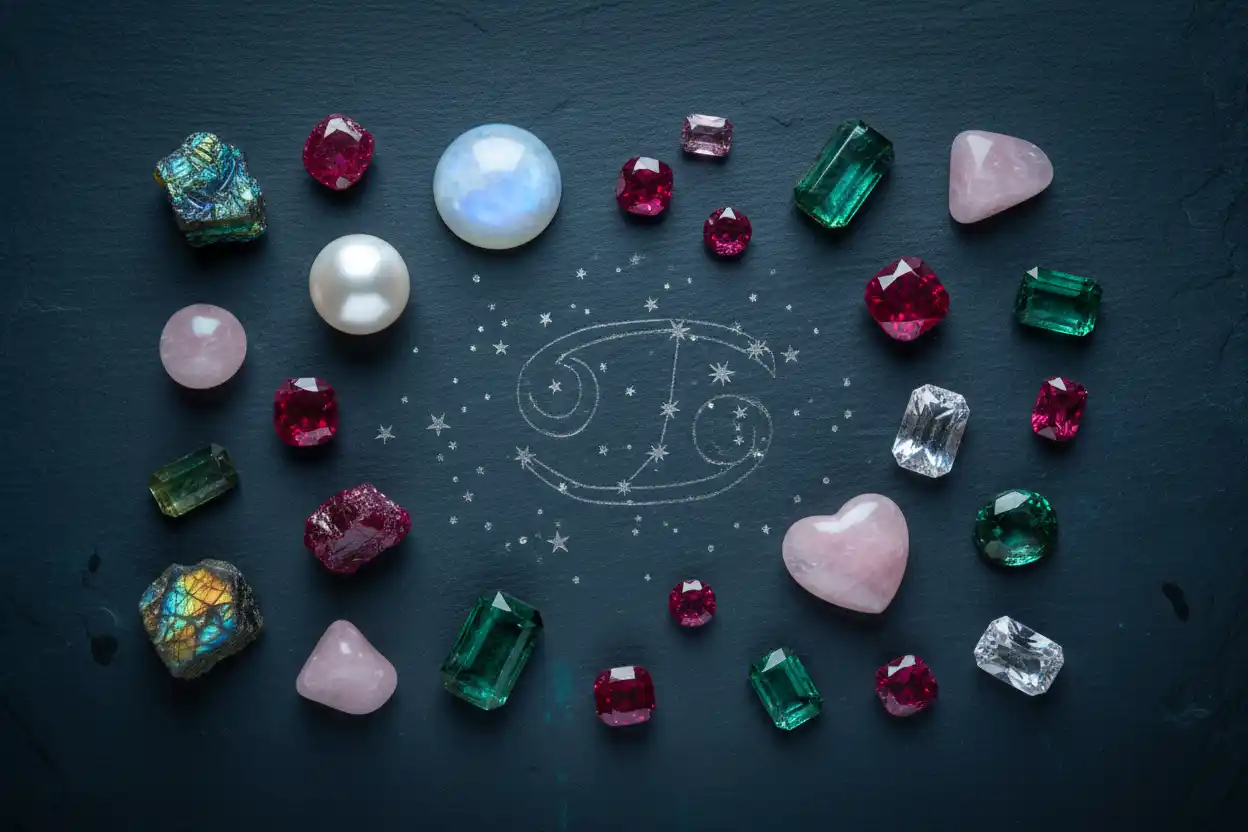
Cancer Birthstone: 18 Sacred Meanings of Ruby & Moonstone Energy
The Cancer birthstone is commonly represented by ruby and moonstone in modern astrological gemstone traditions. The connection is easy to understand from the calendar because Cancer spans parts of June and July, months strongly associated with moonstone and ruby in established birthstone systems. Ruby is the recognized July birthstone, while moonstone is one of the recognized June birthstones. Their additional connection with Cancer belongs to astrology and personal symbolism rather than gemological classification.
The two gemstones are physically very different. Ruby is red corundum with Mohs hardness 9, excellent toughness and no cleavage, making it one of the strongest natural colored gemstones for everyday jewelry. Moonstone is feldspar, normally around Mohs 6 to 6.5, with poor toughness and two cleavage directions. Its appeal comes from adularescence, the floating sheen that appears to move across the gemstone as the viewing angle changes.
Together, ruby and moonstone create a meaningful symbolic contrast. Ruby can represent commitment, courage and outward action, while moonstone can symbolize reflection, cycles and sensitivity. For someone using a Cancer birthstone as a personal emblem, the pairing can represent learning when to act decisively and when to pause. Neither stone determines personality, predicts relationships or produces measurable zodiac energy.
18 Sacred Meanings of the Cancer Birthstone
- Ruby can symbolize emotional courage.
- Red can represent commitment and devotion.
- Ruby durability can symbolize resilience.
- Historic ruby lore can represent dignity and protection.
- July birthstone identity strengthens its Cancer connection.
- Ruby can symbolize decisive action when needed.
- Moonstone can represent emotional cycles.
- Adularescence can symbolize changing perspective.
- June birthstone identity strengthens moonstone’s Cancer association.
- Moon symbolism can represent reflection and receptivity.
- Moonstone can symbolize adapting without losing identity.
- Ruby and moonstone together can represent action balanced by sensitivity.
- Their color contrast can symbolize passion and calm.
- Both can represent protecting what matters.
- Jewelry can symbolize family continuity.
- A Cancer birthstone can mark personal milestones.
- The pairing can represent emotional depth with practical strength.
- Sacred Cancer energy remains symbolic rather than scientifically measurable.
Why Ruby Is Associated With Cancer
Ruby connects naturally with Cancer because part of the sign falls in July, and ruby is the established birthstone for that month. Beyond the calendar, its long-standing symbolism involving love, courage, protection and commitment fits many of the themes modern astrology assigns to Cancer.
Ruby is the red variety of corundum, with chromium providing much of its characteristic color. Fine ruby generally shows vivid red to slightly purplish red and can display strong fluorescence in some lighting conditions. Its Mohs hardness of 9 makes it second only to diamond among the major jewelry gemstones in resistance to scratching.
For Cancer symbolism, durability can represent emotional resilience rather than emotional hardness. Someone may care deeply and still maintain strong boundaries, just as a ruby can be exceptionally durable without being completely indestructible.
The stone’s historical association with passion also does not need to mean dramatic romance. Passion can describe commitment to family, creative work or a long-term goal.
Moonstone Connects Cancer With Cycles and Reflection
Moonstone’s Cancer association is especially intuitive because both modern astrology and the gemstone’s name emphasize lunar symbolism. Moonstone is also one of the recognized June birthstones, creating a direct calendar relationship with the earlier portion of Cancer.
Its defining appearance is adularescence, a floating light effect caused by the internal feldspar structure. The sheen moves as the stone turns, creating the impression that light is drifting beneath the surface.
This optical effect makes changing perspective a particularly natural meaning. Emotions can feel completely convincing in one moment and less overwhelming after time, new information or rest. Moonstone can symbolize remembering that a feeling is important without assuming it is permanent.
The stone does not regulate emotional cycles biologically, but its appearance provides a strong visual metaphor for change.
Ruby and Moonstone Balance Strength With Sensitivity
Cancer is often described in astrology through sensitivity, attachment and protectiveness. If those ideas are used too literally, they can become stereotypes. Ruby and moonstone create a more balanced symbolic pairing.
Ruby represents outward strength, direct action and commitment. Moonstone represents observation, receptivity and reflection.
Someone who tends to avoid difficult conversations may use ruby symbolism to represent the courage to speak. Someone who reacts too quickly may use moonstone symbolism to represent waiting until the situation is clearer.
The purpose is not to correct a zodiac personality. It is to use two visually different gemstones as reminders of two complementary behaviors.
Ruby Is Excellent for Everyday Cancer Birthstone Jewelry
Ruby’s durability gives it a major advantage for rings, bracelets and other pieces exposed to daily wear. Corundum combines Mohs hardness 9 with excellent toughness and no cleavage, so it resists scratching and ordinary impact better than many colored gemstones.
That does not mean ruby cannot break. A severe impact can still chip or fracture the stone, especially where inclusions or surface-reaching features create weaknesses.
For a Cancer birthstone ring intended to become an heirloom, secure setting design and periodic prong inspection are still important.
Ruby should also be stored separately from softer stones because its hard surface can scratch quartz, moonstone, opal, pearl and many other gems.
Moonstone Needs Considerably More Protection
Moonstone requires a different approach. Its Mohs hardness of about 6 to 6.5 provides moderate scratch resistance, but cleavage makes impact the greater concern.
A hard strike can split moonstone along structural planes, particularly when the gemstone is set high above the finger.
Pendants and earrings are therefore easier everyday choices. Rings can still work, but lower settings, bezels or occasional wear are more practical.
Warm soapy water is the safest cleaning approach. High heat, steam and ultrasonic cleaning should be avoided because thermal stress and vibration may cause damage.
This difference in care is important when ruby and moonstone appear together in one piece. Cleaning and handling should always follow the needs of the more delicate stone.
Ruby Color Carries Much of Its Symbolic Meaning
Red naturally attracts symbolism involving blood, life, passion and urgency. Ruby’s color therefore generated intense cultural meanings long before modern zodiac crystal lists appeared.
For Cancer symbolism, red can represent devotion and willingness to protect what matters.
That protection should not be interpreted as supernatural shielding. A ruby cannot prevent accidents or defend a relationship from conflict.
Its role is symbolic. A ring given by a parent, partner or close friend may represent the intention to remain loyal and supportive through changing circumstances.
The emotional significance comes from the gift and relationship rather than from a force emitted by the corundum.
Moonstone’s Sheen Makes Emotional Depth a Natural Metaphor
Moonstone often appears relatively quiet until it is moved into the right angle of light. Then a strong blue or white sheen may cross the surface.
That visual surprise makes hidden depth a compelling symbolic interpretation.
People are often more complicated than their immediate reactions suggest. Someone who appears calm may be processing intense feelings, while another person who reacts strongly may later recognize a different perspective.
A moonstone can represent the idea that emotional depth deserves attention without requiring every feeling to become an immediate action.
This is a more useful form of Cancer symbolism than describing sensitivity as either weakness or supernatural intuition.
Ruby Treatments Matter When Buying Valuable Jewelry
Heat treatment is common in ruby and is generally accepted within the colored-gem trade when properly disclosed. Heating can improve color and clarity.
Fine rubies documented as showing no evidence of heat may command higher prices because they are rarer, but an attractive conventionally heated ruby can still be an excellent jewelry choice.
Other treatments, including glass filling, occupy a different market position and can significantly influence durability and value.
For a Cancer birthstone piece intended as an heirloom, treatment disclosure matters much more than astrological terminology.
A seller calling a stone a “Cancer power ruby” provides no useful information about whether it is natural, synthetic, heated or filled.
Moonstone Quality Depends Heavily on Adularescence
Fine moonstone is valued for an attractive moving sheen, ideally one that is strong, well centered and visible through a useful range of angles.
Body transparency also matters. Highly transparent stones with vivid blue adularescence can be especially desirable, while cloudy or poorly oriented material may show much weaker visual movement.
Cabochon cutting is common because a rounded surface helps display the sheen effectively.
When choosing moonstone jewelry, move the piece slowly rather than judging it through a still image. A photograph may show one ideal flash without revealing how the stone behaves through normal movement.
Cancer Birthstone Jewelry Does Not Need Both Stones
A person does not need ruby and moonstone together for the jewelry to qualify symbolically as a Cancer birthstone piece.
Someone who prefers highly durable jewelry may choose ruby alone. Another person may prefer moonstone’s softer color and optical effect.
A June-born Cancer may feel a stronger connection with moonstone, while a July-born Cancer may prefer ruby because of monthly birthstone tradition. Someone else may simply choose whichever gemstone fits their wardrobe or budget.
Personal preference is more important than rigid astrological rules.
Family Symbolism Makes Both Gems Especially Appropriate
Cancer is frequently associated in popular astrology with family, home and emotional attachment. Whether or not those traits describe an individual, both ruby and moonstone work well for family jewelry.
Ruby’s durability makes it particularly suitable for heirloom rings or pendants intended to remain wearable across generations.
Moonstone can carry equal sentimental value, although its softer physical character requires more careful preservation.
A ruby inherited from a grandparent may symbolize continuity, while a moonstone pendant associated with a major family event can become meaningful because of memory rather than market price.
Jewelry often gains its strongest emotional value through the people connected with it.
Ruby Can Represent Boundaries as Well as Passion
Because ruby is so often described as a gemstone of passion, its symbolism can become unnecessarily intense.
For Cancer birthstone use, ruby can also represent firmness.
Someone who cares deeply about others may still need to say no, leave an unhealthy situation or state a difficult truth.
A red ruby can symbolize the courage to protect personal boundaries without becoming emotionally detached.
This interpretation balances the more receptive symbolism of moonstone and makes the two gemstones particularly complementary.
Moonstone Can Represent Reflection Without Predicting the Future
Moonstone is frequently connected with intuition, dreams and psychic awareness in modern spiritual practice.
There is no established evidence that the gemstone predicts future events or increases supernatural perception.
Its symbolism becomes more useful when intuition means paying attention to subtle observations and emotional reactions while remaining willing to question them.
Someone may use moonstone while journaling about a recurring concern, then compare the feeling with actual events and evidence.
Reflection becomes the useful practice, not prediction.
Cancer Birthstone Energy Is Better Understood as Personal Meaning
The phrase Cancer birthstone energy is common in spiritual writing, but gemstones do not have scientifically demonstrated zodiac frequencies.
Ruby has measurable hardness, refractive properties, chemistry and fluorescence. Moonstone has measurable feldspar structure, hardness, cleavage and adularescence.
The spiritual meanings come from cultural traditions and personal associations layered onto these physical characteristics.
This distinction does not make the jewelry meaningless. It simply places the meaning where it belongs: in the relationship between the wearer and the symbol.
A Practical Ruby and Moonstone Comparison
| Feature | Ruby | Moonstone |
|---|---|---|
| Mineral identity | Corundum | Feldspar |
| Typical appearance | Red to purplish red | Colorless to pale with moving sheen |
| Mohs hardness | 9 | About 6–6.5 |
| Toughness | Excellent | Poor |
| Cleavage | None | Two directions |
| Best jewelry use | Rings, earrings, pendants, bracelets | Pendants, earrings, protected rings |
| Main visual factor | Color and brilliance | Adularescence |
| Symbolic theme | Courage and commitment | Reflection and cycles |
| Care level | Relatively easy | More careful handling required |
This contrast makes ruby and moonstone an unusually complementary Cancer birthstone pair. One emphasizes physical durability and strong color, while the other emphasizes movement, softness and changing light.
Choosing the Right Cancer Birthstone
Choose ruby when durability, vivid color and symbolism involving commitment or courage matter most.
Choose moonstone when you prefer pale color, optical movement and themes involving reflection, cycles or changing perspective.
Choose both if their contrast expresses something personally important. Ruby can represent acting when necessary, while moonstone can represent pausing when more reflection is needed.
There is no objectively stronger Cancer birthstone.
The right choice is the gemstone whose appearance, history and practical wear requirements suit the person receiving or wearing it.
Conclusion
The Cancer birthstone tradition is especially well represented by ruby and moonstone because Cancer spans parts of July and June, the months associated with these two gemstones. Ruby provides exceptional durability, vivid red color and symbolism involving courage, devotion and commitment, while moonstone offers adularescence, softer physical character and themes involving reflection, cycles and emotional awareness. Together they can symbolize strength balanced with sensitivity, but their zodiac meanings remain personal and cultural rather than scientifically measurable. The most meaningful Cancer birthstone is ultimately the one that fits the wearer’s taste, lifestyle and personal story.
FAQs About the Cancer Birthstone
What is the main Cancer birthstone?
There is no single standardized gemological Cancer birthstone. Ruby and moonstone are especially natural choices because Cancer spans parts of July and June, whose recognized birthstones include ruby and moonstone.
Is ruby a Cancer birthstone?
Yes in popular astrological traditions. Ruby is also the recognized July birthstone, making it particularly natural for Cancer birthdays falling in July.
Is moonstone a Cancer birthstone?
Yes. Moonstone is commonly associated with Cancer and is also one of the recognized June birthstones, giving it a strong calendar connection with June-born Cancer individuals.
Which is better for Cancer, ruby or moonstone?
Neither is objectively better. Ruby is considerably more durable and suits frequent jewelry wear, while moonstone offers a softer appearance and distinctive moving sheen.
Can ruby be worn every day?
Yes. Ruby ranks 9 on the Mohs scale, has excellent toughness and no cleavage, making it one of the strongest natural colored gemstones for daily wear.
Can moonstone be worn every day?
Moonstone can be worn regularly, but it requires more care because of its lower hardness and cleavage. Pendants and earrings are generally easier to protect than exposed rings.
Do Cancer birthstones improve intuition?
There is no established scientific evidence that ruby or moonstone increases intuition or psychic perception. They can still serve as symbolic reminders to reflect before making decisions.
Do ruby and moonstone create emotional healing energy?
No scientifically established mechanism shows that either gemstone directly heals emotional conditions. Their emotional meanings come from symbolism, cultural tradition and personal association.