11 Chevron Amethyst Healing Properties: Popular Claims, Verified Facts & Safe Use
Chevron amethyst healing properties are commonly described through calm, emotional balance, sleep rituals, mental clarity, concentration, confidence, creativity, decision reflection, grounding, protective symbolism, and spiritual practice. These interpretations draw partly on the long history of amethyst and partly on modern crystal traditions surrounding the stone’s distinctive purple-and-white pattern. They are not established therapeutic properties. Chevron amethyst has not been shown to treat anxiety or insomnia, alter brain function, remove emotional distress, or emit a measurable healing force through the body. Its physical identity is much clearer: chevron amethyst is patterned quartz in which purple amethyst and pale or milky quartz form repeated angular growth zones, while the chevron amethyst meaning used in spiritual practice comes from symbolism attached to those colors and patterns.
Chevron Amethyst Healing Properties: 11 Popular Claims
The eleven recurring themes can be kept separate without turning small variations of the same belief into additional benefits:
- Calm during stressful moments
- Emotional balance
- Support for a restful bedtime routine
- Mental clarity
- Concentration and patience
- Confidence and self-trust
- Creativity and fresh perspective
- Intuition and decision reflection
- Grounding during uncertainty
- Protective symbolism and personal boundaries
- Chakra and spiritual reflection
Each theme can become a deliberate routine involving breathing, journaling, preparation, meditation, or another action the user controls. The symbolism may be personally meaningful without implying that quartz itself changes physiology.
Purple Amethyst and White Quartz in Angular Bands
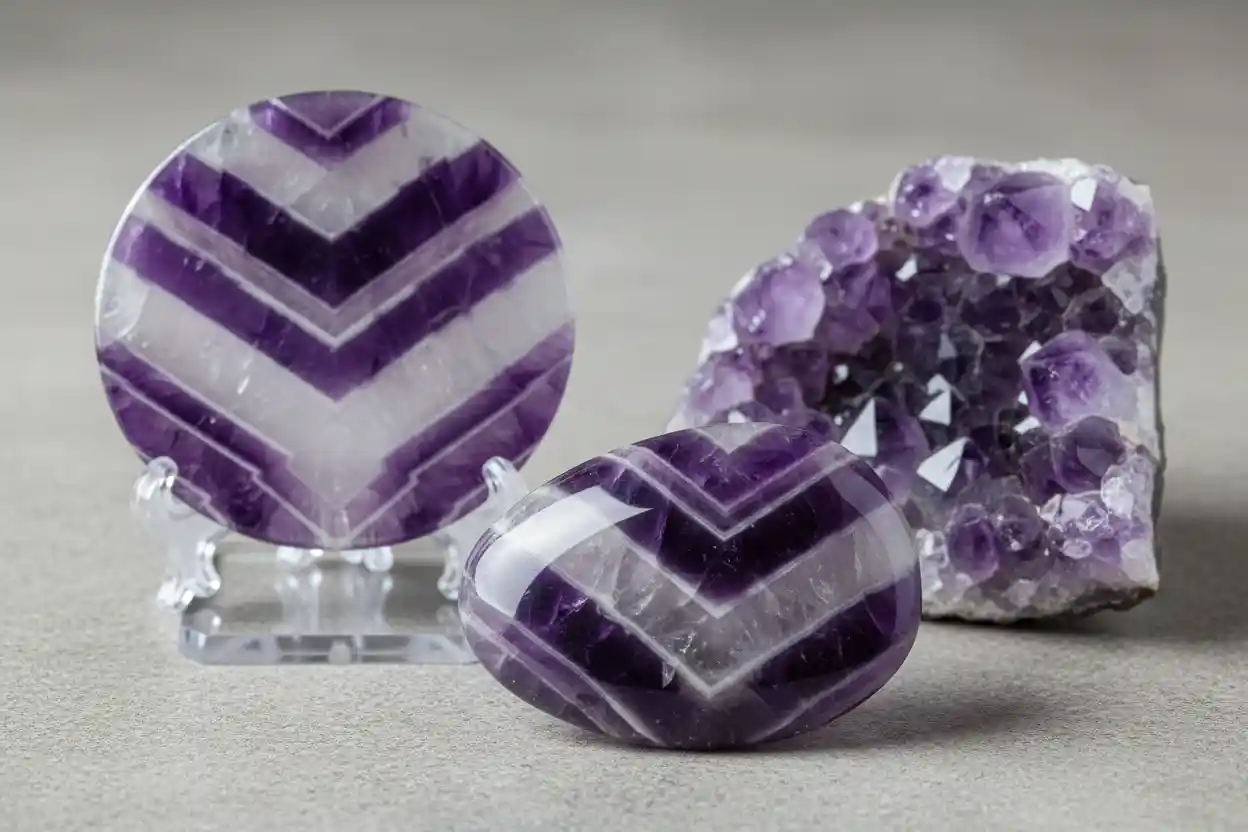
Chevron amethyst is not a separate mineral species. It is a descriptive name for amethyst that displays repeated purple and white quartz growth zones, often forming V-shaped, zigzag, triangular, or nested angular patterns when the stone is cut or polished. “Dream amethyst” and “banded amethyst” are also common commercial names, although usage is not perfectly standardized between sellers.
Both the purple and pale areas belong to the quartz family and share the basic chemical formula SiO₂. Amethyst is simply the purple variety of quartz. Quartz crystallizes in the trigonal system, and amethyst has a Mohs hardness of 7, giving chevron amethyst the same basic hardness as ordinary amethyst. GIA identifies amethyst as quartz with a hardness of 7, while also noting that angular color zoning is a normal feature of natural amethyst.
The purple color develops through iron-related color centers combined with natural irradiation during geological formation. Pale or white zones lack the same visible intensity of purple coloration, and microscopic inclusions can also make quartz look cloudy or milky. When changing growth conditions produce successive zones following crystal faces, cutting across those zones can reveal the characteristic chevron appearance. Banded amethyst from Namibia, for example, has been documented with distinct growth episodes represented by differently colored quartz zones.
This pattern can range from sharp white Vs against dark violet backgrounds to broad lilac-and-white triangles, smoky sections, irregular zigzags, or subtle alternating bands. The appearance depends partly on the original crystal growth and partly on cutting orientation. Those differences explain why chevron amethyst color meaning can vary between pieces even though the underlying stone remains quartz.
Quartz has no true cleavage and usually breaks with conchoidal fracture. Chevron amethyst is therefore more resistant to cleavage-related splitting than stones such as calcite or fluorite, but it is still brittle enough to chip when dropped or struck against a hard surface. The patterned zones do not make it physically harder than ordinary amethyst.
Ancient Amethyst, Modern Chevron Description
Amethyst itself has a genuine ancient history. Its name comes from the Greek amethystos, associated historically with the belief that the purple gem could protect against drunkenness, and surviving amethyst jewelry demonstrates use extending thousands of years into the past. GIA documents an amethyst necklace dating to around 2000 BCE and records ancient Greek and later European beliefs surrounding the gem.
That history should not be transferred automatically to every modern chevron-amethyst claim. The angular banding is a natural geological feature, but “chevron amethyst” and “dream amethyst” function mainly as descriptive or commercial names for patterned stone. Ancient societies certainly used amethyst, but there is far less basis for claiming that today’s distinct package of chevron-amethyst healing interpretations existed as a separate ancient tradition.
The underlying quartz can form in veins, cavities, geodes, and hydrothermal settings where silica-rich fluids deposit successive stages of crystal growth. Amethyst is sourced from many regions, with Brazil, Uruguay, Zambia, and several other countries important to the modern gem trade. GIA identifies Brazil as a major source and Zambia as another significant producer, while patterned amethyst is also reported from other quartz-producing regions. The places where chevron amethyst is found reflect this wider geology rather than one formal type locality, because chevron amethyst is a variety description rather than an independent mineral species.
Calm, Emotional Balance, and Bedtime Rituals
1. Calm During Stress
Chevron amethyst is commonly presented as a calming crystal. The combination of purple and white can make a polished piece visually restful, and someone may associate it with slowing down before reacting to a stressful situation. One practical routine is to hold or look at the stone while taking several measured breaths and deciding whether an immediate response is necessary.
There is no mechanism by which patterned quartz directly suppresses stress hormones or medically treats anxiety. The stone can still serve as a consistent cue. When the same object repeatedly marks the beginning of a breathing or reflection practice, seeing it may remind the person to perform the routine.
2. Emotional Balance
Emotional balance is a separate claim centered on responding thoughtfully when feelings are intense. Chevron amethyst can be placed beside a journal and used as a prompt to distinguish four things: what happened, what emotion followed, what interpretation was added, and what still remains uncertain.
The mineral does not regulate mood or remove distress. The chevron amethyst benefits described in crystal practice are more useful when they direct attention toward habits the person can actually perform rather than promising an automatic emotional change.
3. Support for a Restful Bedtime Routine
Amethyst has long accumulated associations with calm and clear-headedness, and modern crystal practice frequently extends that reputation to nighttime use. Chevron amethyst may be kept near a bedside area as a signal that daytime activity is ending.
The stone does not act as a sedative or treat insomnia. A useful routine might involve dimming lights, putting away a phone, writing down unfinished tasks, reading quietly, or beginning another consistent pre-sleep habit when the stone is placed in its usual position. The routine provides the structure. Quartz does not induce sleep.
Clarity, Concentration, and Confidence
4. Mental Clarity
The contrast between dark purple and pale quartz often inspires symbolism around seeing a situation more clearly. Someone facing a complicated choice can use chevron amethyst as the cue to put the problem into writing, separate known facts from assumptions, and identify information that is still missing.
This is best treated as a metaphor rather than a mechanism. Chevron amethyst does not reorganize thoughts or clear neural pathways. Structured reflection can nevertheless make confusion easier to manage because the problem is no longer being held as one vague mental burden.
5. Concentration and Patience
Chevron amethyst is sometimes kept on a desk during study or detailed work. A practical approach is to associate the stone with one predetermined period of focused activity. Once it is placed beside the work area, notifications are silenced, one task is selected, and attention returns to that task whenever distraction appears.
There is no established evidence that amethyst directly increases memory, intelligence, or attention span. The ways to use chevron amethyst become more defensible when the stone accompanies a real concentration strategy rather than replacing one.
6. Confidence and Self-Trust
Confidence claims often describe chevron amethyst as encouraging trust in one’s own judgment. That idea can be turned into preparation before a meeting, presentation, difficult conversation, examination, or unfamiliar situation. The stone can mark the moment to review what has already been prepared rather than repeatedly searching for reassurance.
The stone does not create confidence. Experience, preparation, competence, support, and repeated action are what build it. Short chevron amethyst affirmations may still fit the ritual when they focus on realistic intentions such as speaking clearly, following a prepared plan, or tolerating temporary uncertainty.
Creativity and Decision Reflection
7. Creativity and Fresh Perspective
Chevron amethyst’s nested angles and changing purple-white patterns make it visually complex enough to work as a creative prompt. A writer, designer, artist, or musician could use one piece as the starting point for a short brainstorming exercise, sketch, color study, or free-writing session.
There is no demonstrated pathway through which patterned quartz activates creativity in the brain. The stone’s practical role is simply to create a repeatable starting cue. Once a person begins experimenting instead of waiting for inspiration, new ideas have an opportunity to develop.
8. Intuition and Decision Reflection
Chevron amethyst is frequently associated with intuition and inner guidance. A safer interpretation treats intuition as information to examine rather than a supernatural instruction that must be followed. Someone can note their immediate reaction to a decision and then compare it with evidence, previous experience, risks, alternatives, and likely consequences.
The mineral cannot reveal hidden facts or predict which choice will succeed. Intuition can emerge from experience and pattern recognition, but it can also reflect fear, preference, or bias. A reflection ritual is useful when it encourages examination instead of unquestioning certainty.
Grounding and Personal Boundaries
9. Grounding During Uncertainty
Although purple stones are often associated with contemplation, chevron amethyst is also used as a grounding object when thoughts feel repetitive or circumstances are changing quickly. A simple practice is to hold a polished piece and identify what is happening now, what remains controllable, and what action actually belongs to the present day.
There is no measurable grounding force passing between the stone and the body. The routine works by bringing attention back from imagined outcomes to immediate facts, physical surroundings, and practical decisions.
10. Protective Symbolism and Personal Boundaries
Amethyst has carried protective symbolism across different periods of history, and modern practice extends similar ideas to chevron amethyst. Protection becomes more useful when it is translated into behavior rather than treated as an invisible shield.
The stone might represent a decision to leave a hostile conversation, postpone an answer when pressure is being applied, protect uninterrupted work time, or limit repeated contact that ignores a clearly stated boundary. Chevron amethyst does not block another person’s influence. The boundary works when the person communicates and maintains it.
Chakra and Spiritual Reflection
11. Third-Eye and Crown Chakra Symbolism
Modern crystal practice commonly associates purple chevron amethyst with the third-eye and crown chakras. Third-eye symbolism tends to focus on introspection, perception, and decision reflection, while crown-chakra interpretations emphasize contemplation, spirituality, and a sense of connection beyond everyday concerns.
Chakras are a spiritual framework, not anatomical structures established by medical science. A chevron amethyst chakra practice therefore belongs to meditation, personal spirituality, or symbolic reflection rather than treatment of the brain, endocrine system, nerves, or other physical structures.
The chevron amethyst spiritual meaning often draws extra symbolism from the alternating purple and white bands. Some practitioners interpret them as layers of thought, movement between uncertainty and clarity, or repeated stages of personal reflection. These interpretations can carry meaning without requiring the quartz to emit a supernatural force.
Safe Care for Chevron Amethyst
Chevron amethyst shares ordinary amethyst’s Mohs hardness of 7 and generally good toughness, making polished pieces suitable for many types of jewelry and regular handling. Hardness does not make quartz indestructible. Topaz, sapphire, ruby, and diamond can scratch it, while a strong impact can chip edges or fracture a carved point. GIA considers amethyst suitable for jewelry but recommends reasonable precautions against scratching and impact.
For ordinary cleaning, warm water, mild soap, and a soft cloth or soft brush are usually appropriate for an intact untreated stone. Avoid harsh chemicals and abrasive powders. Steam cleaning is not recommended, and abrupt temperature changes can cause fracture. GIA also notes that prolonged exposure to intense light can fade some amethyst color and that excessive heat may damage or alter it.
Chevron amethyst is not a hydrated mineral. Its formula is SiO₂, so water is not an essential structural component. Brief washing is therefore different from prolonged ritual soaking. Dyed stones, fracture-filled pieces, glued carvings, jewelry settings, and unknown treatments still justify a more cautious approach.
The practical answer to whether chevron amethyst is safe in water is that normal brief cleaning with fresh water is generally reasonable for an intact untreated specimen, while long immersion, salt water, extreme temperatures, and unnecessary repeated soaking provide little benefit.
Cleansing Without Prolonged Soaking
Ritual cleansing and physical cleaning should remain separate. Chevron amethyst does not need a long water bath, salt burial, aggressive scrubbing, or strong heat simply because someone wants to reset its symbolic purpose. Sound, meditation, reflection, or placing the stone in a clean dedicated area can accomplish the ritual without creating unnecessary wear.
A bell, singing bowl, spoken intention, or quiet period of reflection can mark the end of one use and the beginning of another. These practices do not remove a scientifically demonstrated harmful energy from quartz. Their significance comes from the person’s intention and routine.
The gentlest ways to cleanse chevron amethyst also protect polished surfaces, carved points, jewelry settings, and specimens whose treatment history may not be known.
Conclusion
Chevron amethyst is patterned quartz defined by the natural interaction of purple amethyst and lighter quartz growth zones, with the angular bands recording changes that occurred as the crystal developed. Its eleven popular healing themes can support personally meaningful routines around calm, focus, creativity, boundaries, reflection, and spiritual practice, but they remain traditional or personal interpretations rather than proven therapeutic properties. The stone works most responsibly as a visual reminder while the meaningful changes come from the actions built around it.
Frequently Asked Questions
What are the main chevron amethyst healing properties?
Popular claims include calm, emotional balance, restful routines, mental clarity, concentration, confidence, creativity, intuition, grounding, protective symbolism, and spiritual reflection. These are traditional or personal beliefs rather than established medical effects.
What is chevron amethyst made of?
Chevron amethyst is patterned quartz composed primarily of silicon dioxide, SiO₂. Its appearance combines purple amethyst zones with paler, colorless, or milky quartz zones.
Is chevron amethyst the same as dream amethyst?
“Dream amethyst” is widely used as a commercial name for purple-and-white patterned amethyst, often with chevron banding. The term is not a separate mineral species.
Why does chevron amethyst have V-shaped bands?
The pattern records changing stages of quartz crystal growth. Purple and paler growth zones follow the geometry of the developing crystal, and cutting through those zones can expose nested Vs, triangles, or zigzags.
How hard is chevron amethyst?
It has the same basic hardness as quartz, approximately 7 on the Mohs scale. It has no true cleavage but can still chip or fracture after a hard impact.
Can chevron amethyst reduce anxiety or stress?
Chevron amethyst has not been shown to treat anxiety or directly alter the stress response. It can be used as a cue for breathing, journaling, meditation, or another calming routine.
Does chevron amethyst help with sleep?
The stone does not work as a sedative or treat sleep disorders. Some people use it as a visual signal for beginning a consistent evening routine.
What chakra is chevron amethyst associated with?
Modern crystal practice most often links it with the third-eye and crown chakras. Chakra associations belong to spiritual frameworks rather than human anatomy.
Is chevron amethyst suitable for jewelry?
Yes. Mohs hardness 7 and good general durability make it practical for many jewelry styles, although polished surfaces and exposed edges still need protection from harder gems and strong impacts.
Can chevron amethyst go in water?
Brief washing with fresh water is generally reasonable for an intact untreated piece. Long soaking, salt water, harsh cleaners, heat, and immersion of dyed, filled, glued, or mounted stones are better avoided.
How should chevron amethyst be cleansed?
For ritual cleansing, sound, meditation, intention-setting, or dry placement are gentle choices. Physical dirt should be handled separately with mild cleaning appropriate to quartz.
Crystal healing claims are traditional or personal beliefs and should not replace qualified medical or mental health care.