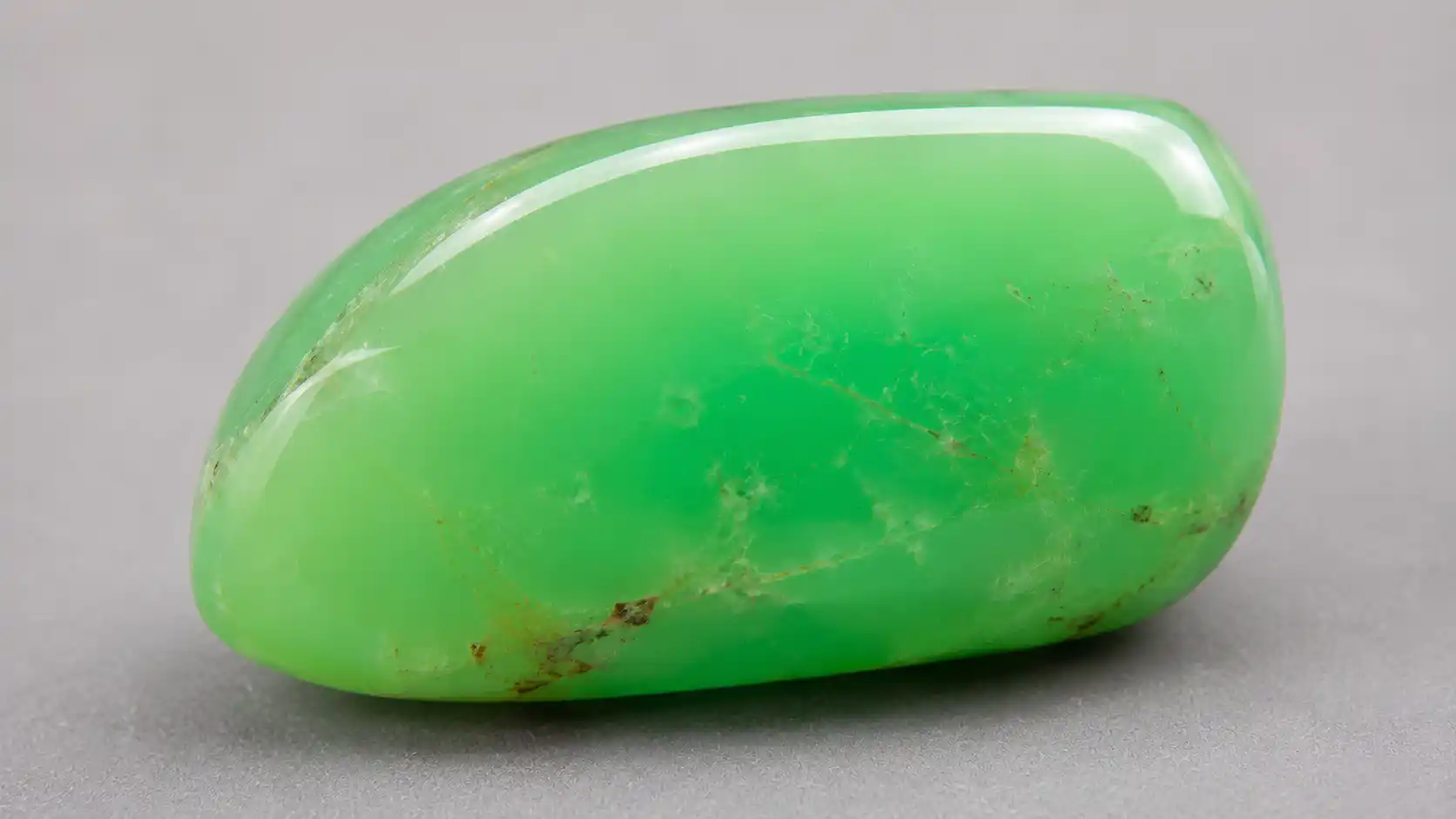
Chrysoprase Meaning: Formation, History & Symbolism
Chrysoprase meaning is easiest to understand when the stone is identified correctly before symbolism is discussed. Chrysoprase is a green variety of chalcedony, the cryptocrystalline form of silica commonly described as microcrystalline quartz with structural complexity at a scale too fine to see with the unaided eye. Its characteristic green color is associated with nickel-bearing components rather than the chromium that colors some other green gems, and the material commonly forms in weathering environments connected with nickel-rich ultramafic rocks. Those measurable facts belong to mineralogy and gemology; ideas about renewal, emotional balance, compassion, prosperity, or heart-centered reflection belong to modern symbolism and personal practice. Gems Lore keeps those categories separate throughout its broader Healing Crystal coverage so that a beautiful green stone does not become evidence for a medical, predictive, or supernatural claim.
A useful reference also has to account for the fact that chrysoprase varies. Some material is highly translucent, evenly colored, and capable of taking a fine polish, while other pieces contain pale zones, brown matrix, fractures, inclusions, or irregular color distribution. Photographs can show many of these characteristics, but they cannot by themselves prove nickel content, treatment status, locality, or the absence of dyed substitutes. That limitation is central to chrysoprase meaning as a responsible reference topic: the material can be appreciated for what is visible and documented without asking appearance to prove more than it can.
Chrysoprase at a Glance
| Property | Practical reference |
|---|---|
| Material identity | Green variety of chalcedony, composed predominantly of cryptocrystalline silica |
| Chemical basis | Predominantly SiO₂, with green color associated with nickel-bearing components |
| Typical color | Apple green, yellow-green, medium green, occasionally deeper green |
| Transparency | Commonly translucent to opaque; finer material may show attractive internal glow at thin edges |
| Hardness | About 6.5–7 on the Mohs scale, consistent with chalcedony |
| Luster | Waxy to vitreous when polished |
| Common formation setting | Silica-rich secondary material in weathered, nickel-bearing ultramafic environments |
| Main identification caution | Green color alone cannot distinguish natural chrysoprase from dyed chalcedony, other green minerals, or trade-named substitutes |
| Symbolic status | Modern interpretations are cultural or personal meanings, not scientifically established effects |
This at-a-glance profile explains why chrysoprase is both familiar and easy to misread. It behaves broadly like chalcedony in durability and polish, but its color, translucency, matrix, and market naming create identification questions that do not arise from chemistry alone. A specimen may be visually convincing while still requiring more evidence before a precise origin or treatment claim can be accepted.
What Chrysoprase Actually Is
Chrysoprase belongs to the chalcedony family rather than forming as large, distinct crystals in the way many people imagine when they hear the word crystal. Chalcedony is made of extremely fine intergrowths of silica phases, principally quartz with variable moganite content, and chrysoprase is the green color variety within that microcrystalline material. Because the internal structure is so fine-grained, a polished surface can look smooth, dense, and almost glowing even though the stone is not a single transparent crystal. This structure helps explain its toughness relative to many visibly crystalline gems and also gives polished chrysoprase its characteristic waxy-to-glassy appearance.
The simple formula SiO₂ describes the dominant silica framework, but it does not explain every visual feature of a chrysoprase specimen. The green color is associated with nickel-bearing components distributed through the chalcedony, while iron staining, host-rock remnants, fractures, weathering products, and other inclusions can introduce brown, yellow, white, or darker areas. That is why a single formula should not be used as if it were a complete description of every piece. The more useful question is how the silica, nickel-related color, texture, and geological environment fit together.
How Chrysoprase Forms
Chrysoprase commonly develops in weathering zones associated with nickel-bearing ultramafic rocks, including serpentinized materials that have undergone prolonged chemical alteration. As near-surface waters move through fractured rock, silica and nickel can be mobilized and redistributed. Silica-rich material then precipitates into fractures, cavities, veins, or porous zones, producing chalcedony whose nickel-related components impart the characteristic green color. This process is not a single instant of crystal growth but part of a wider alteration system in which water chemistry, host-rock composition, permeability, oxidation, and repeated episodes of deposition can all influence the finished stone.
That geological context helps explain why rough chrysoprase may be attached to brown, tan, cream, or iron-stained matrix rather than appearing as a clean green lump. It can also explain irregular bands, pale edges, cloudy areas, and differences in color saturation from one part of the same specimen to another. Readers interested in the geological side can go deeper into chrysoprase formation and deposit geology, while the key point here is that the green material should be read as part of an altered rock environment rather than as an isolated color phenomenon.
What Causes the Green Color?
Chrysoprase is colored by nickel-bearing components associated with the chalcedony, not by the same chromophore responsible for every other green gemstone. This distinction matters because green is not a mineral identity. Emerald owes its famous green to chromium and sometimes vanadium in beryl, many green tourmalines have different chemical causes, and dyed chalcedony can be made green without naturally occurring chrysoprase coloration. In chrysoprase, the color can range from pale yellow-green through fresh apple green to stronger medium green, with translucency and texture greatly affecting how saturated the stone appears.
The exact visual result depends on more than total nickel alone. The microscopic distribution and chemical form of nickel-bearing material, the amount and structure of chalcedony, weathering, inclusions, and lighting can all affect appearance. This is why photographs taken under cool LEDs, warm indoor light, direct sun, or strongly edited white balance may show the same stone quite differently. The specialist guide to chrysoprase optical properties and color behavior explores that subject in more detail, but for identification purposes the safest conclusion is that natural-looking green supports consistency with chrysoprase; it does not prove chrysoprase by itself.
Diagnostic Traits and Their Limits
A chrysoprase specimen is most convincing when several observations agree. A dense microcrystalline texture, apple-green to medium-green color, waxy or vitreous polish, chalcedony-like hardness, translucency at thin edges, and a weathered ultramafic-style matrix can collectively support the identification. Yet each of those observations has limits. Hardness testing can damage a polished object, color varies naturally, matrix may be removed during cutting, and many substitutes can imitate part of the appearance. Responsible identification therefore relies on converging evidence rather than a single dramatic clue.
Magnification can help reveal cloudy color distribution, fractures, particulate inclusions, surface coatings, dye concentrations in cracks, and differences between translucent silica and opaque matrix, but microscopy is not a magic answer. Some natural chrysoprase is internally quiet, while some dyed or treated material can appear convincing without advanced testing. The chrysoprase microscope and inclusion notebook focuses on what magnification can reasonably show and where visual evidence stops.
A Specimen and Photo Evaluation Framework
Begin with the entire piece rather than the brightest green area. In rough material, note whether the green chalcedony fills a vein, forms a compact nodule, follows fractures, or sits against weathered brown or cream matrix. Observe whether the boundary between green material and host rock is gradual, irregular, or sharply artificial-looking, but do not treat one boundary style as proof of authenticity. Natural geological contacts can be abrupt, and cutting can create surfaces that look more regular than the original specimen.
Next, compare color under more than one neutral light source if the piece is available in hand. Look for whether the green remains broadly consistent or changes drastically because of white balance, surface wetting, or image editing. In photographs, ask whether the seller shows front, back, side, and close views rather than a single saturated image. Visible translucency, cloudy internal structure, brown matrix, healed fractures, and natural variation can support a coherent description, but none of those features establishes locality or treatment status without additional evidence.
Then evaluate the trade name. “Chrysoprase” should refer to green chalcedony whose color is associated with nickel, while labels built around color resemblance can be less precise. “Lemon chrysoprase,” for example, is a commercial name frequently applied to yellow-green nickel-bearing magnesite rather than true chalcedony chrysoprase, so the label should not be accepted as a mineralogical synonym without checking the underlying material. Similar caution is appropriate with broad names such as “green onyx,” which can be used inconsistently in commerce. The practical rule is simple: a market name describes how something is sold; it does not automatically establish species, variety, treatment, or composition.
Finally, separate what a photo supports from what it cannot establish. Photographs can document visible color, pattern, polish, matrix, obvious fractures, approximate translucency, and craftsmanship. They cannot conclusively prove nickel chemistry, natural versus dyed origin, stabilization status, exact geographic provenance, or mine identity. When an origin claim affects desirability or price, documentation matters more than visual resemblance, which is why the chrysoprase provenance disclosure checklist is a better framework for evaluating locality claims than trying to identify a deposit from color alone.
Documented History Without Invented Lore
The name chrysoprase is derived from Greek roots commonly translated in relation to “gold” and “leek,” a reference to its green coloration rather than a scientific description of composition. Green chalcedony has been valued as an ornamental material for centuries, and chrysoprase became especially prominent in European decorative and jewelry traditions because its fresh color could be carved, polished, and set effectively. Historical use, however, should be discussed with the same identification discipline applied to modern specimens: an old reference to a green stone is not automatically proof that the material was chrysoprase as now defined.
This matters because modern crystal literature often repeats specific stories about rulers, warriors, or ancient healing traditions without showing how the stone was identified. A broad historical statement about green chalcedony or ornamental green stone should not be converted into a precise claim about chrysoprase unless the object, text, or analysis supports that identification. The responsible version of chrysoprase meaning therefore distinguishes documented material history from later symbolic narratives instead of treating every old green gem reference as evidence of a continuous metaphysical tradition.
Chrysoprase Meaning in Modern Symbolism
In contemporary crystal traditions, chrysoprase meaning is commonly associated with renewal, compassion, emotional openness, hope, forgiveness, and heart-centered reflection. Its vivid green color encourages obvious comparisons with growth, spring, vegetation, and new beginnings, so many modern interpretations use the stone as a metaphor for changing habits, softening resentment, or approaching relationships with greater patience. Some practitioners connect chrysoprase with the heart chakra, while others use it during journaling, meditation, or intention-setting. These are modern symbolic systems and personal practices rather than measured properties of chalcedony.
The distinction becomes especially important when symbolic language drifts toward promises. There is no established scientific evidence that chrysoprase treats depression, anxiety, heart disease, hormonal problems, fertility issues, inflammation, infection, pain, or any other health condition. It also cannot guarantee reconciliation, attract a specific partner, produce financial success, or force a desired outcome. A person can still find meaning in the color, texture, family history, ritual use, or personal associations of a stone, but that meaning is created through interpretation rather than demonstrated mineral action.
A grounded use of chrysoprase meaning might therefore treat the stone as a physical reminder to ask reflective questions. Someone could use it while journaling about what they are ready to change, which relationships require clearer boundaries, or what forgiveness would mean without excusing harmful behavior. The value lies in the structured reflection. The stone does not supply the answer, override consent, or replace professional help.
Chrysoprase, Healing Language, and Evidence
Because chrysoprase appears frequently in crystal-healing contexts, readers may encounter claims that its green color or nickel content gives it special biological effects. Chemistry does not work that way. An element present in a mineral is not automatically transferred to the body in a useful form merely because the object is touched or worn, and even biologically relevant elements have effects that depend on chemical form, dose, solubility, exposure route, concentration, and metabolism. Chrysoprase should therefore not be described as a nutritional nickel source, detoxification aid, cardiovascular treatment, or biochemical therapy.
For readers exploring symbolic traditions more broadly, the distinction can be seen by comparing this page with material such as citrine healing properties, where cultural and reflective practices also need to remain separate from medical claims. The stone species changes; the evidence standard does not. Symbolism can be described as symbolism without presenting it as clinical evidence.
How Chrysoprase Compares With Other Green and Blue-Green Materials
Chrysoprase can be confused visually with other green materials because human perception strongly prioritizes color. Yet identity depends on structure, chemistry, physical properties, inclusions, and geological context. The earlier discussion of “lemon chrysoprase” shows how a similar trade name can conceal a different mineral basis, while dyed chalcedony may imitate the overall green appearance more directly. Even natural green chalcedonies can require careful context before the chrysoprase variety name is justified.
A neighboring example is chrysocolla meaning, where a blue-green copper-bearing mineral material can overlap with chrysoprase in palette but differs fundamentally in composition, geological setting, texture, and durability. The comparison is useful only to reinforce identification discipline: stones that look related by color may belong to very different mineral systems, and their names should not be interchanged simply because a photograph feels similar.
Cutting, Polish, and What They Reveal
Chrysoprase is popular with lapidaries because good material can take a smooth, attractive polish and can be shaped into cabochons, beads, carvings, and inlay. Its microcrystalline silica structure generally gives it useful toughness, but fractures, matrix, internal weakness, and color distribution still influence how a piece should be oriented. A cutter may choose a direction that maximizes even green color, preserves a translucent zone, avoids unstable matrix, or positions natural patterning where it strengthens the finished design.
Polish quality can also reveal differences that are difficult to appreciate in rough material, but it should not be mistaken for proof of identity. Dyed chalcedony can polish beautifully because it is still chalcedony, and a glossy surface says more about hardness, preparation, and workmanship than about color origin. The dedicated chrysoprase cutting, orientation, and polish guide covers those lapidary decisions without turning this meaning reference into a cutting manual.
Jewelry Durability and Setting Context
With hardness around the upper sixes to seven and the toughness associated with chalcedony, chrysoprase is suitable for many jewelry forms, but no gemstone is immune to damage. Thin edges, existing fractures, sharp impacts, poor setting design, and abrasive contact can still chip or scratch a finished piece. Rings experience greater impact and abrasion exposure than earrings or pendants, while beads may rub against one another or against metal components over long periods of wear.
These practical differences belong to jewelry engineering rather than symbolism. The chrysoprase setting and wear engineering reference goes deeper into setting protection, edge exposure, repair considerations, and long-term wear. Here, the important point is that the emotional meaning a wearer assigns to a stone does not change its physical durability; design and handling do.
Buying Chrysoprase With Better Questions
A chrysoprase purchase should begin with material identity and disclosure rather than with metaphysical promises. Ask whether the piece is natural-color chrysoprase, whether any dye, impregnation, coating, or other treatment has been disclosed, what the seller knows about geographic origin, and whether the photos accurately represent the color under ordinary lighting. Uniform bright green can occur in natural material, so vivid color alone is not evidence of treatment, but exceptional claims deserve corresponding documentation.
Value depends on factors such as attractive natural color, translucency, size, uniformity, cutting quality, freedom from distracting fractures, workmanship, and the credibility of treatment and origin disclosures. Because those decisions belong to a purchase-specific page, readers comparing sellers or evaluating commercial offers can use where to buy chrysoprase rather than turning a meaning article into a shopping list.
Safe Ownership and Care Boundaries
Normal handling of an intact chrysoprase specimen or finished jewelry piece does not require alarmist precautions. The more meaningful exposure issue arises during cutting, grinding, drilling, sanding, or crushing because chrysoprase is silica-rich material and fine respirable silica dust is hazardous when inhaled. Lapidary work should therefore use appropriate wet methods, local extraction or ventilation, respiratory controls where required, and established workshop safety practices. The risk profile of dry grinding dust is very different from simply wearing a polished cabochon.
Direct-water crystal elixirs are unnecessary and are not a good default practice because treatment history, surface contamination, metal components, and associated minerals may be unknown. Cleaning should be gentle and appropriate to the actual object rather than based on ritual instructions. Long-term condition also deserves attention when a piece contains matrix, fractures, old repairs, or uncertain stabilization, and the chrysoprase specimen conservation record provides a structured way to document those changes without pretending that every specimen requires museum-level intervention.
Provenance, Treatments, and Claims That Need More Than a Photograph
Provenance means the documented history of where a specimen came from and, ideally, how that information was preserved through ownership and sale. A green color associated in the market with a famous chrysoprase-producing region does not prove that a particular cabochon came from that location. Cut stones are especially difficult to assign visually because the host rock and geological context may have been removed. Seller records, collection labels, invoices, mine information, and credible chain-of-custody documentation are therefore stronger evidence than resemblance.
Treatment claims require similar discipline. An unusually even green does not prove dyeing, while a natural-looking mottled stone is not automatically untreated. Some treatments can be suggested by microscopic or spectroscopic evidence, but conclusive identification may require gemological testing that a photograph cannot provide. A responsible article can explain what testing could establish without implying that Gems Lore has examined a particular object, performed laboratory analysis, or verified a seller’s claim.
Chrysoprase Meaning Without Overstatement
Chrysoprase meaning can be both richer and more credible when its different layers are not blended together. Mineralogically, chrysoprase is green nickel-associated chalcedony formed through silica-rich processes in weathered nickel-bearing environments. Gemologically, it is valued for apple-green color, translucency, toughness, polish, and the quality of the finished object. Historically, it has a genuine ornamental legacy, but broad references to ancient green stones should not be turned into precise chrysoprase stories without evidence. Symbolically, modern users may associate it with renewal, compassion, emotional openness, or reflective change, provided those associations remain clearly identified as interpretations rather than scientific effects.
That boundary gives readers room to appreciate both material and meaning. A polished stone can be meaningful because of its color, personal history, craftsmanship, gift context, or chosen symbolism without needing to cure disease, alter another person’s feelings, guarantee prosperity, or transmit a measurable spiritual force. Chrysoprase does not lose significance when unsupported promises are removed; instead, its geological identity, visual character, human history, and personal symbolism become easier to understand on their own terms.
Gems Lore explains its editorial identity and author context on the About page, while the Disclaimer sets boundaries around educational and symbolic material. Readers who need to flag an error, share documentation relevant to a claim, or ask about a specific page can use Contact, and the site’s data-handling information is available in the Privacy Policy. These trust pages do not substitute for mineral evidence, but they make the limits, correction path, and site responsibilities easier to evaluate.