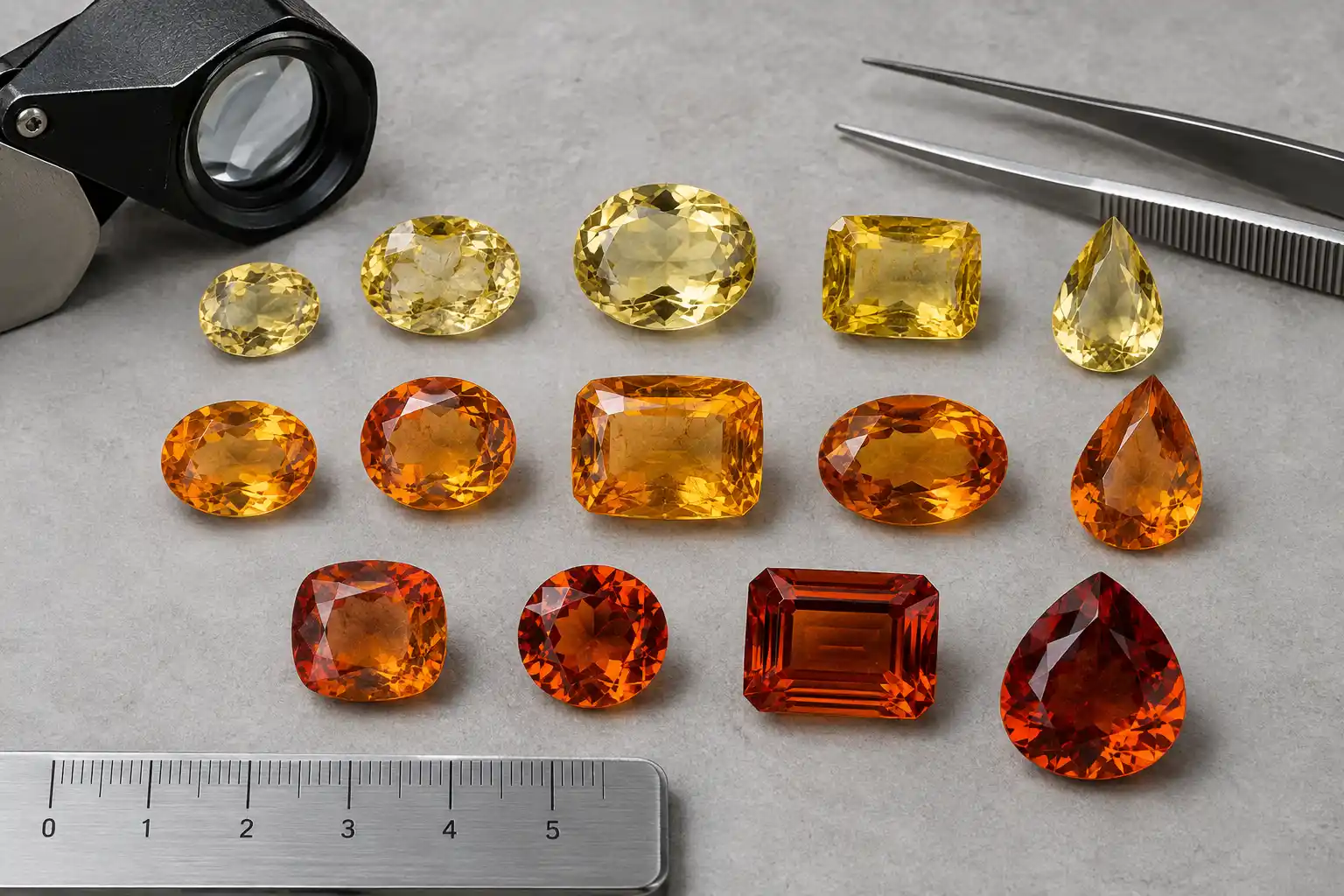
Citrine Price Per Carat: 8 Essential Factors Driving Its Value
Citrine price per carat is generally accessible because quartz is abundant and large clean crystals are available, but the market contains several very different categories that should not be valued as though they were identical. Pale commercial citrine can sell for only a few dollars per carat, while attractive jewelry-quality stones may reach roughly $5 to $20 per carat. Fine saturated golden to orange citrine with good clarity and cutting can move into approximately $20 to $50 per carat, while unusually fine natural-color stones, precision cuts, documented provenance, or collector-quality specimens may command higher individual prices.
The greatest source of confusion is treatment. Much of the orange to reddish-orange citrine sold commercially is produced by heating suitable amethyst, which changes its purple color into yellow, orange, brownish orange, or related tones. Heat-treated amethyst remains natural quartz, but its present citrine-like color is treatment-produced rather than the original geological color. Naturally colored citrine is considerably less common and often shows lighter yellow, golden, smoky yellow, or brownish-yellow hues rather than the intense burnt-orange appearance familiar in mass-market jewelry.
Citrine is crystalline quartz, SiO₂, with a Mohs hardness of 7 and no cleavage. Its color is associated with iron-related defects and color centers within the crystal structure, although the exact mechanisms differ among naturally colored, heated, and irradiated quartz. Because large crystals can be transparent and relatively clean, carat weight does not create the dramatic scarcity premium seen in ruby, alexandrite, or fine emerald. Color quality, natural versus treated status, cut, clarity, and provenance usually matter much more than size alone.
8 Essential Factors Driving Citrine Value
- Natural color versus heat-treated or otherwise modified color
- Hue, saturation, and overall color attractiveness
- Tone and freedom from muddy brown or excessive darkness
- Clarity and transparency
- Cut quality, proportions, and brilliance
- Carat weight and face-up dimensions
- Geographic origin and documented provenance
- Natural versus synthetic identity, craftsmanship, and market demand
These eight factors work together. A large deeply cut orange quartz stone may be inexpensive if its color was commercially produced and its cut is ordinary, while a smaller naturally colored gem with elegant golden hue, excellent transparency, skilled faceting, and reliable provenance can command a much stronger price per carat.
Typical Citrine Price Per Carat
Citrine has no universally fixed price schedule, and retail figures vary according to color, treatment, cutting, seller, provenance, and whether the stone is loose or mounted. Broad ranges nevertheless help separate ordinary commercial quartz from finer material.
| Citrine Quality | Approximate Price Per Carat | Typical Characteristics |
|---|---|---|
| Commercial quality | $2 to $8 | Pale or heavily treated appearance, ordinary cut |
| Good jewelry quality | $5 to $20 | Attractive yellow to golden color, eye-clean, competent cut |
| Fine quality | $15 to $40 | Strong saturation, good brightness, excellent transparency |
| Exceptional color or precision-cut citrine | $30 to $60+ | Rich golden-orange color, fine cutting, clean appearance |
| Specialty natural-color or collector stones | Highly variable | Documented natural color, provenance, exceptional cutting or specimen importance |
These ranges are most useful for loose stones. Finished jewelry can cost much more because gold, platinum, side stones, craftsmanship, brand positioning, and retailer margin are added to the gemstone itself. A custom-cut citrine may also sell well above ordinary quartz rates because the buyer is paying for precision lapidary work as much as for the rough.
Natural Citrine and Heat-Treated Amethyst Belong to Different Rarity Categories
Natural citrine is less common than the volume of citrine jewelry on the market might suggest. Much commercial orange and deep yellow material begins as amethyst and is heated to alter the defect centers responsible for color.
Heating can produce yellow, orange, reddish orange, or brownish tones depending on the original amethyst and its geological characteristics. Some heated crystals retain color zoning patterns related to their earlier amethyst structure, while others develop strong orange color concentrated near crystal tips or specific growth sectors.
Natural citrine often looks subtler. Pale yellow, smoky yellow, golden yellow, and brownish-yellow shades are common, and some stones show gradual zoning rather than the intense orange seen in heated amethyst.
Treatment does not automatically make a gemstone unattractive or unsuitable. Heat-treated quartz can be durable, beautiful, and affordable. The important issue is accurate disclosure because naturally colored citrine and heat-treated amethyst have different rarity stories.
Buyers should also be cautious with labels such as untreated Madeira citrine when no evidence supports the claim. Rich orange color alone does not establish natural color origin.
Color Quality Is the Main Visible Driver of Citrine Price
Citrine ranges from very pale lemon yellow through golden yellow, honey, orange, brownish orange, and reddish orange. Market preference varies, but stones with strong warm color and enough brightness to remain lively generally command more than weakly saturated pale gems.
Golden yellow can produce a classic citrine appearance, while deeper orange and reddish-orange stones are often marketed under Madeira-style terminology because their colors resemble fortified wine. Madeira is primarily a trade color description rather than a guarantee of geographic origin.
Color should remain attractive throughout the face. A strong center surrounded by pale edges, or dark burnt-orange patches interrupted by colorless quartz, can reduce visual balance.
Gray or muddy brown modifiers usually lower appeal when they suppress the warm golden character. Brown can still form part of an attractive honey or cognac-like appearance, but the stone should remain bright enough to look deliberate rather than dull.
The best color depends partly on personal taste, but saturation, evenness, and brightness are more useful valuation tools than an exotic trade name.
Tone Must Be Balanced With Saturation
Tone describes how light or dark a citrine appears. Very pale citrine can look almost colorless in small stones, while very dark orange-brown quartz may lose brilliance and show broad extinction.
Fine stones usually balance enough depth to create rich color with enough transparency to return light effectively. A slightly lighter golden gem with excellent brilliance can therefore be more desirable than a darker stone that appears heavy or nearly opaque in portions.
Cutting strongly affects apparent tone. Deep pavilions increase the path light travels through the colored quartz and can make the stone look darker. Shallow cuts may weaken saturation and create a pale central window.
This interaction explains why two stones from similar rough can look quite different after cutting. The grader should judge the finished face-up color rather than assuming darker rough automatically produces greater value.
High Clarity Is Expected in Fine Faceted Citrine
Quartz commonly forms large transparent crystals, so fine faceted citrine is generally expected to be eye-clean. Minor inclusions visible only through magnification may have little effect, but obvious fractures, clouds, or mineral inclusions usually reduce value because cleaner alternatives are readily available.
Natural inclusions can include fluid features, healed fractures, mineral crystals, veils, growth structures, and other internal characteristics. These features can support geological interpretation and natural origin but become commercially important only when they affect transparency or durability.
Surface-reaching fractures require special attention in jewelry. Citrine has a Mohs hardness of 7 and lacks cleavage, which gives it useful durability, but a heavily fractured stone can still chip or break under impact.
Mineral specimens follow different standards. A natural citrine crystal may be collectible because of crystal habit, matrix, phantoms, smoky zoning, associated minerals, or locality even when it would never produce a flawless faceted stone.
Cut Quality Can Matter More Than Several Extra Carats
Because citrine rough is comparatively available, buyers do not need to accept poor cutting merely to obtain a large stone. A well-cut gem should return light across most of its face, display color evenly, and avoid a conspicuous central window.
Windowing occurs when the pavilion is too shallow and allows the observer to see through the stone. This reduces brilliance and weakens apparent color, particularly in lighter citrine.
Excessive depth creates another problem. A deep gem can retain extra carat weight below the girdle without giving the wearer a larger visible gemstone. The additional light path can also make dark orange citrine look overly brown or closed.
Symmetry, polish, and facet junctions matter as well. Precision cutting can transform ordinary quartz rough into a far more impressive gem by improving scintillation, balance, and face-up spread.
Designer cuts, concave faceting, fantasy shapes, and custom matched pairs can therefore command significant premiums despite citrine’s relatively modest raw-gem cost.
Carat Weight Does Not Produce a Steep Premium in Ordinary Citrine
Large transparent quartz crystals occur naturally, making substantial citrine sizes available at prices far below equally large ruby, sapphire, emerald, or alexandrite.
A ten-carat citrine may therefore remain affordable, particularly when the color is pale or commercially treated. Price per carat may stay relatively stable as size increases rather than rising dramatically.
Large stones become more valuable when exceptional color, evenness, clarity, and precision cutting are maintained. A fifty-carat richly colored gem with excellent proportions is less ordinary than simply finding fifty carats of quartz.
Face-up dimensions should always be checked. A fifteen-carat stone with excessive depth can look smaller than a well-cut twelve-carat gem, making the lighter stone more visually useful in jewelry.
This availability is one of citrine’s strengths. Buyers can obtain dramatic statement gems without paying the extreme size premiums associated with much rarer species.
Origin Can Add Interest, but Color and Treatment Matter More
Citrine and citrine-colored quartz have been associated with deposits in Brazil, Bolivia, Madagascar, Zambia, Russia, and other regions. Brazil is especially important in commercial quartz production and has supplied vast quantities of amethyst and yellow to orange quartz.
Geographic origin usually matters less for faceted citrine than it does for ruby, sapphire, or alexandrite. Color quality, treatment history, clarity, cut, and natural versus synthetic identity are generally stronger valuation factors.
Origin becomes more meaningful for collectible crystals. A documented specimen from a notable mine or classic locality may command a premium for provenance, natural crystal form, and associated minerals rather than for its suitability as jewelry.
A seller should not infer geographic origin solely from color. Golden, orange, and smoky-yellow quartz can occur in multiple geological regions, and treatments can create similar appearances from different starting materials.
Synthetic Citrine and Other Yellow Quartz Products Need Clear Disclosure
Synthetic quartz can be grown hydrothermally in laboratories, and yellow to orange laboratory-grown quartz can resemble natural citrine closely. Because it has quartz chemistry and crystal structure, synthetic quartz is not merely glass, but its origin is artificial.
Irradiation and heating can also alter quartz color. In some cases, combinations of treatment are used to produce attractive commercial hues.
Glass, synthetic spinel, and other transparent yellow substances can serve as citrine imitations as well. Color alone therefore does not confirm quartz identity.
For modest jewelry, treatment and synthetic identification may not justify expensive laboratory testing. Accurate seller disclosure still matters. For a high-priced stone marketed specifically as rare untreated natural citrine, stronger verification becomes much more reasonable.
Madeira Citrine Is a Color Description, Not a Universal Grade
Madeira citrine generally describes richly saturated orange to reddish-orange or brownish-orange quartz reminiscent of Madeira wine. The term can be useful for communicating a color style, but it is not an internationally standardized quality grade.
A stone labeled Madeira can still be poorly cut, excessively dark, included, or strongly zoned. Conversely, a golden-yellow stone that lacks the Madeira label may be exceptionally beautiful and finely cut.
Much deep orange commercial citrine is heat-treated amethyst, so Madeira-style color should not be interpreted automatically as rare untreated natural color.
The safest buying approach is to evaluate hue, saturation, tone, clarity, cut, and disclosure independently and treat the trade name as a secondary description.
How to Compare Two Citrines Before Buying
Place both stones under the same neutral lighting and compare their face-up color before looking at the carat weights. Determine whether one shows stronger saturation, excessive brown, obvious zoning, or a washed-out central area.
Then evaluate brilliance and cut. Rotate the gems slowly and look for windowing, broad extinction, poor symmetry, or areas that remain lifeless. A smaller precision-cut stone may look substantially more impressive than a heavier commercial gem.
Clarity comes next. If both stones appear eye-clean, microscopic differences should usually matter less than color and proportions.
Finally, ask about treatment, natural versus synthetic origin, and provenance when those claims affect the Price. This order prevents marketing language from overshadowing the qualities that are immediately visible.
Is Natural Citrine a Good Investment?
Fine naturally colored citrine is less common than mass-market orange quartz, but ordinary citrine should not be treated as a guaranteed financial investment. Quartz is abundant, and the retail market contains large quantities of treated material at accessible prices.
Collector interest becomes stronger when a stone has unusual natural color, documented untreated status, important locality, exceptional precision cutting, notable size, or mineral-specimen provenance.
Even then, resale depends on finding a buyer who understands those distinctions. Retail margins and cutting premiums may not be recovered in a secondary sale.
For most buyers, citrine offers its greatest value as an attractive, durable, warm-colored gemstone that can be purchased in substantial sizes without an extreme budget.
Citrine Durability and Long-Term Jewelry Value
Citrine has a Mohs hardness of 7 and no cleavage, making it suitable for earrings, pendants, bracelets, brooches, and rings worn with reasonable care.
Strong impacts can still chip facet edges or exploit existing fractures, so large rings should be removed during activities involving tools, hard surfaces, or repeated knocks.
Quartz color can be altered by sufficient heat, and prolonged intense light may affect some colored specimens. Jewelry should therefore be kept away from unnecessary extreme temperature and harsh treatment.
Gentle cleaning with mild soap, lukewarm water, and a soft brush is generally appropriate for intact stones. Separate storage prevents harder gems such as topaz, sapphire, and diamond from scratching the surface.
Conclusion
Citrine price per carat depends mainly on color, treatment history, tone, clarity, cut, size, provenance, natural versus synthetic identity, and craftsmanship. Commercial quartz can cost only a few dollars per carat, while richly colored, beautifully cut, eye-clean stones may command several tens of dollars per carat or more, particularly when natural-color provenance or exceptional lapidary work adds rarity.
The best purchase is not automatically the darkest or largest stone. Fine citrine should look warm, saturated, transparent, and lively while avoiding muddy color, obvious zoning, large windows, and unnecessary depth. Buyers who distinguish naturally colored citrine from heat-treated amethyst and then judge the actual finished gem can understand value much more accurately than buyers relying on a trade name alone.
FAQs About Citrine Price Per Carat
How much does citrine cost per carat?
Commercial citrine may cost only around $2 to $8 per carat, while good jewelry-quality stones can move into roughly $5 to $20 per carat. Fine saturated gems and precision-cut stones may reach roughly $20 to $50 per carat or more.
Why is citrine relatively affordable?
Quartz is abundant and can form large transparent crystals, so gem-size rough is far more available than large ruby, sapphire, emerald, or alexandrite. Commercial heat treatment also creates substantial supplies of orange-yellow quartz.
Is natural citrine more expensive than heat-treated citrine?
Naturally colored citrine can receive a premium because it is less common, especially when untreated status and provenance are credible. Visual quality still matters, so weak natural color does not automatically outrank a beautiful treated stone.
Is most orange citrine heat-treated amethyst?
A large proportion of commercial orange to reddish-orange citrine is produced by heating suitable amethyst. The resulting stone remains natural quartz, but the current color was produced through treatment.
What citrine color is most valuable?
Rich golden yellow, orange, and reddish-orange can all be desirable when saturation is strong and the stone remains bright. Naturally colored material with attractive hue and credible provenance can receive an additional rarity premium.
Is Madeira citrine expensive?
Fine Madeira-style color can command a premium because of its rich orange to reddish-orange appearance, but the term is not a standardized grade and does not prove natural untreated color.
Does larger citrine cost more per carat?
Not necessarily. Large clean quartz is available, so size alone does not create a steep premium. The per-carat value rises more meaningfully when fine color, clarity, and cutting remain exceptional at large sizes.
Does clarity affect citrine value?
Yes. Fine faceted citrine is generally expected to appear eye-clean because transparent quartz is readily available. Visible fractures, clouds, or distracting inclusions normally reduce value.
Can citrine be synthetic?
Yes. Laboratory-grown quartz can be produced in yellow to orange colors. Synthetic quartz can be attractive but should be disclosed because its origin differs from naturally mined citrine.
Can citrine be irradiated?
Quartz color can be influenced through irradiation and heating, depending on the crystal’s impurity and defect structure. Treatment history should be disclosed when known and when it materially affects value.
Is pale citrine valuable?
Pale natural citrine can be attractive and may have collector interest when provenance is good, but mainstream jewelry markets generally reward stronger saturation when cut and clarity are comparable.
Does precision cutting increase citrine Price?
Yes. Precision cutting can improve brilliance, face-up size, symmetry, and color distribution. A custom-cut stone may cost considerably more than mass-produced citrine even when the rough quality is similar.
Is citrine durable enough for everyday rings?
Its hardness of 7 and lack of cleavage make citrine reasonably suitable for rings, although it should still be protected from severe impact and harder gemstones.
What makes citrine expensive?
Fine natural color, strong saturation, exceptional transparency, precision cutting, unusual size, documented provenance, collectible origin, or notable craftsmanship can all raise value above ordinary commercial quartz.