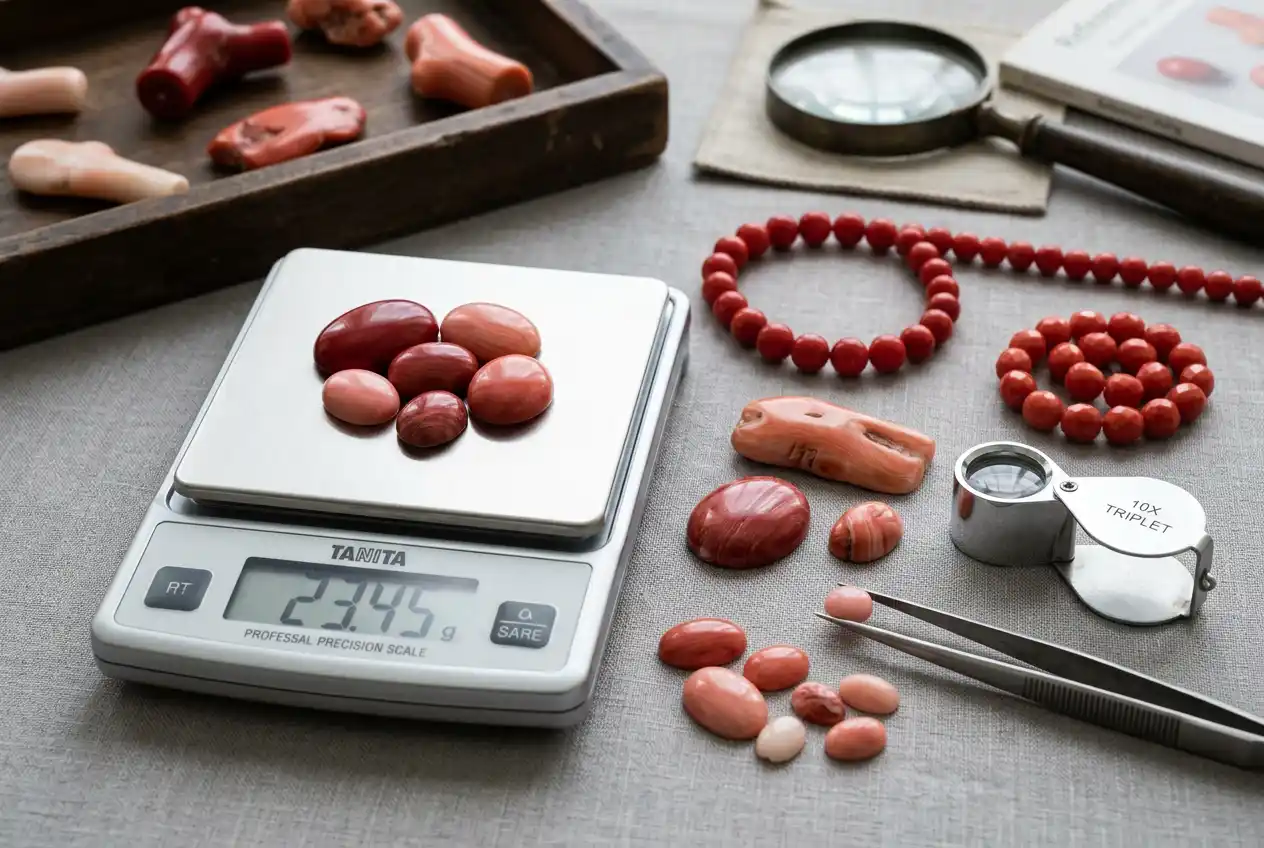
Coral Price Per Carat: 10 Key Drivers of Real Market Worth
Coral price per carat varies enormously because the jewelry market uses the word coral for very different natural, treated, reconstructed, and imitation products. Ordinary dyed or lower-grade coral may be worth only a few dollars per carat, while attractive natural precious coral with even color, fine polish, substantial dimensions, and minimal defects can reach tens or hundreds of dollars per carat. Exceptional deep-red, evenly colored, large, well-matched precious coral can move substantially higher, particularly when the species, provenance, natural color, and lawful source are well documented.
Per-carat comparison is also imperfect because precious coral is frequently sold as beads, cabochons, carvings, branches, matched strands, or finished jewelry rather than as standardized faceted stones. Large matching beads can command a disproportionately higher The Price because producing a uniform strand requires substantial usable coral of similar color, diameter, shape, and surface quality. A carved antique object may derive much of its value from workmanship and history, while a natural branch specimen may be valued for form and provenance rather than weight alone.
Gem coral is an organic gemstone produced from the skeletal structures of certain marine coral organisms. Precious jewelry coral is especially associated with species in the genera Corallium and Pleurocorallium, whose hard calcium-carbonate skeletons can take a smooth polish. This differs from many porous reef-building corals and from inexpensive dyed alternatives sometimes sold under coral trade names. Correct identity therefore comes before any serious valuation.
10 Key Drivers of Coral Market Worth
- Natural precious coral versus dyed, reconstituted, or imitation products
- Natural body color and saturation
- Color evenness and absence of distracting patches
- Size, diameter, and usable thickness
- Surface quality, porosity, cracks, and blemishes
- Shape, cutting, polishing, and carving quality
- Matching quality in beads, pairs, and strands
- Species, geographic provenance, and source documentation
- Treatment, dyeing, impregnation, and reconstruction
- Age, craftsmanship, rarity, and collector demand
These ten factors explain why equal weights can have dramatically different values. A small strand of evenly matched natural red precious coral beads can be worth substantially more than a heavier necklace made from dyed porous coral, while a finely carved antique piece may command a premium that has little to do with its raw carat weight.
Typical Coral Price Per Carat
Coral does not trade through one standardized international per-carat chart. The following ranges are best treated as broad orientation for loose or comparable polished pieces rather than guaranteed retail values.
| Coral Category | Approximate Price Per Carat | Typical Characteristics |
|---|---|---|
| Dyed or inexpensive processed coral | Under $5 to about $15 | Common color enhancement, porous structure, commercial jewelry |
| Natural lower-grade precious coral | $10 to $50 | Uneven color, visible blemishes, smaller sizes |
| Good jewelry-quality precious coral | $40 to $150 | Attractive natural color, good polish, moderate size |
| Fine precious coral | $100 to $300+ | Strong natural color, low porosity, larger clean pieces |
| Exceptional large matched or rare-color coral | $250 to $500+ | Excellent color, size, matching and provenance |
| Important antique or collector pieces | Highly variable | Historical workmanship, unusual size, provenance, rarity |
Finished jewelry can exceed these ranges substantially because gold, platinum, diamonds, hand carving, matching labor, maker attribution, and historical significance may contribute more to the final The Price than the raw coral alone.
Natural Precious Coral Carries the Main Rarity Premium
The first valuation question is whether the object is genuine precious coral and whether its appearance is natural. Fine jewelry coral develops a compact skeleton capable of being polished into beads, cabochons, branches, carvings, and other ornamental forms.
The market also contains dyed bamboo coral, sponge coral, reconstituted products, compressed coral fragments, resin-filled pieces, plastic, glass, shell, and other imitations. These may be attractive decorative products, but they do not possess the same rarity or structure as natural precious coral.
Bamboo coral is particularly important because its naturally pale skeleton can be dyed intense red and sold to resemble more valuable precious coral. Its internal structure and growth characteristics differ from those of premium precious coral, and dye may concentrate within pores, cracks, or growth features.
Reconstituted coral belongs to another category. Small fragments or coral powder may be combined with binders and formed into beads or shapes. Such products can achieve very uniform color and surface appearance, but their manufactured structure substantially changes their rarity and value.
Natural Color Is One of the Strongest Value Factors
Precious coral occurs in several colors, including deep red, red-orange, salmon, pink, pale pink, and near-white tones. Market preferences vary by region and tradition, but naturally attractive color with strong saturation and good uniformity generally commands the highest The Price.
Deep red material is especially sought after in many markets and may be described with trade terms such as oxblood. Such terminology refers to appearance rather than a universally standardized gemological grade, so the actual hue, saturation, species, treatment status, and surface quality still need direct evaluation.
Pale pink coral can also command substantial value. Fine so-called angel-skin color may display a delicate pink body with a smooth, porcelain-like appearance, particularly when large pieces are evenly colored and free from obvious patches or pores.
Orange-red and salmon coral occupy their own markets and can be highly desirable when natural and well polished. A buyer should therefore avoid the simplistic assumption that every darker piece automatically outranks every lighter one. Rarity, species, size, color purity, and market demand interact.
Color Evenness Can Matter as Much as Saturation
Coral grows biologically rather than crystallizing as a transparent mineral, so color may vary across a branch. White cores, pale patches, orange zones, dark areas, growth structures, and surface imperfections can all occur naturally.
Uniform color is especially valuable in beads and cabochons because the eye can easily detect mismatched areas. A richly colored bead with one conspicuous white patch may be less valuable than a slightly lighter bead whose color is even throughout the visible surface.
In carved coral, natural color variations can sometimes be used artistically. Skilled carvers may position lighter and darker areas deliberately to create contrast in a flower, figure, cameo, or other design. In those cases, zoning may contribute to workmanship rather than simply lowering quality.
The important distinction is whether color variation enhances the finished object or looks accidental and distracting.
Size Creates a Strong Premium in Fine Precious Coral
Large usable pieces of fine coral are more difficult to obtain than small beads because coral branches taper and contain natural irregularities. Producing a substantial cabochon, thick carving, or large round bead requires a section with enough diameter and structural integrity to survive cutting.
This creates an important size premium. A strand of 4 mm natural red coral beads is much easier to assemble than a strand of evenly colored 12 mm beads of comparable quality.
The relationship between size and value is therefore nonlinear. Doubling bead diameter does not merely double rarity because much larger branch sections are required, and cutting waste increases considerably.
Thickness also matters in carvings and cabochons. A piece with enough depth for three-dimensional workmanship may command much more than a thin slice of equal surface area.
Carat weight should consequently be interpreted alongside physical dimensions. Two coral pieces with identical weights can offer very different usable size depending on shape and cutting style.
Surface Quality Reveals Much About Coral Grade
Fine precious coral should take a smooth polish while showing relatively limited porosity, pits, cracks, open cavities, or chalky areas. Small natural growth structures are expected, but the most valuable jewelry pieces minimize distracting defects.
Porosity strongly influences appearance. A heavily porous bead can trap dirt or dye and may lack the smooth, dense appearance associated with finer coral.
Cracks are more serious because coral is relatively soft and can be brittle. Open fractures can expand during drilling, setting, or wear, reducing both durability and value.
The surface should also be examined for filler. Resin impregnation can improve stability or conceal pores, while waxes or coatings may enhance luster temporarily. Such treatments should be distinguished from naturally dense polished coral.
An excellent polish creates a soft, refined luster rather than the sharp brilliance expected from a faceted transparent gemstone.
Matching Can Make a Coral Strand Far More Valuable Than Its Individual Beads
Matched strands represent one of the clearest examples of why simple per-carat pricing can fail. A jeweler assembling dozens of beads must match diameter, shape, hue, saturation, surface quality, drill-hole placement, and polish.
Finding one fine 10 mm natural red bead is easier than finding forty or fifty beads that match closely enough to form a high-quality necklace.
As diameter rises, this matching challenge becomes more severe. Fine large strands can therefore command premiums far beyond the sum of ordinary individual bead values.
Pairs matter as well. Earrings require close matching in color, dimensions, dome shape, and surface appearance. Two near-identical cabochons may be worth more together than they would separately.
This matching premium reflects scarcity and labor rather than a different mineralogical property, but it is a genuine market factor.
Cutting, Polishing, and Carving Can Add Major Value
Coral’s relative softness makes it suitable for carving, but softness does not make fine carving easy. Natural branch shape, color variation, pores, cracks, and limited usable thickness all constrain what an artisan can produce.
Well-shaped cabochons should be symmetrical, evenly polished, and free from unnecessary flat spots or poorly finished edges. Beads should be round or intentionally shaped, with drill holes positioned cleanly.
Carvings deserve a different assessment. Fine detail, composition, use of natural branch form, preservation of color, and historical workmanship can contribute substantially to value.
In antique coral jewelry, maker, period, region, and artistic style may matter more than per-carat calculations. Recutting an old piece can therefore destroy historical value even if the polished surface becomes cosmetically cleaner.
Species and Geographic Provenance Can Influence Market Value
Precious coral from the Mediterranean and various Pacific regions has long histories in jewelry and carving. Different species and localities can show characteristic tendencies in color, branch size, internal structure, and rarity.
Mediterranean red coral, especially Corallium rubrum, has an important historical reputation, while Pacific precious corals in related genera can produce red, pink, salmon, pale pink, and other valuable colors.
Locality should not be guessed from color alone. Similar shades can occur in different species, while treatments can alter natural appearance dramatically.
Provenance becomes increasingly important as value rises because lawful sourcing, species identification, age, and collection history can affect both marketability and collector confidence. Trade restrictions and harvest rules vary by species and jurisdiction, so responsible buyers should expect accurate source documentation when the transaction depends on a specific origin or species claim.
Dyeing Is One of the Most Important Coral Treatments to Detect
Dye can transform inexpensive pale coral into intense red, pink, orange, or black products. Strong uniform color at a very low The Price should therefore encourage closer inspection.
Dye often concentrates in pores, cracks, drill holes, surface cavities, or growth structures. Magnification can sometimes reveal these concentrations, although sophisticated treatment may require professional testing.
Color enhancement does not necessarily make a product unsuitable for jewelry. The issue is whether it is being sold and valued accurately.
A dyed strand should not carry the same natural-color rarity premium as a comparable untreated strand whose coloration developed biologically.
Bleaching, wax treatment, polymer impregnation, surface coating, and other processes may also be used to modify coral appearance or durability. Disclosure becomes increasingly important when the treatment has a significant effect on The Price.
Reconstituted Coral Is Different From Naturally Solid Coral
Reconstituted products can be produced from coral fragments, powders, or small pieces combined with binders. This allows manufacturers to create uniform beads and shapes from material that could not have produced equivalent solid pieces naturally.
The resulting product may be attractive and may contain real coral substance, but the manufacturing process removes much of the natural size and structural rarity that gives fine solid coral its value.
Very uniform color and texture can sometimes be clues, particularly when large beads are offered at unexpectedly low prices.
A responsible valuation therefore separates naturally solid coral, stabilized coral, reconstituted products, and outright imitations rather than placing all of them under one generic coral label.
Condition Matters Because Coral Is a Soft Organic Gem
Precious coral generally falls around 3 to 4 on the Mohs scale, depending on composition and structure. It scratches much more easily than quartz, topaz, sapphire, or diamond.
Older jewelry can show worn bead surfaces, chipped drill holes, flattened polish, scratches, cracks, or discoloration caused by years of skin contact, cosmetics, perfume, and cleaning.
Condition affects antique value in complex ways. Light wear may be consistent with age, while severe damage can reduce desirability. Aggressive modern repolishing can also remove original surface and alter historical workmanship.
For contemporary jewelry, clean polish and structural integrity are normally preferred. Beads should be inspected around drill holes because this is where cracking and chipping often begin.
How to Compare Two Coral Pieces Before Buying
Begin by determining whether both pieces belong to the same product category. Natural precious coral should not be compared directly with dyed bamboo coral, reconstituted coral, or resin imitation merely because their colors look similar.
Next compare natural color, evenness, surface density, pores, cracks, and polish under neutral lighting. For beads, examine drill holes because dye concentration and structural damage can often become visible there.
Then compare physical dimensions rather than carat weight alone. Large matched beads, thick cabochons, and substantial carvings can command major premiums because suitable branch diameter is scarce.
Finally, consider provenance, species claims, treatment disclosure, workmanship, and any documentation supporting lawful source or antique history. These characteristics can have a substantial effect on both The Price and future marketability.
Coral Jewelry Care and Preservation
Coral should be handled more gently than quartz or corundum because its surface is relatively soft and chemically sensitive. Perfume, hairspray, cosmetics, household cleaners, acids, and prolonged perspiration contact can dull or damage the polished surface.
Jewelry should generally be put on after cosmetics and perfume have dried. After wear, a soft slightly damp cloth can remove surface residues without abrasive scrubbing.
Steam, ultrasonic cleaning, acids, bleach, and harsh detergents are unsuitable for delicate coral. Prolonged heat can also damage color and organic components.
Separate padded storage is important because harder gemstones can scratch coral rapidly. Necklaces should not be compressed beneath heavy jewelry, and strings should be inspected periodically if the beads are valuable.
Conclusion
Coral price per carat depends on much more than weight. Natural precious coral identity, natural color, evenness, size, surface density, shape, matching, workmanship, species, provenance, treatment, condition, and collector demand all influence real market worth. Commercial dyed products may cost only a few dollars per carat, while fine natural large precious coral can reach hundreds of dollars per carat and exceptional matched or historically significant pieces can move much higher.
The most reliable valuation begins by identifying what the coral actually is. Once natural versus dyed, reconstituted, treated, or imitation status is clear, buyers can judge color, dimensions, matching, polish, provenance, and condition realistically. That approach explains value far more accurately than relying on a red color alone or assuming every product sold as coral belongs to the same market category.
FAQs About Coral Price Per Carat
How much does natural coral cost per carat?
Natural precious coral can range from tens of dollars per carat for modest jewelry quality to hundreds of dollars per carat for fine large pieces with excellent natural color, low porosity, and good provenance. Exceptional matched beads, carvings, or collector pieces can exceed ordinary ranges considerably.
Why is some red coral so expensive?
Fine natural red precious coral is valued for saturated untreated color, density, polish, usable branch diameter, rarity, and long-standing jewelry demand. Large evenly colored pieces are much harder to obtain than small commercial beads.
Is darker red coral always more valuable?
No. Deep red is strongly sought after, but color uniformity, size, surface quality, natural origin, species, and treatment status all matter. Fine pale pink coral can also command high value.
What is oxblood coral?
Oxblood is a trade description for richly saturated deep red coral. It is not a universally standardized grade or proof of species, origin, or untreated status, so the actual gem still needs full evaluation.
What is angel-skin coral?
Angel-skin is a trade description generally associated with delicate pale pink precious coral. Fine examples can be highly valuable when color is attractive, surfaces are dense and smooth, and large matching pieces are available.
Is dyed coral valuable?
Dyed coral can make attractive affordable jewelry, but it generally carries a lower rarity premium than comparable naturally colored precious coral. The treatment should be disclosed clearly.
Is bamboo coral the same as precious red coral?
No. Bamboo coral has a different biological and skeletal structure and is commonly dyed red to imitate more valuable precious coral. It should be sold according to its actual identity.
What is reconstituted coral?
Reconstituted coral is manufactured from coral fragments, powders, or small pieces combined with binders or other processes to create larger uniform products. It differs from naturally solid precious coral.
Do larger coral beads cost more per carat?
Usually yes when natural quality remains high. Large matching beads require thick usable branches and generate substantial cutting waste, so their rarity can increase much faster than weight alone suggests.
Why are matched coral strands expensive?
Matching dozens of beads for diameter, shape, natural color, polish, surface quality, and drill placement is difficult. Large high-quality matched strands can therefore carry a major premium.
Does geographic origin affect coral value?
Yes, particularly for historically important precious coral sources, but origin should be documented rather than inferred from color alone. Species, natural color, size, treatment, and quality remain essential.
Is coral an organic gemstone?
Yes. Gem coral is produced by living marine organisms and consists of their biomineralized skeletal structures. This origin distinguishes it from crystalline mineral gemstones such as sapphire or quartz.
Is coral durable enough for daily jewelry?
Coral is relatively soft at roughly 3 to 4 on the Mohs scale, so it requires careful wear. Earrings and necklaces generally experience less abrasion than exposed rings or bracelets.
Can coral be polished again if scratched?
Minor surface wear can sometimes be repolished by a skilled specialist, but polishing removes material and can affect shape, size, antique surfaces, and value. Important pieces should not be casually refinished.
How can I avoid overpaying for coral?
Confirm whether the piece is natural precious coral, dyed coral, bamboo coral, reconstituted coral, or imitation. Then compare natural color, size, surface condition, matching, treatment disclosure, provenance, and craftsmanship before focusing on carat weight.