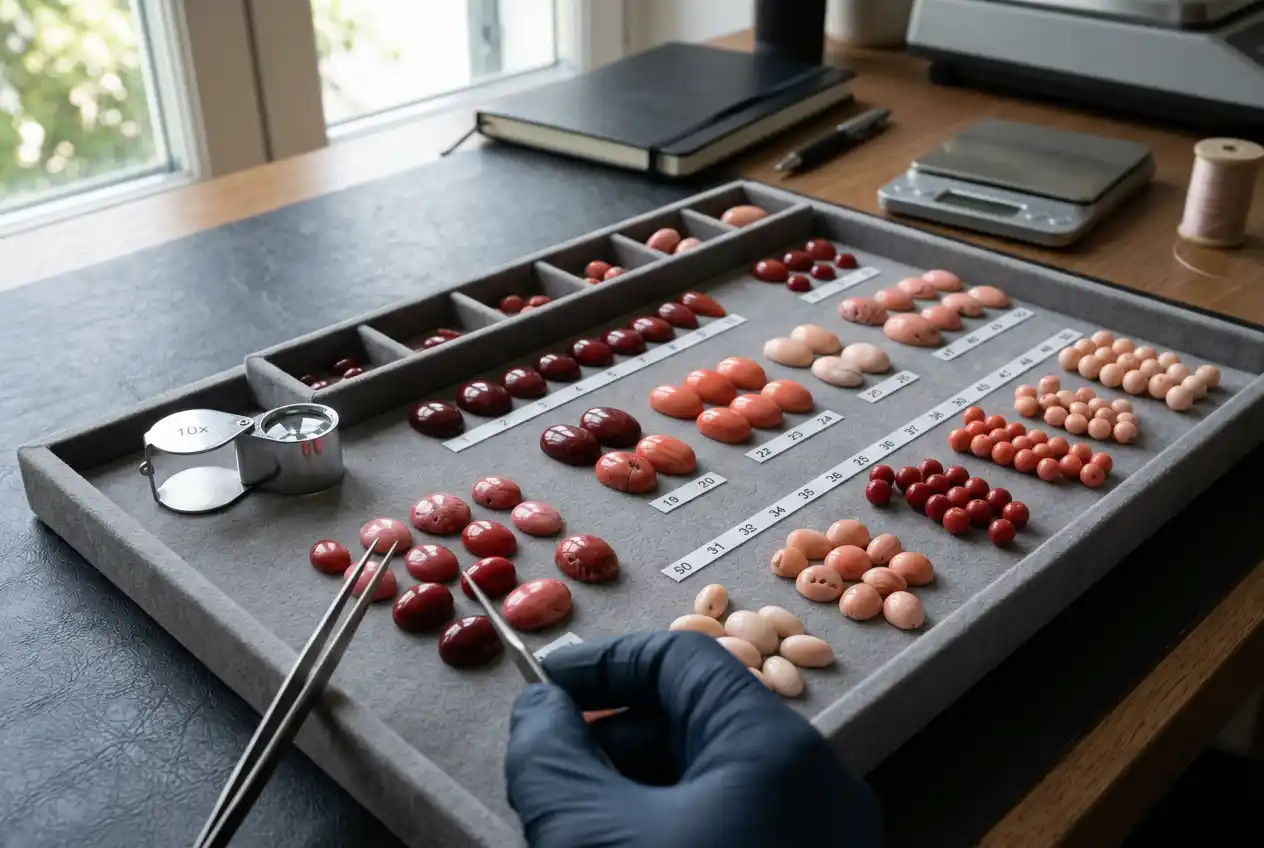
Coral Quality Grading: 7 Crucial Standards for Organic Gems
Coral quality grading begins with identification because the commercial term coral covers natural precious coral, other coral skeletal products, dyed material, reconstituted products, and imitations that can look surprisingly similar after polishing. Fine precious coral should combine naturally attractive color, good color consistency, dense structure, minimal distracting pores or cracks, smooth polish, useful size, and accurate provenance. In bead strands and matched jewelry, consistency between individual pieces becomes another major part of the grade.
Coral is an organic gemstone rather than a mineral crystal. Jewelry-quality precious coral consists of biomineralized calcium-carbonate skeleton produced by marine organisms, particularly species associated with the precious-coral genera Corallium and Pleurocorallium. It is relatively soft, typically around 3 to 4 on the Mohs scale, and its appearance depends on biological growth structure rather than crystal transparency and faceting.
There is no single universal coral grading scale equivalent to diamond’s standardized systems. Seller labels such as AAA, gem red, oxblood, angel skin, premium Mediterranean, or investment grade may be useful trade descriptions, but they do not replace direct evaluation. A dependable grade should explain identity, natural color, uniformity, structure, surface condition, dimensions, workmanship, treatment, provenance, and matching quality.
7 Crucial Standards for Coral Quality Grading
- Confirm natural precious coral identity
- Grade natural color, saturation, and evenness
- Evaluate density, porosity, growth structure, and surface quality
- Inspect cracks, pits, drill holes, and overall condition
- Judge size, shape, polish, carving, and craftsmanship
- Evaluate matching quality in pairs, beads, and strands
- Assess treatment, species, provenance, and lawful source documentation
These seven standards create a practical framework for natural precious coral without turning a seller’s letter grade into an unquestioned measure of quality. A vivid red bead can still be lower grade if the color is dyed, the surface is porous, or the structure has been heavily reconstructed.
Natural Precious Coral Identity Comes Before Color Grading
A polished red or pink object should not be graded as precious coral solely from appearance. Dyed bamboo coral, porous coral skeleton, shell, glass, plastic, resin, bone, reconstructed coral, and other products can imitate important aspects of natural jewelry coral.
Professional identification can examine growth structures, microscopic surface features, density, reaction to appropriate analytical methods, spectroscopy, and other gemological characteristics. Destructive acid or hot-needle testing is unsuitable for valuable finished jewelry because it can permanently damage the object.
Bamboo coral deserves special attention because it is commonly dyed red. Its segmented biological growth and internal structures differ from the dense branching skeleton of precious coral, but once shaped into small beads the distinction may not be obvious to an inexperienced buyer.
Reconstituted products can be even more uniform. Coral fragments or powder may be combined with binders to create smooth beads or carvings whose regularity can initially look like exceptional natural quality. Their manufactured construction places them in a different grading category.
Natural Color Should Be Graded Separately From Treatment
Precious coral can occur naturally in red, orange-red, salmon, pink, pale pink, white, and related tones. The strongest market preferences vary among regions and jewelry traditions, so there is no single hue that always represents the highest possible grade.
Deep saturated red has a major market following, particularly when color is natural and even. Trade terms such as oxblood may be applied to especially rich dark red, but the term has no single globally enforced color boundary.
Fine pale pink coral can also be extremely desirable. Angel-skin terminology is often applied to delicate pale pink material, sometimes with subtle differences in saturation or undertone. Large evenly colored examples can command substantial premiums precisely because achieving both size and delicacy of color is difficult.
Orange-red and salmon tones should be judged for saturation and cleanliness rather than being automatically placed below red. An evenly colored, dense, beautifully polished salmon coral can be much finer than a dark red piece whose surface is porous and dyed.
The first color question is therefore whether the hue is natural. Only after that should saturation and market preference determine the grade.
Color Evenness Is Especially Important in Polished Jewelry
Natural biological growth can produce white cores, lighter patches, darker zones, concentric structures, streaks, and other variations. These features are not inherently artificial, but they influence the visual grade.
A single cabochon generally receives a stronger grade when color appears balanced across the visible dome. Large abrupt pale patches reduce uniformity unless the design intentionally incorporates them.
Beads are even more sensitive because dozens of surfaces appear side by side. Variations that look minor in individual beads can become obvious when assembled into a strand.
Carving changes the grading approach. Natural variations may be positioned deliberately to create artistic contrast, allowing a skilled carver to turn uneven color into part of the design. In that case craftsmanship can compensate for color variation rather than the piece being judged solely by uniformity.
Surface Density and Porosity Reveal Important Quality Differences
Fine precious coral generally has a compact structure capable of taking a smooth, refined polish. Small natural pores and growth structures may still be visible under magnification, but extensive open porosity tends to reduce quality.
Porous material can look chalky or irregular, trap dye and dirt, and be more difficult to polish evenly. Resin impregnation may be used to improve the surface and stability, which changes the treatment category.
The grader should examine the surface under magnification for tiny cavities, filler, color concentrations, growth lines, polish quality, and signs of reconstruction.
A dense surface with a smooth luster usually receives a stronger grade than a heavily porous piece of the same color. This is especially important in deep red products because intense dye can disguise low-density starting coral until the surface is examined closely.
Cracks and Drill-Hole Damage Can Reduce an Otherwise Fine Grade
Coral’s relative softness and biological structure make cracks important. Open fractures can enlarge under tension, especially in beads where drilling creates a local stress point.
Drill holes should be inspected for chipping, radial cracks, rough finishing, accumulated dye, and filler. Fine beads should have cleanly positioned holes without severe damage to the surrounding surface.
Cabochons and carvings require similar attention around thin edges, projecting details, and narrow structural areas. A deep crack running through a carving can be much more serious than a small superficial pit.
Condition should be judged differently in antique pieces. Light wear may be consistent with age, while severe cracking or later repair can reduce value. Aggressive repolishing can remove original workmanship and should not automatically be considered an improvement.
A Practical Coral Surface Quality Framework
| Surface Appearance | Practical Quality Interpretation |
|---|---|
| Dense, smooth and finely polished | Fine to exceptional |
| Minor natural pores visible on close inspection | Very good |
| Moderate porosity or small visible blemishes | Good |
| Obvious pits, cracks or uneven polish | Commercial |
| Heavy porosity, major fractures or reconstruction | Lower natural-jewelry quality |
This framework is descriptive rather than a universal official scale. It works only after natural identity and treatment status have been established.
Size and Branch Diameter Have a Major Effect on Fine Coral Grade
Coral does not grow as large homogeneous blocks. Branches taper, curve, divide, and contain internal structures that limit the size of clean pieces available for cutting.
Large round beads are therefore difficult to produce. A finished bead needs enough branch diameter in every direction, and significant coral may be removed during shaping.
This scarcity becomes more pronounced as bead size increases. A matched strand of large natural beads represents not only more weight but a much harder selection problem.
Large cabochons, thick carvings, and substantial branch sections receive similar premiums when natural color and surface quality remain high.
Carat weight should consequently be interpreted through dimensions. A broad but thin piece and a compact thick bead can weigh the same while belonging to very different rarity categories.
Shape and Polish Should Respect the Natural Coral Structure
Coral is typically polished into beads, cabochons, branches, carvings, and sculptural forms rather than faceted like sapphire or quartz.
A high-quality bead should be intentionally shaped, smoothly polished, and free from obvious flat areas unless the design calls for them. Roundness matters in classic strands because deviations become more visible when beads are placed together.
Cabochons should have balanced domes and well-finished edges. Natural branch sections may retain organic asymmetry, but their surfaces should still be deliberately polished when jewelry quality is intended.
Carvings require an entirely different assessment. Fine workmanship considers detail, composition, structural strength, use of natural branch form, and intelligent placement of color variations.
The best coral craftsmanship works with biological growth rather than forcing a shape that exposes cracks or wastes valuable diameter.
Matching Is a Separate Quality Standard for Coral Jewelry
Matched pairs and strands need to be graded as groups rather than as collections of individually attractive pieces.
A high-quality strand should maintain consistent hue, saturation, diameter, roundness, polish, and surface density from bead to bead. Minor graduation may be intentional, but abrupt color changes or mismatched luster lower the overall grade.
Large matching sets are particularly rare because every bead must come from suitable coral of comparable quality. A single replacement bead can be surprisingly difficult to find years later.
Earring pairs also benefit from close symmetry. Two cabochons should appear related in color, shape, dimensions, and polish when worn together.
This matching requirement explains why fine strands can command much more than the simple sum of their component weights.
Dyeing Can Mimic Fine Natural Color
Dye treatment is among the most important concerns in coral grading because inexpensive pale coral can be transformed into visually convincing red or pink jewelry.
Under magnification, dye may accumulate in pores, cracks, growth lines, drill holes, or surface irregularities. Uneven penetration can also create suspicious concentrations.
Sophisticated treatment may be less obvious, especially in highly polished small beads. Professional gemological testing becomes increasingly appropriate when natural color is central to a high purchase The Price.
A dyed product can still receive a high workmanship grade, but its natural-color grade and rarity category must remain separate. Calling heavily dyed porous coral top-grade natural red coral would combine incompatible categories.
Impregnation, Coating, and Reconstruction Need Separate Disclosure
Porous coral may be impregnated with polymers or resins to improve stability, surface smoothness, or polish. Coatings and waxes can alter luster or temporarily conceal surface irregularities.
Reconstructed products go further by combining coral fragments or powder with binders into new shapes. They may contain genuine coral substance, but their structure is manufactured rather than naturally solid.
These processes influence grading because they can hide the properties of the original material. A seemingly flawless surface can result from filling rather than naturally dense coral.
Treatment does not automatically make an object unsuitable. It simply means the quality description should state whether the smoothness, color, or structural integrity is natural or treatment-assisted.
Species and Provenance Become More Important as Value Rises
Fine jewelry coral has historically been obtained from Mediterranean and Pacific regions, with different species producing a range of red, pink, orange, salmon, and pale colors.
Species can influence color tendencies, branch dimensions, internal structure, rarity, and market tradition. Geographic provenance can add another layer of historical or collector significance.
These characteristics should not be assigned from color alone. Deep red does not prove Mediterranean origin, and pale pink does not establish one specific Pacific species.
Documentation becomes especially important when a seller uses a species or geographic claim to justify a substantial premium. Lawful harvest and trade requirements also vary according to jurisdiction and biological source, making reliable records important for valuable contemporary material.
Antique coral introduces different provenance considerations because age, original setting, collection history, and period craftsmanship can influence value alongside biological origin.
Coral Hardness and Condition Matter to Final Quality
Precious coral’s hardness of roughly 3 to 4 means that scratches develop much more easily than on quartz, topaz, sapphire, or diamond.
A fine modern piece should generally have a clean polish without heavy abrasion. Older jewelry may display gentle surface wear consistent with age, but deep scratches and chips can still reduce desirability.
Chemical sensitivity is equally important. Acids, perfumes, cosmetics, household cleaners, and prolonged perspiration can attack or dull the calcium-carbonate surface.
For this reason, condition is partly a record of how the jewelry has been treated. A well-preserved antique strand can retain unusually attractive polish, while poorly stored pieces may become dull and rough.
Common Coral Grading Mistakes
One of the biggest mistakes is grading only by redness. A vivid red bead may be heavily dyed, porous, reconstructed, or structurally weak, while a lighter natural piece can be substantially finer.
Another mistake is using weight without considering dimensions. Large clean bead diameter creates a stronger rarity premium than an equivalent increase in the weight of a flat irregular piece.
Buyers also sometimes treat every surface line as a defect. Natural growth structures can occur in genuine coral, and the issue is whether they compromise beauty or durability.
Seller-defined AAA terminology creates another problem because one company’s grading system may have no relationship to another’s. Actual identity, treatment, surface density, color, and matching should always come first.
Finally, aggressive cleaning or repolishing can permanently alter important jewelry. Coral’s softness requires preservation rather than the hard-gem assumption that every scratch can be removed without consequence.
A Practical Overall Coral Quality Framework
| Quality Level | Typical Characteristics |
|---|---|
| Exceptional | Natural precious coral, excellent natural color, dense surface, large size, minimal defects, superb matching or workmanship |
| Fine | Attractive natural color, strong polish, limited pores, good dimensions and condition |
| Good | Natural coral with moderate color variation, minor pores or blemishes, competent workmanship |
| Commercial | Uneven color, visible porosity, small size, treatment or ordinary matching |
| Lower category | Heavy dyeing, reconstruction, major cracks, poor surface condition or imitation |
The framework separates natural rarity from workmanship so an accurately disclosed treated piece can still be appreciated for design without being confused with rare untreated precious coral.
Caring for High-Quality Coral
Coral jewelry should generally be put on after perfume, hairspray, lotions, and cosmetics have been applied and allowed to dry. This limits repeated chemical contact with the polished surface.
After wearing, a soft slightly damp cloth can remove perspiration and residues. Abrasive polishing cloths, acids, household cleaners, steam, and ultrasonic cleaning should be avoided.
Separate padded storage protects the coral from harder stones and metal edges. Valuable necklaces should also be restrung periodically if the silk or thread begins to deteriorate.
Stable storage away from strong heat and harsh chemicals preserves both luster and color. Good care is especially important because significant polishing can alter the size and historic surface of fine beads.
Conclusion
Coral quality grading requires confirmation of natural identity before color is judged. Fine precious coral combines attractive natural hue, even coloration, dense structure, low porosity, smooth polish, strong condition, useful dimensions, skilled workmanship, good matching, accurate treatment disclosure, and reliable provenance.
The absence of a universal AAA system makes direct observation especially important. A high-quality coral piece should be valuable because its biological structure, natural color, size, craftsmanship, and provenance are genuinely desirable, not simply because it has been made intensely red. Separating natural rarity from treatment and workmanship provides the clearest way to understand this distinctive organic gemstone.
FAQs About Coral Quality Grading
What is the most important factor in grading coral?
Correct identity and natural color come first. A vivid red appearance has little rarity value if it was produced through dyeing or if the object is reconstructed or imitation coral.
What color coral is considered highest quality?
Deep natural red is strongly prized in many markets, while fine pale pink, salmon, and other precious coral colors can also be highly valuable. Size, evenness, surface density, and treatment status matter alongside hue.
Should fine coral have a perfectly smooth surface?
Fine precious coral should generally take a smooth polish, but tiny natural growth structures or pores can occur. Heavy porosity, cracks, pits, and rough polish reduce conventional jewelry quality.
What is angel-skin coral?
Angel-skin is a trade description for delicate pale pink precious coral. The term describes an appearance rather than a universally standardized gemological grade or guaranteed geographic origin.
What is oxblood coral?
Oxblood describes intensely saturated deep red coral in the trade. The name does not by itself verify natural color, species, locality, or quality, so the actual piece still needs examination.
Can dyed coral receive a high quality grade?
It can be well cut and beautifully polished, but its natural-color and rarity categories should remain lower than comparable untreated precious coral. Treatment needs to be disclosed clearly.
How can dye be detected in coral?
Dye may concentrate in pores, cracks, growth structures, or drill holes and can sometimes be seen with magnification. More sophisticated treatment may require professional gemological examination.
Is reconstituted coral natural coral?
It may contain genuine coral particles or fragments, but the finished object is manufactured from combined material rather than cut from one naturally solid piece. It should be graded as a reconstructed product.
Why are large coral beads highly valued?
Producing a large round bead requires a thick natural branch section with suitable color and limited defects. Matching many large beads for a strand makes the rarity even greater.
Does coral clarity matter?
Coral is normally opaque, so transparent-gem clarity does not apply. Quality instead focuses on surface density, porosity, cracks, growth structures, color uniformity, and polish.
Is coral a mineral gemstone?
No. Coral is an organic gem formed from skeletal structures produced by marine organisms, although those skeletons contain biomineralized calcium carbonate.
How hard is precious coral?
Precious coral is relatively soft, generally around 3 to 4 on the Mohs scale. It scratches much more easily than quartz, sapphire, or diamond and requires careful handling.
Can coral be worn every day?
It can be worn regularly, particularly as earrings or necklaces, but it should be protected from abrasion, cosmetics, perfume, acids, cleaners, heat, and impact.
Does geographic origin determine coral quality?
No. Provenance can influence rarity and collector interest, but natural color, dimensions, surface quality, species, treatment, condition, and craftsmanship still determine the quality of an individual piece.
Are AAA coral grades standardized?
No. AAA and similar commercial grades vary among sellers. Buyers should ask what the grade actually means in terms of natural color, treatment, size, porosity, polish, and matching.
What makes a coral strand exceptional?
An exceptional strand combines natural precious coral, attractive untreated color, excellent color matching, large and consistent bead diameters, dense surfaces, clean drilling, strong polish, minimal cracking, and reliable provenance.