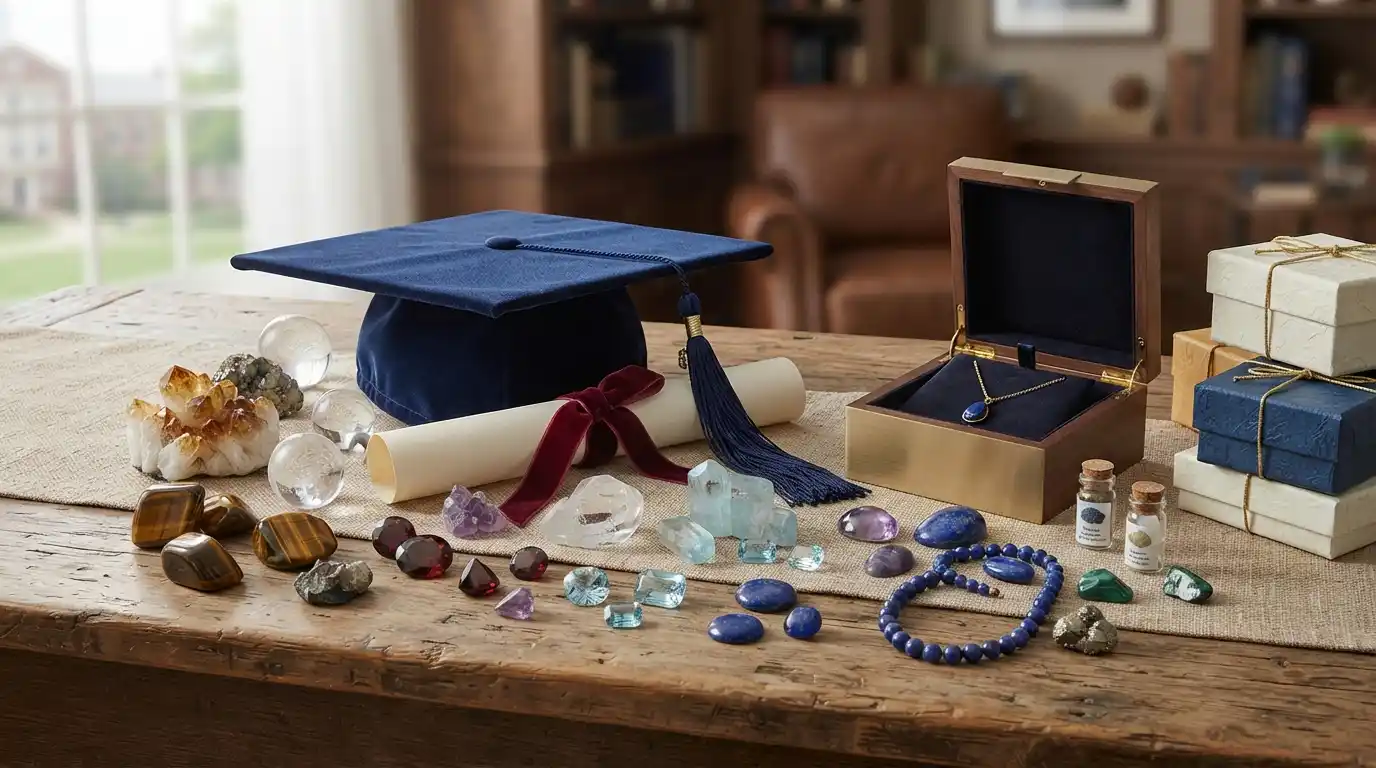
14 Inspiring Crystal Gifts for a Graduation to Boost Success
Crystal gifts for a graduation can mark achievement, persistence, new beginnings, and the transition from education into work, further study, travel, or another stage of life. The most meaningful choices usually combine a genuine gemstone with a form the graduate will actually use, such as a durable pendant, understated bracelet, polished desk stone, mineral specimen, birthstone piece, or small collection. Citrine, tiger’s-eye, clear quartz, garnet, aquamarine, sapphire, carnelian, and several other stones can all make thoughtful gifts when selected for appearance, durability, personal taste, and symbolic meaning rather than exaggerated promises.
The phrase boost success is best understood symbolically. A gemstone cannot guarantee employment, improve exam results after graduation, create wealth, increase intelligence, or cause professional opportunities to appear. A graduate can still use a stone as a reminder of discipline, confidence, curiosity, resilience, or a specific goal. In that sense, a carefully chosen gemstone may become connected with an important milestone even though the mineral itself does not control future outcomes.
Gemological quality also matters. A genuine mineral specimen with attractive crystal form may be more memorable than a poorly identified decorative object, while a ring or bracelet should be chosen with hardness and wearability in mind. Quartz varieties are relatively practical, fluorite is visually attractive but soft, lapis lazuli is better protected from abrasion, and sapphire can tolerate frequent jewelry wear exceptionally well. Matching the gift to the graduate’s lifestyle makes it more useful long after the ceremony.
14 Inspiring Crystal Gifts for a Graduation
- Citrine pendant
- Tiger’s-eye bracelet
- Clear quartz desk crystal
- Garnet earrings
- Aquamarine necklace
- Sapphire keepsake ring
- Carnelian pocket stone
- Lapis lazuli desk piece
- Green aventurine cabochon
- Fluorite study specimen
- Amethyst pendant
- Pyrite mineral specimen
- Personalized birthstone jewelry
- Mixed mineral collector set
These 14 ideas cover jewelry, display pieces, educational specimens, and small personal keepsakes. The best choice depends on what the graduate enjoys, what they are likely to carry or wear, whether they appreciate geology or symbolism, and how much care the chosen stone requires.
Choosing a Graduation Crystal Gift That Fits the Person
A graduation gift works best when it reflects something specific about the recipient. A geology student may appreciate a well-formed pyrite cube or fluorite crystal more than polished spiritual décor. Someone entering a corporate profession may prefer a simple sapphire or garnet pendant that works with everyday clothing. A graduate preparing to travel may value a compact aquamarine necklace or carnelian pocket stone that carries sentimental meaning without being difficult to maintain.
Color preference is another useful starting point. Citrine, tiger’s-eye, carnelian, and pyrite offer warm golden or earthy tones. Aquamarine, sapphire, lapis lazuli, and fluorite provide cooler blues and purples. Clear quartz has a neutral appearance, while aventurine introduces softer green. Choosing a color the graduate already wears often creates a more lasting gift than selecting a stone only because an online meaning chart labels it successful.
The form of the gift matters just as much as the gemstone. Rings need accurate sizing and receive more impact than earrings or pendants. Bracelets frequently contact desks and hard surfaces, while necklaces are easier to protect. Desk stones and mineral specimens avoid jewelry sizing entirely and can become reminders of the graduation milestone in a study or workspace.
Graduation Crystal Gift Comparison
| Gift | Gemological Character | Practical Strength | Symbolic Theme |
|---|---|---|---|
| Citrine | Yellow to orange quartz | Good for jewelry | Optimism and ambition |
| Tiger’s-eye | Chatoyant quartz aggregate | Good with care | Focus and persistence |
| Clear quartz | Colorless crystalline quartz | Good general durability | Clarity and direction |
| Garnet | Mineral group with many colors | Good jewelry durability | Commitment and perseverance |
| Aquamarine | Blue to greenish-blue beryl | Very good for jewelry | Calm communication |
| Sapphire | Corundum | Excellent for frequent wear | Discipline and wisdom |
| Carnelian | Orange-red chalcedony | Good toughness | Courage and initiative |
| Lapis lazuli | Blue ornamental rock | Moderate | Knowledge and reflection |
| Aventurine | Quartz with sparkling inclusions | Good with care | Opportunity symbolism |
| Fluorite | Calcium fluoride mineral | Soft and cleavage-prone | Learning and structure |
| Amethyst | Violet quartz | Good for jewelry | Reflection |
| Pyrite | Iron sulfide mineral | Better for display | Determination symbolism |
| Birthstone jewelry | Depends on selected gem | Varies by stone | Personal identity |
| Mineral set | Multiple genuine minerals | Display use | Curiosity and learning |
The symbolic themes in the table describe traditional or personal associations rather than physical effects produced by the stones. Their actual properties are mineralogical, while the meaning comes from the giver and recipient.
Citrine, Tiger’s-Eye, and Carnelian for Warm Graduation Symbolism
Citrine is a familiar graduation gift because its yellow to orange color naturally suggests sunlight, optimism, and forward movement. It is a variety of crystalline quartz with a Mohs hardness of 7 and no cleavage, making it practical in pendants, earrings, bracelets, and carefully worn rings.
A significant portion of commercial citrine is produced by heating suitable amethyst or smoky quartz. Heated citrine can be attractive and stable, but it should not be represented as unusually rare natural yellow quartz if treatment is known. The graduate is likely to value an honestly described, well-cut stone more than an exaggerated rarity story.
Citrine is frequently associated with prosperity and success in spiritual traditions. A grounded interpretation is to let the stone represent optimism, resourcefulness, or the graduate’s intention to build financial independence through work and good decisions. Citrine does not guarantee money or employment.
Tiger’s-eye has a different appearance. It is known for chatoyancy, a moving band of reflected light produced by its fibrous internal structure. Golden-brown tiger’s-eye combines warm color with a distinctive optical effect and is commonly fashioned into beads, cabochons, and polished desk stones.
Its symbolic connection with focus and determination can suit graduation well. A bracelet might mark the graduate’s persistence through difficult coursework, but the gem does not physically increase concentration or decision-making ability.
Carnelian provides orange to reddish-orange color in chalcedony. Its microcrystalline quartz structure gives it useful toughness and makes it practical for beads, pendants, carved pieces, and pocket stones. Historically used for seals and engraved objects, carnelian has a long decorative tradition that predates modern metaphysical associations.
For a graduate, carnelian can symbolize taking action after years of preparation. That meaning works naturally without implying that the stone produces motivation biologically.
Sapphire, Garnet, and Aquamarine for Lasting Jewelry Gifts
Sapphire is one of the strongest choices when the graduation gift is intended to become long-term jewelry. Corundum reaches 9 on the Mohs scale, has no cleavage, and tolerates frequent wear exceptionally well. Blue is the classic color, but sapphire also occurs in yellow, pink, green, violet, orange, and other shades.
Blue sapphire can symbolize discipline, wisdom, or responsibility, making it suitable for a graduate entering a profession or continuing into advanced study. Those meanings remain symbolic, while the gem’s genuine advantage is durability.
Heat treatment is common in sapphire and may improve color or clarity. A treated stone can still be an excellent gift when represented accurately. For higher-value stones, treatment disclosure becomes particularly important because untreated gems may command different prices.
Garnet offers more color variety than its common red reputation suggests. The garnet group includes red, orange, green, pink, purple, yellow, and other gems. Many garnets fall around 6.5 to 7.5 on the Mohs scale and lack cleavage, giving them good jewelry potential.
A garnet gift can symbolize perseverance or commitment because graduation reflects sustained effort over time. The meaning can be tied directly to what the graduate accomplished rather than to claims that garnet changes energy or guarantees future performance.
Aquamarine offers a calmer visual character. It is blue to greenish-blue beryl with a hardness of 7.5 to 8, making it suitable for necklaces, earrings, and rings. Heat treatment is commonly used to reduce greenish tones and produce a purer blue.
For a graduate entering interviews, presentations, teaching, or another communication-heavy field, aquamarine can symbolize the intention to speak clearly and remain composed. The stone does not physiologically reduce stress, but the personal association may still make the gift meaningful.
Clear Quartz, Fluorite, and Mineral Specimens for Study and Workspaces
Clear quartz is especially suitable for someone who enjoys natural crystals rather than conventional jewelry. Rock crystal commonly forms six-sided prisms terminated by crystal faces, and specimens can contain veils, mineral inclusions, growth features, or internal fractures that record aspects of crystal formation.
Quartz reaches 7 on the Mohs scale and is relatively durable, although crystal points can chip if dropped. A small specimen can sit on a graduate’s desk as a geological object and reminder of the transition into professional life.
Spiritual traditions often describe clear quartz as a stone of clarity or amplification. Gemologically, its real properties involve its crystal structure, hardness, refractive behavior, and piezoelectric characteristics under specific physical conditions. It does not amplify intentions in a scientifically established psychological sense.
Fluorite can be even more educational because it demonstrates cleavage vividly. The mineral has a Mohs hardness of 4 and perfect octahedral cleavage. Purple, green, blue, yellow, and multicolored specimens are available, often in attractive cubic crystals.
A fluorite specimen is much better suited to a desk or display cabinet than to a graduation ring. Its softness and cleavage make it vulnerable to scratches and breakage, but those same characteristics can make it an excellent mineralogical teaching specimen.
Pyrite offers another striking display option. It is iron sulfide and can form metallic cubes, pyritohedra, and other crystal shapes. Its brassy color has produced the familiar nickname fool’s gold, but pyrite is a genuine mineral with its own crystallography rather than a worthless imitation of gold.
A well-formed pyrite specimen can symbolize ambition or determination while remaining primarily an interesting natural object.
Lapis Lazuli, Aventurine, and Amethyst for Decorative Gifts
Lapis lazuli is a blue rock composed principally of lazurite along with varying amounts of calcite, pyrite, and other minerals. Its rich blue color and occasional golden pyrite flecks have made it important in jewelry, carving, and pigment history.
Because lapis is softer than quartz and can react poorly to harsh chemicals, it is better suited to pendants, desk objects, or protected cabochons than to rings exposed to constant abrasion. A polished lapis paperweight or small carving can be a refined graduation gift for someone who likes deep blue.
Green aventurine is quartz containing platy inclusions that can create sparkling aventurescence. Its green coloration is often associated with chromium-bearing mica. At roughly 6.5 to 7 on the Mohs scale, it has useful durability for polished stones and jewelry.
Modern traditions sometimes connect aventurine with opportunity or luck. It cannot scientifically cause favorable outcomes, but it can represent the openness and adaptability often needed after graduation.
Amethyst provides violet color with practical durability. As crystalline quartz, it reaches Mohs 7 and lacks cleavage. Pendants and earrings are particularly easy to maintain, though strong heat and prolonged intense light should be avoided because color can change in some stones.
Amethyst can symbolize reflection at a moment when graduates are deciding what to do next. That symbolic use fits naturally without claiming that the gemstone determines the correct career path.
Personalized Birthstones and Collector Sets
A personalized birthstone gift is often more meaningful than selecting a generic success stone. It connects the graduation milestone with the recipient’s own birth month, and the design can be kept subtle enough for long-term wear.
Durability should guide the jewelry format. Diamond, sapphire, ruby, spinel, chrysoberyl, aquamarine, and many garnets handle frequent wear well. Opal, pearl, turquoise, and moonstone require greater care, making pendants or earrings safer than exposed everyday rings in some cases.
A mixed mineral collector set offers another form of personalization for someone interested in science. An effective beginner set might contain distinct examples of quartz, feldspar, calcite, fluorite, garnet, pyrite, chalcedony, and another recognizable mineral group.
Accurate labeling makes the difference between a decorative assortment and an educational gift. Mineral name, locality when genuinely known, hardness, and a short note about crystal structure or geological formation can give the graduate something worth keeping and studying.
Buying a Graduation Crystal Gift Without Overpaying for Claims
The first question should be what the object actually is. Words such as crystal, natural, rare, healing, and premium are frequently used loosely. A seller should be able to identify the gem or mineral rather than depending on a vague color name.
Treatment is not automatically negative. Heated citrine, heat-treated sapphire, stabilized turquoise, and dyed agate can all be attractive, useful gifts when disclosure is clear. What matters is that the description matches the product.
Synthetic gemstones also deserve accurate language. A laboratory-grown sapphire has the essential chemistry and crystal structure of sapphire but artificial origin. Glass or resin that merely resembles sapphire is an imitation. Those are different categories and should not be priced or represented as though they were interchangeable.
For expensive jewelry, workmanship matters alongside gemstone quality. Secure settings, smooth prongs, an appropriate metal alloy, a comfortable ring or necklace design, and good polishing often have more influence on long-term satisfaction than a dramatic spiritual description.
Caring for Graduation Gemstone Gifts
Quartz varieties such as citrine, amethyst, carnelian, aventurine, and clear quartz can generally be cleaned gently with mild soap, lukewarm water, and a soft brush or cloth when the jewelry setting permits. Garnet, aquamarine, and sapphire are also relatively straightforward under ordinary conditions.
Lapis lazuli needs gentler treatment and should be protected from acids and harsh chemicals. Fluorite specimens require careful handling because low hardness and cleavage make them vulnerable to damage.
Display crystals should be positioned where they cannot easily fall. Strong direct sunlight should also be avoided for stones known to be light-sensitive, particularly when long-term display is intended.
Jewelry should be stored separately because harder stones can scratch softer ones. A sapphire ring can damage quartz, fluorite, or lapis if pieces move against one another repeatedly.
Conclusion
Crystal gifts for a graduation work best when they celebrate achievement without pretending that a gemstone creates future success. Citrine, tiger’s-eye, sapphire, garnet, aquamarine, carnelian, quartz, lapis lazuli, aventurine, fluorite, amethyst, pyrite, birthstone jewelry, and mineral sets all offer different ways to mark an important transition.
A thoughtful gift combines real gemological identity, appropriate durability, honest treatment disclosure, and a symbolic idea that genuinely relates to the graduate. Success will depend on the person’s choices and opportunities, while the gemstone can remain a lasting reminder of how much effort it took to reach graduation.
FAQs About Crystal Gifts for a Graduation
What is the best crystal gift for a graduation?
There is no single best choice for every graduate. Sapphire jewelry is excellent for durability, citrine offers warm color, aquamarine works well for someone who loves blue, and a labeled mineral specimen can be ideal for a graduate interested in science. Personal taste should guide the final choice.
What crystal symbolizes success after graduation?
Citrine, aventurine, tiger’s-eye, and pyrite are frequently associated symbolically with success, opportunity, confidence, or ambition. These traditions do not mean the stones guarantee employment, money, or professional achievement.
Can a crystal actually improve career success?
There is no scientific evidence that a gemstone directly creates promotions, job offers, wealth, intelligence, or professional success. A stone can serve as a reminder of goals or habits the graduate wants to maintain.
Is citrine a good graduation gift?
Yes. Citrine is durable enough for many jewelry forms, has a warm yellow to orange appearance, and is widely associated with optimism and prosperity symbolism. Much commercial citrine is heat-treated quartz, which is acceptable when described accurately.
Is sapphire suitable for a graduation ring?
Sapphire is one of the strongest choices because it has a Mohs hardness of 9 and no cleavage. It can withstand frequent wear better than many common gemstones, making it well suited to a ring intended as a long-term graduation keepsake.
What is a good graduation gift for someone who does not wear jewelry?
A clear quartz specimen, pyrite crystal, fluorite specimen, agate object, polished lapis piece, or labeled mineral collection can make an excellent non-jewelry gift. These options avoid sizing concerns and may suit a desk or display cabinet.
Is tiger’s-eye durable enough for a bracelet?
Tiger’s-eye is quartz-based and has reasonable durability for bracelets, though repeated impact against desks and hard surfaces can still cause wear. A well-polished bead bracelet can remain attractive for years when worn sensibly.
Is fluorite a good graduation crystal?
Fluorite can be a beautiful display gift, especially for someone interested in minerals. It is not ideal for frequently worn jewelry because its hardness is only 4 and it has perfect cleavage.
Should I choose the graduate’s birthstone?
A birthstone is an excellent option when you want the gift to feel personal. The best jewelry design should also account for the durability of that particular birthstone, since some are much better suited to rings than others.
Do crystals improve concentration or studying?
Gemstones have no established scientific ability to increase concentration, memory, or academic performance. A graduate may still associate a stone with discipline or focus as a personal cue, but studying habits and working conditions are what directly affect performance.
Are treated gemstones acceptable as graduation gifts?
Yes. Many accepted gemstone treatments improve color or durability. Heating, stabilization, and other treatments can produce attractive gifts when disclosed honestly and priced appropriately.
What is better for graduation, jewelry or a mineral specimen?
Jewelry works well for someone who enjoys wearing gemstones, while a mineral specimen is often better for a collector, science enthusiast, or person who prefers objects for a desk or shelf. Neither is inherently more meaningful.
How much should I spend on a graduation crystal gift?
There is no required amount. A carefully chosen polished stone or specimen can be meaningful at a modest price, while sapphire, fine garnet, aquamarine, or custom birthstone jewelry can support a larger budget. Accurate identity and workmanship matter more than spending as much as possible.
How should a graduation gemstone gift be cared for?
Care depends on the stone. Most quartz, sapphire, garnet, and aquamarine pieces tolerate gentle soap-and-water cleaning, while softer stones such as fluorite and lapis lazuli require more cautious handling. Separate storage helps prevent harder gems from scratching softer ones.