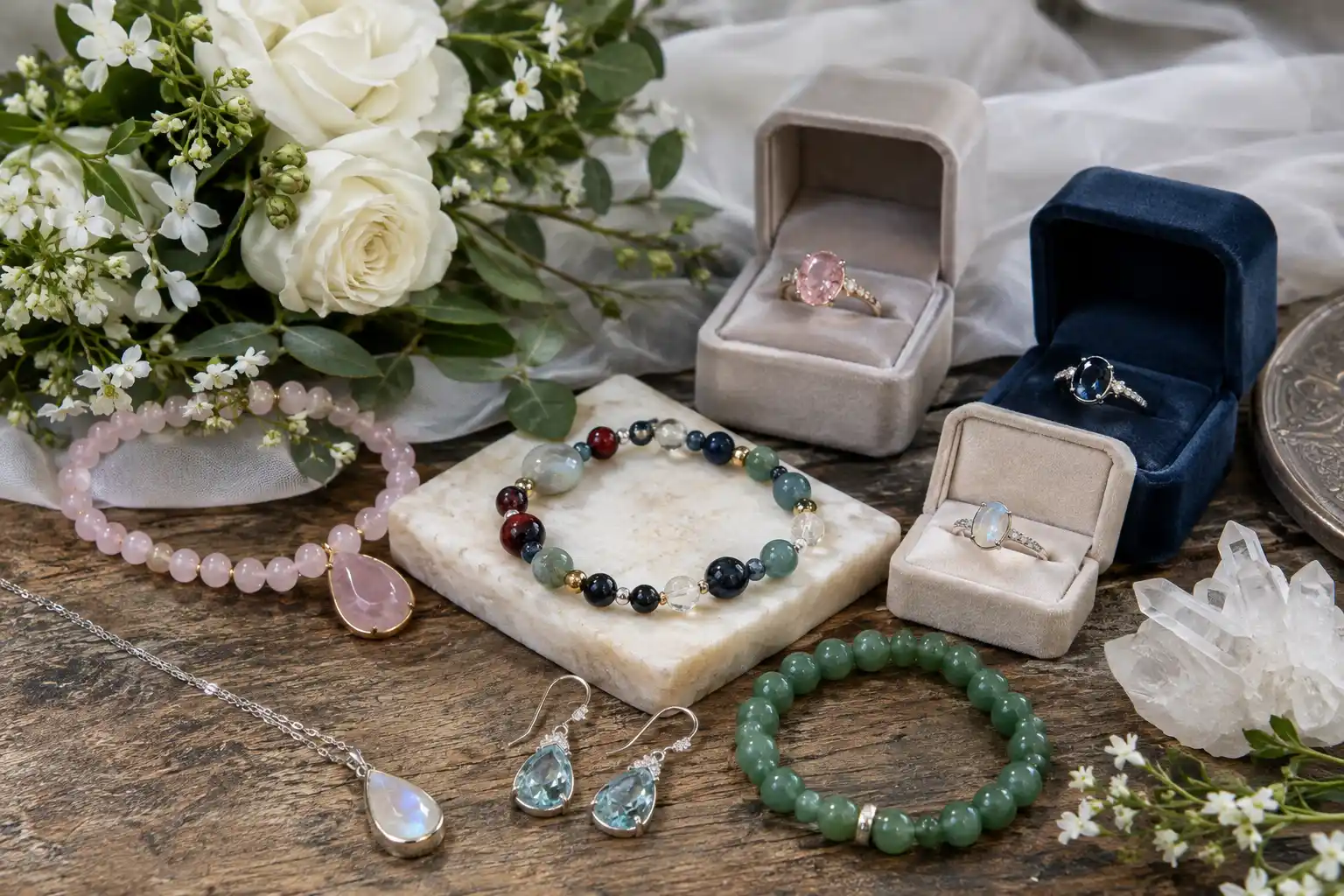
17 Sacred Crystal Gifts for a Wedding to Bless Eternal Union
Crystal gifts for a wedding can commemorate commitment, partnership, shared history, and the beginning of married life through gemstones that are beautiful enough to keep for decades. Rose quartz, sapphire, garnet, aquamarine, moonstone, jade, pearl, spinel, clear quartz, and other stones can all work as wedding gifts, but the strongest choice depends on the couple’s taste, how the gift will be used, and whether durability matters more than rarity or symbolic meaning. A sapphire pendant intended for regular wear needs different qualities from a quartz specimen displayed at home, while a personalized pair of birthstones may carry more meaning than an expensive gem with no connection to the couple.
The phrase bless eternal union can be understood as ceremonial and symbolic. Gemstones have been used in wedding jewelry, heirlooms, religious objects, and family gifts for centuries, so assigning them meanings such as loyalty, affection, patience, renewal, and enduring commitment is natural. The stones themselves do not guarantee a lifelong marriage, change another person’s feelings, prevent conflict, or create supernatural protection around a couple. Their significance comes from the promises, memories, rituals, and intentions attached to them.
Gemological accuracy makes the gift more valuable in a practical sense as well. Sapphire is extremely durable at Mohs 9, while moonstone is softer and possesses cleavage. Pearl is organic and delicate, whereas garnet and spinel are considerably easier to wear. Rose quartz is a translucent form of quartz rather than a mysterious energy substance, and jade may refer to jadeite or nephrite, two different gem substances with exceptional toughness. Choosing with these distinctions in mind helps a symbolic wedding gift survive real married life.
17 Sacred Crystal Gifts for a Wedding
- Rose quartz heart keepsake
- Blue sapphire pendant
- Garnet earrings
- Aquamarine necklace
- Moonstone jewelry
- Jade carving
- Pearl earrings
- Red spinel ring
- Clear quartz specimen
- Amethyst keepsake
- Citrine decorative stone
- Lapis lazuli box
- Agate bookends
- Couple’s birthstone necklace
- Personalized gemstone charms
- Paired mineral specimens
- Anniversary gemstone keepsake
These 17 ideas range from wearable fine jewelry to decorative objects and personalized keepsakes. The best wedding gift is the one that suits the couple’s actual style and home rather than the one carrying the most dramatic spiritual description.
Choosing a Wedding Crystal Gift the Couple Will Keep
A wedding gift should be chosen with the couple’s long-term habits in mind. Some couples appreciate fine jewelry, while others prefer home objects, travel mementos, or natural specimens. A person who rarely wears jewelry may find an agate box or paired mineral specimens more useful than a ring, while someone who wears a pendant every day may value a sapphire or aquamarine necklace for years.
Color can create another personal connection. Blue sapphire and aquamarine suit couples who prefer cool shades, garnet and spinel offer red, rose quartz provides soft pink, jade introduces green or white, and amethyst adds violet. Choosing a gemstone that already appears in the couple’s jewelry, décor, or wedding colors often makes the gift feel intentional.
Personalization can go further through birthstones. A necklace combining both partners’ birthstones can represent individuality within marriage without suggesting that certain gemstones determine compatibility. The two stones simply become visual markers of the people involved.
Wedding Gemstone Gift Comparison
| Gift | Gemological Character | Practical Use | Symbolic Theme |
|---|---|---|---|
| Rose quartz | Pink quartz | Keepsake, pendant | Affection |
| Sapphire | Corundum | Frequent-wear jewelry | Loyalty |
| Garnet | Mineral group | Earrings, rings, pendants | Commitment |
| Aquamarine | Blue beryl | Necklace, earrings, ring | Calm communication |
| Moonstone | Feldspar | Pendant, earrings | Shared phases |
| Jade | Jadeite or nephrite | Carving, pendant | Continuity |
| Pearl | Organic gem | Earrings, necklace | Grace |
| Spinel | Spinel mineral | Rings, earrings | Resilience |
| Clear quartz | Crystalline quartz | Display specimen | Clarity |
| Amethyst | Violet quartz | Jewelry or keepsake | Reflection |
| Citrine | Yellow quartz | Decorative piece | Optimism |
| Lapis lazuli | Ornamental rock | Box, carving | Wisdom symbolism |
| Agate | Chalcedony | Bookends, décor | Stability symbolism |
The symbolic themes are personal interpretations rather than measurable gemstone effects. The actual characteristics of each stone come from its mineral composition, crystal structure, hardness, toughness, optical behavior, and treatment history.
Sapphire, Garnet, and Spinel for Durable Wedding Jewelry
Sapphire is one of the strongest wedding gemstone choices because corundum reaches 9 on the Mohs scale and lacks cleavage. Blue sapphire has a long association with loyalty and commitment, but sapphire also occurs naturally in pink, yellow, green, violet, orange, and other shades.
Heat treatment is common and may improve color or clarity. A heat-treated sapphire can be a beautiful and durable wedding gift when treatment is disclosed accurately. Fine untreated examples may command higher prices, but untreated status is not required for emotional significance.
Garnet offers greater color diversity than many buyers expect. The garnet group includes red, orange, green, pink, purple, and yellow varieties. Many garnets have hardness around 6.5 to 7.5 and no cleavage, giving them useful durability for earrings, pendants, and carefully worn rings.
Deep red garnet can symbolize commitment or enduring affection, but the stone does not strengthen a marriage biologically or spiritually in any scientifically established way. Its value as a wedding gift comes from color, craftsmanship, and the message chosen by the giver.
Spinel is another excellent option. Red and pink spinel were historically confused with ruby, but spinel is a separate mineral with a hardness around 8 and generally good toughness. Its durability makes it suitable for rings and other frequently worn pieces.
A spinel gift can be especially appealing for a couple who prefers unusual fine gems rather than the more familiar diamond, sapphire, or ruby.
Rose Quartz, Moonstone, and Aquamarine for Softer Wedding Symbolism
Rose quartz is widely associated with love in modern spiritual traditions, making it an obvious wedding gift. It is pink quartz with a hardness of 7 and usually appears translucent rather than transparent.
A rose quartz heart, bowl, pendant, or polished keepsake works especially well because the soft color suits ceremonial gifting without demanding the durability of an everyday ring. Some rose quartz can display a six-rayed star when cut correctly as a cabochon, a real optical effect caused by oriented microscopic inclusions.
Its romantic symbolism is personal rather than physical. Rose quartz cannot guarantee affection, heal a troubled relationship, or create unconditional love. It can simply represent the affection the couple already shares or hopes to practice.
Moonstone offers a different type of beauty through adularescence. This floating light effect forms as light interacts with fine internal feldspar structures. Fine stones may display a blue or white sheen that moves across the surface as the gem is tilted.
Moonstone is softer than sapphire and can chip because of cleavage, so earrings and pendants are usually easier to maintain than exposed rings. Its changing light can symbolically represent the many phases of married life.
Aquamarine combines a pale blue to greenish-blue appearance with a hardness of 7.5 to 8. As a variety of beryl, it is related mineralogically to emerald and morganite. Heat treatment is commonly used to reduce greener tones and create a purer blue.
Its calm color can symbolize thoughtful communication and patience. Those values are especially relevant to marriage, but they come from the couple’s behavior rather than from a physical effect of the gemstone.
Jade and Pearl for Heirloom-Style Wedding Gifts
Jade has a long history in jewelry and carving, and a wedding gift made from jadeite or nephrite can feel especially timeless. The term jade refers to these two distinct gem substances rather than one mineral.
Jadeite generally reaches about 6.5 to 7 on the Mohs scale, while nephrite is somewhat softer. Both can show exceptional toughness because of interlocking internal structures, making carved objects and pendants surprisingly durable.
Treatment matters greatly for jadeite. Bleaching, polymer impregnation, and dyeing can change both appearance and value. An expensive jade wedding gift should be sold with clear treatment information rather than vague claims of rare natural jade.
Pearl creates a more traditional bridal association. Natural and cultured pearls are organic gems formed within mollusks, with their characteristic luster produced by layers of nacre or related structures.
Pearl is much softer than most faceted gemstones, usually around 2.5 to 4.5 on the Mohs scale. Perfume, acids, hairspray, cosmetics, and abrasion can damage its surface, making earrings and necklaces more practical than rings.
Pearls can symbolize patience, grace, or something valuable formed over time. That metaphor works beautifully for marriage without implying that pearls influence relationship outcomes.
Quartz, Amethyst, Citrine, and Agate for Home Gifts
Clear quartz makes an excellent wedding gift when the couple prefers natural specimens to jewelry. A well-formed crystal with visible prism faces, terminations, inclusions, or growth features can become a permanent display piece in a home.
Quartz has a Mohs hardness of 7 and is abundant enough that attractive specimens are available at many prices. The most meaningful examples are often those with good crystal form or reliable locality information rather than those marketed with dramatic metaphysical claims.
Amethyst and citrine provide purple and yellow varieties of quartz. Amethyst gains violet color through iron-related defects and natural irradiation, while citrine ranges from yellow to orange. Much commercial citrine is created by heating suitable amethyst or smoky quartz.
Both can make decorative bowls, polished stones, small sculptures, or jewelry. Their symbolic associations with reflection and optimism can fit wedding gifting while remaining separate from physical gemstone properties.
Agate is chalcedony with banding or other distinctive patterns. Bookends, boxes, coasters, and carved objects can reveal striking natural structures, although commercial agate is frequently dyed to produce bright colors.
For a couple setting up a home together, agate can provide a functional gift with a geological story rather than a purely ceremonial object.
Couple’s Birthstones and Personalized Wedding Gemstone Gifts
Combining the birthstones of both partners is one of the easiest ways to personalize a wedding crystal gift. The design may use two gemstones side by side, one central stone with another as an accent, or several stones representing the couple and close family members.
Different birthstones have different durability requirements. Diamond, sapphire, ruby, spinel, chrysoberyl, aquamarine, and many garnets tolerate regular wear well. Pearl, opal, turquoise, and moonstone require greater care.
A necklace or pendant is often the safest design when combining stones with very different hardness levels because it receives less impact than a ring or bracelet.
Engraved initials, a wedding date, or another private detail can add emotional value without changing the gemstone itself. The most lasting personalized pieces tend to be those that connect a real memory to a durable design.
What Blessing a Wedding With Crystals Can Mean
In ceremonial language, blessing a marriage can mean wishing the couple love, patience, health, stability, mutual respect, and many years together. Gemstones can carry those wishes symbolically because people have used precious objects to mark vows and major life transitions for centuries.
Sapphire may stand for loyalty, garnet commitment, rose quartz affection, moonstone change, jade continuity, and aquamarine communication. These associations can enrich a gift without requiring a supernatural claim.
No crystal can prevent divorce, guarantee fidelity, make disagreements disappear, or determine how long a marriage lasts. Strong relationships depend on communication, trust, practical cooperation, and the choices both people continue to make.
The gemstone’s role is simpler and often more powerful: it becomes a physical reminder of the wedding day and of what people wished for the couple when their marriage began.
Buying Wedding Crystal Gifts With Accurate Identification
A wedding gift does not need to be untreated or exceptionally rare, but it should be represented honestly. Natural, laboratory-grown, treated, and imitation stones belong to different categories.
Laboratory-grown sapphire or ruby has the essential chemistry and crystal structure of corundum but artificial origin. Glass that resembles sapphire is a simulant rather than synthetic sapphire.
Treatments are common. Sapphire and ruby may be heated, jadeite may be impregnated or dyed, agate may be dyed, pearls may be bleached or colored, and quartz varieties may receive heat or irradiation.
These processes can produce attractive products. The important issue is disclosure, particularly when treatment has a major effect on rarity or price.
For higher-value jewelry, workmanship is equally important. Secure prongs, well-finished metal, comfortable chains, reliable clasps, and settings suited to the gemstone determine whether a sentimental wedding gift actually survives decades of use.
Caring for Wedding Gemstone Gifts
Sapphire, spinel, garnet, aquamarine, quartz, amethyst, citrine, and many other durable gems can generally be cleaned gently with lukewarm water, mild soap, and a soft brush or cloth when treatment and setting conditions permit.
Moonstone requires greater impact protection, while pearl needs especially gentle cleaning and should be kept away from perfume, cosmetics, acids, and abrasive surfaces. Jade is very tough but can still be scratched by harder gems.
Decorative mineral specimens should be displayed securely. Crystal points and cleavage-prone specimens can chip if knocked from a shelf even when their surface hardness seems respectable.
Separate storage helps preserve wedding jewelry because a hard sapphire or diamond can scratch quartz, pearl, moonstone, jade, and other softer stones when loose pieces repeatedly contact one another.
Conclusion
Crystal gifts for a wedding can commemorate partnership through gemstones that combine beauty, geology, craftsmanship, and personal symbolism. Sapphire, garnet, aquamarine, rose quartz, moonstone, jade, pearl, spinel, quartz, amethyst, citrine, lapis lazuli, agate, birthstones, and personalized keepsakes all offer different ways to mark the beginning of married life.
A gemstone cannot guarantee eternal union, but it can represent the intentions behind the vows and remain physically connected with the memory of the wedding. The best gift is accurately identified, suited to the couple’s lifestyle, durable enough for its intended use, and chosen for a reason that genuinely belongs to them.
FAQs About Crystal Gifts for a Wedding
What is the best crystal gift for a wedding?
The best choice depends on the couple. Sapphire works exceptionally well for durable jewelry, rose quartz suits soft romantic keepsakes, jade can become an heirloom carving, and a pair of birthstones can create a highly personal gift.
What crystal symbolizes marriage?
Sapphire, garnet, rose quartz, aquamarine, jade, pearl, and several other gemstones can symbolize loyalty, commitment, affection, communication, continuity, or patience. These meanings are cultural and personal rather than scientifically produced by the stones.
Can a crystal bless a marriage?
A gemstone can be included symbolically in a wedding blessing or ceremonial gift, but it does not scientifically create protection, harmony, fidelity, or marital success. The blessing comes from the intention, tradition, or faith of the people involved.
Is sapphire a good wedding gift?
Yes. Sapphire is exceptionally durable at Mohs 9, comes in many colors, and has longstanding associations with loyalty and commitment. It is well suited to rings, earrings, pendants, and heirloom jewelry.
Is rose quartz suitable for wedding jewelry?
Rose quartz can be used in wedding jewelry, particularly pendants, earrings, and cabochons. It has a Mohs hardness of 7, making it reasonably durable, though it is softer than sapphire and better protected from heavy abrasion.
Is moonstone a good wedding gift?
Yes. Moonstone’s adularescence gives it a distinctive appearance, and its changing light can symbolize different phases of married life. Because moonstone has cleavage and moderate hardness, pendants and earrings are usually easier to maintain than frequently worn rings.
Is pearl durable enough for a wedding keepsake?
Pearls can last for generations when handled carefully, but their surfaces are much softer than most mineral gemstones. Perfume, cosmetics, acids, abrasion, and improper storage can damage nacre, so pearl jewelry requires thoughtful care.
Is jade suitable for an heirloom wedding gift?
Yes. Jadeite and nephrite are known for exceptional toughness and can make durable pendants, bangles, carvings, and decorative objects. Treatment disclosure is particularly important for valuable jadeite.
Are couple’s birthstones a good wedding gift?
Yes. Combining both partners’ birthstones creates a direct personal connection. A pendant is often practical when the two gemstones have very different hardness or toughness because it receives less impact than a ring.
Can crystals improve relationship compatibility?
There is no scientific evidence that gemstones change compatibility, control emotions, or determine whether a marriage succeeds. They can serve as symbols of values such as patience, loyalty, communication, or affection.
Are treated gemstones acceptable as wedding gifts?
Yes. Treated gemstones can be beautiful and durable. Heat-treated sapphire, dyed agate, stabilized turquoise, and other enhanced stones are legitimate choices when the treatment is disclosed honestly.
What wedding crystal gift works for a couple who does not wear jewelry?
Agate bookends, a quartz specimen, a jade carving, a gemstone keepsake box, paired mineral specimens, or another decorative stone object can provide a lasting wedding gift without requiring jewelry sizing.
Should an expensive wedding gemstone have a laboratory report?
A report can be useful when value depends strongly on natural origin, treatment status, color origin, or provenance. High-value sapphire, ruby, diamond, jadeite, and certain other gemstones particularly benefit from dependable identification.
What gemstone symbolizes loyalty in marriage?
Blue sapphire has one of the strongest historical associations with loyalty and fidelity in jewelry culture. Garnet and spinel can also represent commitment or resilience through personal symbolism.
How should wedding gemstone gifts be stored?
Jewelry should be separated in soft pouches or divided compartments so harder gems do not scratch softer ones. Delicate pearls, moonstones, and opals benefit especially from careful storage, while mineral specimens should be displayed where they cannot be knocked over.
Can a wedding crystal become a family heirloom?
Yes. Durable gemstones such as sapphire, ruby, spinel, garnet, aquamarine, jade, and well-protected quartz can remain attractive for generations. Craftsmanship, secure settings, proper storage, and realistic care are essential for long-term preservation.
What makes a crystal wedding gift truly meaningful?
The strongest meaning comes from a specific connection to the couple, such as a birthstone, shared color, memorable location, family tradition, wedding date, or value they consciously want the gift to represent. Personal relevance usually lasts longer than generic metaphysical claims.