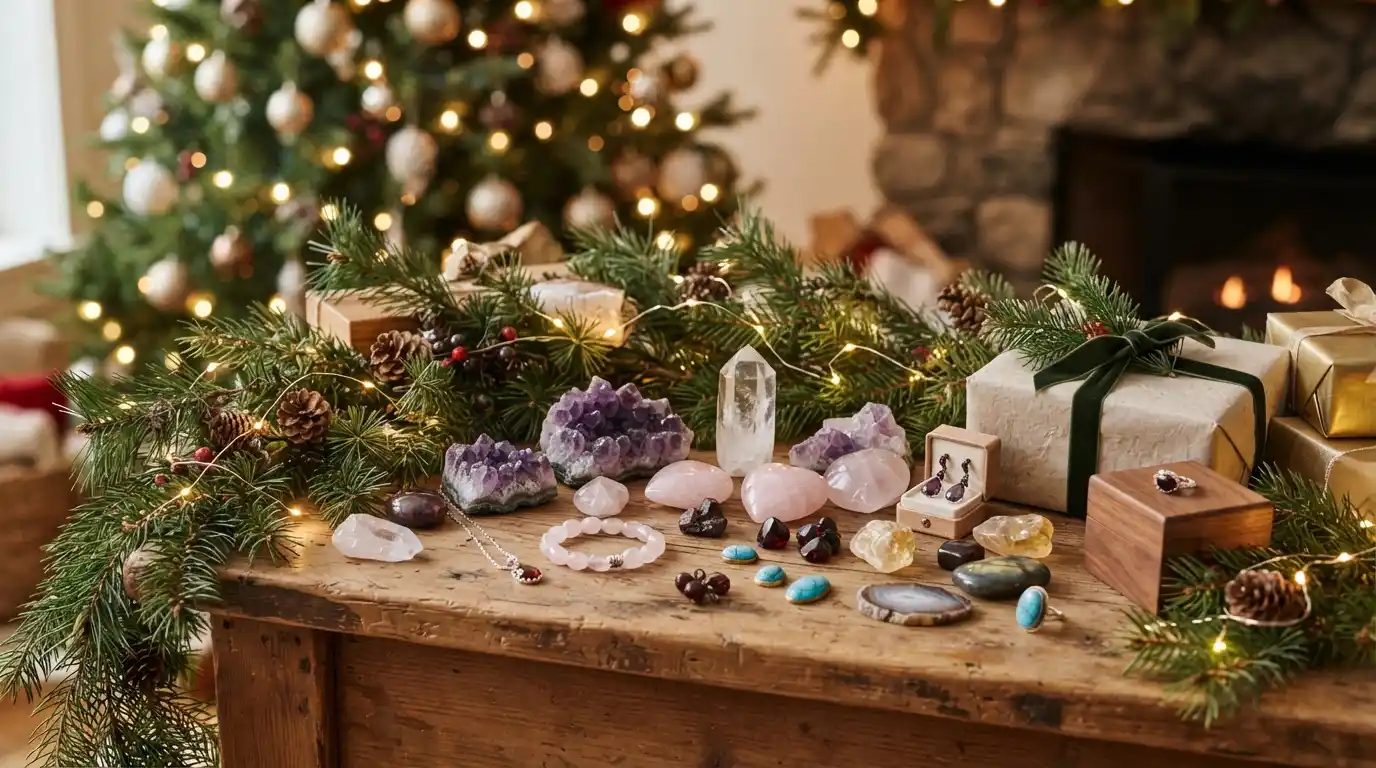
18 Magical Crystal Gifts for Christmas to Spread Love & Peace
Crystal gifts for Christmas can range from wearable gemstone jewelry and polished pocket stones to mineral specimens, carved ornaments, decorative bowls, bookends, and small collecting sets. The most thoughtful choice usually comes from matching the gem to the recipient rather than choosing a stone solely because a spiritual list assigns it a particular power. Amethyst, rose quartz, clear quartz, garnet, turquoise, agate, jasper, fluorite, moonstone, and other popular gift stones all have different mineral identities, durability characteristics, treatments, and care requirements.
The word magical can describe the atmosphere of Christmas gifting without implying that a crystal performs supernatural acts. Gemstones can carry cultural associations with love, peace, friendship, courage, remembrance, or renewal, and a chosen stone can become meaningful because of the relationship, memory, or intention attached to it. They do not scientifically transmit love, eliminate conflict, heal disease, guarantee protection, or change another person’s emotional state.
A good Christmas crystal gift therefore combines visual beauty with truthful identification and practical usefulness. A person who wears jewelry every day may appreciate a durable sapphire or garnet pendant, while a mineral collector may value an unpolished crystal specimen far more than a mass-produced carving. Someone new to gemstones may prefer a small labeled collection that teaches differences between quartz, feldspar, beryl, chalcedony, and other gem groups.
18 Crystal Gifts for Christmas
- Amethyst pendant
- Rose quartz heart carving
- Clear quartz crystal specimen
- Garnet earrings
- Turquoise cabochon pendant
- Agate bookends
- Jasper desk stone
- Moonstone ring
- Fluorite display specimen
- Citrine bracelet
- Aquamarine necklace
- Lapis lazuli ornament
- Black obsidian carving
- Labradorite palm stone
- Carnelian pocket stone
- Mixed mineral collector set
- Gemstone Christmas ornament
- Personalized birthstone jewelry
These 18 ideas cover very different recipients and budgets. Jewelry works best when the wearer’s style, metal preference, ring size, and daily routine are understood. Specimens and decorative pieces are often easier to give because exact sizing is unnecessary, while collector sets can be especially rewarding for someone interested in geology, mineralogy, or gem identification.
Choosing a Christmas Crystal Gift That Feels Personal
A gemstone becomes a stronger gift when there is a clear reason for choosing it. Birth month is one possibility, but color preference, jewelry style, a shared memory, collecting interests, or the geological story of the stone can be equally meaningful.
Someone who prefers cool colors may enjoy aquamarine, turquoise, lapis lazuli, or blue fluorite. A recipient who loves warm colors may appreciate garnet, citrine, carnelian, or tiger’s-eye. Amethyst suits someone who already wears violet jewelry, while rose quartz often works well in understated pink decorative pieces.
Jewelry also requires attention to lifestyle. An amethyst pendant does not face the same abrasion as an amethyst ring. Turquoise earrings are easier to protect from household chemicals than a turquoise bracelet. Fluorite can be beautiful on a shelf but is too soft and cleavage-prone for careless everyday ring wear.
This practical matching often makes a gift feel more thoughtful than selecting a stone from a generic meaning chart. A collector who studies crystal habits may be delighted by a well-formed natural quartz specimen even if it has no expensive setting, while a jewelry lover may value excellent cutting and craftsmanship more than geological rarity.
Amethyst, Rose Quartz, and Clear Quartz as Classic Christmas Choices
Amethyst is one of the easiest gemstones to give because its violet color is widely recognized, attractive specimens are available at many price levels, and the quartz itself has reasonable durability. Amethyst has a Mohs hardness of 7 and no cleavage, making it practical for pendants, earrings, bracelets, and carefully worn rings.
Its violet color involves iron-related defects and natural irradiation within quartz. Color can range from pale lilac to strong purple, sometimes with visible zoning. Heat can alter the color of some amethyst, so specimens and jewelry should be kept away from unnecessary high temperatures.
Historically and spiritually, amethyst has been associated with restraint, reflection, and spiritual life. For Christmas, it can symbolically represent peace or thoughtful renewal, but it does not scientifically calm the nervous system, treat anxiety, or improve sleep.
Rose quartz offers a softer appearance. It is also quartz, with a hardness of 7, but it is usually translucent and cloudy rather than highly transparent. Hearts, polished palm stones, small bowls, and pendants are particularly common gift formats.
Its pink color has made rose quartz a symbol of affection and kindness in modern spiritual traditions. A heart carving can therefore express love or gratitude while remaining simply a decorative gemstone object rather than a promise that the stone will create emotional healing.
Clear quartz offers another direction. Rock crystal is transparent colorless quartz and can form striking hexagonal prisms and crystal clusters. A natural specimen can make an excellent gift for someone interested in crystallography because its visible faces, terminations, inclusions, and growth patterns provide something to examine beyond decorative appearance.
Garnet, Turquoise, Aquamarine, and Birthstone Jewelry
Birthstone jewelry can be especially personal at Christmas because the gift can connect directly with a recipient’s birth month without requiring spiritual claims. Garnet is strongly associated with January, amethyst with February, and aquamarine with March, while other months have their own traditional or modern choices.
Garnet is particularly suitable for earrings, pendants, and rings. The garnet group contains several mineral species rather than a single gemstone, creating red, orange, green, pink, purple, and other colors. Common red garnets are durable enough for many jewelry uses and require relatively straightforward care.
Turquoise is a recognized December birthstone and naturally fits Christmas gifting for someone born during the month. It is usually opaque blue to blue-green and may contain dark or brown host-rock matrix.
Treatment disclosure matters because turquoise may be stabilized with polymer, dyed, reconstructed, or imitated. Stabilized turquoise can be a practical jewelry choice when represented accurately, but it should not be sold as untreated natural turquoise.
Aquamarine is blue to greenish-blue beryl with a hardness of 7.5 to 8. Its relatively strong durability makes it suitable for pendants, earrings, and rings. Heat treatment is commonly used to reduce greener or yellowish components and produce a purer blue.
A carefully selected birthstone pendant can be more practical than a ring when the giver does not know exact sizing. It also experiences fewer impacts, making delicate or included gemstones easier to wear safely.
Decorative Crystal Gifts for the Home or Office
Not every crystal gift needs to be jewelry. Agate bookends, polished jasper desk stones, mineral specimens, small bowls, and carved decorative objects can combine geological interest with practical display value.
Agate is a variety of chalcedony with fine banding or other patterns. Natural colors can include white, gray, brown, red, orange, and other tones, while strongly colored commercial agates are sometimes dyed. A pair of bookends can reveal beautiful banding across a cut nodule while remaining functional on a shelf.
Jasper is another microcrystalline quartz gem, usually opaque and valued for patterns or earthy coloration. It works well as a polished desk stone because quartz-based stones offer reasonable resistance to scratching and take a good polish.
Fluorite is visually striking for display but should be treated much more carefully. It has a Mohs hardness of only 4 and perfect cleavage in several directions. Purple, green, blue, yellow, and multicolored fluorite can form beautiful cubic or octahedral crystals, but specimens should be handled gently and kept away from edges where they could fall.
Lapis lazuli can also work beautifully in decorative Christmas pieces. It is a rock composed mainly of lazurite with varying amounts of calcite, pyrite, and other minerals. Deep blue stones with attractive golden pyrite flecks can make striking ornaments, boxes, and carvings, though lapis is too soft for careless handling.
Moonstone, Labradorite, and Optical Effects as Gift Features
Some gemstones make memorable gifts because they display real optical effects that change as the stone moves. Moonstone and labradorite are two excellent examples within the feldspar family.
Moonstone is known for adularescence, a floating glow produced by light interacting with fine internal feldspar layers. The best effect appears to glide beneath the surface as a cabochon is tilted. Blue adularescence can be especially striking against a near-colorless body.
Moonstone has a hardness around 6 to 6.5 and possesses cleavage, so rings require care. Pendants and earrings reduce impact risk and may be more practical Christmas gifts for someone unfamiliar with delicate gems.
Labradorite can display labradorescence, an iridescent effect that produces blue, green, gold, orange, and sometimes other flashes across a darker body. The phenomenon results from light interference within internal structures in the feldspar.
A palm stone or polished freeform can display this effect dramatically. The color is real optical behavior, not an artificial aura and not evidence of supernatural energy. A recipient can appreciate the changing light simply as one of mineralogy’s most beautiful visual phenomena.
Citrine, Carnelian, and Warm-Colored Gifts for a Festive Look
Warm-colored gemstones fit naturally with Christmas interiors dominated by gold, candles, wood, and warm lighting. Citrine ranges from yellow to orange-yellow and can make attractive bracelets, earrings, pendants, and faceted ornaments.
Commercial citrine is often produced by heating suitable amethyst or smoky quartz. The resulting color can be stable and attractive, but accurate treatment representation remains preferable to claims that every vivid orange stone developed naturally in the ground.
Carnelian provides warmer orange to reddish color in translucent chalcedony. Iron-related compounds contribute to its coloration, and heat may deepen color in some stones. Its hardness around 6.5 to 7 and useful toughness make it suitable for pocket stones, beads, carved seals, and jewelry.
A small polished carnelian can be an especially simple gift when jewelry sizing is uncertain. A beautifully cut and polished natural stone may cost less than elaborate jewelry while still carrying geological and personal interest.
Spiritual traditions sometimes connect citrine with abundance and carnelian with motivation or courage. Those associations are best used as gift symbolism rather than promises that the stones will cause financial success or physically increase energy.
Obsidian and Other Dark Stones for Minimalist Gifts
Black obsidian appeals to recipients who prefer minimalist or dramatic designs. It is natural volcanic glass formed when silica-rich lava cools rapidly enough to prevent substantial crystallization.
Because obsidian is glass rather than a crystalline mineral, it behaves differently from quartz or sapphire. It is around 5 to 5.5 on the Mohs scale and breaks with conchoidal fracture, producing sharp curved surfaces.
Polished carvings, cabochons, and small decorative objects are generally safer gift choices than delicate exposed rings. Black obsidian can take a mirror-like polish that works particularly well in modern interiors or monochrome jewelry.
Modern spiritual traditions often call obsidian protective, but the idea is symbolic. An obsidian gift may represent resilience, boundaries, remembrance, or strength without implying that the stone physically absorbs negative energy.
Mixed Mineral Sets for Collectors and Curious Beginners
A well-labeled mineral collection can be one of the most educational Christmas gifts because it encourages comparison rather than treating every colorful stone as interchangeable. A small set might include quartz, feldspar, calcite, fluorite, garnet, chalcedony, pyrite, and other common specimens.
Good labeling improves the gift substantially. Mineral name, variety, locality when genuinely known, and a few physical characteristics can turn a decorative box into a miniature geology collection.
Avoid sets that assign every stone an unsupported medical effect while providing little information about actual identity. A collector generally gains more lasting value from knowing why fluorite cleaves, how quartz grows, what distinguishes chalcedony from macrocrystalline quartz, or why garnet represents a mineral group.
Specimen size is less important than quality of selection. A small well-formed crystal with documented locality can be more interesting than a large poorly identified polished piece.
Personalized Birthstone Jewelry for a More Lasting Christmas Gift
Personalization can make gemstone jewelry especially memorable. Birthstone earrings for a parent, a pendant containing children’s birthstones, or a simple ring using a partner’s birth month can connect the stone with a family story.
The best design considers durability as well as sentiment. Sapphire, ruby, diamond, spinel, chrysoberyl, aquamarine, garnet, and several other gems perform well in frequently worn jewelry. Opal, pearl, turquoise, and moonstone need greater care.
Metal choice also affects appearance. Yellow gold can warm pale blue or violet stones, white metal can emphasize cool colors, and rose gold can amplify pink, peach, and warm purple tones.
For expensive pieces, gemstone identity and treatment disclosure remain important even when emotional meaning is the main reason for purchase. Sentiment does not reduce the need for accurate representation.
Understanding Crystal Symbolism at Christmas
Christmas gifting frequently centers on peace, generosity, family, remembrance, gratitude, reconciliation, and affection. Gemstones can represent these ideas effectively because physical objects often become associated with important memories.
Amethyst might represent reflection, rose quartz affection, clear quartz clarity, garnet commitment, and turquoise friendship. These symbolic meanings can enrich a gift without requiring a claim that the gemstone changes the recipient physically or emotionally.
A crystal cannot force reconciliation between family members, eliminate grief, cure illness, block harmful energy, or guarantee peace. The real value comes from the gesture, the relationship, the craftsmanship, the beauty of the stone, and the memory associated with receiving it.
This also means there is no universally correct Christmas crystal. The best choice is the one suited to the recipient rather than the one carrying the most dramatic metaphysical description.
Buying Genuine Crystal Gifts Without Falling for Marketing Claims
Natural, synthetic, treated, and imitation stones can all appear in gift products. None of these categories should be confused with another.
Synthetic gemstones are laboratory-grown versions of specific gem species and may possess essentially the same chemistry and crystal structure as their natural counterparts. Imitations simply resemble another gemstone visually. Glass, resin, ceramic, dyed stone, and assembled products can all be marketed in ways that obscure what they actually are.
Treatments are equally common. Amethyst can be heated, turquoise may be stabilized or dyed, agate is frequently dyed, quartz can receive irradiation, and many jewelry gemstones have established enhancement practices.
A trustworthy gift does not have to be untreated or exceptionally rare. It simply needs to be represented honestly. A beautiful dyed agate ornament can still be enjoyable when sold as dyed agate rather than as a rare naturally vivid specimen.
Caring for Crystal Gifts After Christmas
Care depends on the actual stone. Quartz varieties such as amethyst, citrine, rose quartz, carnelian, agate, and jasper can generally be cleaned gently with mild soap and water when jewelry components permit.
Turquoise, pearl, fluorite, moonstone, lapis lazuli, and opal require more caution. Harsh cleaners, high heat, aggressive ultrasonic cleaning, and prolonged chemical exposure can damage certain stones or treatments.
Display specimens should also be placed thoughtfully. Fluorite can chip if knocked from a shelf, while some colored stones may fade under prolonged intense sunlight. Crystal clusters can collect dust between points and may be better cleaned with a soft brush than repeatedly soaked.
Jewelry storage should keep harder stones away from softer ones. Sapphire, diamond, and other hard gems can scratch quartz, turquoise, opal, or polished decorative stones if stored loosely together.
Conclusion
Crystal gifts for Christmas can be meaningful without relying on exaggerated supernatural claims. Jewelry, carved stones, natural mineral specimens, optical-effect gems, collector sets, ornaments, and birthstone pieces all offer different ways to combine beauty with personal significance.
The best gift matches the recipient’s interests, style, and everyday habits while accurately representing the gemstone’s identity, treatment, and durability. Love and peace come from the relationship and the gesture, while the crystal becomes a lasting object associated with that memory.
FAQs About Crystal Gifts for Christmas
What is the best crystal to give for Christmas?
There is no single best Christmas crystal for everyone. Amethyst, rose quartz, clear quartz, garnet, turquoise, aquamarine, and agate are versatile choices, but the recipient’s favorite color, birth month, jewelry habits, and collecting interests usually provide a better basis for choosing.
What crystal gift symbolizes love?
Rose quartz is widely associated with affection and love in contemporary spiritual traditions, while garnet can symbolize commitment and loyalty. These meanings are symbolic rather than scientifically produced by the stones.
What crystal symbolizes peace?
Amethyst, aquamarine, clear quartz, and several pale blue stones are frequently used as symbols of peace, calmness, or thoughtful communication. They do not physically create peace or treat anxiety, but they can represent those intentions in a gift.
Is a crystal specimen a good Christmas present?
Yes, especially for someone interested in geology, collecting, science, or natural objects. A well-formed specimen with accurate identification and genuine locality information can offer more educational and collecting value than a highly processed decorative stone.
Are crystal jewelry gifts better than loose stones?
Neither is automatically better. Jewelry is practical for someone who enjoys wearing gemstones, while polished stones and specimens suit collectors or recipients who do not wear much jewelry. The best format depends on the person receiving the gift.
Is amethyst durable enough for Christmas jewelry?
Amethyst has a Mohs hardness of 7 and no cleavage, making it suitable for many pendants, earrings, bracelets, and carefully worn rings. It should still be protected from hard impacts and unnecessary high heat.
Is turquoise a good December Christmas gift?
Yes. Turquoise has a recognized association with December and can make a particularly personal gift for someone born during the month. Buyers should consider treatment because stabilized, dyed, reconstructed, and imitation turquoise are all found in the market.
Are crystal healing claims scientifically proven?
Claims that gemstones cure disease, regulate hormones, improve circulation, strengthen immunity, treat depression, or create measurable chakra effects are not established through gemological science. Gemstones can still carry cultural, historical, decorative, or personal significance.
What is a good crystal gift for someone new to gemstones?
A small labeled mineral set can be especially useful because it allows the recipient to compare several real minerals and learn their identities, colors, crystal habits, hardness differences, and geological origins.
Can I give a crystal based on someone’s birthstone?
Yes. Birthstone jewelry is one of the easiest ways to personalize a gemstone gift. It connects the gift to a recognized calendar tradition while still allowing selection based on durability, color, jewelry style, and budget.
What crystal gift works for someone who does not wear jewelry?
Mineral specimens, agate bookends, polished desk stones, carved objects, gemstone ornaments, and small collector sets are good alternatives. They can be appreciated visually without requiring ring sizing or knowledge of the recipient’s jewelry habits.
Are dyed or treated gemstones bad Christmas gifts?
Not necessarily. Treatments can produce attractive and durable gemstones. The important issue is honest disclosure. A treated stone can be an excellent gift when the recipient knows what it is and the price reflects its actual identity.
Should I buy a raw crystal or polished gemstone?
Raw specimens highlight natural crystal growth and geological features, while polished gems emphasize color, pattern, translucency, or optical effects. A collector may prefer a natural crystal form, while someone interested in decoration or jewelry may prefer a polished piece.
Do crystals protect a home during Christmas?
There is no scientific evidence that gemstones create an invisible protective field around a home. Black obsidian, tourmaline, quartz, and other stones may carry protective symbolism in spiritual traditions, but actual household safety depends on practical measures.
Can crystals spread love and peace?
Crystals do not physically transmit love or peace. A gemstone gift can symbolize affection, reconciliation, gratitude, remembrance, or peaceful intentions because of the meaning given to it by the people involved.
How can I tell if a crystal gift is genuine?
Accurate labeling, transparent seller disclosure, realistic descriptions, and professional gemological testing for valuable stones are more reliable than color alone. Extremely vivid colors, improbable rarity claims, or guarantees of supernatural effects should not substitute for proper identification.
What should I avoid when buying Christmas crystal gifts?
Avoid undisclosed imitations, misleading claims of natural rarity, unclear treatment descriptions, fragile stones placed in unsuitable jewelry, and products marketed mainly through unsupported medical or financial promises. Choose according to actual identity, workmanship, appearance, and recipient preference.
How should Christmas gemstone gifts be stored?
Store jewelry and polished stones separately when possible so harder gems do not scratch softer ones. Delicate specimens should be protected from falls, while light-sensitive stones should not be left permanently in intense direct sunlight. Individual pouches, boxes, or padded display areas work well.