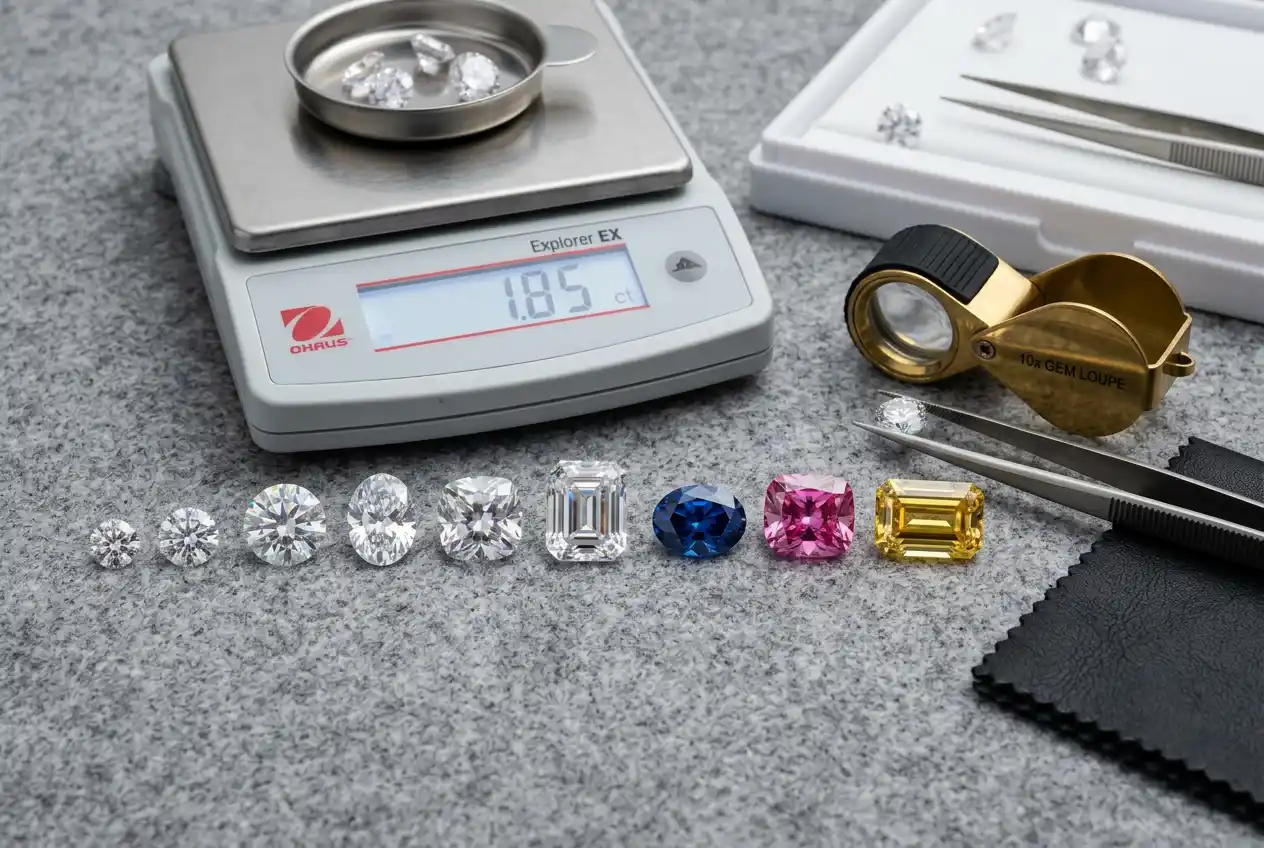
Cubic Zirconia Price Per Carat: 8 Factors That Determine Value
Cubic zirconia price per carat is usually far lower than the price of natural diamond because jewelry-grade cubic zirconia is laboratory-manufactured rather than mined from a scarce geological deposit. Ordinary loose stones can cost only a few dollars per carat, while better-cut gems may reach roughly $5 to $20 per carat. Precision-cut, unusually large, colored, coated, specialty, or branded cubic zirconia can rise to several tens of dollars per carat, although much of the final Price in finished jewelry often comes from the setting, precious metal, design, labor, and brand rather than the center stone itself.
Cubic zirconia, commonly abbreviated CZ, is crystalline zirconium dioxide, ZrO₂, produced in a stabilized cubic crystal structure for gem use. Stabilizing oxides are added so the cubic phase remains stable at ordinary temperatures. CZ is not zircon, despite the similarity of the names. Zircon is a natural zirconium silicate mineral, ZrSiO₄, with its own geological origin, optical properties, treatments, and value structure. Confusing zircon and cubic zirconia can lead to inaccurate buying decisions because they are entirely different gem substances.
The comparatively low cost of CZ comes from repeatable production rather than poor optical performance. A well-cut colorless stone can display high brilliance, strong dispersion, and excellent clarity. Its refractive index is lower than diamond’s but still high enough to produce substantial sparkle, while its dispersion is higher than diamond’s and can create conspicuous rainbow flashes. Value differences within the CZ market therefore depend less on rarity and more on cutting quality, manufacturing consistency, color, size, surface condition, coatings, and the workmanship of the finished jewelry.
8 Factors That Determine Cubic Zirconia Price Per Carat
- Cut precision and facet quality
- Color grade and color consistency
- Clarity and manufacturing cleanliness
- Carat weight and physical dimensions
- Stabilization, coatings, and specialty finishes
- Shape and cutting complexity
- Manufacturing quality and brand positioning
- Jewelry setting, craftsmanship, and overall presentation
These eight factors explain why two CZ stones of similar weight can be offered at noticeably different Prices even though neither has the geological rarity associated with fine natural gemstones. In this market, craftsmanship and consistency usually matter more than scarcity.
Typical Cubic Zirconia Price Per Carat
Cubic zirconia is commonly sold by piece, millimeter size, parcel, or finished jewelry item rather than through a formal international per-carat chart. Approximate loose-stone ranges are still useful for understanding how ordinary machine-cut CZ differs from better specialty stones.
| Cubic Zirconia Category | Approximate Price Per Carat | Typical Characteristics |
|---|---|---|
| Basic commercial CZ | Under $1 to about $5 | Mass-produced, simple cutting, ordinary finish |
| Good jewelry-quality CZ | $3 to $10 | Clean appearance, consistent color, competent cut |
| High-quality precision-cut CZ | $10 to $25 | Strong symmetry, polish, controlled proportions |
| Specialty colored or coated CZ | $10 to $30+ | Unusual color, optical finish, custom treatment |
| Branded or custom-cut stones | Highly variable | Precision faceting, specialty design, brand premium |
These ranges concern the loose stone rather than the complete jewel. A cubic zirconia ring set in platinum or high-karat gold can cost hundreds or thousands of dollars even when the center CZ itself represents only a small portion of the total Price.
Cut Quality Is the Strongest Driver of Visible CZ Value
Cubic zirconia is inexpensive enough that buyers should not have to accept obviously poor cutting in a high-quality piece. The best stones have symmetrical outlines, crisp facet junctions, balanced proportions, strong polish, and pavilion angles that return light rather than allowing it to leak through the bottom.
A poorly cut CZ can look flat despite the stone’s inherently useful refractive properties. Excessively shallow pavilions can create windowing, while excessively deep cuts can produce dark zones and unnecessary weight beneath the girdle. Off-center culets, crooked facet junctions, uneven girdles, and weak polish can all reduce sparkle.
Precision cutting creates a stronger Price difference because skilled faceting requires more time and may sacrifice more rough to achieve ideal proportions. Since raw CZ is inexpensive compared with rare natural gems, much of the premium in a high-end loose stone can reflect cutting labor rather than crystal scarcity.
Cut quality is also one reason comparing CZ strictly by carat weight can be misleading. A lighter stone with efficient proportions may look larger and brighter face-up than a heavier stone carrying unnecessary depth.
Colorless CZ and Colored CZ Have Different Pricing Logic
Colorless cubic zirconia is usually manufactured to appear as neutral and free from obvious yellow or brown tint as possible. Because production can be controlled, very colorless CZ is readily available and does not require the same rarity premium associated with high-color natural diamonds.
Some sellers use diamond-like color terminology for marketing, but those labels should not be assumed to follow the same standardized laboratory system used for natural or laboratory-grown diamond. The useful question is whether the CZ looks neutral, consistent, and attractive in realistic lighting.
Colored cubic zirconia is produced in a wide range of hues, including blue, green, yellow, orange, pink, red, purple, champagne, and black. These colors can result from controlled additions during manufacturing or from post-growth surface treatments and coatings.
Strong, uniform color can add production and design value, particularly when the hue is difficult to manufacture consistently. A specialty color may therefore cost more than ordinary colorless CZ even though the stone remains laboratory-produced.
Color-changing or coated fashion stones can command additional premiums when the finish is attractive and durable. The coating should be disclosed because a surface-applied color does not have the same wear resistance as color distributed throughout the crystal.
High Clarity Is Expected Rather Than Rare
One of CZ’s manufacturing advantages is that extremely clean stones can be produced routinely. Fine jewelry-quality CZ should therefore appear eye-clean, and many stones will look free of noticeable inclusions even under moderate magnification.
Bubbles, growth disturbances, unmelted inclusions, scratches, polishing marks, chips, and other manufacturing defects can occur in lower-quality products. They usually lower the grade because cleaner stones are readily available.
Clarity does not carry the same price structure as diamond. A flawless-looking CZ is not rare in the way a natural internally flawless diamond is rare, so the absence of inclusions should be viewed as a basic quality expectation rather than a major scarcity premium.
Surface condition can matter more than internal clarity after the stone has been worn. Scratches, chips, facet-edge abrasion, and residue can reduce brilliance even when the original crystal was perfectly clean.
Carat Weight Does Not Create a Strong Scarcity Premium
Large cubic zirconia can be manufactured far more readily than large fine natural gemstones. A ten-carat CZ therefore does not become disproportionately rare simply because its weight is high.
The Price per carat may remain stable or even fall in mass-market production because larger stones do not require the discovery of unusually large natural crystals. Manufacturing efficiency and cutting yield determine cost more directly.
Large stones can still cost more in total because more crystal volume, cutting time, polishing, and quality control are required. Specialty cuts in large sizes may also need more careful engineering to avoid excessive depth or unattractive optical effects.
Physical dimensions should be compared alongside carat weight because CZ has a relatively high density. It is significantly denser than diamond, so a CZ and diamond with the same millimeter dimensions will not normally have the same carat weight. This is one reason buyers should avoid treating a CZ’s carat figure as a direct visual equivalent to a diamond of the same weight.
Cubic Zirconia Is Denser Than Diamond
The density difference between CZ and diamond has practical consequences. Cubic zirconia typically has a specific gravity around 5.6 to 6.0 depending on composition, while diamond is about 3.52.
This means a one-carat cubic zirconia is physically smaller than a one-carat diamond when both are cut to similar proportions and shape. Conversely, a CZ with the same diameter as a one-carat round diamond will weigh considerably more than one carat.
Retail descriptions sometimes use diamond-equivalent size to communicate visual dimensions. Buyers should check whether a listing gives actual carat weight or an equivalent millimeter appearance.
For CZ, millimeter dimensions are often more useful than weight when the goal is choosing how large the stone will look in a ring or pendant.
Shape and Cutting Complexity Can Raise the Price
Round brilliant CZ is widely produced and benefits from highly standardized manufacturing. Common ovals, cushions, pears, princess cuts, and emerald cuts are also available in large quantities.
Less common shapes can cost more because they require specialty cutting, custom programming, additional labor, or lower production volumes. Precision-cut hearts, shields, hexagons, kites, fantasy cuts, Portuguese-style rounds, and complex custom designs can therefore carry noticeable premiums.
Cutting complexity matters even though the starting crystal is inexpensive. The craft involved in producing a perfectly symmetrical custom stone can be worth far more than the raw CZ itself.
Matched pairs and calibrated sets introduce another workmanship factor. Earrings or multi-stone designs require stones that match closely for size, color, facet pattern, and optical performance.
Coatings and Surface Treatments Affect Both Appearance and Price
Some cubic zirconia receives surface coatings intended to change color, create iridescence, modify reflectivity, or imitate particular gemstone appearances. Such finishes can produce striking fashion jewelry, but their durability differs from the durability of the CZ crystal itself.
CZ is reasonably hard, generally around 8 to 8.5 on the Mohs scale, but a thin decorative coating can scratch or wear much more easily than the underlying stone.
A coated CZ should therefore be represented accurately. Buyers paying extra for a specialty finish should understand whether the color exists throughout the crystal or only on its surface.
Routine stabilized CZ should not be confused with a coating. Stabilizing oxides are part of the crystal composition and allow the cubic structure to remain stable. They are fundamental to jewelry-grade cubic zirconia rather than a cosmetic surface treatment.
Manufacturing Quality Can Produce Noticeable Differences
Cubic zirconia production is mature, but not every batch is manufactured to the same standard. Crystal homogeneity, stabilizer composition, color consistency, strain, internal defects, and cutting quality can vary among manufacturers.
Higher-quality producers may invest more heavily in controlled growth, sorting, calibrated dimensions, cutting consistency, and final inspection. This matters particularly in jewelry containing many matched stones because slight differences become obvious across a row or pavé setting.
Branding can add another premium. A branded CZ may cost far more than an unbranded stone even when their fundamental gemological properties are similar because the buyer is also paying for design, quality assurance, marketing, warranty, and distribution.
The higher Price does not mean the stone has become geologically rarer. It reflects a different commercial product.
Finished Jewelry Often Matters More Than the CZ Stone Price
For inexpensive loose CZ, the setting can easily be worth many times more than the center stone. Gold purity, platinum, sterling silver, accent gemstones, design complexity, setting labor, and finishing can dominate the retail Price.
This is particularly important when comparing engagement-style rings. A well-made gold ring with excellent prongs, durable finishing, and precise stone setting may be far more valuable as an object than a cheaply manufactured ring containing a similar-size CZ.
Repairability should also be considered. CZ is inexpensive enough that replacing a worn stone can sometimes cost less than extensively repolishing it, but a high-quality setting can remain useful through multiple replacements.
Buyers should therefore evaluate CZ jewelry as a complete piece rather than assuming the center stone determines most of the value.
Cubic Zirconia Versus Diamond Price
The enormous Price difference between CZ and diamond comes primarily from origin, rarity, market structure, and production economics rather than from a simple visual ranking.
Natural diamond forms geologically and requires mining, sorting, cutting, grading, and distribution. Laboratory-grown diamond is also manufactured, but it is crystalline carbon with essentially the same mineral structure and core gemological properties as natural diamond.
CZ is zirconium dioxide and is a diamond simulant rather than synthetic diamond. It resembles diamond visually but has different chemistry, density, hardness, thermal behavior, refractive index, and dispersion.
A high-quality CZ can offer impressive brilliance for a small fraction of diamond’s cost, but it should never be represented as a type of diamond.
Cubic Zirconia Versus Natural Zircon
Natural zircon and cubic zirconia are often confused because of their names. Zircon is zirconium silicate, ZrSiO₄, and forms naturally in geological environments. It occurs in colorless, blue, brown, yellow, red, green, and other colors.
CZ is laboratory-produced stabilized zirconium dioxide, ZrO₂. It does not belong to the zircon mineral species.
Natural zircon can carry genuine rarity and provenance premiums, while ordinary CZ is manufactured in large quantities. Their price structures are therefore fundamentally different.
A seller describing CZ simply as zircon creates unnecessary confusion. Accurate terminology protects buyers from paying natural-gem prices for a laboratory-produced simulant.
Does Cubic Zirconia Lose Value Over Time?
The resale value of ordinary loose CZ is generally limited because new stones are inexpensive and supply is abundant. A used CZ rarely becomes more valuable simply because it has aged.
Finished jewelry can retain value through its precious metal, craftsmanship, brand, design, antique significance, or associated natural gemstones. In these cases, the CZ may be only a small part of the secondary-market valuation.
A custom precision-cut stone can also retain specialized appeal because of the lapidary work involved, but it should still not be assumed to appreciate financially.
CZ is best understood as an affordable jewelry gemstone and diamond simulant rather than an investment asset based on material scarcity.
Cubic Zirconia Durability and Long-Term Appearance
With a Mohs hardness around 8 to 8.5, cubic zirconia is durable enough for many types of jewelry. It resists ordinary scratching better than quartz but remains substantially softer than diamond.
Daily wear can eventually create fine scratches and facet-edge abrasion, particularly in rings. Accumulated oil and residue can also reduce brilliance, making the stone look cloudy even when it is structurally intact.
Gentle cleaning with mild soap, lukewarm water, and a soft brush usually restores much of the sparkle. Coated stones require greater caution because abrasive cleaning can damage the surface finish.
Separate storage prevents harder gemstones such as sapphire and diamond from scratching CZ. Well-maintained stones can remain attractive for years, although heavily worn inexpensive CZ is often replaced rather than recut.
Conclusion
Cubic zirconia price per carat is determined primarily by cutting quality, color, clarity, size, coatings, shape complexity, manufacturing consistency, brand positioning, and the quality of the finished jewelry. Ordinary loose CZ may cost only a few dollars per carat, while precision-cut or specialty stones can reach several tens of dollars per carat.
The most important buying distinction is that cubic zirconia is laboratory-produced zirconium dioxide, not natural zircon and not synthetic diamond. Its affordability reflects manufacturing availability rather than an inability to produce attractive optical performance. Buyers who focus on cut, polish, dimensions, surface condition, disclosure, and setting quality can find excellent CZ without paying premiums based on misleading rarity claims.
FAQs About Cubic Zirconia Price Per Carat
How much does cubic zirconia cost per carat?
Basic loose cubic zirconia can cost less than a few dollars per carat, while better jewelry-quality stones may fall around $3 to $10 per carat. Precision-cut, specialty colored, coated, custom, or branded stones can reach roughly $10 to $30 per carat or more.
Why is cubic zirconia inexpensive?
CZ is manufactured in controlled laboratory processes and can be produced in large quantities and large sizes. It does not depend on discovering rare natural crystals, so supply is much easier to scale.
Is expensive cubic zirconia better than cheap CZ?
It can be. Higher Prices may reflect better crystal consistency, cutting precision, polish, calibration, specialty color, coating, custom design, quality control, or brand value. The raw gem substance itself remains comparatively inexpensive.
Does larger cubic zirconia cost more per carat?
Usually not because of rarity. Large CZ is relatively easy to manufacture, so increases in total Price mainly reflect additional crystal volume, cutting labor, specialty proportions, and quality control.
Why does cubic zirconia weigh more than diamond?
CZ has a much higher specific gravity than diamond. Two stones with the same dimensions and similar cut will therefore have different carat weights, with the CZ weighing substantially more.
Is cubic zirconia the same as zircon?
No. Cubic zirconia is laboratory-produced zirconium dioxide, while zircon is a natural zirconium silicate mineral. Their chemistry, origin, optical properties, and market values are different.
Is cubic zirconia a synthetic diamond?
No. Synthetic or laboratory-grown diamond is crystalline carbon with diamond’s structure. Cubic zirconia is zirconium dioxide and is classified as a diamond simulant.
Does colorless CZ have grading like diamond?
Sellers may use diamond-like terminology, but CZ does not share one universally standardized color-grading market equivalent to diamond. Buyers should judge whether the stone looks neutral, consistent, and well cut.
Does cubic zirconia have more fire than diamond?
CZ has higher dispersion than diamond, so it can produce stronger rainbow flashes. Diamond has different brilliance, hardness, refractive behavior, and contrast, so the overall visual effect is not identical.
Can cubic zirconia be colored?
Yes. CZ can be manufactured in many colors, including blue, pink, green, yellow, orange, red, purple, champagne, and black. Some effects may also be produced with surface coatings.
Are coated cubic zirconia stones worth more?
Specialty coatings can add design and manufacturing cost, but the coating may be less durable than the underlying CZ. The treatment should be disclosed so buyers understand how the color was produced.
Is precision-cut CZ worth buying?
Yes for buyers who value optical performance and craftsmanship. Precision cutting can improve symmetry, brilliance, scintillation, and face-up proportions even though the raw stone is inexpensive.
Does cubic zirconia have resale value?
Ordinary loose CZ usually has limited resale value because new stones are inexpensive and plentiful. Finished jewelry may retain value through precious metal, craftsmanship, brand, or other gemstones.
Is cubic zirconia durable for daily wear?
Its hardness around 8 to 8.5 makes it suitable for regular jewelry, but rings can develop scratches and facet-edge wear over time. Proper cleaning and separate storage help maintain appearance.
What makes one cubic zirconia more valuable than another?
Cut precision, polish, clarity, color consistency, specialty treatments, unusual shape, size, manufacturing quality, matching, brand positioning, and the quality of the jewelry setting create the main value differences.