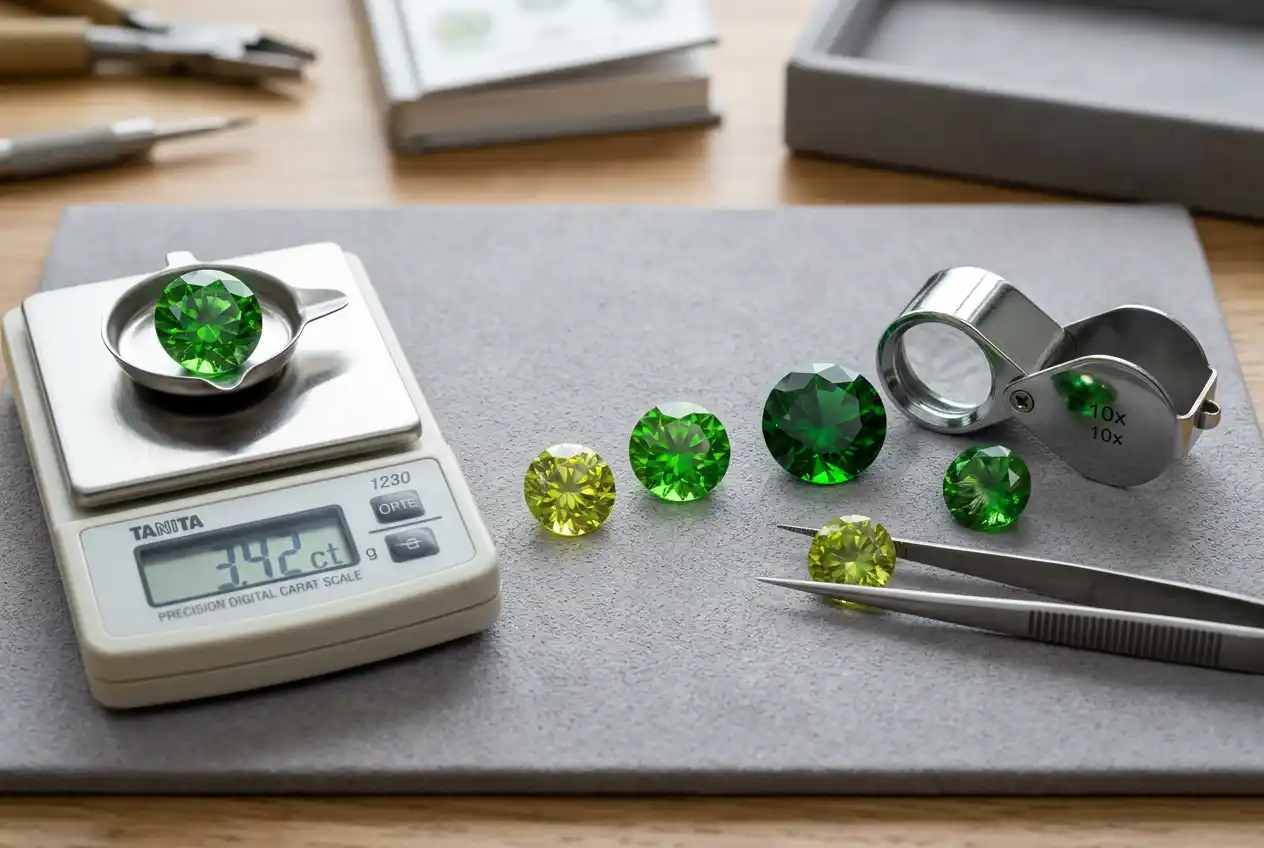
Demantoid Garnet Price Per Carat: 11 Rarity & Cost Drivers
Demantoid garnet price per carat can rise quickly because fine transparent stones with strong green color, high brilliance, and useful size are genuinely scarce. Commercial yellowish-green stones below one carat may sell for several hundred dollars per carat, while attractive vivid green gems can move into roughly $1,000 to $4,000 per carat. Fine stones around or above one carat may reach several thousand dollars per carat, and exceptional larger gems with intense green color, strong fire, high transparency, and desirable provenance can exceed $5,000 to $10,000 per carat, with particularly rare collector examples moving substantially higher.
Demantoid is the green variety of andradite garnet, with the idealized formula Ca₃Fe₂(SiO₄)₃. Chromium is an important contributor to the finest green coloration, while iron is inherent to andradite and influences the overall optical and color character. What makes demantoid especially distinctive is its combination of rich green color and unusually high dispersion. Its dispersion is greater than diamond’s, so a well-cut stone can show vivid spectral flashes, often called fire, through the green body color.
The market becomes more complicated because color, fire, clarity, inclusions, origin, and size do not always move in the same direction. Deep green can command a strong premium, yet excessive darkness may hide dispersion. A characteristic horsetail inclusion may increase collector interest in a Russian stone even though inclusions usually reduce transparency. A large gem can be much more valuable than a smaller one, but only when its color and cut remain strong. These competing factors explain why simple carat-weight pricing cannot describe demantoid accurately.
11 Rarity and Cost Drivers Behind Demantoid Garnet Price Per Carat
- Strength and attractiveness of green color
- Tone and balance between richness and brightness
- Dispersion and visible spectral fire
- Clarity and transparency
- Horsetail and other characteristic inclusions
- Cut quality and optical performance
- Carat weight and scarcity of larger stones
- Geographic origin and documented provenance
- Treatment status
- Natural identity and species confirmation
- Craftsmanship, certification, condition, and collector demand
These eleven factors work together rather than functioning as isolated price switches. A 0.80-carat stone with vivid green color, excellent brilliance, and strong dispersion can be worth more per carat than a heavier gem with muddy yellow-green color and extensive extinction. At the highest end of the market, size, color, provenance, and beauty need to occur together.
Typical Demantoid Garnet Price Per Carat
Demantoid does not have a single standardized international price schedule, and individual stones vary too much for one figure to apply reliably. Broad ranges can still help buyers understand where commercial, fine, and collector-level material usually differ.
| Demantoid Quality | Approximate Price Per Carat | Typical Characteristics |
|---|---|---|
| Commercial quality | $300 to $1,000 | Yellowish green, smaller size, visible inclusions, ordinary cutting |
| Good jewelry quality | $800 to $2,500 | Attractive green, good brilliance, reasonable clarity |
| Fine quality | $2,000 to $5,000 | Rich green, strong dispersion, good transparency, fine cut |
| Fine larger stones | $4,000 to $10,000+ | Rare size, vivid color, strong fire, good clarity |
| Exceptional collector demantoid | Highly variable, sometimes well above $10,000 per carat | Important size, Russian provenance, exceptional color, distinctive inclusions or historical significance |
These figures are best treated as broad orientation rather than a fixed tariff. A documented Russian stone with fine color and desirable horsetail inclusions can attract a collector premium, while a precision-cut stone from another source may command a premium for optical performance rather than provenance.
Vivid Green Color Is the Foundation of Demantoid Value
The most important visible quality in demantoid is green color. Stones can range from yellowish green and olive through lively medium green to richer, deeper green. The market generally rewards stones whose green is strong enough to look distinctly saturated without becoming so dark that brilliance and dispersion disappear.
Yellow is common in demantoid because andradite contains iron, and a slight yellow component does not automatically make the stone low quality. In fact, somewhat lighter yellow-green stones can show spectacular fire because more white light returns through the crown and separates into spectral colors.
Deep green gems may command a premium because strong chromium-related color is highly desirable, but the darkest stone is not always the finest. If tone becomes too deep, large areas can appear black or closed under ordinary indoor lighting. A somewhat lighter stone with brighter scintillation may be more attractive and can display the optical character that gives demantoid its name, derived historically from its diamond-like brilliance.
Color therefore needs to be judged under realistic lighting and through normal movement rather than from one highly illuminated photograph.
Tone Controls the Balance Between Richness and Fire
Tone describes how light or dark the stone appears. In demantoid, tone is especially important because the gem’s dispersion competes visually with its body color.
A moderately light green stone can reveal flashes of red, orange, yellow, and blue more easily because the body color does not absorb as much of the returning light. A darker green stone may look more luxurious in color but show less visible fire.
This trade-off means there is no single ideal tone for every buyer. Collectors who prioritize rich chromium green may prefer deeper stones, while buyers attracted to demantoid’s famous dispersion may choose a somewhat lighter gem.
Cut depth also changes apparent tone. A stone cut too deeply can look darker than the rough truly warrants, while a shallow cut can reduce saturation and create windowing.
Fine demantoid therefore needs a balanced interaction among body color, depth, cut, and light return. The highest-value stone is usually the one that looks both richly green and visibly alive.
Demantoid’s Dispersion Is One of Its Most Valuable Optical Features
Demantoid has very high dispersion, exceeding that of diamond. Dispersion separates white light into its component spectral colors, creating flashes that can appear red, orange, yellow, green, blue, or violet depending on the facet geometry and lighting.
The effect is easiest to see in stones that are not excessively dark and are cut with strong light return. Small point-like light sources can reveal the fire particularly well.
Dispersion should not be confused with pleochroism or color change. Garnet is singly refractive, and demantoid’s spectral flashes result from wavelength separation rather than directional body-color differences or changes between light sources.
Fine cutting can make the dispersion dramatically visible, while poor proportions can suppress it. A shallow window leaks light through the pavilion, and excessive extinction prevents sufficient light from returning to the observer.
The Price can therefore reflect both the inherent optical property of the gem and the cutter’s ability to reveal it.
Clarity Matters, but Demantoid Has an Unusual Inclusion Exception
Transparent demantoid can contain crystals, needles, veils, fractures, and other inclusions. Ordinarily, inclusions that reduce transparency or interrupt brilliance lower the value of a faceted gemstone.
Demantoid is unusual because certain inclusions can add collector interest. The most famous are horsetail inclusions, usually seen as curved, radiating fibrous bundles associated historically with classic Russian demantoid.
A well-positioned horsetail can enhance desirability when it is recognizable but does not overwhelm transparency. Collectors may actively seek stones that display this feature under magnification.
That does not mean every included demantoid is more valuable. Random fractures, opaque crystals, clouds, or heavy inclusions that interfere with brilliance still reduce quality. The premium applies to distinctive and attractive inclusion scenes that support provenance or collector interest.
The effect also depends on the entire stone. A vivid green gem with a graceful horsetail may be highly desirable, while a pale heavily included stone does not become valuable simply because fibrous inclusions are present.
Horsetail Inclusions Can Add Collector Value Without Guaranteeing Origin
Classic horsetail inclusions are strongly associated with Russian demantoid and have become one of the gem’s most famous identifying features. They typically appear as radiating or curved fibrous structures around a central crystal or point.
Historically, these inclusion scenes became closely linked with deposits in the Ural region. Their presence can therefore support a Russian-origin interpretation when combined with other gemological evidence and provenance.
They should not be treated as an absolute proof of geographic origin on their own. Similar fibrous inclusion structures have been reported from other sources, and origin determination should rely on a broader set of observations when a substantial premium is involved.
A well-developed horsetail can nevertheless add collector appeal because it combines visual beauty, gemological interest, and historical association. In some stones, buyers willingly accept lower conventional clarity in exchange for this distinctive natural feature.
Cut Quality Has a Major Effect on Brilliance and Color
Demantoid is usually faceted to emphasize brilliance and dispersion. Round and oval cuts are common because they can provide strong light return, while cushions and other shapes can also perform well when proportions are carefully chosen.
The cutter faces a difficult balance between preserving rare weight and improving optical performance. Rough can be small, irregular, included, or fractured, so the ideal symmetrical cut is not always economically practical.
Windowing is particularly damaging because it creates a transparent central area that weakens both color and fire. Excessive pavilion depth creates a different problem by adding hidden weight and darkening the face.
Polish also matters. Demantoid has high luster, and fine polishing allows that luster to contribute fully to brilliance. Scratches or abraded facet edges reduce the crispness expected from a fine stone.
A precision-cut demantoid may therefore command a premium even when it weighs slightly less than a deeper commercial stone cut from similar rough.
Carat Weight Creates a Strong Scarcity Premium
Large demantoid is genuinely scarce. Many faceted stones are under one carat, and high-quality gems above one carat become much more difficult to obtain.
The scarcity rises further beyond roughly two or three carats, particularly when strong green color, transparency, and good cutting are all preserved. Large rough often contains fractures or inclusions that reduce the final usable yield.
This produces a nonlinear Price structure. A two-carat fine demantoid can be worth far more than twice the total value of a comparable half-carat stone because finding another gem with similar size and quality is much harder.
Weight should still be considered alongside face-up dimensions. A deep two-carat gem may look smaller than a better-proportioned 1.6-carat stone, so visual spread matters for jewelry.
At the collector end of the market, large size becomes especially important when accompanied by Russian provenance or exceptional color.
Russian Demantoid Carries Strong Historical Prestige
Demantoid was historically discovered and mined in Russia’s Ural region, and classic Russian material developed an enduring reputation for vivid green color, strong dispersion, and characteristic horsetail inclusions.
Because of this history, well-documented Russian stones can command significant premiums, especially when they combine fine color, desirable inclusions, substantial size, and old provenance.
Other important sources include Namibia, Madagascar, Iran, Italy, and additional localities. Some non-Russian stones can show excellent green color and transparency and may outperform ordinary Russian stones visually.
Origin therefore should not replace quality. A dull Russian demantoid is not automatically better than a vivid well-cut Namibian or Madagascan gem.
The strongest origin premiums apply when the provenance itself is meaningful and credible rather than based on seller assumption.
Treatment Status Can Affect Collector Value
Demantoid is often valued for natural color, but low-temperature heating has been reported in some Russian stones to reduce brownish or yellow-brown components and improve the apparent green.
Such treatment can be difficult to detect in certain cases, which makes confident treatment statements challenging without appropriate gemological evidence.
Heating does not change the stone into another species. It remains demantoid garnet, but treatment history can matter to collectors who place a premium on completely natural appearance.
The overall market is much less treatment-driven than the sapphire market, yet buyers should not assume that every demantoid is automatically untreated simply because treatments are less widely discussed.
For expensive collector stones, a reputable laboratory report can provide valuable information about identity and, where possible, treatment and origin.
Natural Identity Needs to Be Confirmed Before Paying Demantoid Prices
Demantoid is andradite garnet, not simply any green garnet. Other garnets, including grossular varieties such as tsavorite, can also be vivid green but differ in chemistry, optical properties, inclusions, dispersion, and market value.
Tsavorite is calcium aluminum grossular, while demantoid is calcium iron andradite. Both can be beautiful and expensive, but they belong to different garnet species and should not be marketed interchangeably.
Green glass, synthetic products, and other gemstones can also resemble demantoid in photographs. Refractive index, optical character, spectroscopy, inclusions, and other standard gemological observations help confirm identity.
The combination of high dispersion and green color can be suggestive, but proper identification should precede a substantial purchase.
Demantoid Versus Tsavorite Garnet Value
Demantoid and tsavorite are both important green garnets, but their appeal is different. Tsavorite is prized primarily for rich green color and excellent transparency, while demantoid combines green body color with extraordinary dispersion.
Tsavorite can occur in larger stones, although large fine examples are also rare. Demantoid’s scarcity becomes especially severe at relatively modest carat weights.
Fine demantoid may show more visible spectral fire, while fine tsavorite often delivers a cleaner, more saturated green appearance with less yellow.
Neither is automatically superior. The choice depends on whether the buyer prioritizes color purity, dispersion, provenance, inclusions, or rarity at a specific size.
How to Compare Two Demantoids Before Buying
Begin under neutral daylight-equivalent lighting and compare the overall green without looking at the carat labels. Determine whether one stone appears too yellow, too brown, too dark, or significantly brighter than the other.
Next move both gems under a point-source light and observe dispersion. A well-cut demantoid should show lively spectral flashes without losing its basic green identity.
Then inspect inclusions. Distinguish a graceful horsetail from random fractures or opaque inclusions, and consider whether the feature enhances collector interest or simply reduces transparency.
Finally compare dimensions, weight, provenance, treatment documentation, and condition. This sequence prevents rarity labels from overshadowing the actual visible gemstone.
Demantoid Durability and Long-Term Jewelry Value
Demantoid generally falls around 6.5 to 7 on the Mohs scale. This makes it suitable for jewelry, but it is more vulnerable to scratching than sapphire, spinel, or diamond.
Rings can be worn successfully when the setting protects the stone and the wearer avoids hard impacts. Pendants and earrings provide lower-risk options for especially rare stones.
Fractures deserve attention because inclusions can affect toughness. A beautiful horsetail itself is not necessarily a structural problem, but surface-reaching fractures or chips around the girdle can increase vulnerability.
Gentle cleaning with lukewarm water, mild soap, and a soft brush is generally appropriate for intact stones. Ultrasonic or steam cleaning should be approached cautiously when significant fractures or treatment uncertainty are present.
Separate storage prevents harder gemstones from scratching the polished facets and helps preserve the brilliance that contributes so strongly to demantoid’s value.
Conclusion
Demantoid garnet price per carat is driven by vivid green color, balanced tone, visible dispersion, clarity, characteristic inclusions, cutting, carat weight, provenance, treatment, identity, and collector demand. Commercial yellowish-green stones may remain comparatively accessible, while fine one-carat and larger gems can reach several thousand dollars per carat because top-quality rough becomes increasingly scarce.
The finest demantoid is not necessarily the darkest or cleanest stone. A slightly lighter green gem may display stronger fire, while a beautiful horsetail inclusion can add collector value rather than simply reducing clarity. Buyers who consider color, dispersion, size, inclusions, cut, and provenance together are better equipped to understand why seemingly similar green garnets can carry dramatically different Prices.
FAQs About Demantoid Garnet Price Per Carat
How much does demantoid garnet cost per carat?
Commercial stones may begin around several hundred dollars per carat, while good jewelry-quality gems can move into roughly $800 to $2,500 per carat. Fine stones can reach several thousand dollars per carat, and exceptional larger examples may exceed $5,000 to $10,000 per carat.
Why is demantoid garnet expensive?
Fine demantoid is scarce, particularly in larger sizes. Strong green color, high dispersion, good transparency, difficult cutting yield, and collector demand for Russian stones and characteristic inclusions all contribute to value.
What color demantoid is most valuable?
Vivid green with strong saturation is generally preferred, especially when the stone remains bright enough to show dispersion. Excessively dark stones can lose brilliance and fire.
Does demantoid have more fire than diamond?
Demantoid has higher dispersion than diamond, so it can produce very strong spectral flashes. The appearance still depends on color, cut, lighting, and transparency.
Are horsetail inclusions valuable?
They can be. Well-developed horsetail inclusions are especially associated with classic Russian demantoid and can add collector interest when they are attractive and do not overwhelm transparency.
Does a horsetail prove Russian origin?
Not by itself. Horsetail inclusions are historically associated with Russian stones, but similar fibrous inclusion scenes have been reported elsewhere. Reliable origin assessment should use additional evidence.
Is Russian demantoid more valuable?
Fine documented Russian demantoid can command a strong premium because of historical prestige, classic locality, and collector demand. Visible quality still matters, so origin alone does not determine value.
Is demantoid rarer above one carat?
Yes. Fine stones become noticeably scarcer as size increases, and high-quality gems above two or three carats are particularly difficult to obtain.
Is lighter demantoid less valuable?
Not always. Lighter stones may show exceptional dispersion because less body color masks the spectral flashes. The best balance depends on green saturation, brightness, and fire.
Is demantoid treated?
Some demantoid, particularly certain Russian material, may be heated to improve color. Treatment should be disclosed when known, especially for high-value collector stones.
Is demantoid the same as tsavorite?
No. Demantoid is green andradite garnet, while tsavorite is green grossular garnet. They have different chemistry, optical properties, inclusions, and rarity profiles.
Does clarity strongly affect demantoid Price?
Yes, but clarity needs nuance. Random fractures or heavy clouds generally lower value, while a characteristic attractive horsetail inclusion may increase collector interest.
Does precision cutting increase demantoid value?
Yes. Good proportions reveal brilliance and dispersion while preserving strong green color. Poor cutting can create windowing, extinction, or unnecessary hidden weight.
Is demantoid suitable for an engagement ring?
It can be used in rings, but its hardness around 6.5 to 7 requires more care than sapphire or diamond. Protective settings and avoidance of hard impacts are sensible.
Is demantoid a good investment gemstone?
Exceptional demantoid has strong collector appeal, particularly in larger sizes with excellent color and provenance, but no gemstone guarantees financial appreciation. Purchase Price, rarity, condition, documentation, and resale liquidity all matter.
What makes demantoid collector quality?
Collector-quality stones combine strong green color, visible fire, significant natural size, attractive clarity or characteristic inclusions, fine cutting, good condition, and trustworthy provenance.