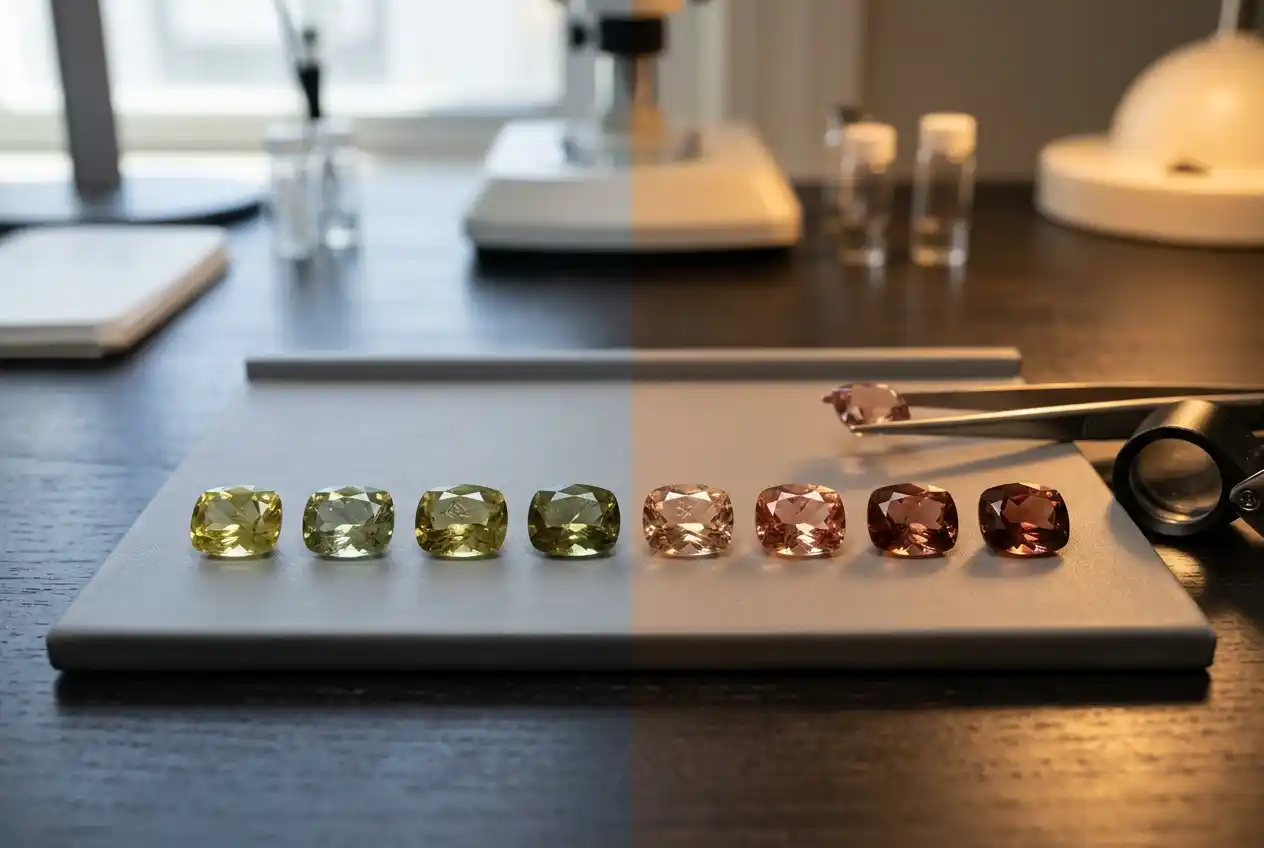
Diaspore Quality Grading: 8 Key Standards for Rare Crystals
Diaspore quality grading should focus on the complete optical performance of the gemstone rather than simply asking whether it changes color. Fine stones combine an obvious and attractive difference between cooler and warmer illumination with strong transparency, useful pleochroism, balanced tone, good face-up brightness, accurate cutting orientation, and enough structural integrity to survive setting and wear. Larger stones become increasingly important only when those characteristics remain strong.
Diaspore is an orthorhombic aluminum oxide hydroxide with the formula AlO(OH). Its hardness is approximately 6.5 to 7 on the Mohs scale, but the mineral’s pronounced cleavage and brittle behavior require more careful handling than that hardness number might suggest. Gem-quality transparent crystals suitable for faceting are much less common than ordinary mineral diaspore, which is why good color-change material occupies a specialized collector and jewelry market.
No universally enforced AAA or similar grading scale governs diaspore. Commercial descriptions such as premium, collector, Zultanite, Csarite, Turkish color change, or investment grade can communicate marketing position without defining color-change strength, clarity, cutting, or condition precisely. A useful grade therefore needs to describe what the gemstone actually does under controlled viewing conditions.
8 Key Standards for Diaspore Quality Grading
- Confirm natural diaspore identity
- Grade the strength of the light-source color change
- Evaluate the color under daylight-equivalent illumination
- Evaluate the color under warm illumination
- Assess pleochroism and cutting orientation
- Grade clarity, transparency, and structural integrity
- Judge cut quality, proportions, and carat-weight efficiency
- Evaluate provenance, treatment status, trade naming, and condition
These eight standards prevent the grading process from becoming a simple search for the largest or most dramatically marketed stone. Fine quality depends on how well the gem performs in multiple lights, how effectively the cutter has oriented the crystal, and whether the finished stone remains both beautiful and structurally sound.
Confirm Natural Diaspore Identity Before Grading Color Change
Diaspore should first be identified as an aluminum oxide hydroxide mineral rather than assumed from color change alone. Other gemstones can change color under different illumination, while glass and manufactured products can be designed to imitate dramatic optical shifts.
Standard gemological testing can consider refractive properties, birefringence, specific gravity, optical character, spectroscopy, inclusions, and other diagnostic observations. Because diaspore is orthorhombic and strongly anisotropic, its optical behavior differs from singly refractive gemstones.
Natural versus synthetic or imitation identity becomes particularly important when a large stone carries a substantial Price. A dramatic photograph cannot establish mineral identity or geological origin by itself.
The first quality grade should therefore describe confirmed identity, with color, clarity, and cutting assessed only after the gemstone category is secure.
Color Change Must Be Judged Under Controlled Light Sources
The defining quality of gem diaspore is its response to different illumination spectra. Under daylight-like light, the gemstone can appear yellow-green, olive, greenish yellow, or related cool-toned shades. Under warmer incandescent-style illumination, it may shift toward champagne, peach, pinkish, reddish-brown, purplish, or cinnamon colors.
A strong color change should be obvious enough that the stone presents a distinctly different visual identity when the light source changes. The grader should avoid relying on vague impressions created by moving between rooms with unknown LED spectra.
The most useful approach compares a cool daylight-equivalent source with a controlled warm source. Both lights should be strong enough for the gemstone to remain bright, but neither should be so intense that saturation becomes exaggerated unnaturally.
The grade should describe the two appearances rather than reducing them to a single percentage. A stone with a moderate but beautiful change can be finer than a stone with a larger numerical shift between two unattractive colors.
The Cool-Light Color Needs Its Own Quality Grade
Diaspore is sometimes marketed almost entirely through its transformation, but the daylight state deserves independent evaluation. Buyers will often see the gemstone for long periods under cool or mixed illumination, so this appearance cannot be treated merely as a starting point.
Fine cool-light color should possess enough saturation to remain distinct while avoiding excessive gray or muddy brown. Yellowish green and olive can both be attractive when the stone remains transparent and bright.
Tone should also be appropriate for size. Large deep stones can become darker because light travels farther through the crystal, while small stones may appear comparatively pale.
A clean green or greenish-yellow appearance with strong brightness generally creates a stronger quality impression than a dull olive-brown stone, even when both later change under warm light.
Color uniformity across the crown also matters. Faceting can create deliberate reflections of different pleochroic directions, but large dead patches or black extinction should not be mistaken for desirable color depth.
The Warm-Light Appearance Must Be Attractive Rather Than Merely Different
The second half of quality grading examines the gem under warmer illumination. Fine stones may develop champagne, peach, pinkish, cinnamon, reddish-brown, or purplish tones that contrast beautifully with the cooler daylight appearance.
A strong change into dull brown does not automatically produce top quality. The warm color needs enough saturation and brightness to remain appealing.
The best stones preserve transparency while creating an obvious shift. Facet reflections should still look lively rather than becoming uniformly dark.
Grading both light states independently also prevents exaggeration. A seller can truthfully say that a gemstone changes dramatically even when one of the two appearances is commercially weak. Quality grading needs to record not only the magnitude of the transformation but the attractiveness of both endpoints.
Pleochroism Must Be Separated From Light-Source Color Change
Diaspore can display strong pleochroism because different crystallographic directions absorb light differently. This means the stone can show different colors when rotated under a single fixed light source.
That phenomenon is not the same as color change. Color change occurs because the spectral distribution of the illumination changes, while pleochroism occurs because the viewing direction through the crystal changes.
In a faceted diaspore, both effects can appear at once. Individual facets may return different pleochroic colors while the entire stone also shifts when moved from cool to warm light.
A fine cut uses this behavior intentionally. Greenish, yellowish, champagne, or warm components should interact attractively rather than producing a muddled face.
Poor orientation can cause an unattractive brown direction to dominate, reducing apparent quality even if the rough contained stronger color-change potential.
Clarity Should Support Both Transparency and Color Change
Fine color-change diaspore should generally be transparent enough for light to move through the gem and return from the pavilion facets effectively.
Natural inclusions may include crystals, veils, fractures, and growth features. Small inclusions visible only under magnification can be acceptable, particularly in larger stones where clean rough is scarcer.
Large clouds and centrally located fractures reduce brilliance and can obscure the color-change effect. Surface-reaching fractures are even more significant because they may interact with the mineral’s cleavage and increase breakage risk.
Clarity grading should therefore consider beauty and structure simultaneously. A slightly included gemstone with strong transparency and no serious fracture risk can still rank highly, while a superficially clean stone with a dangerous cleavage-related crack deserves a lower practical grade.
A Practical Diaspore Clarity Framework
| Face-Up Appearance | Practical Quality Interpretation |
|---|---|
| Eye-clean with high transparency | Fine to exceptional |
| Minor inclusions visible only under magnification | Very good |
| Small visible inclusions with limited brilliance loss | Good |
| Obvious fractures or clouds | Commercial |
| Heavy fracturing or structural weakness | Lower jewelry quality |
This framework is descriptive rather than an official international scale. It is useful because it relates clarity to the way the gemstone actually performs and wears.
Cleavage Is a Critical Quality Consideration
Diaspore’s hardness can mislead buyers into assuming that the gem will behave like quartz. Both occupy a broadly similar Mohs range, but their toughness is not equivalent.
Diaspore has pronounced cleavage, meaning the crystal can split more readily along particular structural directions. This property complicates cutting and makes finished stones vulnerable to sharp impacts.
A grader should inspect the girdle, corners, pointed ends, and any surface-reaching fractures carefully. Chips along a cleavage plane may indicate previous impact or cutting stress.
Jewelry design matters as well. A pendant or earring exposes the stone to fewer hard knocks than a ring. If a fine diaspore is intended for a ring, protective settings can help reduce direct impact on vulnerable edges.
Structural condition should therefore influence the final quality grade rather than being treated as a care issue that begins only after purchase.
Cut Orientation Determines Whether the Gem Reaches Its Potential
The cutter must decide how the crystal’s pleochroic directions, color change, cleavage, and rough shape should be balanced. This makes diaspore considerably more demanding than a gem whose main goal is simple weight retention.
A successful orientation should reveal attractive colors through the table while allowing the change under warm illumination to remain visible. If the table is placed poorly relative to the crystal axes, one less desirable direction can dominate.
Windowing is another serious weakness. A shallow pavilion creates a transparent central area and reduces saturation, which can make the change look less dramatic.
Excessively deep cutting can preserve weight but creates a smaller face-up stone and may darken the gem. Because larger diaspore commands a rarity premium, cutters may be tempted to retain unnecessary depth near an important carat threshold.
Fine grading should reward a stone that uses its weight efficiently while still protecting the crystal from cleavage-related damage.
Shape Can Affect Color, Yield, and Durability
Diaspore is often seen in elongated shapes because the rough crystal habit and cleavage can encourage cutters to preserve length. Ovals, cushions, pears, emerald-style forms, and other elongated designs may therefore occur frequently.
Shape itself does not determine quality. The important question is whether it suits the crystal and uses the optical directions successfully.
Pointed shapes require additional durability consideration because tips concentrate impact forces. A long pear or marquise-style stone may look elegant but deserves protective setting around its most vulnerable areas.
Rectangular and cushion forms can offer good color presentation when facet design is adapted to the rough. Precision-cut custom designs can command premiums because they optimize optical behavior rather than simply following a standardized template.
Carat Weight Strengthens a Fine Grade but Cannot Create One
Transparent color-change diaspore becomes increasingly rare at larger sizes, so carat weight contributes strongly to collector significance when other quality factors remain high.
A fine five-carat stone is harder to replace than a fine one-carat gem, while exceptionally large transparent examples can become major collector objects.
Size should not erase weaknesses. A large gem with weak change, obvious windowing, and poor clarity can still rank below a smaller stone with exceptional optical performance.
Face-up dimensions help reveal whether the cutter has used the rough efficiently. A deeper stone may carry a higher weight without appearing much larger.
The best overall grade therefore rewards size only after color change, clarity, cut, and structural condition have been established.
Turkish Provenance and Trade Names Need Accurate Interpretation
Turkey has the strongest commercial association with transparent color-change diaspore, particularly material from southwestern Anatolia. Fine documented Turkish origin can add collector and market interest.
Trade names including Zultanite and Csarite have been used for selected Turkish color-change diaspore. They should be understood as commercial names rather than separate mineral species.
A branded stone can receive a premium because of controlled sourcing, cutting, marketing, distribution, documentation, or presentation. That premium should be kept separate from the gemological quality grade.
Two natural diaspores can therefore have similar optical quality even when one is marketed under a trade name and the other is sold generically.
For high-value stones, reliable origin and identity documentation provide a stronger foundation than branding alone.
Treatment Status Should Be Evaluated Separately From Beauty
Color-change diaspore is generally valued for naturally occurring optical behavior, and routine widespread color treatment is not the main feature of its market.
A gemstone can still be imitated or misrepresented, so natural identity should not be assumed simply because the stone appears to change color.
Where treatment status materially affects value, laboratory examination may be appropriate. Buyers should be particularly cautious when unusually dramatic colors are combined with vague origin information and a premium Price.
A quality report should distinguish what is observed visually from what is known about treatment. This prevents an attractive appearance from being used as evidence for unsupported rarity claims.
Common Diaspore Grading Mistakes
A common mistake is judging the gemstone in only one light source. Color-change diaspore needs at least two deliberately different lighting environments before its defining feature can be evaluated properly.
Another mistake is confusing pleochroism with color change. A stone may show different facet colors when rotated in daylight even before the light source changes, and that directional behavior should be assessed separately.
Buyers also sometimes chase maximum carat weight without noticing deep pavilions, small face-up dimensions, or structural fractures. Large size adds rarity only when cutting and condition remain strong.
Trade names create another source of confusion. Zultanite or Csarite branding should not be treated as evidence that a gemstone belongs to a mineral species different from diaspore.
Finally, hardness alone should not be used to judge jewelry durability because cleavage plays a major role in how the stone responds to impact.
A Practical Overall Diaspore Quality Framework
| Quality Level | Typical Characteristics |
|---|---|
| Exceptional | Strong attractive color change, beautiful colors in both lights, high transparency, excellent orientation, significant size |
| Fine | Clear change, attractive green and warm-light colors, good clarity and cut |
| Good | Noticeable change, moderate saturation, minor inclusions or cutting compromise |
| Commercial | Weak change, pale or muddy color, visible inclusions, ordinary cut |
| Lower quality | Poor transparency, serious fractures, weak optical effect, significant damage |
This framework is descriptive rather than a formal universal grading scale. Its advantage is that every quality judgment can be explained through observable characteristics.
Diaspore Jewelry Care Should Match Its Cleavage Risk
Diaspore can be worn successfully in fine jewelry, but the owner should treat it more carefully than sapphire, spinel, or diamond.
A protective ring setting can shield vulnerable edges, while earrings and pendants naturally receive fewer direct impacts. Large stones should not be worn during heavy manual work, exercise involving equipment, or other activities where the gem may strike a hard surface.
Gentle cleaning with mild soap, lukewarm water, and a soft brush is normally the safer routine. Mechanical cleaning methods should be avoided when significant fractures are present or structural condition is uncertain.
Separate padded storage also prevents harder gemstones from scratching the surface and keeps sharp jewelry components from striking cleavage-sensitive edges.
Conclusion
Diaspore quality grading requires independent evaluation of natural identity, color-change strength, daylight color, warm-light color, pleochroism, clarity, structural integrity, cutting, size, provenance, treatment, and condition. Fine gems need to look attractive in both lighting states rather than simply changing dramatically from one mediocre color to another.
The best stones also demonstrate skillful orientation. Their pleochroic directions enrich the face-up appearance, their proportions support brightness, and their larger size does not come at the expense of transparency or durability. Evaluating those qualities directly provides a far more reliable grade than relying on a trade name, a single photograph, or carat weight alone.
FAQs About Diaspore Quality Grading
What is the most important diaspore quality factor?
The strength and attractiveness of the color change is the defining factor, but both the cool-light and warm-light colors need to be appealing. Clarity, cutting, size, and durability then refine the overall grade.
What colors should high-quality diaspore show?
Fine stones may appear yellow-green, olive, or greenish yellow under daylight-equivalent light and shift toward champagne, pinkish, peach, reddish-brown, purplish, or cinnamon colors under warmer illumination.
Is a stronger color change always better?
Not automatically. A dramatic change between two unattractive colors can be less desirable than a moderate change between two beautiful, saturated, transparent appearances.
Is pleochroism the same as color change in diaspore?
No. Pleochroism depends on viewing direction through the crystal under one light source, while color change depends on changing the spectral composition of the illumination.
Should high-quality diaspore be eye-clean?
Eye-clean transparency is highly desirable, especially in larger stones, but minor inclusions may be acceptable when they do not affect brilliance or durability.
Why is cutting orientation so important?
Orientation determines which pleochroic directions appear through the crown and can strongly influence the colors visible in each lighting environment. Poor orientation can make an otherwise promising crystal look muddy or overly brown.
Does diaspore have good durability?
Its hardness is moderate at roughly 6.5 to 7, but pronounced cleavage makes it more vulnerable to impact than hardness alone suggests. Protective jewelry settings are advisable.
Does larger diaspore receive a premium?
Yes when strong color change, transparency, cutting, and structural condition remain intact. Large facetable crystals meeting all of those standards are much scarcer than small commercial stones.
Is Zultanite an official mineral name?
No. Zultanite is a commercial trade name used for certain color-change diaspore. The mineral itself remains diaspore.
What is Csarite?
Csarite is another trade name used for selected color-change diaspore associated with Turkish material. It does not represent a different mineral species.
Is Turkish origin important?
Turkey has the strongest commercial association with fine color-change gem diaspore, so documented origin can add market and collector interest. Visible optical quality still remains essential.
Is diaspore commonly treated?
Routine color treatment is not a dominant feature of the market. Natural identity and any treatment claims should nevertheless be established accurately for valuable stones.
Why can photographs of diaspore be misleading?
Camera white balance, exposure, lighting spectrum, saturation processing, and viewing angle can exaggerate or suppress color change. Direct comparison under controlled cool and warm light is more reliable.
Does the darkest diaspore receive the highest grade?
No. Excessive darkness can reduce brilliance and obscure both pleochroism and color change. Fine stones balance saturation with transparency and light return.
How should diaspore be examined before buying?
Inspect it under controlled cool and warm light, rotate it to assess pleochroism, check face-up clarity and structural fractures, look for windowing and extinction, compare dimensions with weight, and verify origin or trade-name claims when they materially affect value.
What makes diaspore exceptional?
Exceptional diaspore combines a strong attractive color change, beautiful colors in both lighting conditions, useful pleochroism, excellent transparency, skilled orientation and cutting, significant size, strong structural condition, natural identity, and reliable provenance.