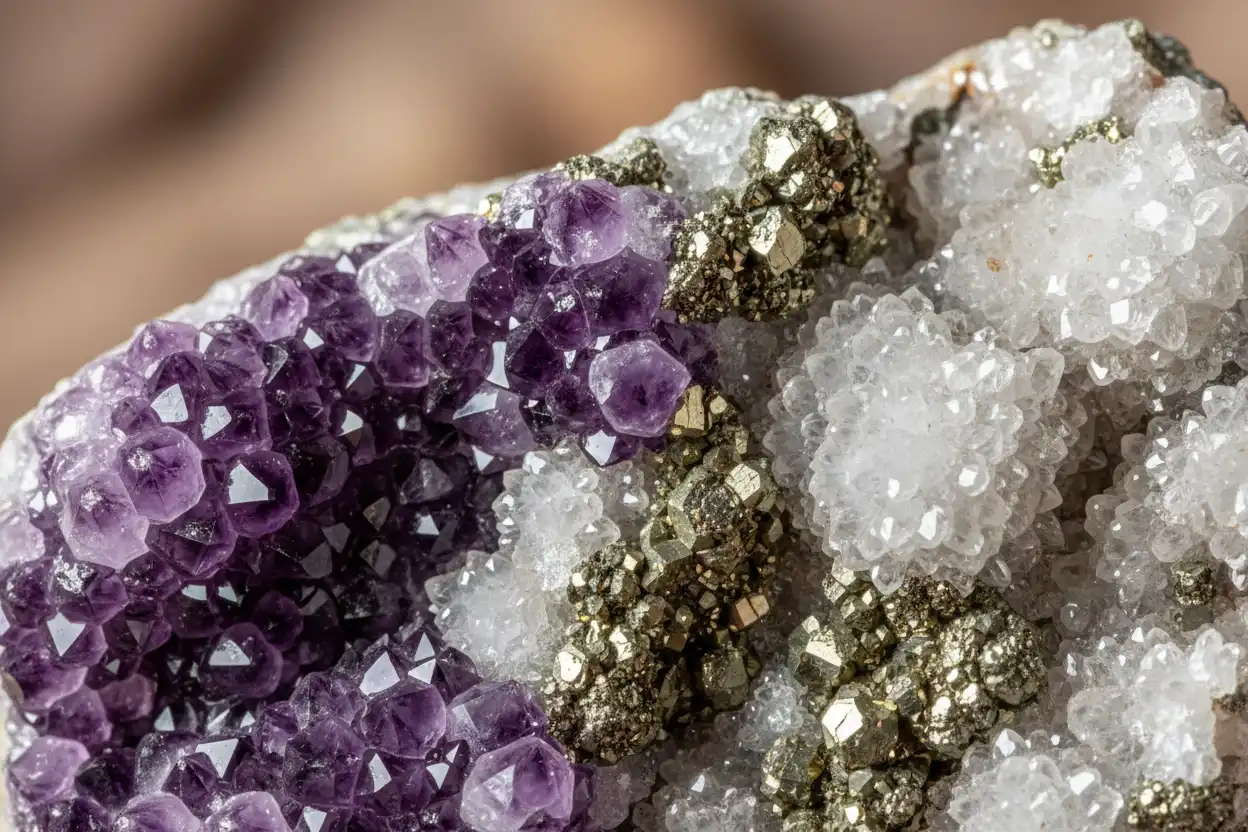
Druzy Quartz Meaning: Facts, Formation & Symbolism
Druzy quartz meaning begins with a distinction that commercial naming often hides: druzy describes a crystal texture, while quartz identifies the mineral. A druzy surface consists of numerous small crystals covering a cavity wall, fracture surface, nodule interior, or another substrate. When those crystals are quartz, the material can reasonably be called druzy quartz. The same druzy texture can also occur in other minerals, which means “druzy” by itself is not a mineral species, chemical formula, or guarantee that the sparkling surface is quartz.
That distinction explains why druzy quartz can appear in so many forms. Some specimens are geodes whose interiors are lined with hundreds of tiny quartz points. Others are slabs or cabochons cut so that a crystal-coated cavity becomes the focal surface. Natural crystals can be colorless, white, gray, smoky, iron-stained, or influenced visually by the host rock, while commercial material may additionally be dyed, coated, metallized, or otherwise altered to produce colors that would not occur naturally in that form. The sparkle itself arises because countless small crystal faces reflect light from slightly different orientations, creating a shifting field of highlights as the specimen, observer, or light source moves.
Modern druzy quartz meaning commonly includes abundance, clarity, collective strength, renewal, creativity, celebration, and the idea that many small contributions can produce a larger effect. Those themes fit the texture naturally: one microscopic-looking crystal may seem insignificant, but hundreds or thousands together create the visual character of the specimen. That metaphor can be personally meaningful, yet it remains symbolism rather than evidence that a druzy surface multiplies energy, amplifies other crystals, heals the body, or produces measurable emotional effects.
Within Gems Lore’s Gemstone Guides collection, the useful approach is therefore host first, mineral second, texture third, symbolism last. Druzy quartz meaning becomes much clearer when the reader knows what the sparkling layer actually is before interpreting what its appearance represents.
Druzy Quartz at a Glance
| Property | Practical reference |
|---|---|
| Material identity | Quartz crystals forming a druzy coating or lining |
| Main formula | SiO₂ |
| Mineral class | Oxide |
| Crystal system | Trigonal |
| Meaning of “druzy” | A surface covered with numerous small crystals |
| Is druzy a mineral species? | No |
| Typical natural colors | Colorless, white, gray, pale smoky, iron-stained yellow, orange, or brown depending on material |
| Transparency | Individual crystals may be transparent to translucent; dense coatings can appear opaque overall |
| Luster | Vitreous |
| Mohs hardness of quartz | 7 |
| Main visual effect | Sparkle from many differently oriented crystal faces |
| Common settings | Geodes, vugs, cavities, fracture surfaces, nodules, mineralized veins |
| Main identification caution | Druzy surfaces can consist of minerals other than quartz |
| Main commercial caution | Bright colors or metallic rainbow surfaces may be dyed or coated |
| Symbolic associations | Abundance, cooperation, clarity, creativity, renewal, collective strength |
| Evidence boundary | Symbolism is interpretive rather than a scientifically demonstrated healing effect |
The table highlights the most important conceptual point in druzy quartz meaning: the word “druzy” tells you how crystals occur, not which mineral they are. Identifying quartz requires evidence about the actual crystals, while identifying a druzy texture requires only the observation that many small crystals coat a surface.
Druzy Is a Texture, Not a Species
A mineral species is defined through composition and crystal structure. Quartz is a mineral species because it has the characteristic SiO₂ composition and quartz structure. Druzy is different. It describes the way many small crystals cover a surface.
That means several statements commonly seen in commercial descriptions are technically incomplete.
“Druzy is a healing crystal” treats a texture as though it were one mineral.
“Druzy has a hardness of 7” is true only when the druzy crystals themselves are quartz.
“Druzy is always natural quartz” ignores the fact that calcite, dolomite, chalcedony-associated minerals, and other species can form sparkling crystal coatings.
“Rainbow druzy is a natural quartz color” may ignore dye or surface treatment.
A more precise description begins with two questions: What mineral forms the tiny crystals, and what material forms the substrate beneath them?
For genuine druzy quartz, the first answer is quartz. The second can vary widely.
What Quartz Contributes to the Material
Quartz is crystalline silicon dioxide, SiO₂, and one of Earth’s most widespread rock-forming and vein-forming minerals. It occurs in igneous, sedimentary, metamorphic, and hydrothermal environments and can crystallize in open spaces where silica-bearing fluids have room to deposit new material.
When quartz forms a druzy surface, the individual crystals are usually small enough that hundreds can fit within a modest cavity. Each crystal still belongs to the same mineral species as a large rock-crystal point even though its size and growth environment are different.
Quartz contributes a Mohs hardness of 7, vitreous luster, characteristic crystal habit, and optical properties that make fresh druzy surfaces especially reflective.
The substrate can behave very differently.
A quartz druzy layer may sit on chalcedony, agate, another silica-rich material, carbonate rock, altered volcanic rock, or a more complex host. The durability of the entire object therefore depends on more than the hardness of the tiny quartz crystals.
How Druzy Quartz Forms
Druzy quartz commonly develops when silica-rich fluids enter an open cavity, fracture, pore system, or other available space. As the fluid becomes supersaturated with respect to quartz, silica begins to crystallize on the exposed surface.
Many nucleation points can form simultaneously.
Instead of one crystal monopolizing the cavity, numerous small quartz crystals grow outward from the substrate. If crystal growth stops before the cavity is completely filled, a sparkling layer remains exposed.
Continued mineralization can produce several generations of growth. An early chalcedony layer may coat the cavity wall, followed by crystalline quartz. Later iron oxides, calcite, or other minerals may form on top of or between the quartz crystals.
This sequence is important because a druzy specimen can preserve a miniature record of changing fluid chemistry.
The detailed geological mechanisms belong in druzy quartz formation and deposit geology. For druzy quartz meaning, the central point is that the sparkle results from repeated crystal nucleation and growth across a surface rather than from glitter embedded artificially in the rock.
Why Geodes Commonly Have Druzy Interiors
A geode provides an ideal environment for druzy growth because it contains an open cavity inside rock.
Mineral-bearing fluids can enter through microscopic fractures or porous pathways. Material begins coating the cavity wall, sometimes producing concentric chalcedony layers before larger or smaller quartz crystals grow into the remaining open space.
If mineralization continues long enough, the cavity can become partly or almost completely filled.
If growth stops earlier, a hollow center remains lined with crystal points.
This explains why cutting a geode open can reveal a brilliant quartz interior even when the exterior appears dull or ordinary. The crystals grew in protected open space rather than on the weathered outside surface.
The internal cavity geometry also influences crystal orientation. Each quartz point grows away from its nucleation surface, creating a multidirectional lining whose many faces produce the familiar sparkle.
Why Druzy Sparkles
Druzy quartz sparkle is fundamentally an optical effect created by geometry.
A polished flat quartz surface can reflect light strongly, but a druzy coating contains hundreds or thousands of small faces tilted in many directions. At any given moment, some of those faces are positioned to return light toward the observer while others remain dark.
Move the specimen slightly and a new set of crystal faces aligns with the illumination.
The result is scintillation-like sparkle across the surface.
This is not fluorescence, phosphorescence, electrical discharge, or an invisible energetic field. It is ordinary visible light reflecting and refracting at numerous crystalline interfaces.
Crystal transparency, surface cleanliness, crystal size, lighting direction, and surface coatings can all change the effect.
The detailed relationship among reflection, transparency, inclusions, color, and artificial coatings belongs in druzy quartz optical properties and color behavior.
Crystal Size Changes the Look
Not all druzy quartz has the same visual texture.
Extremely fine crystals can create a sugar-like sparkle that appears almost granular from a distance. Slightly larger crystals reveal distinct points and individual terminations. Coarser cavity linings may gradually stop looking “druzy” to some observers and instead be described simply as quartz crystal clusters.
There is no universal crystal-size threshold that transforms one category into another with mathematical precision.
The term is descriptive.
What matters is that the surface is dominated by a dense population of relatively small crystals rather than one or a few major crystals.
This flexible boundary is useful commercially, but it also explains why different sellers may use the word druzy for somewhat different textures.
Natural Druzy Quartz Color
Relatively pure quartz crystals are colorless. A dense layer of tiny transparent or translucent crystals often looks white because light scatters repeatedly from crystal boundaries, inclusions, fractures, and the substrate underneath.
Gray or smoky appearances may arise from the quartz itself, the host material, inclusions, or lighting.
Yellow, orange, reddish, or brown coloration can result from iron-bearing coatings and staining. In some specimens, iron oxides or hydroxides occupy spaces between crystals or coat crystal faces rather than being incorporated uniformly through the quartz.
That distinction matters during identification.
A golden-brown druzy surface does not automatically represent citrine. Orange coating does not automatically mean orange quartz grew with that body color. The color may belong to a later mineralization stage.
The safest first description states where the color appears.
Why Vivid Blue, Purple, Pink, and Rainbow Druzy Need Scrutiny
Commercial druzy quartz is frequently sold in extremely saturated blue, magenta, purple, turquoise, metallic gold, silver, or rainbow colors.
Some natural minerals can produce unusual hues, but intense uniform coloration across both crystals and fractures should prompt questions about treatment.
Dyeing can alter porous or fractured material.
Metallic vapor deposition or other thin-film coatings can create strong iridescent rainbow effects.
Titanium and other metal-related coatings are often marketed under names such as aura quartz.
Those products can be visually attractive, but treatment changes what the color represents.
A coated quartz specimen remains quartz underneath if the substrate and crystals are genuine quartz, yet the surface color is no longer a natural quartz growth color.
Druzy quartz meaning should not turn an artificial rainbow coating into evidence of unusual natural mineral chemistry.
Coating Versus Natural Iridescence
Thin-film interference can occur naturally in some minerals and surface alteration layers, so rainbow appearance alone does not prove artificial treatment.
The question is how the color behaves and what the surface shows under magnification.
Artificial metallic coatings often create very strong, continuous iridescence over exposed crystal faces. Color may shift dramatically with viewing angle and appear especially concentrated on surface relief.
Natural iron films, oxide coatings, interference layers, or inclusions can create subtler effects that follow geological textures differently.
No visual rule is perfect.
When treatment status materially affects value, analytical testing and reliable disclosure are stronger than assumptions based on photographs.
What Magnification Can Reveal
A druzy surface is an excellent subject for magnification because features that appear like uniform glitter to the naked eye become hundreds of separate crystals under a loupe or microscope.
The druzy quartz microscope and inclusion notebook deals with these observations in detail.
At low magnification, individual quartz terminations may become visible. Crystal sizes can be compared, broken points identified, and coatings distinguished from internal color.
Magnification can also reveal adhesive, resin, glitter, artificial backing, drill damage, polishing compound, chips, or dirt trapped among crystals.
Natural crystal surfaces usually show three-dimensional relationships that continue into protected recesses and connect coherently with the substrate. Artificial glitter or surface decoration may instead sit irregularly on top.
The microscope cannot always prove that the crystals are quartz, but it can determine whether the supposed druzy is actually crystalline.
An Original Druzy Quartz Surface Checklist
Start by examining the specimen without magnification. Record whether the sparkling area occurs inside a natural cavity, along a fracture, on a cut slab, on the surface of a cabochon, or on a manufactured backing.
Next, inspect the edge where the druzy meets the host. Genuine geological growth should show a physical transition from substrate into crystal coating. A chalcedony layer, cavity wall, vein margin, or mineralized fracture may be visible beneath the crystals.
Use magnification to determine whether the sparkle comes from identifiable crystal points or from granular glitter. Look for repeated natural terminations rather than flat metallic flakes.
Check color distribution. Does color occur inside the quartz, as a film over the surface, inside fractures, within the host, or only on exposed crystal tips? These patterns can help distinguish natural coloration from dye or coating.
Rotate the specimen under one fixed light. Natural crystal sparkle should shift among different faces. A metallic coating may add strong iridescent color changes, while artificial glitter may reflect as plate-like flashes.
Inspect protected recesses. If exposed crystal tips are bright blue while deep recesses remain white, a surface-applied treatment becomes more plausible.
Look at chipped crystals. A coated crystal can reveal a colorless or white interior beneath a colored surface.
Finally, record four separate conclusions:
Texture: Is the surface genuinely druzy?
Species: Are the tiny crystals quartz?
Color: Natural body color, mineral coating, dye, metallic treatment, or uncertain?
Substrate: What material supports the druzy?
This approach produces more information than simply deciding whether a specimen is “real.”
A Claim-Reconciliation Table
| Common claim | What can reasonably be retained | What needs correction or stronger evidence |
|---|---|---|
| “Druzy is a mineral.” | Druzy is a recognized descriptive term | It describes crystal texture, not one mineral species |
| “All druzy is quartz.” | Quartz commonly forms druzy surfaces | Other minerals can form druzy coatings |
| “Druzy quartz is SiO₂.” | Quartz crystals are SiO₂ | The entire specimen may include chalcedony, host rock, coatings, and other minerals |
| “Rainbow druzy is naturally rainbow quartz.” | Rainbow surfaces can be visually striking | Many commercial rainbow examples are coated |
| “Bright blue druzy is a natural quartz variety.” | Natural blue mineral associations exist | Uniform vivid blue commercial material may be dyed or treated |
| “More sparkle means higher purity.” | Clean crystal faces can sparkle strongly | Sparkle depends heavily on geometry, lighting, crystal size, and coatings |
| “Druzy amplifies energy because it has many crystals.” | Many-crystal imagery supports amplification symbolism | Crystal count does not establish measurable metaphysical amplification |
| “Tiny crystals are more powerful together.” | Collective strength is a coherent metaphor | No established physical healing field increases with crystal number |
| “Quartz hardness makes the whole specimen Mohs 7.” | Individual quartz crystals are hardness 7 | The host and crystal attachment can be much weaker |
| “A sparkling surface proves natural formation.” | Natural druzy can sparkle intensely | Glitter, coatings, and manufactured surfaces can imitate the effect |
| “Druzy quartz cleanses other crystals.” | Cleansing is a modern metaphysical practice | No established mineralogical mechanism demonstrates energy cleansing |
| “The crystal points release healing frequencies.” | Crystal geometry affects visible light | No validated therapeutic frequency is established through ordinary possession |
The central error is easy to see: a visible physical feature becomes evidence for an unrelated metaphysical conclusion. Many crystals really do produce more optical sparkle than one small crystal. That does not prove that they multiply healing energy.
Druzy Quartz Versus Dumortierite
Dumortierite is a distinct aluminum borosilicate mineral that can occur as blue, violet, brown, or fibrous material and may be included within quartz in certain ornamental stones.
Druzy quartz is defined primarily by a surface texture composed of small quartz crystals.
A blue dumortierite-bearing quartz and a blue-dyed druzy quartz can therefore look superficially related in commercial photographs while obtaining their blue appearance in completely different ways.
One can involve a naturally blue mineral inclusion.
The other may involve surface treatment.
Color alone cannot establish which material is present.
Druzy Quartz Versus Dravite
Dravite is a magnesium-rich tourmaline species commonly forming brown prismatic crystals. Its identity is based on tourmaline chemistry and structure rather than aggregate texture.
Druzy quartz may grow as thousands of small crystals on one substrate, while dravite commonly attracts attention as individual prismatic crystals or crystal groups.
The comparison illustrates an important mineralogical distinction: habit and species answer different questions.
Dravite is a mineral name.
Druzy is a growth-description term.
Quartz is the species name in druzy quartz.
Druzy Quartz Versus Eclogite
Eclogite is a high-pressure metamorphic rock typically characterized by a distinctive mineral assemblage rather than one mineral species.
It provides a useful contrast because both eclogite and a druzy-bearing specimen can contain multiple mineral components.
The organizing principle differs.
Eclogite is defined as a rock by its metamorphic mineralogy and formation conditions.
Druzy quartz describes quartz crystals forming a dense surface coating, regardless of whether the host beneath them is geologically simple or complex.
One term is lithological.
The other combines a mineral species with a crystal texture.
This difference matters whenever commercial stone names are being translated into mineralogical language.
Druzy Quartz Versus Dragon Blood Jasper
Dragon Blood Jasper is a trade-named red-and-green ornamental rock whose visual identity comes from contrasting mineral phases exposed by cutting and polishing.
Druzy quartz produces visual interest in a completely different way.
Its sparkle comes from exposed crystal faces rather than color patches inside a polished rock.
The contrast also demonstrates why one hardness value cannot always describe a whole decorative object. Quartz crystals may be Mohs 7, but their host can be softer. Dragon Blood Jasper can contain different mineral phases with their own hardness and cleavage characteristics.
The complete object matters more than the trade name.
Documented History of Druzy Quartz
Quartz has an extensive documented history in mineralogy, lapidary work, ornament, scientific study, and human material culture. Geodes and crystal-lined cavities have likewise fascinated collectors because an ordinary exterior can reveal a sparkling crystalline interior.
The specific modern phrase “druzy quartz” belongs more naturally to mineral collecting, lapidary, jewelry, and contemporary commercial description than to one universal ancient spiritual category.
That distinction matters.
An ancient reference to quartz does not automatically document a special belief about tiny druzy surfaces.
A historic crystal-lined vessel does not prove modern claims about energetic amplification.
The safest historical approach is to document quartz and geode use where evidence exists, then describe modern druzy quartz meaning separately rather than projecting recent terminology backward.
Why Abundance Became a Natural Symbol
Abundance is perhaps the easiest modern druzy quartz meaning to understand visually.
A small surface can hold hundreds of quartz crystals. There is no single dominant point; the effect comes from repetition.
That naturally suggests multiplicity, accumulated effort, resources, opportunity, or the idea that small contributions can become significant together.
A person might use a druzy specimen as a reminder to notice incremental progress rather than waiting for one dramatic breakthrough.
The symbolism is strengthened by the physical pattern.
It does not require the quartz to attract money, increase luck, or generate material abundance through an invisible force.
Collective Strength Without Crystal Hierarchy
Druzy quartz also supports a useful symbolism of collective strength because many small crystals share one underlying surface.
The metaphor can apply to teamwork, communities, families, distributed systems, or any process in which multiple components contribute toward one outcome.
Unlike a large solitary quartz point, a druzy surface has no obvious visual “leader.”
That difference can inspire a different kind of symbolism: importance does not need to be concentrated in one large element.
The idea remains interpretive.
The mineral does not scientifically improve teamwork or coordinate people through energy transmission.
Clarity Symbolism and a Visually Complex Surface
Quartz is commonly associated with clarity because transparent rock crystal allows light to pass through relatively clean material.
Druzy quartz complicates that symbolism in an interesting way.
A dense druzy surface may appear white or sparkling rather than transparent because numerous tiny crystal boundaries scatter light.
The mineral can therefore be transparent at the individual-crystal level while visually complex as an aggregate.
This creates a more nuanced interpretation of clarity: understanding does not always mean reducing a situation to one simple element. Sometimes clarity comes from recognizing how many smaller parts interact.
That symbolism grows from real optical complexity rather than a claimed mental-healing mechanism.
Creativity and Variation
No two natural druzy surfaces need to look identical.
Crystal size, cavity geometry, substrate color, iron staining, later minerals, fracture patterns, and growth history produce substantial variation.
That irregularity explains why modern druzy quartz meaning sometimes includes creativity or individuality.
The metaphor works best when connected with actual practice. A writer might use the specimen as a prompt to generate several smaller ideas before choosing one direction. A designer might associate the changing highlights with exploring alternatives rather than committing to the first solution.
The crystal does not cause creativity.
It provides an object around which creative behavior can be intentionally organized.
“Amplification” Needs a Scientific Boundary
Quartz is widely described in metaphysical literature as an amplifier, and druzy quartz is sometimes said to amplify even more strongly because many crystal points are present.
There is a visual analogy behind the claim.
One reflective face creates one highlight.
Thousands of small faces can create a field of highlights.
That optical multiplication is real.
It does not demonstrate multiplication of healing energy, intentions, emotions, manifestation power, chakra activity, or the properties of neighboring gemstones.
Druzy quartz meaning can use amplification symbolically—such as focusing more attention on an important goal—without presenting an unmeasured metaphysical process as physics.
Chakra Associations
Different druzy quartz colors are often assigned to different chakras in modern crystal practice.
White or clear druzy may be associated with the crown.
Purple-treated material may inherit amethyst-like symbolism.
Pink material may be assigned to the heart.
Blue examples may be associated with communication.
The problem is obvious when color has been artificially created.
A dyed blue druzy quartz has not become a different mineral species, and a metallic coating does not create a new anatomical effect.
Chakra associations can still be part of a personal spiritual framework, but they should be presented as interpretation rather than mineralogical evidence.
Quartz Chemistry Is Not Medicine
Quartz is silicon dioxide.
Silicon and oxygen are familiar chemical elements, and silicon occurs in many geological and biological contexts.
That does not make quartz a medical silicon source.
The atoms are bound within a highly stable crystalline structure, and ordinary skin contact does not deliver a controlled nutritional dose.
Likewise, a quartz druzy containing iron staining does not function as iron therapy, and a metal-coated specimen does not become a nutritional source of the coating metal.
Chemical identity explains what the specimen is.
It does not establish what the body should absorb from it.
Safe Ownership
An intact druzy quartz specimen can generally be handled normally, but the crystal-coated surface is mechanically different from a solid polished quartz object.
The individual quartz points are hard, yet many are tiny and project outward from narrow bases. They can chip, snap, or detach when rubbed against hard surfaces.
The substrate may also be softer than quartz.
A geode containing carbonate minerals, porous matrix, thin cavity walls, or repaired sections can require more care than the phrase “quartz is hardness 7” suggests.
Dust-generating cutting, grinding, drilling, or sanding should use appropriate lapidary controls because crystalline silica-bearing dust is a serious occupational hazard. Wet processing, local extraction, respiratory controls, and appropriate protective equipment matter far more than symbolic ideas about quartz purity.
The site’s Disclaimer provides the wider boundary between general mineral information and individualized medical or workplace-safety guidance.
Cleaning Requires Access Between Crystals
Druzy surfaces trap dust, fibers, skin oils, polishing compound, soap residue, and other debris more readily than smooth cabochons.
Aggressive scrubbing can break small points.
Chemical cleaning may affect host minerals, treatments, dyes, adhesives, coatings, or metal settings even when quartz itself would tolerate the substance.
This makes whole-object identification important before cleaning.
A white natural quartz druzy on stable chalcedony may tolerate different care from a dyed druzy slice, a metallic-coated surface, or a fragile geode containing calcite.
Druzy quartz meaning does not need a complete cleaning protocol, but safe ownership does require recognizing that “quartz” may describe only the crystal layer rather than everything present.
Cutting Druzy Is Usually About Preserving a Surface
Conventional faceting seeks to create new polished planes.
Druzy lapidary work often does the opposite: the natural crystal surface is the feature the cutter wants to preserve.
A slab may be shaped around a sparkling cavity.
A cabochon can combine polished margins with an untouched crystal center.
A geode half can be cut and polished on the rim while leaving its interior unchanged.
The druzy quartz cutting, orientation, and polish guide addresses how orientation, backing, crystal attachment, cavity depth, and polishing interact.
The important conceptual difference is that grinding the druzy face smooth would destroy the very texture that gives the material its name.
Jewelry Engineering Is About Protecting the Texture
Druzy quartz is widely used in pendants, earrings, rings, bracelets, and statement jewelry because a relatively small area can produce intense sparkle.
The crystal surface creates mechanical challenges.
Raised points can catch fibers.
Sharp crystals can scratch adjacent materials.
Weakly attached crystals can detach.
A thin slice can fracture around a cavity.
A setting must therefore protect the substrate without crushing the exposed druzy.
Those technical decisions belong in druzy quartz setting and wear engineering.
The symbolism of collective strength should not be mistaken for structural strength. A thousand small quartz points can be visually powerful and mechanically delicate at the same time.
Conservation Should Preserve the Crystal Surface
A natural druzy surface can preserve growth sequence, mineral coatings, crystal-size variation, later alteration, and the relationship between quartz and substrate.
Overcleaning can erase that information.
Removing iron staining may make a specimen look whiter while destroying evidence of later mineralization.
Recoating a dull crystal surface with oil or resin may improve apparent luster while permanently changing the object.
Reattaching broken druzy sections without documentation can complicate future provenance and condition assessment.
The druzy quartz specimen conservation record provides a way to document cleaning, repairs, detached crystals, coatings, labels, and changes in condition when a specimen has enough collector or scientific importance to justify systematic records.
A natural cavity does not need to look commercially perfect to be worth preserving.
Provenance Is More Than “Brazilian Druzy”
Druzy quartz occurs in many geological environments, so appearance alone rarely establishes geographic origin.
A white quartz-lined cavity can come from numerous regions.
Purple, brown, orange, or gray coloration may suggest certain geological associations but still cannot function as a unique geographic fingerprint.
Commercial cutting creates another layer of uncertainty because rough can be transported, slabbed, dyed, coated, and distributed far from where it was mined.
The druzy quartz provenance disclosure checklist provides the stronger evidence hierarchy: original labels, mine records, supplier documentation, acquisition history, host-rock context, and coherent chain of custody should support origin claims when locality adds value.
A trade-country label is not automatically a mine record.
The Strongest Evidence Begins With the Surface
Druzy quartz is particularly well suited to the evidence-first framework described on Gems Lore’s About page because the specimen exposes its growth texture directly.
A person can observe whether tiny crystals are present.
Magnification can document crystal terminations.
A chipped coated crystal can expose underlying color.
The boundary with the host can reveal whether the surface belongs naturally to the rock.
More difficult claims require more evidence.
“Quartz” may need gemological or mineralogical confirmation.
“Natural color” may require treatment assessment.
“From a specific locality” requires provenance.
“Ancient healing stone” requires historical documentation.
“Treats illness” requires medical evidence.
The sparkling appearance cannot prove all five at once.
Frequently Asked Questions About Druzy Quartz Meaning
What is druzy quartz?
Druzy quartz is a surface or cavity covered with numerous small quartz crystals. Quartz is the mineral; druzy describes the crystal-coated texture.
What does druzy quartz meaning symbolize?
Modern druzy quartz meaning commonly includes abundance, collective strength, clarity, creativity, renewal, celebration, and amplification as a metaphor. These are symbolic interpretations rather than scientifically demonstrated effects.
Is druzy a type of quartz?
Not by itself. Druzy is a descriptive growth texture that can occur in quartz or other minerals. Druzy quartz specifically refers to druzy crystals identified as quartz.
Is druzy quartz natural?
Natural druzy quartz is common, particularly in geodes, cavities, fractures, and mineralized surfaces. Commercial specimens can still be dyed, coated, backed, repaired, or otherwise modified.
Why does druzy quartz sparkle?
Hundreds or thousands of small crystal faces reflect light from different angles. As the viewing geometry changes, different faces produce bright flashes.
Is rainbow druzy quartz natural?
Some natural surface phenomena can create iridescence, but much vivid rainbow commercial druzy is artificially coated. Individual specimens should be evaluated rather than assuming every rainbow surface has the same origin.
Is blue druzy quartz natural?
Natural quartz can occur with blue-looking inclusions or associated minerals, but strongly saturated commercial blue druzy may be dyed or coated. Color distribution and treatment disclosure matter.
Is druzy quartz hardness 7?
The quartz crystals themselves are approximately Mohs 7. The host rock, crystal attachment, coatings, and other minerals in the complete object can have different durability.
Is druzy quartz the same as a geode?
No. A geode is a rock cavity lined with minerals. Many geodes contain druzy quartz, but druzy quartz can occur on other surfaces and not every geode has a fine druzy lining.
Is druzy quartz a crystal cluster?
It can be considered a dense coating or aggregate of many small crystals. The term usually emphasizes the fine, sparkling surface rather than a cluster dominated by several large points.
Does druzy quartz amplify energy?
Amplification is a modern metaphysical interpretation. Many crystals can amplify visual sparkle, but no established scientific evidence demonstrates multiplication of healing or spiritual energy.
Does druzy quartz cleanse other crystals?
There is no established mineralogical mechanism showing that druzy quartz removes invisible negative energy from another stone. Cleansing belongs to spiritual practice rather than gemological testing.
Does druzy quartz have healing properties?
There is no established scientific evidence that druzy quartz treats disease, changes mental-health conditions, alters hormones, improves circulation, or causes medical healing through ordinary handling.
How can I tell if druzy quartz is coated?
Examine color distribution under magnification, especially chipped points, recesses, crystal bases, and the transition into the substrate. Strong surface-only iridescence or color differences between exposed and broken areas can support a coating interpretation.
How should druzy quartz be handled?
Protect the exposed crystal surface from abrasion and impact, avoid assuming the substrate has quartz’s hardness, and consider possible dyes, coatings, repairs, and associated minerals before cleaning.
The Meaning Is in the Many Small Crystals
The most distinctive druzy quartz meaning comes from a feature that can be observed directly: the specimen’s visual impact does not depend on one large crystal. Hundreds or thousands of small quartz points share the surface, and each contributes only a fraction of the total sparkle.
That structure makes abundance and collective strength unusually natural symbolic themes. A single small effort may appear modest. Repetition can change the overall result. One reflective surface produces a flash; an entire druzy coating produces a field of light.
The geology also introduces an important boundary. Druzy is not a species, bright color is not automatically natural, and a hardness value for quartz does not describe every host or coating. A sparkling surface can be genuine while its blue color is dyed. A natural quartz coating can sit on a softer rock. A geode can preserve several mineralization stages rather than one simple quartz event.
Those distinctions make the symbolism more useful, not less. Druzy quartz can represent accumulated effort without promising wealth, collective strength without generating invisible power, and clarity without becoming medical treatment.
When a specimen presents a specific uncertainty—such as a suspected metallic coating, unidentified host, artificial-looking color, repaired crystal surface, or provenance claim that conflicts with the physical material—clear photographs of the whole specimen, edges, broken areas, and crystal surface can be submitted through Contact so the evidence can be evaluated at the level of the actual object.