Ethiopian Opal Price Per Carat: 11 Key Value Drivers
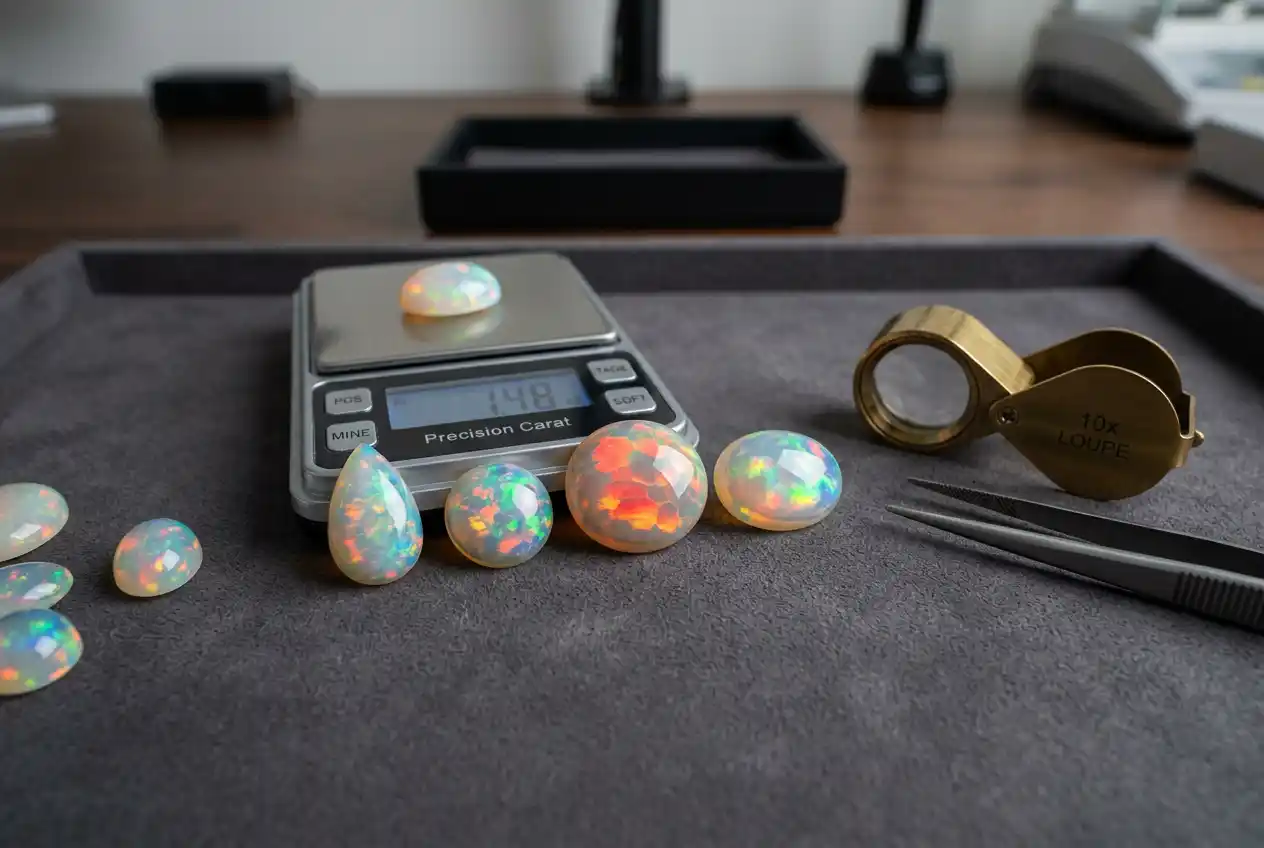
Ethiopian opal price per carat can range from roughly $10 to $30 for commercial stones with subdued play-of-color to several hundred dollars per carat for fine transparent or translucent gems displaying intense red, orange, green, and blue across much of the face. Exceptional stones with very high brightness, rare patterns, strong red or full-spectrum play-of-color, excellent stability, attractive transparency, and desirable size can move beyond ordinary ranges and occasionally exceed several hundred dollars per carat by a substantial margin. Ethiopian opal is therefore not priced simply according to weight. The Price depends much more strongly on how vividly the stone performs, how its pattern behaves as it moves, whether its body is naturally attractive, and whether treatment or hydrophane behavior affects long-term appearance.
Most internationally traded Ethiopian precious opal is strongly associated with deposits in the Welo or Wollo region. Much of this material is hydrophane opal, meaning its porous structure can absorb water. When wet, some stones become temporarily more transparent and may appear to lose or weaken their play-of-color. As they dry, their normal appearance can gradually return. This unusual behavior is an important part of identification, care, treatment detection, and valuation because the same porosity that makes hydrophane opal distinctive can also allow it to absorb dyes, smoke-related substances, oils, cosmetics, and other liquids.
The attraction of fine Ethiopian opal lies in optical performance. Some stones display tiny pinpoints of spectral color, while others produce broad flashes, rolling patterns, cellular or honeycomb structures, or complex multicolor mosaics. Bright red is particularly prized, but a stone does not become exceptional merely because a small red flash is present. The highest values generally occur when strong brightness, desirable spectral colors, broad coverage, attractive pattern, stable structure, natural appearance, and skilled cutting occur together.
11 Key Value Drivers Behind Ethiopian Opal Price Per Carat
- Brightness and intensity of the play-of-color
- Presence and strength of red, orange, green, and full-spectrum color
- Pattern rarity, organization, and movement
- Face-up play-of-color coverage
- Body transparency, translucency, and natural body appearance
- Hydrophane behavior and long-term stability
- Natural versus smoked, dyed, coated, or otherwise treated condition
- Carat weight, dimensions, and usable face-up size
- Cut quality, dome shape, polish, and symmetry
- Clarity, cracks, crazing, inclusions, and structural condition
- Ethiopian provenance, documentation, craftsmanship, and market demand
These eleven factors need to be evaluated together rather than treated as independent boxes. A smaller opal with exceptional red multicolor play, a rare honeycomb pattern, strong brightness, and almost complete face-up coverage can be worth considerably more per carat than a heavier stone whose colors appear weak, directional, or concentrated in only a small part of the surface. The same principle applies to treatment. A dark stone may look dramatic at first glance, but if its body color was created through smoking or dyeing, it belongs to a different value category from naturally colored material.
Typical Ethiopian Opal Price Per Carat
Ethiopian opal is often more affordable than exceptional Australian black opal, but the finest stones can still command substantial premiums. Because individual patterns and optical behavior vary so dramatically, the ranges below are best used as practical orientation rather than a fixed tariff.
| Ethiopian Opal Quality | Approximate The Price Per Carat | Typical Characteristics |
|---|---|---|
| Commercial quality | $10 to $30 | Weak color, limited coverage, ordinary pattern, visible imperfections |
| Good jewelry quality | $30 to $100 | Noticeable multicolor play, useful brightness, good polish |
| Fine quality | $100 to $300 | Strong brightness, red or multicolor fire, broad coverage, attractive transparency |
| Exceptional quality | $300 to $700+ | Intense spectral color, rare pattern, excellent coverage, fine condition |
| Rare collector stones | Highly variable | Exceptional honeycomb or organized pattern, intense red, important size, outstanding stability |
A loose opal should not be compared directly with a finished ring or pendant simply by dividing the jewelry’s total cost by the center stone’s carat weight. Precious metal, accent gemstones, setting labor, designer work, matching, and retailer margin may contribute substantially to the final The Price. Custom cutting can also add value because preserving a rare play-of-color pattern while producing an attractive, stable cabochon requires judgment and skill.
Brightness and Spectral Color Dominate Ethiopian Opal Value
Brightness is one of the strongest value factors because it determines how quickly the play-of-color attracts the eye. Fine Ethiopian opal should display spectral flashes clearly rather than requiring intense directional lighting or a very narrow viewing angle. A highly bright green-blue stone can therefore be more desirable than a nominally red opal whose red appears only as a faint isolated spot. Grading should compare stones under the same illumination because direct sunlight, spotlighting, diffuse daylight, and indoor LEDs can produce very different impressions of the same gem.
Red generally receives the strongest color premium because longer-wavelength red play-of-color is less commonly displayed strongly than green or blue. Orange and yellow can also be highly desirable, especially when they occur with red, while vivid green and blue remain important contributors to fine multicolor appearance. Full-spectrum stones capable of revealing red, orange, yellow, green, blue, and violet during movement can enter a much higher value category when the colors remain bright and well distributed rather than appearing as weak scattered points.
Color should also persist through movement. Some opals produce an impressive photograph because one narrow angle reveals a brilliant flash, yet ordinary wear causes the color to disappear quickly. Fine stones tend to remain active through a useful range of orientations, allowing the play-of-color to move, roll, or reorganize as the gemstone is turned. That dynamic performance is one of the main reasons two visually similar still photographs can represent stones with very different real-world values.
Pattern and Face-Up Coverage Can Create Major Premiums
Ethiopian opal is known for an extraordinary variety of patterns. Pinfire consists of numerous small points of color, while broad flash produces larger fields that can move across the gem. Rolling flash may sweep through the stone as it tilts, and cellular or honeycomb-like patterns can create repeated geometric divisions that are especially prized when each cell carries intense spectral color. Other stones display patchwork, ribbon-like, floral, mosaic, or irregular multicolor arrangements.
A rare pattern earns its strongest premium when it is clearly organized and bright. A faint honeycomb outline without strong play-of-color may be less desirable than a simpler broad-flash stone whose red and green are intense across nearly the entire face. Pattern terminology should therefore describe what the eye sees rather than act as an automatic quality grade. The same term can be applied loosely by different sellers, so the visual definition, brightness, and movement of the pattern matter more than the name.
Coverage describes how much of the visible face participates in the color display. Near-full coverage is especially desirable because the stone remains visually active rather than presenting large inactive areas. Partial dark or transparent zones are not automatically defects, since they can create artistic contrast, but inactive areas that interrupt an otherwise fine display generally reduce value. The highest grades combine pattern, brightness, color range, and coverage so that the surface feels coherent rather than fragmented.
Hydrophane Behavior Is Central to Ethiopian Opal Valuation
Many Welo opals are hydrophane, which means they contain a pore network capable of absorbing water. When a dry hydrophane opal is immersed, water can enter the structure and change the way light travels through the stone. The opal may become noticeably more transparent, and its play-of-color can weaken, disappear temporarily, or change character. Once the stone dries thoroughly, its original appearance generally returns, although drying time varies according to porosity, size, cutting, and environmental conditions.
This property should not be treated as a novelty requiring repeated home testing. Deliberately soaking valuable opal can complicate evaluation and expose the gemstone to unnecessary contamination. Hydrophane opal can absorb oils, perfumes, cosmetics, dyes, and other substances more persistently than clean water, potentially changing body color or transparency. A buyer should therefore evaluate a stone in a stable dry condition and ask whether it has been recently wet, oiled, smoked, dyed, or exposed to other treatments that could influence appearance.
Hydrophane behavior does not automatically make Ethiopian opal lower quality. Many spectacular and durable gemstones are hydrophane. The important valuation question is whether the stone remains stable in normal dry wear, whether its porosity has been exploited for treatment, and whether the owner understands appropriate care.
Treatment Can Change Apparent Value Dramatically
The porosity of hydrophane opal makes treatment especially relevant. Smoking can introduce dark substances into the pore structure, creating a gray, brown, or blackened body that increases contrast and can make play-of-color appear more dramatic. Dyeing can produce other colors, while coatings or impregnation may alter surface appearance or durability. Such stones can still be attractive jewelry products, but their dark or unusual body color should not receive the same rarity premium as an equivalent natural appearance.
A very dark Ethiopian opal offered at a surprisingly low The Price deserves careful examination because naturally dark body color and treatment-induced darkening occupy different market categories. Magnification, spectroscopy, microscopic observation, and other gemological methods may be needed when the treatment is not obvious. The simple fact that a stone comes from Ethiopia does not reveal whether its current appearance is natural.
Treatment disclosure also protects realistic price comparison. A smoked hydrophane opal should be compared with other treated stones rather than with naturally dark premium opal from a different geological source. Accurate terminology helps buyers appreciate an attractive treated gem without paying a premium based on a rarity it does not possess.
Transparency, Body Appearance, and Cut Need to Work Together
Ethiopian opal occurs across a range from translucent milky stones to crystal-like transparent opal. Greater transparency can create an impression of depth because play-of-color appears to float within the gemstone rather than sitting only at the surface. Crystal and semi-crystal appearances can therefore be highly desirable when spectral color remains bright and evenly distributed.
A transparent stone is not automatically superior. If the body becomes too clear and the play-of-color is weak, the gem can look watery. Conversely, a milky body can provide excellent contrast and produce a powerful display when color patches are bright. Quality comes from the relationship between the background body and the spectral pattern rather than from a requirement that every opal be as transparent as possible.
Cutting affects this relationship substantially. Ethiopian opal is commonly fashioned as a cabochon because a curved polished surface can reveal color movement effectively while preserving weight. The dome should be appropriate to the rough, and the base should be stable enough for setting. An unnecessarily thick base can add hidden carat weight without increasing visible size, while an excessively thin edge may become vulnerable. Fine polishing is particularly important because scratches and pits scatter light and weaken the clarity of the color display.
Carat Weight Matters Only When Fine Quality Survives at Larger Sizes
Ethiopian opal can occur in sizable nodules, so weight alone does not produce the same scarcity premium seen in fine ruby or alexandrite. Large commercial stones with modest color can remain relatively affordable. The market becomes much more selective when larger size is combined with very strong brightness, red or full-spectrum color, rare pattern, high coverage, good stability, and attractive cutting.
A ten-carat exceptional opal with intense play-of-color across most of its surface belongs to a different rarity category from a ten-carat pale stone whose color appears only at one edge. This means The Price per carat can rise with size in high-quality stones while remaining comparatively flat in lower-quality material.
Face-up dimensions deserve as much attention as carat weight because cabochons can vary greatly in thickness. A broad eight-carat stone may appear much larger than a deep twelve-carat cabochon while providing more visible color. Buyers should therefore compare length, width, dome height, base thickness, and active color area alongside total weight.
Cracks, Crazing, and Structural Stability Can Override Beautiful Color
Opal is hydrated amorphous silica rather than a crystalline gemstone, and its hardness is generally around 5.5 to 6.5 on the Mohs scale. Existing cracks, crazing, chips, and surface-reaching fissures can reduce both durability and value, particularly when they pass through the most active color area.
Crazing refers to a network of cracks caused by internal stress and can seriously compromise a stone. A spectacular color pattern cannot fully compensate for progressive structural deterioration. Stable stones that have remained intact through normal dry conditions are much more suitable for jewelry and long-term collecting than gems showing active cracking.
Hydrophane character should not be confused with crazing. Water absorption is a porosity behavior, while crazing involves physical cracking. A dry hydrophane opal can be completely stable, just as a non-hydrophane opal can contain fractures. The quality assessment should therefore examine the actual stone rather than treating its Ethiopian origin or hydrophane behavior as an automatic durability judgment.
Ethiopian Provenance and Market Position
Ethiopia has become one of the world’s major commercial sources of precious opal, with Welo material particularly important in modern jewelry. Its combination of strong play-of-color, varied patterns, sizeable rough, and hydrophane behavior gives it a recognizable place in the market.
Earlier Ethiopian deposits, including material associated with Shewa, can display different physical characteristics and appearance from much Welo production. Provenance can therefore be interesting to collectors, although ordinary jewelry valuation still depends primarily on brightness, pattern, color range, stability, treatment, and cutting.
Fine documented provenance becomes more significant for exceptional specimens, rare patterns, unusual natural body colors, or historically important production. For everyday purchases, accurate description of hydrophane behavior and treatment status is often more valuable than a vague locality claim.
Caring for Ethiopian Hydrophane Opal
Hydrophane opal deserves careful protection from substances it can absorb. Perfume, hand lotion, hair products, oils, colored liquids, and household chemicals should not be allowed to soak into the gemstone. Jewelry is best put on after cosmetics have dried, and rings should be removed before cleaning, swimming, washing dishes, or working with oils and chemicals.
Gentle surface cleaning with a slightly damp soft cloth is usually preferable to prolonged soaking. Steam and ultrasonic cleaning should be avoided because heat, vibration, existing fractures, and treatment uncertainty can create unnecessary risk. If a hydrophane opal accidentally becomes wet and changes appearance, it should be allowed to dry naturally rather than being exposed to intense heat in an attempt to accelerate the process.
Separate padded storage protects the relatively soft surface from harder gemstones. These precautions are especially important for fine opal because scratches, contamination, and cracking can alter precisely the optical qualities that create most of its value.
Conclusion
Ethiopian opal price per carat is driven by brightness, spectral color, pattern, coverage, transparency, hydrophane behavior, treatment, size, cutting, stability, provenance, and overall market demand. Commercial stones can remain inexpensive, while vivid multicolor gems with strong red, rare organized patterns, wide coverage, excellent polish, and stable untreated appearance can command several hundred dollars per carat or more.
The best valuation begins with the dry stone itself rather than carat weight or a dramatic photograph. Fine Ethiopian opal should remain visually active through normal movement, display attractive colors over a useful portion of the face, show a stable structure, and have clearly disclosed treatment status. When those qualities occur together in a large hydrophane opal with exceptional pattern and brilliance, the gemstone can move into a distinctly higher collector category.
FAQs About Ethiopian Opal Price Per Carat
How much does Ethiopian opal cost per carat?
Commercial Ethiopian opal may sell for roughly $10 to $30 per carat, while good jewelry-quality stones can reach approximately $30 to $100 per carat. Fine gems with bright red or multicolor play, strong coverage, and attractive pattern can move into roughly $100 to $300 per carat, while exceptional collector stones may rise substantially higher depending on size, pattern, stability, and treatment status.
Why is some Ethiopian opal much more expensive than other stones?
The strongest premiums occur when intense brightness, rare spectral colors, attractive pattern, broad face-up coverage, fine polish, substantial size, and structural stability occur together. A large weak-color stone can remain inexpensive, while a smaller opal with brilliant red honeycomb or broad multicolor flash may command a much stronger The Price per carat.
What is hydrophane Ethiopian opal?
Hydrophane opal has a porous structure capable of absorbing water. When wet, it may become more transparent and temporarily lose or alter its play-of-color, then gradually return toward its normal appearance after drying. This behavior is common in Welo opal and influences care, treatment detection, and valuation.
Does hydrophane opal mean the stone is low quality?
No. Hydrophane behavior is a physical characteristic rather than a quality grade. Some exceptional Ethiopian opals are hydrophane, and their value depends on brightness, pattern, coverage, stability, treatment, and overall beauty rather than porosity alone.
Is red Ethiopian opal more valuable?
Strong red play-of-color generally receives a premium because vivid red is less common than green or blue. The red must still be bright and well distributed, since one faint red spot does not automatically make a stone superior to a brilliant green-blue or full-spectrum opal.
What is honeycomb Ethiopian opal?
Honeycomb describes a cellular pattern in which play-of-color forms repeated cell-like areas across the gemstone. Well-defined honeycomb with intense multicolor play can attract strong collector interest, especially when brightness and face-up coverage are excellent.
Can Ethiopian opal be smoked or dyed?
Yes. Hydrophane porosity can allow treatments such as smoking or dyeing to modify body color and contrast. Treated stones can be attractive, but they should be disclosed and valued separately from comparable naturally colored opal.
Is dark Ethiopian opal always treated?
No, but unusually dark Ethiopian opal deserves careful examination because smoking and other darkening treatments are known in the market. Natural body color, treatment history, and hydrophane behavior should be established before a rarity premium is applied.
Does larger Ethiopian opal cost more per carat?
Fine larger stones can receive higher rates when strong color, rare pattern, stability, and coverage are preserved. Large ordinary stones do not necessarily become expensive because sizeable Ethiopian opal rough can occur.
Can Ethiopian opal lose its color when wet?
Some hydrophane opals temporarily become more transparent and show weaker or altered play-of-color after absorbing water. The normal appearance generally returns as the stone dries, although the process can take time and repeated soaking is unnecessary.
Can oil permanently affect Ethiopian opal?
Hydrophane opal can absorb oils and other substances, and contamination may be more persistent than simple water absorption. This is why perfume, lotion, cooking oils, and oily cleaning products should be kept away from valuable stones.
Is Ethiopian opal suitable for everyday rings?
It can be worn in rings, but it requires more care than sapphire or diamond because opal is softer and may contain cracks. Protective settings, careful wear, and avoidance of chemicals and prolonged soaking are sensible.
What makes Ethiopian opal collector quality?
Collector-quality Ethiopian opal combines exceptional brightness, desirable red or full-spectrum play, rare or highly organized pattern, broad coverage, stable hydrophane behavior, excellent polish, useful size, natural appearance, and accurate treatment disclosure.