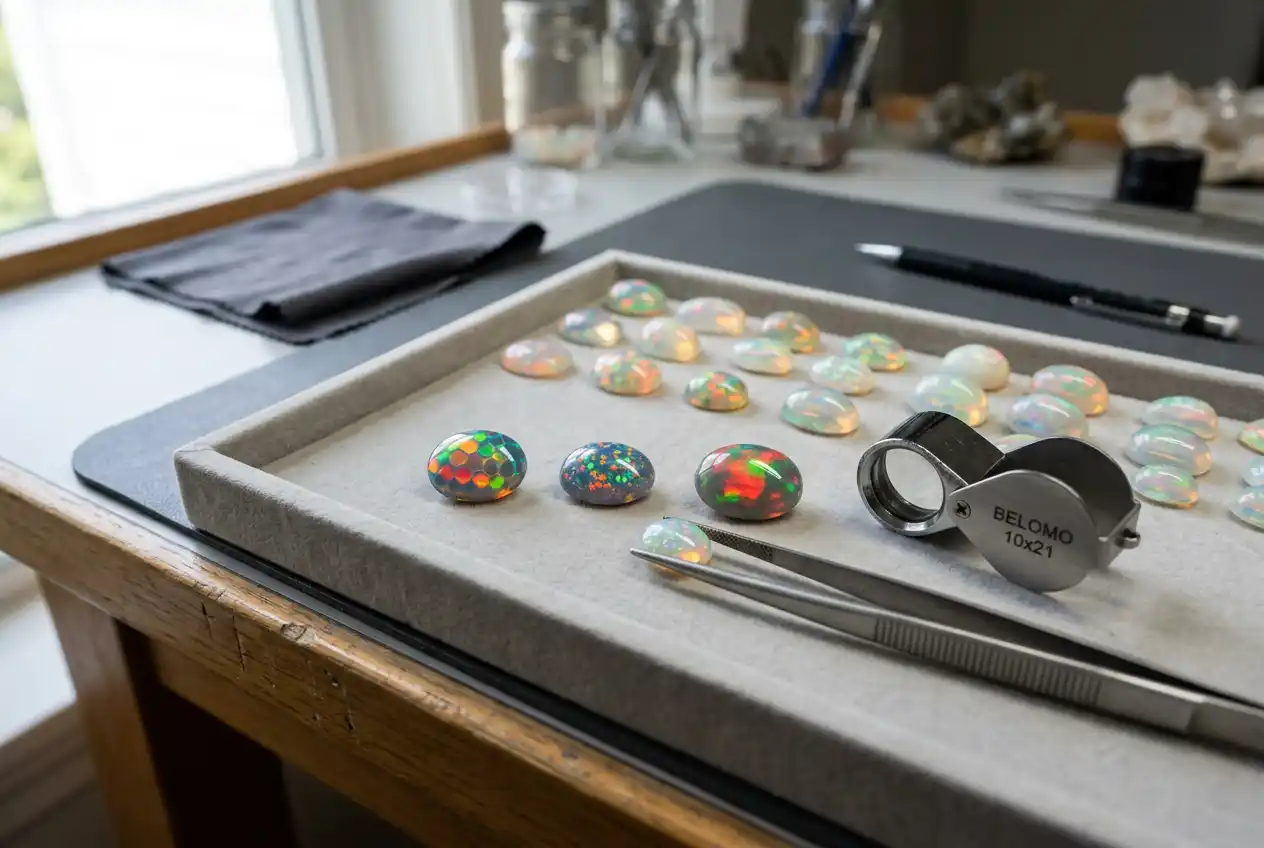
Ethiopian Opal Quality Grading: 8 Ways to Evaluate Hydrophane Fire
Ethiopian opal quality grading should focus on the strength and distribution of play-of-color, the rarity and attractiveness of the pattern, body transparency, hydrophane behavior, structural stability, treatment status, cutting, and overall face-up performance. Fine stones do not merely show several colors. Their spectral flashes remain bright through ordinary movement, cover a substantial portion of the polished face, and interact with the body of the opal in a way that creates depth rather than a weak or patchy display.
The word fire is often used informally when describing opal, but play-of-color is the more precise gemological term. Opal produces this phenomenon through diffraction within ordered arrangements of microscopic silica spheres, causing different wavelengths of visible light to appear as the stone, observer, or illumination changes position. This differs from the dispersion called fire in diamond, demantoid, or benitoite, where white light separates according to refractive dispersion within a crystalline gem.
Much Ethiopian Welo opal is hydrophane, meaning its porous structure can absorb water and other liquids. That feature has major implications for grading because a wet stone may temporarily look much more transparent and may lose or weaken its play-of-color. A meaningful quality assessment therefore needs to examine a clean, fully dry stone and distinguish natural body appearance from temporary water effects, oil contamination, smoking, dyeing, or other treatments.
8 Ways to Evaluate Ethiopian Hydrophane Opal Quality
- Grade the brightness and intensity of play-of-color
- Evaluate dominant spectral colors and overall color range
- Judge pattern rarity, definition, and movement
- Assess face-up color coverage and viewing angles
- Evaluate body transparency, translucency, and hydrophane behavior
- Inspect cracks, crazing, inclusions, and structural stability
- Judge cut quality, polish, proportions, and carat efficiency
- Verify treatment, provenance, natural appearance, and overall market rarity
These eight standards create a practical grading framework without relying on seller-defined AAA terminology. They also recognize that hydrophane behavior is part of the gemstone’s physical character rather than a defect by itself. A high-grade opal can be strongly hydrophane if it remains structurally stable, untreated, brilliantly colored when dry, and properly cared for.
Brightness Is the Foundation of High-Quality Ethiopian Opal
Brightness determines how strongly the play-of-color appears against the body of the gemstone. Fine opal should show vivid spectral flashes without requiring one extremely narrow viewing position or harsh concentrated light. When several stones are compared under the same illumination, high-brightness examples usually separate themselves quickly because their colors look luminous rather than muted.
Lighting consistency is essential because opal can change dramatically according to the light source. Direct sunlight, diffused daylight, warm indoor lamps, and cool LED fixtures can emphasize different parts of the spectral pattern. A fair quality comparison therefore uses the same light, viewing distance, and background for every stone before conclusions are drawn.
Brightness should also remain meaningful during movement. A gem that produces one extraordinary photograph at a single angle but goes nearly blank when moved may be less useful in jewelry than a stone whose color remains active through many orientations. Fine grading rewards persistent visual performance because opal is normally experienced in motion rather than as a fixed image.
Spectral Color Needs to Be Graded by Both Rarity and Strength
Ethiopian opal can show blue, green, yellow, orange, red, violet, and combinations of those colors. Red generally receives the strongest market premium because bright red play-of-color is less commonly produced than blue and green, but hue should never be graded without brightness and coverage. A weak reddish speck near one edge does not make an otherwise dull stone exceptional.
Fine multicolor opal can display several spectral hues simultaneously or reveal different colors as the viewing angle changes. Stones showing intense red, orange, green, and blue across a substantial area often rank highly because both color range and rarity are strong. Full-spectrum appearance becomes especially desirable when the individual colors remain distinct rather than merging into a low-contrast haze.
Blue-green stones can still achieve excellent grades when their brightness is exceptional and the pattern is attractive. A highly organized electric green-blue honeycomb may outrank a weaker multicolor stone because visual quality is determined by the complete display rather than a rigid hierarchy of color names.
Pattern Quality Separates Ordinary Opal From Exceptional Stones
Pattern describes the spatial organization of the play-of-color. Ethiopian opal may show pinfire, broad flash, rolling flash, cellular formations, honeycomb, patchwork, mosaic-like patterns, ribbon effects, and many other arrangements. The most desirable examples have enough definition that the pattern can be recognized clearly rather than imagined from random scattered flashes.
Honeycomb is particularly associated with premium Ethiopian opal in the marketplace. Fine honeycomb should display recognizable repeated cells or network-like divisions combined with strong spectral color. Merely having cellular structure does not guarantee top quality. If the cells are weak, colorless, or visible only under extreme magnification, their market impact is much smaller.
Broad flash and rolling patterns can be equally impressive because large fields of color move through the gem as it turns. These patterns create strong jewelry presence and can remain visible at normal viewing distance. Pinfire is more common, but extremely bright dense pinfire covering the entire stone can still achieve a high grade. Pattern rarity therefore works only when brightness and aesthetics support it.
Face-Up Coverage and Directionality Determine Real-World Performance
Coverage measures how much of the visible surface participates in the play-of-color. A stone with almost complete active coverage usually offers stronger visual value than one where bright color occupies only a small corner, assuming brightness and pattern are otherwise comparable.
Inactive areas are not always undesirable. Transparent or milky regions can frame a concentrated color patch and create an appealing composition, while a dark or quiet zone can improve contrast. The grader should therefore ask whether inactive space supports the design or merely represents a section where the optical effect is absent.
Directionality deserves equal attention. Some opals show powerful color from the normal face-up position but lose much of it when viewed slightly from the side. Others remain colorful through wide angles. Jewelry stones generally benefit from broader viewing performance because the wearer’s movement continually changes orientation relative to the light and observer. A fine grade should record how the stone behaves through movement rather than evaluating only the single strongest angle.
Hydrophane Behavior Must Be Understood Before the Body Is Graded
Hydrophane opal has interconnected pores capable of absorbing liquids. When water enters those pores, the difference in refractive behavior between the silica structure and the pore spaces changes, which can make the gemstone more transparent and alter its play-of-color. As the water leaves, the dry appearance gradually returns.
A grader should evaluate body color and transparency only when the stone is fully dry and has reached a stable appearance. Recently wet opal can look dramatically different and may produce misleading conclusions about clarity, body tone, or pattern. Drying should occur naturally rather than through strong heat, which can create unnecessary stress.
Hydrophane character does not automatically reduce quality. It becomes important when the porosity has allowed foreign substances to alter appearance or when repeated environmental changes create uncertainty about stability. A clean untreated hydrophane stone with strong dry play-of-color can rank among the finest Ethiopian opals.
Transparency and Body Character Need to Support the Play-of-Color
Ethiopian opal ranges from milky translucent material to relatively transparent crystal opal. Greater transparency can create visual depth because flashes appear from within different layers of the stone. Crystal-like material with strong color can therefore be exceptionally attractive.
Milky stones can also be high quality because the pale body provides a bright neutral background that makes spectral flashes easy to see. The grading question is not whether the stone is transparent but whether its body appearance improves or weakens the play-of-color.
A watery transparent gem with sparse color may be less desirable than a slightly milky stone covered in intense red and green. Excessive cloudiness can also lower quality if it blocks depth and makes the colors appear diffuse.
The body should therefore be treated as a stage for the spectral display. Fine quality is achieved when transparency, translucency, and body tone create useful contrast without overwhelming the opal’s color pattern.
Cracks and Crazing Must Be Separated From Normal Hydrophane Porosity
One of the most important grading mistakes is treating hydrophane behavior and structural cracking as the same phenomenon. They are not. Hydrophane refers to liquid absorption through porosity, while crazing refers to networks of physical cracks caused by internal stress.
A stable hydrophane opal can remain intact for long periods under appropriate care. A crazed stone, by contrast, may show intersecting fractures that reduce durability and can continue to affect the surface. Crazing therefore lowers the grade strongly even if play-of-color is exceptional.
Single fractures also need careful examination. A small internal feature may have little practical effect, while a surface-reaching crack crossing the dome can create a significant setting risk. Chips around the girdle, undercut areas near the base, and damaged edges should also be recorded.
Fine quality requires structural stability because the optical beauty of an opal has limited jewelry value if the stone cannot withstand reasonable handling.
Cut, Dome Shape, and Polish Have a Direct Effect on the Grade
Most Ethiopian precious opal is cut as a cabochon because curved polished surfaces reveal the shifting play-of-color effectively. The cutter needs to position the best color on the face, retain enough supporting thickness, remove unstable portions where possible, and create an outline that suits the natural color distribution.
A high dome can produce attractive depth and movement, but extreme thickness may add carat weight without improving face-up performance. A very thin cabochon can maximize apparent spread but may leave vulnerable edges or insufficient structural support.
The polish should be smooth enough to reveal the color pattern without scratches, pits, or dull patches interrupting light. Surface finish is particularly important in transparent hydrophane opal because scratches become obvious across a glassy-looking body.
Freeform shapes should not automatically be considered lower quality. A skillful freeform can preserve rare honeycomb or broad-flash color that would have been destroyed by forcing the rough into a calibrated oval.
A Practical Ethiopian Opal Quality Framework
| Quality Level | Typical Characteristics |
|---|---|
| Exceptional | Extremely bright multicolor play, red present, rare pattern, broad coverage, stable structure, excellent polish |
| Fine | Strong brightness, attractive pattern, good spectral range, good coverage and stability |
| Good | Clearly visible color, moderate pattern quality, some inactive areas, competent cutting |
| Commercial | Weak brightness, limited coverage, simple pattern, visible flaws or ordinary cutting |
| Lower quality | Serious crazing, major cracks, poor color, heavy treatment uncertainty or significant damage |
This framework is descriptive rather than an internationally standardized grading scale. Its purpose is to make every quality judgment understandable instead of relying on unexplained letters or claims such as premium and investment grade.
Treatment Detection Is Essential in Hydrophane Opal Grading
The same porosity that allows water absorption can also allow Ethiopian opal to accept artificial darkening and coloring. Smoking can create a gray to black body, while dye can produce other body colors. Surface coatings and impregnation may also modify appearance.
A treated stone can display spectacular play-of-color because a darkened body increases contrast, but the rarity category is different from naturally colored opal. The treatment should therefore be recorded separately from optical beauty.
Magnification may reveal color concentrations in pores or fractures, but not every treatment can be diagnosed reliably from simple visual examination. Expensive stones with unusual dark body colors or exceptional claims may justify professional laboratory testing.
Treatment disclosure becomes part of the quality grade because durability and care may also change. Coatings can wear, dyes can behave differently from natural coloration, and absorbed substances may be difficult to remove from a porous stone.
Ethiopian Opal Versus Australian Opal Quality
Ethiopian and Australian precious opals can both reach exceptional quality, but their physical behavior and market traditions differ. Much Welo opal is hydrophane, whereas many important Australian opals are much less absorbent. Australian black opal also has a long-established premium market for naturally dark body tone.
Ethiopian opal often offers intense play-of-color, unusual patterns, transparency, and significant size at a more accessible The Price. Its hydrophane nature requires different care and creates greater treatment concerns, particularly with smoking and dyeing.
Quality should therefore be assessed within the correct opal category. Comparing a transparent Ethiopian honeycomb opal directly with a solid Australian black opal solely by body tone or carat weight ignores the features that make each type distinctive.
Common Ethiopian Opal Grading Mistakes
A major mistake is judging the gemstone while it is wet. Water can change transparency and play-of-color dramatically, so meaningful grading requires a fully dry and stabilized appearance. Another mistake is assuming that every dark Ethiopian opal has a naturally black body. Treatment must be considered because hydrophane stones can be darkened through smoking or other processes.
Pattern names can also distort grading when they are treated as automatic premiums. Honeycomb, broad flash, and other named structures only become valuable when the pattern is clear, bright, and aesthetically appealing. A weak example should not outrank a brilliant simpler pattern merely because its label sounds rarer.
Buyers also overvalue total carat weight without checking thickness and face-up dimensions. A deep cabochon can hide substantial mass beneath the visible surface, while a lighter broad stone may display much more active color. Fine grading therefore considers the whole object rather than one measurement.
Caring for High-Quality Ethiopian Opal
Hydrophane opal should be protected from oils, cosmetics, perfumes, household cleaners, colored liquids, and unnecessary soaking because the pore structure can absorb substances that alter appearance. Jewelry should be put on after lotions and fragrances have dried, and rings should be removed before washing dishes, bathing, swimming, or handling oily products.
If the stone becomes wet and temporarily changes transparency, it should be allowed to dry naturally in a stable environment. Strong heat should not be used to speed the process. Steam and ultrasonic cleaning are also inappropriate because heat, vibration, porosity, fractures, and possible treatments introduce unnecessary risk.
Separate padded storage protects the opal from harder gemstones and sharp metal components. Careful handling preserves both structural stability and the bright polished surface that allows the play-of-color to remain clearly visible.
Conclusion
Ethiopian opal quality grading should evaluate brightness, spectral range, pattern, coverage, body transparency, hydrophane behavior, structural stability, cutting, treatment, and provenance together. The finest stones display strong color through useful viewing angles, show an attractive organized pattern, remain stable when dry, and have clearly understood treatment status.
Hydrophane behavior is neither an automatic defect nor a quality guarantee. It is a defining physical property of much Welo opal that affects care and treatment assessment. A high-grade stone succeeds because its dry face-up appearance is brilliant, its pattern remains engaging in motion, its structure is sound, and its natural characteristics have not been confused with temporary water effects or artificial darkening.
FAQs About Ethiopian Opal Quality Grading
What is the most important Ethiopian opal quality factor?
Brightness is one of the strongest factors because vivid play-of-color creates the gemstone’s immediate visual impact. Pattern, spectral range, coverage, stability, hydrophane behavior, and treatment status then determine how exceptional the stone is overall.
What does hydrophane mean in Ethiopian opal?
Hydrophane means the opal has a porous structure capable of absorbing water. Water absorption can temporarily increase transparency and alter or weaken play-of-color, with the dry appearance generally returning gradually after the stone releases the absorbed moisture.
Is hydrophane opal lower quality than non-hydrophane opal?
Not automatically. Many fine Ethiopian opals are hydrophane. Quality depends on dry play-of-color, brightness, pattern, stability, treatment, cutting, and condition rather than porosity by itself.
What is the best Ethiopian opal pattern?
There is no single pattern that always ranks highest, but well-defined honeycomb, broad flash, rolling flash, and other organized patterns can command strong premiums when brightness and spectral color are exceptional. A rare pattern with weak color may still grade below a simpler but much brighter stone.
Is red the best color in Ethiopian opal?
Bright red usually receives the strongest rarity premium, especially when it appears over a substantial area with orange, green, or blue. Red should still be judged together with brightness and coverage rather than counted simply because a small red flash exists.
Should Ethiopian opal be transparent?
It does not have to be. Transparent crystal-like opal can show impressive depth, while milky translucent material can create excellent contrast for strong spectral colors. The best body appearance is the one that supports the play-of-color most effectively.
How can I tell if Ethiopian opal is smoked?
Dark body color, treatment clues under magnification, and gemological testing can help identify smoking, but appearance alone may not be conclusive. Valuable dark Ethiopian opal should be examined professionally when natural body color is an important part of the claimed rarity.
Can Ethiopian opal be dyed?
Yes. Hydrophane porosity can allow dye to enter the stone and change its body color. Dyed opal can be attractive, but the treatment should be disclosed and should not receive the rarity premium of naturally colored material.
What is crazing in Ethiopian opal?
Crazing is a network of physical cracks caused by internal stress within the opal. It is different from normal hydrophane porosity and can substantially reduce durability and value.
Does Ethiopian opal lose color permanently when wet?
Hydrophane opal can temporarily lose or alter play-of-color while water occupies its pores, and the normal dry appearance generally returns after sufficient drying. Foreign oils, dyes, or contaminants can be more problematic because they may persist within the porous structure.
Does a larger Ethiopian opal receive a higher grade?
Only when brightness, pattern, coverage, stability, and cutting remain strong. Large commercial stones can be abundant enough that weight alone does not make them exceptional.
Is honeycomb Ethiopian opal always expensive?
No. Honeycomb earns its strongest premium when the cellular structure is clearly defined and filled with vivid multicolor play. Weak or low-brightness honeycomb may be less valuable than a simpler pattern with exceptional color.
Is Ethiopian opal suitable for rings?
Yes, but it needs careful wear because opal is relatively soft and hydrophane stones can absorb liquids. Protective settings, avoidance of impact, and protection from lotions, oils, and chemicals are important.
Are AAA Ethiopian opal grades standardized?
No. AAA, premium, investment grade, and similar descriptions vary among sellers. A meaningful grade should explain brightness, spectral colors, pattern, coverage, stability, cut, treatment, and body character directly.
What makes Ethiopian opal exceptional?
Exceptional Ethiopian opal combines intense brightness, vivid red or broad-spectrum color, a highly attractive pattern, extensive face-up coverage, a stable dry structure, excellent polish, useful size, natural appearance, and accurate disclosure of hydrophane behavior and treatment.