

Garnet’s price per carat isn’t a fixed number but a sliding scale that behaves differently depending on the variety: common red garnet stays roughly flat as stones get bigger, while rare green tsavorite and demantoid climb steeply, because large clean crystals are scarce. Understanding why per-carat pricing works this way tells you when a bigger stone is a bargain and when it’s a luxury.
This guide explains garnet’s per-carat pricing from every angle. You’ll learn how the pricing mechanic works, why size changes it, and how to calculate what you should pay. At Gems Lore, we want you to buy with confidence.
A quick note first. This is general educational information, not a quote or appraisal.
Per-Carat Pricing at a Glance
- Per carat means per unit weight. One carat is 0.2 grams.
- Total price = per-carat price × weight. But the rate itself changes with size.
- Common red garnet: roughly flat, so big stones stay affordable.
- Rare garnets: steeply rising, so big stones cost disproportionately more.
What “Per Carat” Actually Means
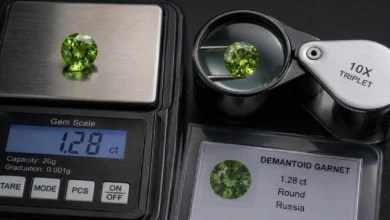
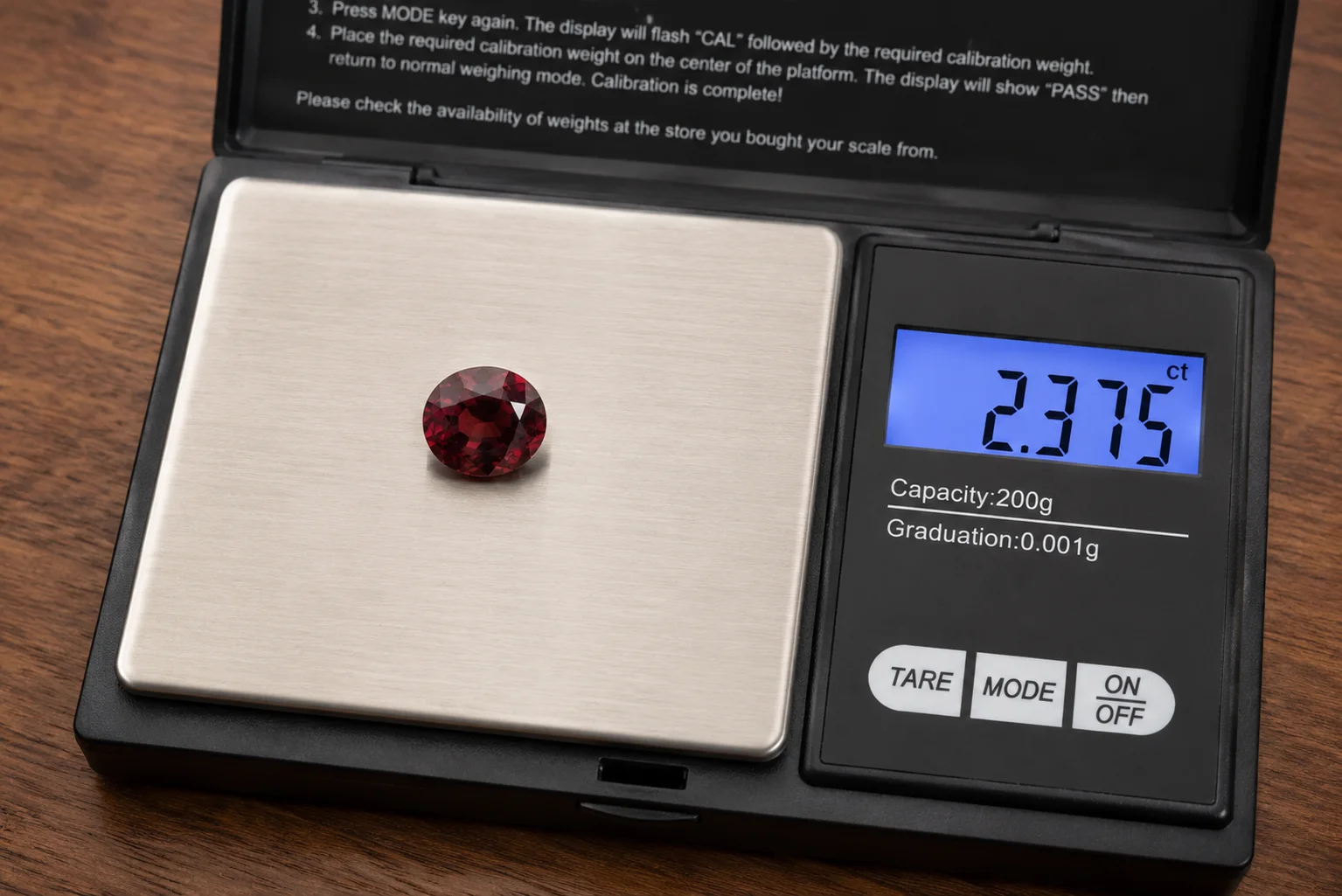
Let’s start with the basics, since the term trips people up. A carat is a unit of weight, not size, equal to 0.2 grams, or one fifth of a gram. It’s abbreviated “ct.”
Gems are priced per carat, and the total is simply the per-carat rate times the weight. A 2-carat garnet at $30 per carat costs $60. Straightforward so far. The complication, and the thing worth understanding, is that the per-carat rate itself is not constant. It changes with the size of the stone.
Why the Rate Rises with Size
Here’s the mechanic that governs all gemstone pricing. Large, clean crystals of any gem are rarer than small ones, because nature produces far more small material than large, and because bigger crystals have more chances to contain a flaw.
So as size increases, supply drops. The rate per carat therefore rises, meaning a 2-carat stone costs more than twice a 1-carat stone of identical quality. This is why gem pricing is non-linear, and it’s why “price per carat” always needs a size attached to be meaningful.
The steepness of that rise depends entirely on how scarce large material is for that particular gem. And that’s where garnet gets interesting.
The Garnet Split: Two Different Curves
Garnet is unusual because the family contains both ends of this spectrum. Its varieties behave in nearly opposite ways, which our types of garnet guide maps out.
Common red garnet (almandine, pyrope) is abundant, and large rough is plentiful. So the per-carat rate stays relatively flat as size grows. A 5-carat almandine might cost only modestly more per carat than a 1-carat. This is why big, dramatic red garnet cocktail rings are so affordable, a point our garnet ring guide notes.
Rare garnets (tsavorite, demantoid) behave like fine sapphire. Large clean crystals are genuinely scarce, so the rate climbs steeply. A 3-carat tsavorite can cost several times the per-carat rate of a 1-carat, and 5-carat stones enter serious collector territory.
Approximate Rates by Variety
Here’s roughly where things sit in 2026, though real prices vary by quality and seller. Our garnet price guide covers the full variety breakdown.
- Almandine and pyrope (red): roughly $10 to $50 per carat, fairly flat with size.
- Rhodolite (raspberry): roughly $50 to $400 per carat, rising modestly.
- Spessartine (orange): roughly $100 to $1,000+ per carat, rising noticeably.
- Tsavorite (green): roughly $500 to several thousand per carat, rising steeply.
- Demantoid (green): roughly $1,000 to $8,000+ per carat, rising very steeply.
Notice the range within each variety. That spread is quality, mostly color, which our garnet quality and grading guide explains.
Carat Is Not the Same as Size
This catches people out, so it’s worth being clear. Two stones of equal carat weight can look quite different in size, because density and cut both matter.
Garnet is fairly dense, denser than quartz or beryl, so a 1-carat garnet looks slightly smaller face-up than a 1-carat amethyst of the same cut. You’re paying for weight, but you’re wearing appearance.
Cut depth matters too. A deeply cut stone hides weight in its pavilion, below the setting, where you can’t see it. A well-proportioned stone shows more face-up spread per carat. When comparing, ask for millimeter dimensions alongside carat weight, since that’s what actually shows on your hand.
The Dark Stone Interaction
Garnet has a size-color quirk worth factoring into value. Larger stones look darker, because light travels through more material.
This means a large red garnet needs better starting color than a small one to look equally bright. A 1-carat almandine that glows nicely may become a blackish 5-carat if the material is the same. So when buying larger red garnet, don’t just take the flat per-carat rate as good news, check that the color survives the size.
Calculating What You Should Pay
Here’s a practical method. First, identify the variety, since it sets the rate band entirely.
Second, judge the quality within that band: is the color vivid and bright, or dark and dull? A glowing stone sits at the top of its range, a blackish one at the bottom. Third, apply the rate to the weight for a rough stone cost.
Then remember the total price includes more than the gem. The metal, setting, and craftsmanship of finished jewelry often exceed the cost of a red garnet entirely, which surprises people. For a $60 garnet in a gold ring, you’re mostly buying gold.
When Bigger Is a Bargain
Here’s the practical takeaway that makes garnet fun. Because common red garnet’s rate stays flat, size is cheap. If you want a large, impressive colored stone on a modest budget, red garnet is one of the best options in all of gemology.
The opposite applies to green garnet. If you want tsavorite or demantoid, going up in size costs disproportionately, so many buyers optimize for color quality at a smaller size instead. Our garnet buying guide covers making that trade-off.
Total Weight vs Stone Weight
One more pricing term deserves attention, because it’s a common source of confusion in finished jewelry. Listings often quote “total carat weight,” abbreviated ctw or TCW.
Total carat weight adds up every stone in the piece. A tennis bracelet advertised at 5 ctw might contain fifty small garnets of 0.1 carats each. That is a very different thing from a single 5-carat stone, and it’s worth far less, because those fifty small stones are common and cheap while one large stone is comparatively scarce.
The same logic applies to halo rings and cluster pendants, where a headline weight may combine a modest center stone with many tiny accents. When you see a total weight, ask for the center stone’s individual weight. That single number tells you more about value than the total ever will.
This matters less for red garnet, where size is cheap anyway, but it matters enormously for tsavorite and demantoid, where a single large stone and a cluster of small ones inhabit completely different price worlds.
Frequently Asked Questions
How much is garnet per carat?
It depends entirely on variety. Common red garnet runs roughly $10 to $50 per carat, rhodolite about $50 to $400, and spessartine from $100 into the thousands. Green tsavorite and demantoid range from about $500 to $8,000 or more per carat, with quality driving the spread within each band.
Why does price per carat increase with size?
Large, clean crystals are rarer than small ones, because nature produces more small material and bigger crystals have more chances to contain flaws. Lower supply means a higher rate, so a 2-carat stone costs more than twice a 1-carat one of equal quality. The rise is steepest for scarce varieties.
Is a bigger garnet more expensive per carat?
For rare garnets like tsavorite and demantoid, yes, significantly, because large clean stones are scarce. For common red garnet, barely, since large rough is plentiful, so the rate stays fairly flat. This is why big red garnets are affordable while big green ones are not.
Is carat the same as size?
No. Carat is weight, 0.2 grams, not dimensions. Garnet is fairly dense, so a 1-carat garnet looks slightly smaller face-up than a 1-carat amethyst. Cut depth matters too, since deep stones hide weight below the setting. Always ask for millimeter dimensions alongside carat weight.
Why is my garnet ring more expensive than the stone’s carat price suggests?
Because you’re buying jewelry, not just a gem. The metal, setting, and craftsmanship often cost more than a red garnet itself, which is inexpensive. For affordable stones set in gold, the majority of the price is typically the gold and the labor rather than the garnet.
Where to Go From Here
Garnet’s per-carat pricing tells a clear story: red garnet’s flat curve makes size genuinely affordable, while the rare greens follow the steep curve of scarce gems. Identify the variety, judge the color, mind the size-darkness trade-off in reds, and you’ll know exactly what you’re paying for.
See the full breakdown in our garnet price guide and the grading guide, both linked above, or verify a stone with our real vs. fake garnet guide.
Working out a garnet’s value? Tell us about it in the comments.
This guide is for general educational purposes and is not a quote or appraisal. Market prices vary by stone, quality, and seller.