Garnet Quality Grading: 8 Essential Steps to Rate Fine Gems
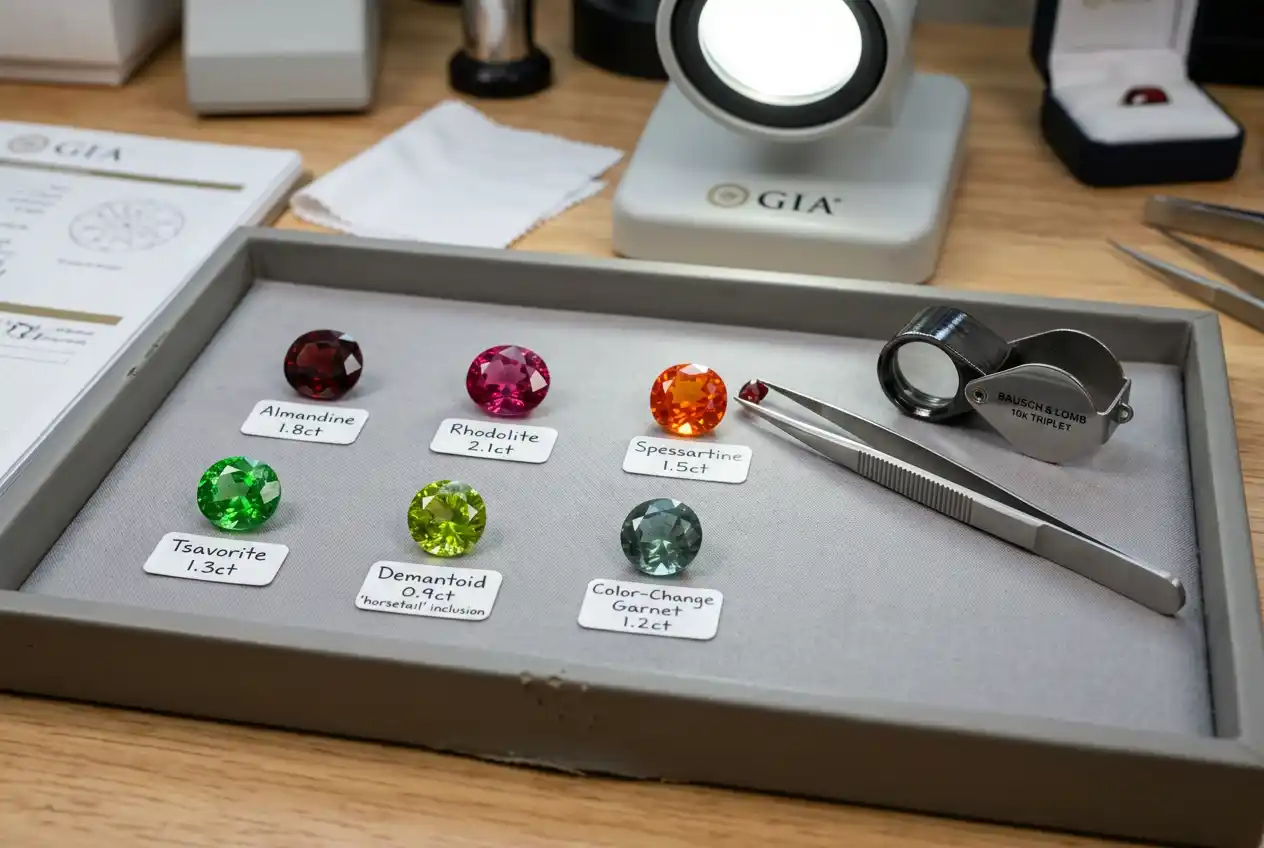
Garnet quality grading begins by identifying the species or commercial variety because the garnet group includes gemstones with very different colors, inclusion expectations, optical properties, size rarity, and market value. Fine red almandine cannot be judged through exactly the same standards as vivid green demantoid, orange spessartine, or color-change garnet. A meaningful grade therefore needs to establish what kind of garnet is being examined before color, clarity, cut, and carat weight can be interpreted correctly.
Garnets belong to a family of related cubic silicate minerals whose compositions form several solid-solution series. Important gem species include pyrope, almandine, spessartine, grossular, andradite, and uvarovite, while commercial names such as rhodolite, tsavorite, hessonite, demantoid, malaia, and color-change garnet describe particular compositional or appearance categories within that family. Because the chemistry varies continuously, some gemstones cannot be understood adequately through one simple end-member label.
There is no universal AAA or AAAA grading scale that applies consistently to every garnet variety. Fine grading depends on observable characteristics and species-specific expectations. Color is usually the strongest visible factor, but tone, clarity, transparency, cutting, size, optical effects, treatment, provenance, and condition need to be interpreted together before an overall quality judgment is reliable.
8 Essential Steps to Rate Fine Garnets
- Confirm garnet identity, species, and commercial variety
- Grade hue, saturation, and color attractiveness
- Evaluate tone, brightness, and face-up extinction
- Assess clarity, transparency, and inclusion character
- Judge cut quality, symmetry, polish, and light return
- Consider carat weight and size rarity within the specific variety
- Evaluate special optical effects such as color change, asterism, or dispersion
- Review origin, treatment, condition, documentation, and overall rarity
These eight steps provide a consistent method without pretending that all garnets should meet one visual standard. The goal is to judge each stone according to the qualities that make its own variety desirable, while still applying common principles such as attractive color, suitable transparency, efficient cutting, sound condition, and accurate identification.
Garnet Identity Must Be Established Before Quality Is Compared
A red gemstone labeled garnet can belong primarily to almandine, pyrope, spessartine, or a compositional mixture, while green garnet may be grossular, andradite, or another less common type. Accurate identification can involve refractive index, specific gravity, absorption spectra, magnetic response, microscopic inclusions, chemistry, and other gemological observations.
This matters because identical-looking weights can carry completely different rarity. A one-carat ordinary almandine and a one-carat fine demantoid are both natural garnets, yet the demantoid can command a dramatically higher market value because its species, color, dispersion, source, and size rarity differ.
Trade names require equally careful interpretation. Rhodolite generally refers to attractive purplish-red pyrope-almandine garnet, tsavorite refers to vivid green grossular, demantoid is green andradite, and hessonite is an orange to cinnamon grossular variety. These names are useful only when the gemstone actually possesses the characteristics associated with them.
A strong grading process therefore starts with identity and moves to quality afterward rather than allowing color alone to determine the variety.
Color Must Be Graded According to the Garnet Variety
Fine red garnet should show an attractive red, purplish red, or raspberry hue without becoming excessively brown or nearly black. Rhodolite is particularly valued when its purplish-red color remains bright and open rather than dark, while pyrope and almandine can range from vivid red to much deeper tones depending on composition and size.
Spessartine has a different ideal. Strong orange, mandarin, or reddish-orange color with limited brown generally receives greater demand than muddy darker material. Tsavorite is judged through vivid green saturation and transparency, while demantoid often balances green body color against the need to preserve enough brightness for its dispersion to remain visible.
Color-change garnet needs at least two separate evaluations because its appearance under daylight-like illumination and warm incandescent-style light may differ significantly. A strong change is valuable only when both colors are attractive rather than one state appearing muddy or weak.
This variety-specific approach prevents a simplistic rule such as darker is better or green is always more valuable. Quality depends on whether the individual color represents a desirable expression of the particular garnet.
Tone and Extinction Can Make Fine Color Look Ordinary
Garnets can absorb substantial light, particularly in deeply colored red varieties. A stone may have theoretically strong saturation yet look nearly black across much of its face if tone is too dark or the cut creates heavy extinction. This problem is especially common in commercial red garnets cut deeply to preserve weight.
Fine quality requires enough brightness for individual facets to return visible light. Red, orange, and green should remain identifiable under ordinary indoor conditions rather than becoming apparent only when the stone is held directly against a powerful lamp.
Cutting and tone are closely connected. Excessive pavilion depth can increase darkness, while shallow cutting can weaken saturation and create a window. A well-proportioned stone allows the body color to remain rich without sacrificing brilliance.
This balance is especially important in demantoid because dark green body color can hide the spectral fire that makes the variety exceptional. A lighter or medium-green stone may therefore grade higher when its dispersion and brilliance are substantially stronger.
Clarity Standards Need to Reflect Natural Inclusion Patterns
Many garnets can be found with high transparency, so fine red, rhodolite, and spessartine stones generally benefit from being eye-clean or close to it. Obvious black crystals, dense clouds, or large fractures usually lower conventional quality because cleaner alternatives may be available.
Some varieties require more nuanced interpretation. Demantoid’s famous horsetail inclusions can add collector value when they form graceful radiating fibers without destroying transparency. Hessonite often shows a characteristic internal roiled appearance that can support identification and is not judged through the same expectations applied to a perfectly transparent rhodolite.
Star garnets depend on oriented inclusions to create asterism, meaning the inclusions responsible for the star are essential to the optical effect rather than merely flaws. The grader should therefore distinguish inclusions that create desirable identity or phenomena from random features that reduce beauty or durability.
Structural fractures remain important regardless of variety. A visually interesting inclusion scene does not compensate for an open crack that threatens the integrity of the gemstone.
A Practical Garnet Clarity Comparison
| Garnet Appearance | Practical Quality Interpretation |
|---|---|
| Eye-clean with strong transparency | Fine for varieties normally expected to be clean |
| Minor inclusions visible only under magnification | Very good |
| Attractive variety-specific inclusions | Potentially fine or collector quality |
| Obvious random crystals or clouds reducing brilliance | Commercial to good |
| Large fractures or significant structural weakness | Lower jewelry quality |
This framework is descriptive rather than universal because inclusion expectations differ across the garnet family. Its purpose is to separate harmless or valuable natural features from clarity problems that interfere with the gemstone’s performance.
Cut Quality Should Reveal the Strength of Each Garnet Type
A well-cut garnet should return light across most of its face while showing the strongest possible expression of its color. Because many garnets have relatively high refractive indices, they can produce excellent brilliance when pavilion angles and crown proportions are coordinated effectively.
Windowing is a major weakness because it creates a transparent central zone and lowers apparent saturation. Excessive depth is equally problematic when it preserves hidden weight but creates dark extinction and reduces visible size. Fine cutting balances these two extremes while maintaining symmetry and durability.
Demantoid presents additional challenges because its high dispersion should remain visible through the green body color. Precision cutting can reveal red, orange, yellow, and blue spectral flashes that would remain hidden in a poorly proportioned stone. Color-change garnet requires thoughtful orientation so both light-source appearances remain attractive.
Polish and facet junctions refine the grade further. Scratched facets, rounded edges, asymmetry, or poor alignment reduce the crispness of light return even when the rough itself is valuable.
Carat Weight Must Be Judged Within the Correct Variety
Large size does not mean the same thing across the garnet group. Almandine can occur in substantial crystals, so a large stone may remain commercially affordable. Rhodolite also reaches useful jewelry sizes with less severe scarcity than rare green garnets.
Tsavorite and demantoid become significantly rarer as finished size rises while strong color and transparency are maintained. A fine multi-carat tsavorite or demantoid therefore receives a much stronger rarity grade than a similar-weight ordinary red garnet.
Spessartine occupies an intermediate but variable position. Large clean mandarin-orange stones can be very valuable because fine saturation and transparency become harder to maintain as size increases. Strong color-change garnet can also earn steep size premiums when the shift remains distinct and the gemstone stays clean.
A quality grade should therefore record weight but interpret it through the scarcity profile of the variety rather than assuming one carat threshold applies equally to every garnet.
Special Optical Effects Can Redefine the Quality Hierarchy
Demantoid’s extraordinary dispersion is one of the clearest examples of a special optical property affecting quality. Its fire can exceed diamond’s, and a well-cut stone may display vivid spectral flashes through an attractive green body. A darker demantoid can have richer color but weaker visible dispersion, so grading needs to balance the two rather than rewarding saturation mechanically.
Color-change garnet requires a different standard because the strength, completeness, and attractiveness of the light-source shift become central. Stones that move decisively between greenish or bluish daylight appearances and reddish or purplish warm-light appearances can rank extremely highly when clarity and cutting are also good.
Star garnet depends on the sharpness, centering, number, and movement of rays across a cabochon. Asterism should be assessed under a point-source light and judged for definition rather than applying faceted-garnet brilliance standards. These examples show why special optical behavior can change which quality factors deserve the greatest weight.
Origin and Provenance Matter Most at the Rare End of the Market
Geographic origin is usually a minor factor in ordinary red garnet, but it can become important for collector varieties. Russian demantoid from the Ural region has historic prestige and can carry a premium when origin is well supported and the stone also has strong color, fire, size, or characteristic horsetail inclusions.
East African tsavorite has an established identity tied particularly to Kenya and Tanzania, while notable spessartine production from Namibia and other regions has created locality-specific collector interest. Certain star garnets and unusual color-change stones can also become more desirable when their mining source is documented.
Origin should still be applied after visible quality is graded. A famous locality cannot transform a dull, fractured stone into a fine gem, and an exceptional stone from a less celebrated source can remain objectively superior in color and cutting.
Laboratory documentation becomes most useful when provenance materially affects value rather than as a mandatory requirement for every inexpensive garnet.
Treatment Is Usually Limited, but Disclosure Still Belongs in the Grade
One of garnet’s appealing characteristics is that many important jewelry varieties commonly reach the market without routine heat or clarity treatment. Their colors are often largely natural, allowing buyers to evaluate the gemstone without navigating the extensive treatment systems seen in sapphire or emerald.
That general pattern should not become an assumption that every garnet is completely untreated or correctly labeled. Surface coatings, assembled products, filling, imitation stones, and incorrect variety names can occur, particularly in low-transparency markets.
A high-value stone marketed as rare demantoid, tsavorite, or color-change garnet should therefore be identified accurately before a major premium is paid. Disclosure is part of quality because confidence in what the buyer actually owns influences both marketability and long-term value.
A Practical Overall Garnet Quality Framework
| Quality Level | Typical Characteristics |
|---|---|
| Exceptional | Top variety color, strong brightness, excellent transparency or desirable inclusions, fine cut, important size |
| Fine | Attractive saturation, good transparency, strong cutting, limited distracting inclusions |
| Good | Pleasing color, moderate clarity, competent cut, commercially useful size |
| Commercial | Dark or weak color, obvious inclusions, windowing, ordinary cut |
| Lower quality | Poor transparency, significant fractures, weak color, severe abrasion or misidentification concerns |
This framework is useful only after the garnet variety has been established. An exceptional almandine and an exceptional demantoid can both occupy the top of their respective quality categories while still having very different market values.
Garnet Durability and Condition Complete the Final Grade
Most gem garnets have suitable hardness and toughness for jewelry, but their exact hardness varies across the group. Surface scratches, chipped facet edges, open fractures, and heavy abrasion should therefore be included in the final condition assessment rather than ignored because the gemstone was originally well cut.
Rings expose garnet to more wear than earrings or pendants, and hard contact with sapphire or diamond can scratch garnet surfaces. Protective storage and sensible wear help preserve high polish and sharp facet junctions.
Cleaning should remain appropriate to the individual stone. Sound untreated garnet usually tolerates mild soap and lukewarm water well, while highly included or fracture-bearing stones deserve more cautious handling. A fine quality grade represents the gemstone’s current condition, not merely the theoretical quality it had when first polished.
Conclusion
Garnet quality grading requires identification of the species or commercial variety before color, tone, clarity, cut, carat weight, optical phenomena, provenance, treatment, and condition can be interpreted correctly. The group is too diverse for one AAA scale to describe every gemstone meaningfully, and the best grading systems explain individual characteristics rather than hiding them behind an unexplained label.
Fine garnet should represent an attractive expression of its own variety. That may mean luminous raspberry color in rhodolite, vivid orange in spessartine, saturated green in tsavorite, dispersion and a desirable horsetail in demantoid, or a powerful light-source transformation in color-change garnet. When those variety-specific qualities occur together with strong cutting, structural integrity, and accurate identification, the gemstone belongs at the higher end of its natural category.
FAQs About Garnet Quality Grading
What is the most important factor in garnet quality?
The most important factor depends on the garnet variety, although color is usually central. Fine rhodolite needs attractive purplish-red color, spessartine benefits from vivid orange, tsavorite is judged strongly by green saturation, and demantoid needs a successful balance between green color and visible dispersion.
Are all garnets graded the same way?
No. The garnet group contains several mineral species and many commercial varieties with different inclusion patterns, size rarity, optical effects, and preferred colors. A useful grade first identifies the variety and then applies standards appropriate to that particular type.
Should fine garnet be eye-clean?
Many red, rhodolite, spessartine, and tsavorite stones are most desirable when inclusions are not obvious face-up, but important exceptions exist. Demantoid horsetail inclusions can add collector appeal, while star garnet relies on oriented inclusions to produce its optical effect.
Is darker red garnet higher quality?
Not necessarily. Very dark almandine or pyrope-almandine can appear almost black and lose brilliance under normal lighting. Fine red garnet should retain enough brightness for the red or purplish-red hue to remain visible and attractive.
How is tsavorite quality graded?
Tsavorite is evaluated primarily through vivid green hue, saturation, tone, transparency, cutting, carat weight, and structural condition. Fine stones become particularly rare in larger sizes, so substantial weight can add a strong premium when color and clarity remain excellent.
How is demantoid quality different from other garnets?
Demantoid is valued not only for green color but also for exceptional dispersion, which can produce strong spectral fire. Characteristic horsetail inclusions can add collector interest, particularly in stones associated with historic Russian production, so conventional clarity rules require more nuance.
Does carat weight determine garnet quality?
No. Weight affects rarity differently across varieties. Large almandine may remain common, while comparable fine tsavorite or demantoid can be extremely scarce, so carat weight must always be interpreted within the correct garnet category.
Are AAA garnet grades standardized?
No. AAA, AAAA, premium, and similar commercial grades vary among sellers. A meaningful garnet grade should explain variety, color, tone, transparency, inclusions, cut, size, optical effects, treatment, and condition directly.
Is color-change garnet considered high quality?
It can be exceptionally valuable when the light-source change is strong, both colors are attractive, clarity is good, and the stone is well cut. A weak shift between muddy colors does not become high quality simply because some color change is present.
Does origin determine garnet quality?
Origin can add collector value in rare varieties, especially Russian demantoid or important East African green garnets, but it should not replace visible grading. Color, transparency, cut, size, condition, and optical properties remain essential.
What makes a garnet exceptional?
An exceptional garnet combines accurate variety identification with top-quality color, balanced tone, strong transparency or desirable characteristic inclusions, precise cutting, appropriate size rarity, sound condition, and any optical effect that defines the variety at its best.