Gem Silica Meaning: Properties, Uses & Symbolism
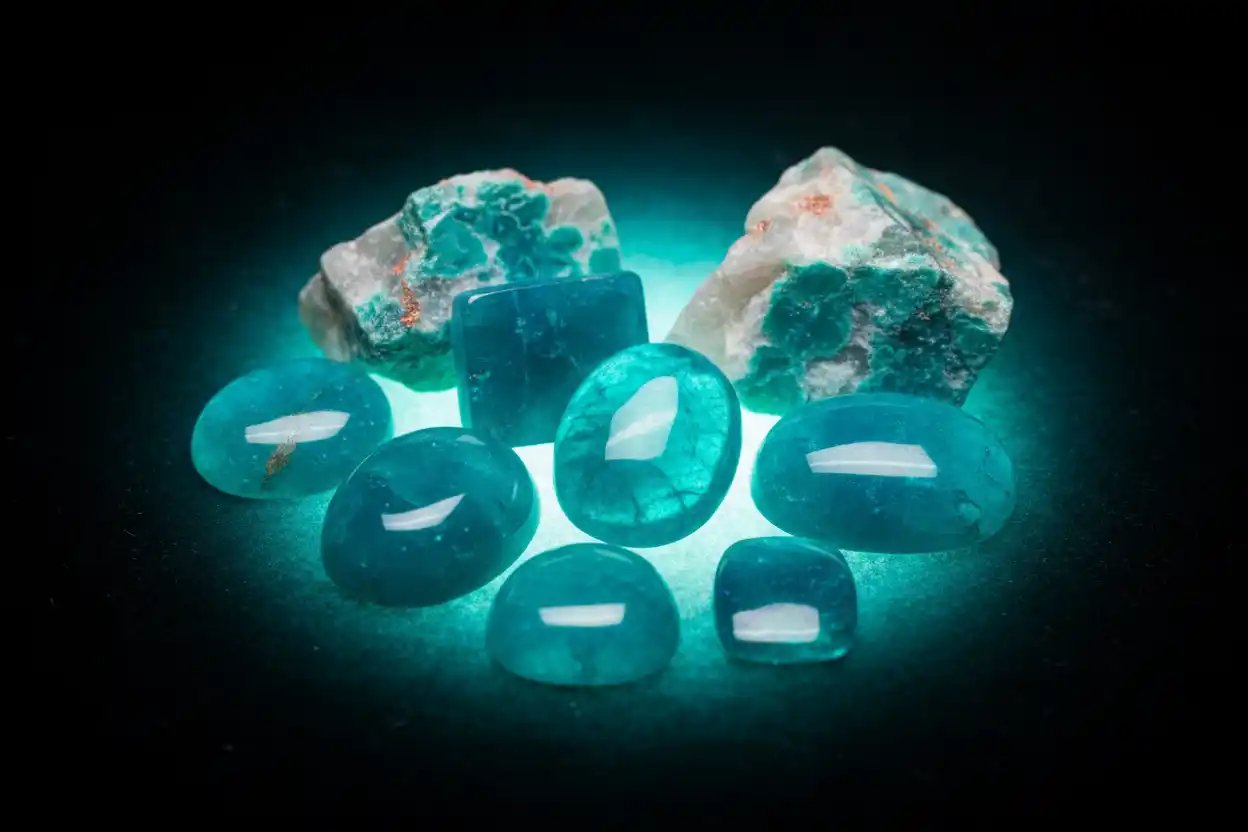
Gem silica meaning is easiest to understand when the material is identified before symbolism is added. In gemological usage, gem silica commonly refers to blue to greenish-blue chrysocolla-bearing chalcedony, often described as “chrysocolla chalcedony” or “chrysocolla-in-chalcedony.” The host is chalcedony—a cryptocrystalline silica material—while extremely fine chrysocolla inclusions can create the characteristic copper-related blue or bluish-green coloration. GIA specifically describes gem silica as chrysocolla chalcedony whose attractive color is produced by finely disseminated minute inclusions of chrysocolla.
That material distinction is fundamental. Gem silica is not simply a poetic synonym for every blue-green silica gemstone, nor should every bright blue chalcedony automatically be identified as gem silica. Dyed chalcedony and greenish-blue glass have both been documented as imitations, and other naturally colored chalcedonies can derive their color from different elements or mineral phases. Color therefore provides an initial clue, not definitive proof of identity.
Within Gems Lore’s Gemstone Guides, this page owns the material-first definition, documented naming context, broad diagnostic framework, responsible symbolism, and safe ownership of gem silica. It does not replace the separate pages devoted to microscopic inclusions, optical measurements, deposit geology, cutting, jewelry engineering, provenance, or specimen conservation.
Gem Silica Meaning at a Glance
| Question | Evidence-based answer |
|---|---|
| What is gem silica? | A gemological/trade name commonly used for chrysocolla-bearing blue to greenish-blue chalcedony |
| Main host material | Chalcedony, a cryptocrystalline silica aggregate |
| Major color relationship | Finely dispersed chrysocolla and Cu²⁺-related absorption can create characteristic blue to bluish-green color |
| Typical appearance | Translucent to semi-translucent blue, cyan, turquoise-blue, or greenish-blue material |
| Mohs hardness basis | Chalcedony is generally about 6.5–7 |
| Cleavage | Chalcedony is generally described as having no cleavage |
| Important identification limitation | Color alone cannot distinguish natural gem silica from dyed chalcedony, glass, or other blue-green chalcedony |
| Common fashioned form | Cabochons and other polished forms that emphasize color and translucency |
| Historical status of the name | “Gem silica” is a modern gem/trade term rather than an ancient mineral species name |
| Modern symbolism | Often associated with calm communication, reflection, creativity, or personal clarity |
| Scientific status of symbolism | These themes are interpretive and are not established medical or physiological effects |
| Safe-use principle | Ordinary handling of intact material differs from cutting, grinding, drilling, sanding, or generating silica-bearing dust |
Gem silica meaning should therefore be read in three layers: measurable material properties, documented gemological or trade history, and modern symbolic interpretation. Problems arise when these layers are collapsed into one another—for example, when copper-bearing inclusions are described as if they medically deliver copper through the skin, or when a modern crystal interpretation is presented as an ancient documented belief.
What Is Gem Silica?
Gem silica is best understood as chalcedony whose blue to greenish-blue appearance is associated with finely distributed chrysocolla. GIA literature uses terms including “gem silica,” “chrysocolla chalcedony,” and “chrysocolla-in-chalcedony” for this gem material. Laboratory work on natural material has shown that the colored chalcedony can contain microscopic chrysocolla, while Raman analysis of chalcedony itself can show silica phases such as quartz and moganite.
This means a polished gem silica cabochon should not be described as though it were simply a massive piece of pure chrysocolla. The blue-green mineral phase may occur as extremely fine inclusions distributed through a chalcedony host. Conversely, “chrysocolla in quartz” can describe materials with visibly separate chrysocolla, quartz, chalcedony, or other phases and is not automatically equivalent to fine translucent gem silica. GIA has examined chrysocolla-in-quartz material containing several identifiable components as well as polymer impregnation, illustrating why visually similar trade descriptions can conceal materially different structures.
The distinction becomes especially important when a seller uses names loosely. “Blue chalcedony,” “chrysocolla,” “chrysocolla quartz,” and “gem silica” are not interchangeable under every circumstance. Appropriate terminology should follow the actual composition and structure of the specimen.
Gem Silica Identity Table
| Characteristic | Practical description |
|---|---|
| Material family | Chalcedony / cryptocrystalline silica |
| Typical coloring association | Fine chrysocolla inclusions and Cu²⁺-related absorption |
| Common color range | Blue through greenish blue, sometimes cyan or turquoise-like |
| Transparency | Commonly translucent; quality and thickness influence apparent transparency |
| Luster when polished | Commonly waxy to vitreous-looking |
| Chalcedony hardness | Approximately 6.5–7 Mohs |
| Chalcedony specific gravity | Commonly around 2.55–2.70, although actual material can vary |
| Chalcedony refractive-index range | Roughly 1.53–1.54 in standard gemological references |
| Cleavage | Generally none in chalcedony |
| Structure | Aggregate rather than a single large transparent quartz crystal |
| Typical fashioned form | Cabochon, carving, bead, or polished ornamental piece |
| Major look-alike risks | Dyed chalcedony, colored glass, other naturally blue-green chalcedonies, and mixed chrysocolla–silica material |
| Confirmation tools | Microscopy, refractive-index work, spectroscopy, Raman analysis, chemical analysis, or other laboratory methods as needed |
General chalcedony references place hardness around 6.5–7, specific gravity approximately 2.55–2.70, and refractive index around 1.530–1.543. Those ranges are useful screening information, but a specimen containing substantial additional minerals, matrix, fractures, polymer, or composite construction may not behave exactly like homogeneous chalcedony.
How Gem Silica Forms
Gem silica formation requires both silica-rich mineralization and a copper-bearing geological environment capable of introducing chrysocolla or related copper components into chalcedony. Chalcedony itself commonly precipitates as fine silica in cavities, fractures, veins, and other spaces in rocks. Where copper-bearing alteration occurs, chrysocolla or other secondary copper minerals may coexist with the silica, creating the conditions for blue-green chrysocolla-bearing chalcedony.
The exact sequence is locality-dependent. Some material may form where chalcedony develops in fractures or cavities associated with oxidized copper deposits; another occurrence may show different host rocks, alteration histories, or accompanying copper minerals. A specimen’s attractive color does not reconstruct its geological history by itself. Deposit interpretation should use mineral associations, host-rock relationships, field evidence, and appropriate analytical work rather than one generalized origin story.
The detailed geological evidence belongs in the mapped Gem Silica Formation and Deposit Geology guide. Within gem silica meaning, formation is relevant because it explains the physical relationship between silica and copper-bearing minerals—not because geological alteration proves that the stone can transform a person’s health, emotions, or circumstances.
What Causes Gem Silica Color?
The characteristic gem silica color is tied to copper. GIA research on chrysocolla-in-chalcedony identifies Cu²⁺ associated with chrysocolla micro-inclusions as fundamental to the greenish-blue coloration. Raman spectroscopy can detect chrysocolla-related features in natural examples, while spectral and chemical methods can help distinguish natural coloration from some artificial treatments.
The visible result can range from relatively pale blue to vivid cyan, turquoise-like blue, or bluish green. Color concentration may be uneven because mineral inclusions and silica texture are not necessarily distributed uniformly. Thickness also matters: a translucent cabochon can look more saturated where it is deeper, while thin edges may transmit more light. Photographic exposure, white balance, background, saturation adjustments, and display calibration can further change apparent color.
The mapped Gem Silica Optical Properties and Color Behavior guide owns the deeper optical treatment. The critical point here is that attractive blue-green color is evidence to investigate, not enough evidence to authenticate gem silica.
Why Color Alone Cannot Identify Gem Silica
Color-based identification is particularly risky with this material because documented imitations can look convincing. GIA has reported greenish-blue glass fashioned into cabochons to imitate gem silica. It has also documented chalcedony colored with copper salts in a way that visually imitates natural chrysocolla-bearing chalcedony. Laboratory examination of dyed material found chalcedony but not the characteristic chrysocolla signature expected in natural chrysocolla-in-chalcedony.
Natural blue-green chalcedony can also derive its color from mechanisms unrelated to chrysocolla. GIA has characterized another natural bluish-green chalcedony whose color involved chromium and nickel rather than the chrysocolla mechanism associated with classic gem silica. Standard gemological properties alone placed the material within chalcedony, but microscopy, chemistry, and spectroscopy were needed to characterize the source of its unusual color.
The lesson is not that every gem silica listing is suspicious. It is that the evidentiary burden rises with the specificity and commercial importance of the claim.
Diagnostic Traits and Identification Limits
A first-pass examination can record hue, tone, saturation, translucency, texture, matrix, fractures, polishing quality, apparent grain structure, and any visible mineral concentrations. A refractive-index spot reading consistent with chalcedony can help establish the silica host, while specific gravity and aggregate optical behavior can add supporting evidence. None of these observations, taken alone, necessarily establishes that chrysocolla causes the color.
Magnification may reveal clouds, color concentrations, mineral particles, veining, fractures, or other structures. Those features can guide further testing but should not be overinterpreted from photographs. The dedicated Gem Silica Microscope Inclusion Notebook owns the detailed inclusion and microscopy work.
If identification materially affects a purchase, scientific record, collection attribution, insurance issue, or provenance claim, suitable gemological or laboratory confirmation may be needed. Raman spectroscopy, visible-range spectroscopy, infrared methods, chemical analysis, and microscopy have all been used in published investigations of blue-green chalcedony.
Original Information Gain: Gem Silica Name and Claim Audit
Gem silica has unusually fertile ground for naming confusion because several visually related materials contain combinations of silica, copper minerals, green-blue color, or trade terminology. The following framework separates reasonable terminology from claims that require stronger evidence.
| Term or claim | What it can reasonably mean | What it should not automatically mean | Verification question |
|---|---|---|---|
| Gem silica | High-quality blue to greenish-blue chrysocolla-bearing chalcedony | Every blue-green chalcedony | Is chrysocolla actually associated with the color? |
| Chrysocolla chalcedony | Chalcedony containing finely distributed chrysocolla | Pure massive chrysocolla | Is chalcedony the host material? |
| Chrysocolla-in-chalcedony | Descriptive term for chrysocolla occurring within chalcedony | A separate formal mineral species | What phases have testing identified? |
| Blue chalcedony | A color description for chalcedony | Proof of chrysocolla | What causes the blue color? |
| Chrysocolla | A copper-bearing mineral/material designation | Automatically gem silica | Is the sample mainly chrysocolla, or chrysocolla within silica? |
| Chrysocolla quartz | Broad trade/descriptive wording that may involve chrysocolla and silica | Automatically equivalent to fine translucent gem silica | Is the silica macrocrystalline quartz, chalcedony, or a mixed structure? |
| Natural gem silica | A natural-origin claim | Proof that color is untreated or composition authenticated | What supports natural color and material identity? |
| Untreated | A treatment-status claim | Something a photograph can establish | Has treatment been appropriately tested or disclosed? |
| Museum grade | Marketing language | A standardized gemological grade | What measurable quality criteria define it? |
| Ancient healing stone | Historical/metaphysical claim | Established history merely because chrysocolla has an older name | Is there a traceable historical source specifically addressing this material? |
| Copper healing stone | Metaphysical or wellness marketing | A scientifically demonstrated method of delivering useful copper through skin | What medical evidence supports the biological claim? |
| Rare | A contextual scarcity claim | Proof of quality, authenticity, or value | Rare in what sense—deposit, color, quality, size, or current supply? |
This audit resolves a common problem in gem silica meaning content: repeated terminology can look authoritative even when several websites are simply repeating the same unverified wording. The strongest description identifies the physical material first and labels commercial, historical, and spiritual claims according to the evidence actually available.
Gem Silica Versus Chrysocolla
Gem silica and chrysocolla are related in classic material, but they are not identical terms. Chrysocolla contributes the characteristic color in traditional chrysocolla-bearing chalcedony, while chalcedony provides the silica-rich host. Calling a polished gem silica cabochon “chrysocolla” may be understandable in casual trade language, yet it can conceal the structural distinction that gives fine gem silica much of its durability and translucency.
This difference also explains why the physical behavior of massive chrysocolla cannot simply be transferred to every gem silica cabochon. The properties of the chalcedony host matter. Likewise, a piece containing visible chrysocolla mixed with quartz or other phases may require a different description from translucent, finely colored chrysocolla chalcedony.
A nearby green material can create similar naming problems. The mapped Gaspeite Meaning guide concerns a nickel carbonate mineral, not a chalcedony variety, despite the possibility of overlapping green coloration in photographs.
Gem Silica, Hardness, and Cleavage
Because the host is chalcedony, gem silica generally inherits the relatively high scratch resistance associated with chalcedony. A Mohs hardness around 6.5–7 makes polished material considerably more scratch resistant than softer copper minerals used alone. Yet hardness should never be confused with complete durability. Fractures, cavities, matrix, impregnation, poor setting design, or impact can still damage a stone.
The difference between hardness, toughness, and overall wearability is important enough that the mapped Gemstone Hardness Chart should be used when comparing scratch resistance across materials. Likewise, the absence or presence of cleavage is only one structural factor; the separate Gemstone Cleavage Explained guide provides the broader context.
A hardness number does not authenticate a stone, and deliberate scratch testing on a finished gem is generally a poor identification strategy because it can permanently damage the object.
Documented Naming and History
The underlying materials—chalcedony, quartz, copper minerals, and chrysocolla—have histories that extend much further back than the modern commercial expression “gem silica.” That does not make every story attached to gem silica historically ancient. The modern gem trade uses “gem silica” as a practical name for especially attractive chrysocolla-bearing chalcedony, and contemporary gemological literature explicitly recognizes the term alongside “chrysocolla chalcedony.”
This distinction is essential for responsible historical writing. A historical reference to chrysocolla cannot automatically be reinterpreted as a reference to modern gem silica unless the material itself can be identified accordingly. Ancient and early lapidary terminology often grouped stones by color, appearance, locality, or use rather than by modern laboratory mineralogy.
The same naming problem occurs across many gemstones. The mapped Garnet History guide provides another example of why historical gem names and modern mineral species cannot always be mapped one-to-one.
Gem Silica Meaning in Modern Symbolism
Modern gem silica meaning is commonly framed around communication, calm reflection, emotional composure, creativity, thoughtful expression, or clarity. The blue-green color can make those interpretations intuitively appealing because many modern symbolic systems already associate blue with communication or calm and green with growth or balance.
These associations can be used as personal metaphors. Someone may place gem silica beside a journal as a reminder to think before speaking, wear a cabochon because it represents calm communication, or use it as a visual cue during reflection. In these situations the meaning comes from the person’s intentional use of the object rather than a scientifically demonstrated field, frequency, or therapeutic emission.
A mineral can carry meaning without that meaning becoming a laboratory property.
Gem Silica and Communication
Communication is among the most common themes attached to gem silica meaning. Used responsibly, the association can become a practical reflection prompt: What am I trying to communicate? What evidence supports my position? Am I listening as carefully as I am speaking? Is there information I should verify before making a claim?
That is materially different from saying gem silica can force honesty, make another person communicate, repair a relationship, or guarantee that someone will understand a message. No gemstone can override another person’s agency, consent, judgment, or behavior.
A symbolic stone may help someone remember an intention. The actual communication still depends on language, listening, timing, boundaries, and action.
Gem Silica and Calm
The soft blue and blue-green appearance of fine gem silica is often interpreted symbolically as calmness or emotional steadiness. A person may find the color visually soothing, just as someone else may find a particular landscape, artwork, or object calming. That subjective response does not establish a mineral-specific medical effect.
Gem silica should not be described as treating anxiety disorders, depression, neurological conditions, panic attacks, cardiovascular problems, sleep disorders, or other medical conditions. If someone uses a stone during meditation or reflection, the practice should be understood as personal ritual rather than clinical treatment.
The distinction protects both the reader and the integrity of the mineral information.
Gem Silica and Creativity
Creativity-oriented gem silica meaning often develops from the combination of its saturated color, unusual material structure, and association with communication. Artists, writers, or collectors may choose it as a personal symbol of expression, curiosity, or experimentation.
There is no evidence that gem silica directly changes cognition, raises intelligence, activates a specific brain region, or guarantees creative output. A useful symbolic practice would instead connect the object to an observable behavior: write one page, sketch one concept, revise one paragraph, or return to an unfinished project.
The object can mark the practice. It does not perform the practice.
Metaphysical Claims Versus Mineral Facts
The chemistry of a gemstone should never be converted directly into a health claim. Because gem silica is associated with copper-bearing chrysocolla, some descriptions imply that its copper content can therapeutically enter the body through ordinary skin contact. That inference is not justified. An element present within a mineral or inclusion is not automatically a bioavailable nutrient, transdermal treatment, medicine, or supplement.
Likewise, copper-bearing color does not prove that gem silica improves circulation, balances hormones, treats inflammation, detoxifies the body, alters immune activity, controls pain, or repairs neurological function. Those are medical claims requiring medical evidence.
Modern symbolism can be stated clearly without constructing a false biochemical mechanism.
Safe Ownership of Gem Silica
Ordinary handling of an intact, stable gem silica cabochon or specimen is fundamentally different from cutting, drilling, grinding, crushing, or sanding it. Chalcedony is silica-rich, and lapidary work can generate fine silica-containing particulate matter. Material may also contain chrysocolla, matrix minerals, treatments, or other associated phases whose composition is not obvious from appearance.
For that reason, gem silica should not be deliberately powdered or ground for spiritual use, and dry dust-generating work should not be treated as a casual home ritual. Proper lapidary engineering uses appropriate wet methods, local dust control, suitable respiratory and eye protection, equipment guards, cleanup procedures, and other controls appropriate to the task.
Detailed workmanship belongs in the mapped Gem Silica Cutting, Orientation, and Polish guide rather than being duplicated here.
Do Not Make Gem Silica Elixirs for Drinking
Gem silica should not be ground, powdered, steeped, or placed into drinking water with the assumption that mineral constituents will provide health benefits. The presence of silica or copper-bearing mineral inclusions does not transform a gemstone into a supplement.
The composition of natural mineral material may also be more complex than a trade name suggests. Matrix, treatments, fracture fillers, associated minerals, surface contaminants, or unidentified phases can be present. There is no practical reason to introduce that uncertainty into drinking water.
The site-wide health and evidence boundary is set out in the mapped Gems Lore Disclaimer.
Setting and Wear Considerations
Gem silica’s chalcedony host gives it useful scratch resistance, but an individual stone may still contain fractures, color concentrations, matrix zones, cavities, or treated areas that influence durability. A ring receives different mechanical exposure from a pendant, and a thin high-domed cabochon may face different risks from a thick protected stone.
Setting choice should therefore respond to the physical stone rather than its symbolic meaning. Protective rims, adequate support, careful pressure during setting, and avoidance of unnecessary impact can matter more than a generic hardness number.
The mapped Gem Silica Setting and Wear Engineering guide owns the detailed jewelry-engineering discussion.
Specimen Conservation and Documentation
A mineral or lapidary specimen can lose valuable information when its original labels, locality notes, receipts, photographs, or laboratory reports become separated from it. For gem silica, those records can be particularly useful because locality, treatment, and identification may not be recoverable from visual inspection alone.
A sound collection record can preserve the stated source, acquisition channel, dimensions, weight, photographs under neutral lighting, associated matrix, treatment disclosures, laboratory documentation, and any older labels. Changes in appearance or condition can then be compared with earlier records rather than reconstructed from memory.
The mapped Gem Silica Specimen Conservation Record provides the structured conservation framework.
Provenance Claims Need Their Own Evidence
A source known to produce gem silica does not prove that an unlabeled stone came from that source. GIA has discussed material associated with regions including the United States, Mexico, Peru, Taiwan, and Indonesia, but geographic occurrence and specimen provenance are different evidentiary questions.
A locality claim should ideally remain attached to original documentation: mine or dealer records, collection labels, invoices, laboratory reports where applicable, and an understandable chain of custody. “Looks like material from X” is not equivalent to documented origin.
The mapped Gem Silica Provenance Disclosure Checklist is the appropriate place to evaluate how strongly a locality or ownership claim is supported.
Treatments, Imitations, and Why Testing Matters
Identification uncertainty deserves special attention because documented dyed chalcedony can mimic gem silica remarkably well. Laboratory examination has shown copper-dyed chalcedony with color zoning produced by treatment, while natural chrysocolla-bearing chalcedony shows a different mineralogical basis for color. GIA has also documented greenish-blue glass fashioned specifically to imitate gem silica.
Other chrysocolla-and-silica materials may be impregnated with polymer to improve structural stability. GIA analysis of one chrysocolla-in-quartz material confirmed a polymer component and noted how such treatment could affect identification terminology.
These examples do not justify assuming treatment whenever a stone is vivid. They demonstrate why a photograph or seller adjective cannot settle every technical question.
A Practical Specimen Review Sequence
When examining a possible gem silica specimen, start with non-destructive observations. Record its apparent color under neutral light, translucency, dimensions, surface polish, matrix, fractures, zoning, and any obvious color concentrations. Next, check whether the seller or collection record distinguishes gem silica, chrysocolla, chalcedony, and mixed chrysocolla-in-quartz material rather than using the names interchangeably.
If the claim carries significant scientific or financial weight, move from observation to appropriate testing instead of increasing confidence through repetition. Standard gemological properties may establish that the host behaves like chalcedony, while spectroscopy, Raman analysis, chemistry, or microscopy may be required to characterize the coloring phase or identify an imitation.
The process should end with the strongest conclusion the evidence supports—not the most valuable or exciting name available.
What Gem Silica Meaning Does Not Establish
Gem silica meaning does not establish that a stone can cure illness, detoxify organs, treat anxiety or depression, improve cardiovascular function, change hormones, restore fertility, strengthen immunity, relieve pain, alter neurological activity, or act as a nutritional source of copper.
It also does not demonstrate guaranteed wealth, successful manifestation, supernatural protection, telepathy, forced reconciliation, or control over another person. Claims of those kinds move beyond personal symbolism into medical, financial, or behavioral assertions that require evidence the mineral itself does not provide.
A person can still value the stone as an object of beauty, a collector material, a symbolic reminder, or a focus during reflective practice.
Evidence Limits
This article does not claim first-hand mine visits, private specimen purchases, unpublished laboratory testing, personal authentication, or specialist examination of the reader’s gem silica. Published gemological work demonstrates that subtle distinctions in blue-green chalcedony can require microscopy, spectroscopy, Raman analysis, chemistry, or other analytical methods, so a general online guide cannot authenticate an individual stone from description alone.
The broader editorial scope and evidence approach of the site are described on About Gems Lore. If a mineralogical, historical, naming, or safety statement can be materially improved by better evidence, readers can use Contact Gems Lore to provide the relevant documentation or correction.
Frequently Asked Questions About Gem Silica Meaning
What is gem silica meaning?
Gem silica meaning combines the material identity of chrysocolla-bearing chalcedony with modern symbolic interpretations commonly associated with communication, reflection, calmness, creativity, and clarity. The symbolism is interpretive rather than a scientifically measured property of the mineral.
What is gem silica made of?
Classic gem silica is primarily chalcedony containing finely dispersed chrysocolla associated with its blue to greenish-blue color. GIA literature commonly calls it chrysocolla chalcedony or chrysocolla-in-chalcedony.
Is gem silica the same as chrysocolla?
Not exactly. Chrysocolla is the copper-bearing component associated with the color in classic gem silica, while chalcedony is the silica-rich host. Massive chrysocolla and chrysocolla-bearing chalcedony therefore should not automatically be treated as identical materials.
Is gem silica a type of quartz?
Gem silica belongs to the chalcedony family, and chalcedony is a cryptocrystalline silica aggregate commonly dominated by quartz, with moganite also occurring. Calling it a chalcedony material is generally more informative than imagining it as a single transparent macrocrystalline quartz crystal.
Why is gem silica blue or greenish blue?
Published gemological research links classic gem silica color to microscopic chrysocolla and Cu²⁺-related absorption. The precise appearance varies with the distribution of coloring material, transparency, thickness, matrix, and lighting.
Can gem silica be identified by color?
No. Dyed chalcedony, colored glass, and other natural blue-green chalcedonies can resemble gem silica. Gemological or laboratory testing may be necessary when accurate identification is important.
Is gem silica rare?
Fine, richly colored, translucent chrysocolla-bearing chalcedony can be uncommon, but “rare” should be qualified. The rarity of top-quality transparent-looking material is different from the broader geological occurrence of chalcedony, chrysocolla, or mixed copper-bearing silica.
Does gem silica have healing properties?
There is no established scientific evidence that gem silica treats disease or produces specific physiological healing effects. Healing descriptions associated with gem silica meaning should be treated as modern metaphysical interpretations, not medical guidance.
Can gem silica improve communication?
A person may use gem silica as a symbolic reminder to communicate clearly or listen carefully. The stone is not scientifically demonstrated to force communication, alter another person’s behavior, or guarantee a particular relationship outcome.
Is gem silica safe to touch?
Ordinary handling of an intact, stable specimen or polished stone is different from cutting or grinding it. Lapidary processing can generate silica-bearing dust and should use appropriate professional dust-control and protective practices.
Can gem silica go in drinking water?
It should not be used to prepare drinking-water elixirs or mineral supplements. Its natural composition, associated minerals, possible treatments, and surface contaminants are not reasons to ingest or soak it for supposed health effects.
Does gem silica have cleavage?
The chalcedony host is generally described as lacking cleavage, but that does not make every gem silica stone unbreakable. Fractures, matrix zones, inclusions, impact, and workmanship can still affect durability.
Is blue chalcedony always gem silica?
No. “Blue chalcedony” is a broad color-based description. GIA has documented naturally blue-green chalcedony colored by mechanisms other than chrysocolla as well as artificially dyed chalcedony.
Is chrysocolla quartz the same as gem silica?
Not automatically. “Chrysocolla quartz” can describe material containing chrysocolla with quartz or chalcedony in structures that differ from fine, evenly colored chrysocolla-bearing chalcedony. The actual phases and structure should determine the description.
Final Perspective
Gem silica meaning becomes clearer once the physical material is allowed to lead the discussion. Classic gem silica is chrysocolla-bearing chalcedony, with fine copper-bearing inclusions producing the distinctive blue to greenish-blue appearance recognized in gemological literature. Its chalcedony host provides measurable optical and physical properties, while microscopy and laboratory analysis can distinguish genuine chrysocolla-bearing material from dyed chalcedony, glass, and other visually similar stones.
Its symbolism belongs to a different category. Calm communication, creativity, reflection, and clarity can be personally meaningful themes, but they should not be rewritten as mineral chemistry, ancient history, medical treatment, or guaranteed supernatural effects. The most responsible interpretation keeps those boundaries visible: identify the material carefully, document provenance proportionally to the claim, protect the specimen physically, use appropriate controls during lapidary work, and treat modern gem silica meaning as symbolism rather than scientific mechanism.