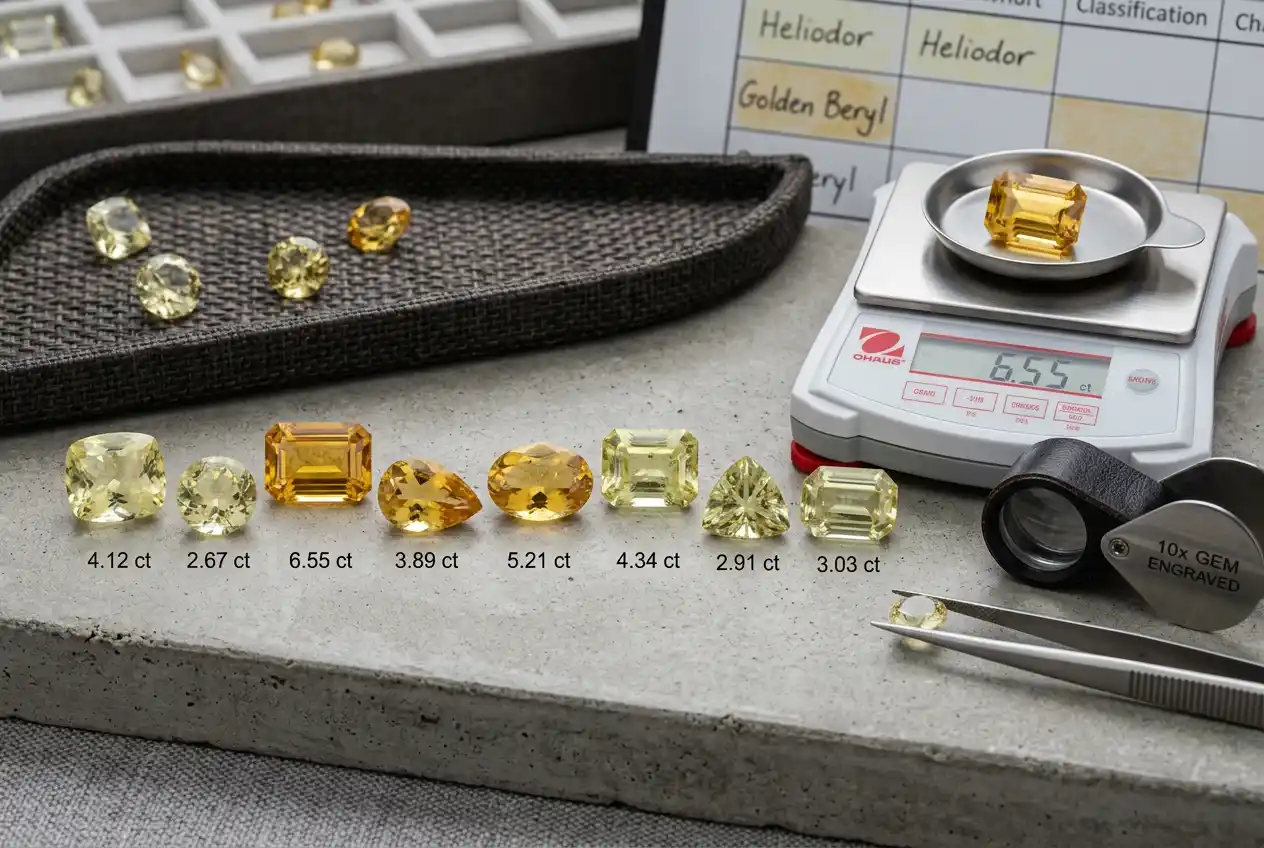
Heliodor Price Per Carat: 10 Key Drivers of Market Worth
Heliodor price per carat is usually moderate compared with emerald because clean yellow beryl can occur in relatively large crystals, but fine color, high transparency, precise cutting, and attractive golden saturation can still create meaningful premiums. Commercial pale-yellow stones may sell for roughly $20 to $60 per carat, while well-cut jewelry-quality heliodor with cleaner color and stronger saturation can move into approximately $60 to $200 per carat. Fine golden stones with excellent transparency, precision cutting, and attractive size may reach several hundred dollars per carat, while unusually vivid, large, well-documented collector gems can exceed ordinary ranges when color and craftsmanship are exceptional.
Heliodor belongs to the beryl mineral species, Be₃Al₂Si₆O₁₈, the same family that includes emerald, aquamarine, morganite, and goshenite. Its yellow to golden appearance is associated mainly with iron-related coloring processes within the crystal, especially ferric iron. The trade sometimes uses heliodor and golden beryl almost interchangeably, although some dealers prefer heliodor for greener or slightly more yellow-green material and golden beryl for richer yellow to golden stones. Because this usage is not perfectly standardized, the individual gemstone’s visible color matters more than the label alone.
The market also differs sharply from emerald because clarity expectations are much higher. Fine yellow beryl can be very transparent and eye-clean, so obvious inclusions, haziness, fractures, poor polish, or deep windowed cutting reduce value quickly. Large size is available enough that weight alone rarely creates the kind of steep scarcity premium seen in fine emerald or alexandrite. The best heliodor therefore earns value through a balanced combination of rich golden color, cleanliness, cut quality, efficient face-up size, durability, and trustworthy identity.
10 Key Drivers of Heliodor Market Worth
- Yellow, golden, or greenish-yellow hue quality
- Saturation and strength of golden color
- Tone, brightness, and freedom from brown or gray modifiers
- Clarity and transparency
- Cut quality, symmetry, polish, and brilliance
- Carat weight and face-up dimensions
- Natural identity within the beryl family
- Treatment history and color stability
- Geographic provenance and collector interest
- Craftsmanship, condition, matching, and market demand
These ten factors explain why a smaller well-cut golden heliodor can be worth more per carat than a much larger pale stone. Because sizeable beryl crystals occur naturally, rarity rises most strongly when color, clarity, and workmanship all improve together rather than when weight increases in isolation.
Typical Heliodor Price Per Carat
Heliodor does not have a universally standardized price chart, and stones are often sold according to total beauty, cutting, and size rather than through a rigid per-carat schedule. The ranges below are therefore practical orientation for natural loose gemstones rather than fixed market rules.
| Heliodor Quality | Approximate Price Per Carat | Typical Characteristics |
|---|---|---|
| Commercial quality | $20 to $60 | Pale yellow, ordinary cutting, minor inclusions |
| Good jewelry quality | $60 to $150 | Attractive yellow to golden color, good transparency |
| Fine quality | $150 to $350 | Strong golden saturation, eye-clean clarity, fine polish |
| Exceptional precision-cut quality | $300 to $700+ | Vivid color, excellent clarity, custom cutting, strong face-up spread |
| Rare collector stones | Highly variable | Exceptional size, provenance, natural crystal form, unusual color or craftsmanship |
These categories become even more flexible in finished jewelry because gold, platinum, accent stones, designer work, brand positioning, and setting labor can easily exceed the value of the loose heliodor itself. Custom-cut stones can also command rates that appear high relative to the rough because lapidary labor and design account for a significant portion of The Price.
Golden Color Creates the Strongest Visual Premium
Fine heliodor should show an attractive yellow to golden-yellow body rather than a weak washed-out tint. Pale lemon stones can be elegant and bright, but stronger saturation usually attracts greater demand when transparency remains high. Rich golden stones often receive the highest premiums because they combine the clarity expected from beryl with enough color strength to look distinctive rather than merely colorless with a slight yellow cast.
The best color should remain lively instead of becoming brownish or gray. Brown modifiers can make the gem look darker and heavier, especially in large stones, while gray reduces visual warmth and lowers saturation. Slight greenish components are acceptable and can be attractive, particularly in stones marketed traditionally as heliodor, but the body should still feel intentionally yellow or golden rather than drifting toward weak green beryl.
Color should always be evaluated under neutral lighting because warm artificial lamps can exaggerate gold and orange. A high-quality stone should remain visibly yellow or golden under daylight-equivalent illumination and should not depend on a warm spotlight to appear saturated.
Tone and Brightness Matter as Much as Saturation
Tone describes how light or dark a gemstone appears, and the ideal heliodor usually balances enough depth for rich color with enough brightness for the facets to remain lively. A very pale stone can look brilliant but weak in color, while an overly dark stone may preserve golden saturation yet lose transparency and face-up sparkle.
Large stones deserve special attention because greater thickness naturally deepens apparent color. A ten-carat heliodor can therefore look darker than a two-carat stone cut from similar rough. This is not necessarily a problem, but excessively deep cutting can amplify tone beyond what is visually desirable and may preserve hidden carat weight at the expense of face-up spread.
Fine heliodor should remain open and luminous. Individual facets should return light clearly, and the yellow body should look transparent rather than smoky. That balance between color strength and brightness is more valuable than maximum darkness.
Clarity Is Expected to Be High in Fine Heliodor
Beryl can form in large, transparent crystals, and fine yellow beryl is commonly expected to be eye-clean. Minor fluid inclusions, healed fissures, crystals, or growth features can occur naturally, but obvious central inclusions generally reduce value because cleaner stones are available.
This clarity expectation distinguishes heliodor sharply from emerald, where visible inclusions are common even in expensive gems. A moderately included emerald can remain valuable because fine clean emerald is exceptionally rare, while an equally included heliodor may be penalized more strongly because transparent yellow beryl is easier to obtain.
Surface-reaching fractures deserve more attention than harmless microscopic inclusions because they can affect durability. A tiny internal feature visible only with magnification may have almost no practical effect, while a fracture near the girdle can influence both setting risk and long-term value.
The finest faceted stones therefore combine transparent interiors with clean polished surfaces and minimal structural weaknesses.
Cut Quality Can Create More Value Than Extra Weight
Heliodor has a refractive index typical of beryl, lower than diamond or zircon but sufficient for attractive brilliance when proportions are well designed. A properly cut stone should return light across most of the face without a large central window or excessive dark extinction.
Shallow cutting is a common problem because transparent beryl can look appealing from the side while revealing a see-through center face-up. Deep cutting creates the opposite issue, retaining weight under the girdle while reducing visible spread and sometimes making the stone unnecessarily dark.
Precision cutting can add substantial value because colorless-to-yellow beryl responds beautifully to clean symmetry and polished facets. Custom concave, Portuguese-style, step, or fantasy cuts can transform good rough into a distinctive finished gem, and the resulting premium often reflects the cutter’s skill more than the scarcity of the crystal itself.
Fine polish is especially important because scratches and rounded facet junctions are easy to notice in transparent yellow gems. A vivid stone with weak finishing will generally look less valuable than a slightly lighter gem with excellent workmanship.
Carat Weight Produces a Moderate Rather Than Extreme Premium
Large beryl crystals can occur naturally, so heliodor does not become exponentially rarer at modest weight thresholds. Five-, ten-, or even larger-carat stones can be available when rough is sufficiently clean, which keeps per-carat increases more restrained than in rare gems that seldom occur in large transparent crystals.
Size becomes more valuable when a large stone preserves strong golden color, excellent transparency, efficient proportions, and eye-clean clarity. These qualities become harder to maintain together as crystal volume increases, even if large rough itself is not exceptionally rare.
Face-up dimensions are therefore essential. A deep twelve-carat stone may look smaller than a well-proportioned nine-carat gem, and the better-spread stone can offer greater visual impact despite its lower weight. Buyers should compare millimeter measurements along with carat weight instead of treating the scale as the only measure of size.
Heliodor, Golden Beryl, and Yellow Beryl Naming Can Vary
Trade terminology around yellow beryl is not entirely uniform. Heliodor is widely used for yellow to greenish-yellow beryl, while golden beryl often refers to warmer, richer yellow material. Some sellers use the terms interchangeably, and others try to create a strict separation that is not universally recognized across the gem trade.
This naming variation means The Price should not rise merely because one label sounds more prestigious. A vivid golden-yellow beryl sold simply as yellow beryl can be a better gemstone than a pale greenish specimen marketed as heliodor.
The correct valuation approach is to identify the stone as beryl, establish whether the color is natural and stable, then judge hue, saturation, tone, transparency, cut, and size. Trade names are useful for description, but the visible gem determines quality.
Natural Identity Separates Heliodor From Similar Yellow Gems
Heliodor can resemble yellow sapphire, citrine, yellow topaz, chrysoberyl, yellow tourmaline, and certain glasses or synthetic products. These gemstones can overlap significantly in photographs, especially when the exact tone is golden yellow.
Gemological testing can distinguish them through refractive index, birefringence, specific gravity, optic character, absorption features, inclusions, and other properties. Beryl’s combination of optical characteristics differs clearly from corundum, quartz, topaz, and chrysoberyl when tested properly.
This distinction matters because each yellow gemstone has its own rarity and price structure. A yellow sapphire and a heliodor of similar size may have very different market values even when they look comparable from a distance.
For expensive or unusually large stones, confident identification becomes more important because a rare-sounding trade name should not substitute for proper gemological evidence.
Treatment and Color Stability Need Careful Interpretation
Yellow beryl can be affected by radiation-related color centers and iron chemistry, and certain beryl colors can be modified through irradiation or heat. Some induced colors may be unstable when exposed to prolonged light or heat, depending on the mechanism responsible for the color.
Routine treatment is not as central to the heliodor market as heat treatment is in sapphire or oiling is in emerald, but buyers should still avoid assuming that every yellow beryl has an untouched color history. When a seller charges a premium specifically for untreated natural color, that claim should be supported appropriately if The Price is substantial.
A stable attractive stone remains desirable regardless of whether its exact shade fits a preferred trade term. Treatment disclosure becomes most important when the process materially affects color permanence, rarity, or market value.
Geographic Origin Usually Matters Less Than Visible Quality
Heliodor and yellow beryl occur in pegmatite regions around the world, including Brazil, Madagascar, Namibia, Ukraine, Pakistan, Afghanistan, and other beryl-producing areas. Many sources can produce large transparent crystals, so country of origin generally has less effect on faceted-stone pricing than it does for emerald.
Provenance becomes more interesting when the crystal comes from a famous locality, has unusual natural crystal form, or is tied to an old collection. In those situations an intact specimen can carry mineralogical value beyond what the same crystal might be worth if faceted.
For ordinary jewelry heliodor, however, origin should not replace direct grading. A vivid, clean, precision-cut stone from a less famous source can be more valuable than a pale included gem from a celebrated mine.
Heliodor Durability Makes It Practical for Jewelry
With a Mohs hardness around 7.5 to 8, heliodor is durable enough for many jewelry applications. It resists everyday scratching reasonably well, although sapphire and diamond are harder and can damage its polished surface when stored together.
Beryl can contain fractures and has imperfect cleavage tendencies, so individual stones still need structural inspection. Clean heliodor performs well in rings, pendants, earrings, and bracelets when protected from severe impact.
Gentle cleaning with mild soap, lukewarm water, and a soft brush is generally appropriate for sound untreated stones. Steam and ultrasonic cleaning should be approached cautiously when significant fractures or uncertain treatment history are present.
Condition influences value because chipped edges, abraded facet junctions, and surface scratches reduce the crisp optical appearance that transparent yellow beryl depends on.
Conclusion
Heliodor price per carat is driven by golden color, saturation, tone, clarity, cutting, face-up dimensions, natural identity, treatment history, provenance, condition, and craftsmanship. Commercial pale stones can remain affordable, while richly saturated golden gems with excellent transparency and precision cutting can move into several hundred dollars per carat or higher.
The best heliodor is not simply the largest or darkest stone. Fine quality comes from balance, with enough golden saturation to look distinctive, enough transparency to stay luminous, and enough cutting precision to return light efficiently. Because large clean beryl can occur naturally, craftsmanship and color often influence value more strongly than weight alone.
FAQs About Heliodor Price Per Carat
How much does heliodor cost per carat?
Commercial heliodor may sell for roughly $20 to $60 per carat, while good jewelry-quality stones can reach approximately $60 to $150 per carat. Fine golden stones with excellent transparency and cutting may move into roughly $150 to $350 per carat, while precision-cut or collector-level examples can rise higher when color, size, provenance, and craftsmanship are exceptional.
Why is heliodor usually cheaper than emerald?
Both belong to the beryl species, but fine emerald combines rare green coloration with a geological environment that commonly produces fissures and inclusions, making clean saturated rough much scarcer. Yellow beryl can occur in larger and cleaner crystals, so supply is generally greater and the size premium is much less severe.
Is heliodor the same as golden beryl?
The terms overlap significantly in trade usage. Some sellers use heliodor for greener yellow stones and golden beryl for warmer rich yellow gems, while others use both names more broadly for yellow beryl. The individual stone’s color, clarity, and cut matter more than attempting to force every specimen into a rigid naming distinction.
What color heliodor is most valuable?
Strong golden yellow with clean saturation and good brightness generally attracts the strongest demand, especially when the stone remains transparent rather than brownish or overly dark. Slightly greenish-yellow material can also be attractive, but vividness and overall beauty matter more than a particular label.
Does clarity strongly affect heliodor value?
Yes. Fine heliodor is generally expected to be eye-clean because transparent yellow beryl can occur relatively cleanly. Large visible inclusions, clouds, or fractures therefore lower quality more strongly than comparable inclusion levels would in emerald.
Does larger heliodor cost more per carat?
Large stones can command a premium when excellent color, transparency, and cutting remain intact, but size increases are usually moderate because beryl can form in large crystals. Efficient face-up dimensions often matter more than simply preserving maximum carat weight.
Can heliodor be treated?
Beryl color can be affected by irradiation and heat depending on the trace-element chemistry and defect structure. Routine enhancement is not the defining feature of the heliodor market, but color history should be disclosed when known, especially if untreated status is being used to justify a substantial premium.
Is heliodor durable enough for a ring?
Its hardness around 7.5 to 8 makes it reasonably suitable for rings, particularly when the stone is clean and securely set. Strong impacts and contact with harder gemstones should still be avoided because scratches, chips, or fractures can reduce both beauty and value.
What makes heliodor collector quality?
Collector-quality heliodor combines vivid natural-looking golden color, excellent transparency, substantial size, fine precision cutting or exceptional crystal form, strong condition, and credible provenance. An unusual specimen with important locality history can also carry collector value even when it is not intended for faceting.