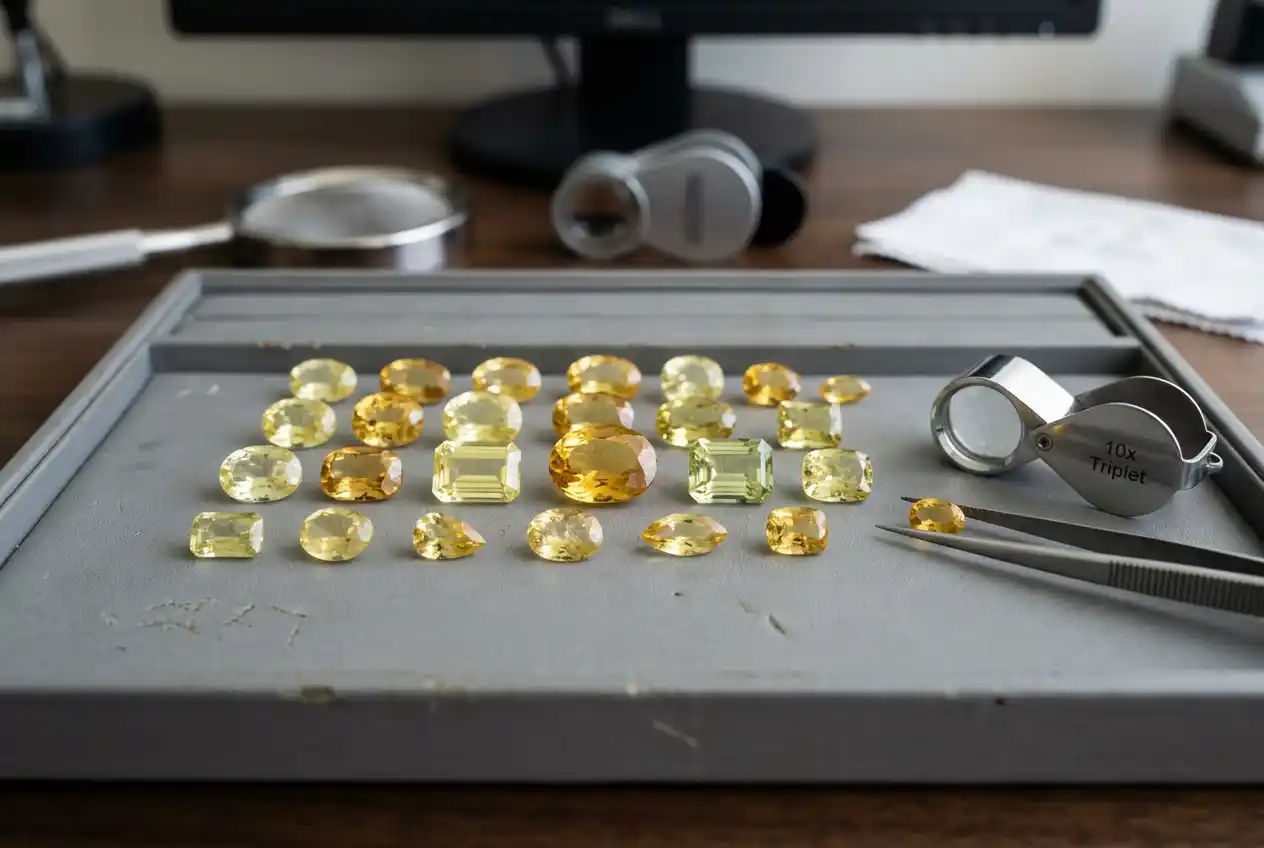
Heliodor Quality Grading: 9 Essential Ways to Rate Golden Beryl
Heliodor quality grading should focus on hue, saturation, tone, transparency, clarity, cut, size, treatment, and natural identity because yellow beryl is generally expected to be clean and luminous. Fine stones show a clearly attractive yellow or golden body without excessive gray or brown, remain bright enough for their facets to return light cleanly, and contain few inclusions visible from normal viewing distance. Large size can enhance an already strong grade, but it does not compensate for washed-out color, poor cutting, or cloudy transparency because sizable beryl crystals occur naturally.
The gemstone belongs to the beryl species, Be₃Al₂Si₆O₁₈, together with emerald, aquamarine, morganite, goshenite, and related varieties. Yellow coloration is associated mainly with iron-related processes within the structure, and natural stones can range from pale lemon through yellow-green to rich golden yellow. Trade terminology is not perfectly consistent, so some dealers distinguish heliodor from golden beryl while others treat the names as overlapping descriptions. Grading should therefore concentrate on the visible gemstone rather than assuming that one term represents a universally higher category.
There is no internationally standardized AAA or AAAA system for heliodor. Commercial grades may help one seller sort inventory, but they do not provide a shared scientific scale. A more useful approach evaluates observable characteristics directly and explains why a stone is fine, good, or commercial based on actual color, transparency, cutting, dimensions, and condition.
9 Essential Ways to Rate Golden Beryl
- Confirm natural beryl identity
- Grade yellow or golden hue quality
- Evaluate saturation and color strength
- Judge tone, brightness, and unwanted modifiers
- Assess transparency, clarity, and inclusion visibility
- Evaluate cut quality, symmetry, polish, and brilliance
- Consider carat weight, proportions, and face-up dimensions
- Review treatment history and color stability
- Assess condition, provenance, craftsmanship, and overall rarity
These nine standards provide a practical grading framework without treating every yellow beryl as though it should resemble a diamond or emerald. Fine heliodor succeeds because its golden color and transparency remain balanced, allowing the cutter to produce a bright, elegant gemstone rather than merely preserving maximum weight.
Natural Beryl Identity Comes Before Quality
Yellow gemstones can look remarkably similar in photographs, and heliodor may be confused with citrine, yellow sapphire, yellow topaz, yellow tourmaline, chrysoberyl, zircon, glass, and synthetic products. Proper identification therefore needs to establish that the stone belongs to the beryl species before a heliodor quality grade has any meaning.
Gemologists can distinguish beryl through refractive index, birefringence, specific gravity, optic character, absorption behavior, and microscopic features. These measurements separate it clearly from quartz, corundum, topaz, and other yellow gems when performed correctly.
This first step matters economically because every species has a different rarity profile. A vivid yellow sapphire can occupy a different market category from a similarly colored heliodor, while pale citrine may be substantially more abundant. Quality should always be judged after identity rather than inferred from color alone.
Hue Should Look Intentionally Yellow or Golden
High-quality heliodor should display a distinct yellow, golden-yellow, or slightly greenish-yellow appearance rather than looking nearly colorless with a faint tint. Pale lemon hues can be attractive, especially in bright precision cuts, but stronger golden color generally creates greater visual presence.
Slight green can occur naturally and may support traditional heliodor naming, while richer warmer yellow is often called golden beryl. Because these naming boundaries are not universally enforced, hue should be described directly instead of assuming one term automatically signals higher quality.
Brown or gray modifiers usually reduce conventional desirability because they weaken the fresh golden appearance. A trace of warmth can add richness, but muddy brown should not be confused with strong saturation.
Neutral daylight-equivalent illumination is the best starting point because warm artificial light can exaggerate gold and orange. Fine color should remain convincing without relying on a lamp that artificially enriches the hue.
Saturation Determines Whether the Stone Looks Fine or Merely Pale
Saturation describes how strongly the yellow color appears. A very pale beryl can be transparent and clean yet still look ordinary because the body color lacks enough intensity to distinguish it clearly from goshenite.
Fine heliodor generally benefits from medium to strong saturation, provided transparency remains high. The most desirable stones look golden rather than smoky, with color that fills the face evenly enough to create a cohesive appearance.
Color zoning can occur in beryl, and skillful cutting may reduce its visual impact by orienting the strongest region through the face. Obvious pale and dark bands usually reduce quality if they interrupt the appearance, while subtle natural variation can be acceptable in a large otherwise fine gem.
Saturation should therefore be judged across the entire crown rather than from one isolated edge where color may be concentrated.
Tone and Brightness Need to Remain Balanced
Tone determines whether heliodor appears light, medium, or dark, and excessive darkness can make a richly colored stone look less transparent. Fine stones should maintain enough brightness that individual facets remain visible and the body looks luminous.
Large heliodor often appears deeper in tone simply because light travels through more crystal. A cutter can also intensify apparent color through greater depth, but this strategy becomes counterproductive when the stone develops extinction or hides too much weight beneath the girdle.
Very light tone creates the opposite issue by weakening the visual identity of the gem. A perfectly clean pale-yellow stone can remain attractive, but it will generally grade below a comparably clean specimen with richer golden saturation and equally strong brightness.
The best grading decision therefore considers tone, saturation, transparency, and cutting together rather than ranking darkness by itself.
Clarity Standards Are High for Heliodor
Fine yellow beryl is commonly expected to be eye-clean because clean crystals are available. Internal features such as fluid inclusions, healed fissures, mineral crystals, growth tubes, or veils can occur naturally, but highly visible inclusions usually lower the grade when they interrupt transparency.
This expectation differs from emerald, where visible jardin is common even in valuable stones. Heliodor does not receive the same degree of tolerance because comparable clean material is easier to obtain.
Inclusion position still matters. A small transparent crystal near the girdle may have little effect, while a dark inclusion beneath the table can become the most noticeable feature in an otherwise bright stone. Surface-reaching fractures deserve even more attention because they can reduce durability.
Fine clarity therefore means more than an absence of obvious inclusions. It also means that the gemstone looks optically clean enough for color and cutting to dominate the face.
A Practical Heliodor Clarity Framework
| Face-Up Appearance | Practical Quality Interpretation |
|---|---|
| Eye-clean with excellent transparency | Fine to exceptional |
| Minor inclusions visible only under magnification | Very good |
| Small visible inclusions with limited brilliance loss | Good |
| Obvious clouds, crystals, or fractures | Commercial |
| Major fractures or poor transparency | Lower jewelry quality |
This framework is descriptive rather than a formal international grading standard. It reflects the practical reality that yellow beryl is judged more strictly for clarity than naturally inclusion-rich emerald.
Cut Quality Determines How Golden Color Performs
Heliodor can be fashioned into rounds, ovals, cushions, emerald cuts, pears, and elaborate custom designs because beryl rough often occurs in elongated crystals. The cutter should balance weight retention with proportions that return enough light for the golden body to remain bright.
Windowing is one of the clearest signs of weak cutting. When pavilion angles are too shallow, the center looks transparent and the viewer can see through the gem instead of receiving reflected light. This weakens both saturation and brilliance.
Excessive depth creates the opposite problem by hiding weight and increasing darkness. A deep stone may preserve a higher carat figure but appear smaller face-up than a lighter gem with better proportions.
Symmetry and polish refine the quality further because transparent yellow stones reveal craftsmanship easily. Crisp facet junctions, smooth polish, and balanced outlines can raise the overall grade substantially, particularly in precision-cut or designer stones.
Carat Weight Is Secondary to Face-Up Quality
Large heliodor can be impressive, but size alone is not rare enough to define top quality. Beryl crystals can reach substantial dimensions, and sizeable yellow stones may remain comparatively affordable when color or cutting is ordinary.
A larger gem becomes more important when vivid golden saturation, eye-clean clarity, efficient proportions, and fine polish survive together. Those combined characteristics are harder to maintain as the stone grows, even though large rough itself can occur.
Face-up spread should therefore be evaluated alongside weight. Two ten-carat stones can look very different if one carries unnecessary pavilion depth. The broader, brighter gem may provide substantially greater visual value despite identical scale readings.
Quality grading should reward efficient use of rough rather than simply maximizing retained carats.
Treatment and Color Stability Should Be Considered Separately From Beauty
Beryl color can be influenced by irradiation, heat, trace-element chemistry, and structural defects. Certain induced yellow or other colors can show different stability depending on how the color center was produced.
Routine treatment is not the dominant feature of the heliodor market, so many buyers reasonably focus on visible color and clarity. Treatment becomes more important when a seller claims an unusual stone is completely untreated or when the color looks dramatically different from typical natural yellow beryl.
A stable well-documented gemstone deserves greater confidence than a stone whose color history is uncertain and whose appearance may change with prolonged light or heat exposure. Treatment should therefore be recorded separately rather than used automatically to override visible quality.
Provenance and Condition Complete the Final Grade
Geographic origin has relatively limited influence on ordinary faceted heliodor because excellent yellow beryl can come from several major pegmatite regions. Brazil, Madagascar, Namibia, Ukraine, Pakistan, Afghanistan, and other localities can all produce attractive crystals.
Provenance matters more strongly for mineral specimens, historically important stones, or gems associated with documented old collections. A natural crystal with excellent termination, unusual size, attractive associated minerals, or a famous locality can be valuable as a specimen even if it would not produce the highest faceted clarity.
Condition always matters. Scratched facets, chipped corners, abraded edges, or open fractures reduce quality regardless of provenance. A fine grading system therefore records the gemstone as it exists now rather than relying solely on its original cutting quality or mine history.
Heliodor Versus Citrine, Yellow Sapphire, and Yellow Topaz
Citrine is quartz and usually has a lower refractive index and different hardness from beryl. Yellow sapphire is corundum, considerably harder and generally capable of commanding much higher prices at fine quality. Yellow topaz has different cleavage, density, and optical properties, while chrysoberyl can also appear golden yellow but belongs to another mineral species entirely.
These distinctions are important because appearance alone does not establish value. A large yellow stone may look impressive but belong to a common and inexpensive species, while another visually similar gem may be much rarer.
Heliodor’s appeal lies in being a natural yellow beryl with good durability, clean transparency, and the ability to occur in large precision-cut gems. It should therefore be graded on those qualities rather than mainly on how closely it resembles a more expensive yellow gemstone.
Common Heliodor Grading Mistakes
One common mistake is assuming that the darkest golden stone must be the finest. Rich saturation is desirable, but excessive darkness or brown tone can reduce transparency and brilliance. Another error is paying heavily for size while ignoring deep cutting, since large beryl rough is available enough that hidden weight should not receive a premium simply because it pushes the stone past a psychological carat threshold.
Clarity can also be misunderstood when emerald expectations are transferred directly to heliodor. Visible inclusions that may be acceptable in fine emerald generally carry a stronger penalty in yellow beryl because eye-clean alternatives are more accessible.
Finally, trade names can create artificial hierarchy. Heliodor and golden beryl overlap in usage, so a buyer should grade the actual color and quality rather than paying extra solely because one seller prefers a more prestigious-sounding label.
Conclusion
Heliodor quality grading should evaluate natural beryl identity, hue, saturation, tone, transparency, clarity, cut, dimensions, treatment, condition, and provenance together. Fine stones combine rich yellow or golden color with enough brightness to remain luminous, while inclusions and poor cutting stay sufficiently limited that the body color remains the dominant visual feature.
The highest quality does not come from size or darkness alone. A smaller eye-clean golden gem with balanced proportions and excellent polish can grade far above a heavier stone that looks pale, windowed, or muddy. Clear descriptive grading therefore provides a much more useful assessment than seller-defined AAA terminology or inconsistent distinctions between heliodor and golden beryl.
FAQs About Heliodor Quality Grading
What is the most important factor in heliodor quality?
Color is usually the strongest visible factor, but fine color needs to be supported by transparency and cutting. A rich golden hue loses much of its value if the stone is cloudy, excessively dark, or badly windowed, so overall balance matters more than one isolated characteristic.
What color is considered the best heliodor?
Rich golden yellow with clean saturation and good brightness is generally highly desirable, while attractive slightly greenish-yellow material can also grade well. Excessive brown, gray, or darkness usually lowers the conventional grade because it weakens the luminous golden appearance associated with fine yellow beryl.
Should high-quality heliodor be eye-clean?
Yes, eye-clean clarity is normally expected in fine stones because clean yellow beryl occurs relatively readily. Minor inclusions under magnification may be acceptable, but obvious central crystals, clouds, or fractures generally reduce quality more strongly than they would in emerald.
Is heliodor the same as golden beryl?
The terms overlap and are not separated consistently throughout the trade. Some dealers use heliodor for greener yellow stones and golden beryl for richer warm yellow, while others use the names interchangeably. Grading should therefore focus on the actual gemstone’s color, clarity, and cutting rather than the label.
Does larger heliodor receive a higher quality grade?
Not automatically. Large beryl crystals can occur naturally, so size becomes meaningful mainly when strong golden color, excellent clarity, and efficient cutting survive together. A large pale stone with excessive depth can grade below a smaller precision-cut gem.
Is darker heliodor better?
Not necessarily. Strong saturation is valuable, but excessive darkness can reduce transparency and create extinction. The finest stones usually balance golden color strength with enough brightness for the facets to remain lively.
How important is cut in heliodor grading?
Cut is very important because shallow proportions can create windowing and deep proportions can hide weight while darkening the stone. Fine symmetry, polish, and efficient pavilion angles allow yellow beryl to appear brighter and more saturated.
Is heliodor commonly treated?
Treatment is not the defining feature of the market, but beryl color can be altered through irradiation or heat in suitable stones. Treatment and color stability should be disclosed when known, particularly if untreated status is being used to justify a premium.
Are AAA heliodor grades standardized?
No. AAA, AAAA, premium, and similar commercial labels vary among sellers. A useful grade should explain hue, saturation, tone, clarity, cut, dimensions, treatment, and condition directly rather than relying on an undefined letter category.
What makes heliodor exceptional?
Exceptional heliodor combines vivid golden-yellow color, strong transparency, eye-clean clarity, excellent polish, well-balanced proportions, substantial but efficiently distributed size, stable natural-looking color, strong condition, and, where relevant, notable precision cutting or provenance.