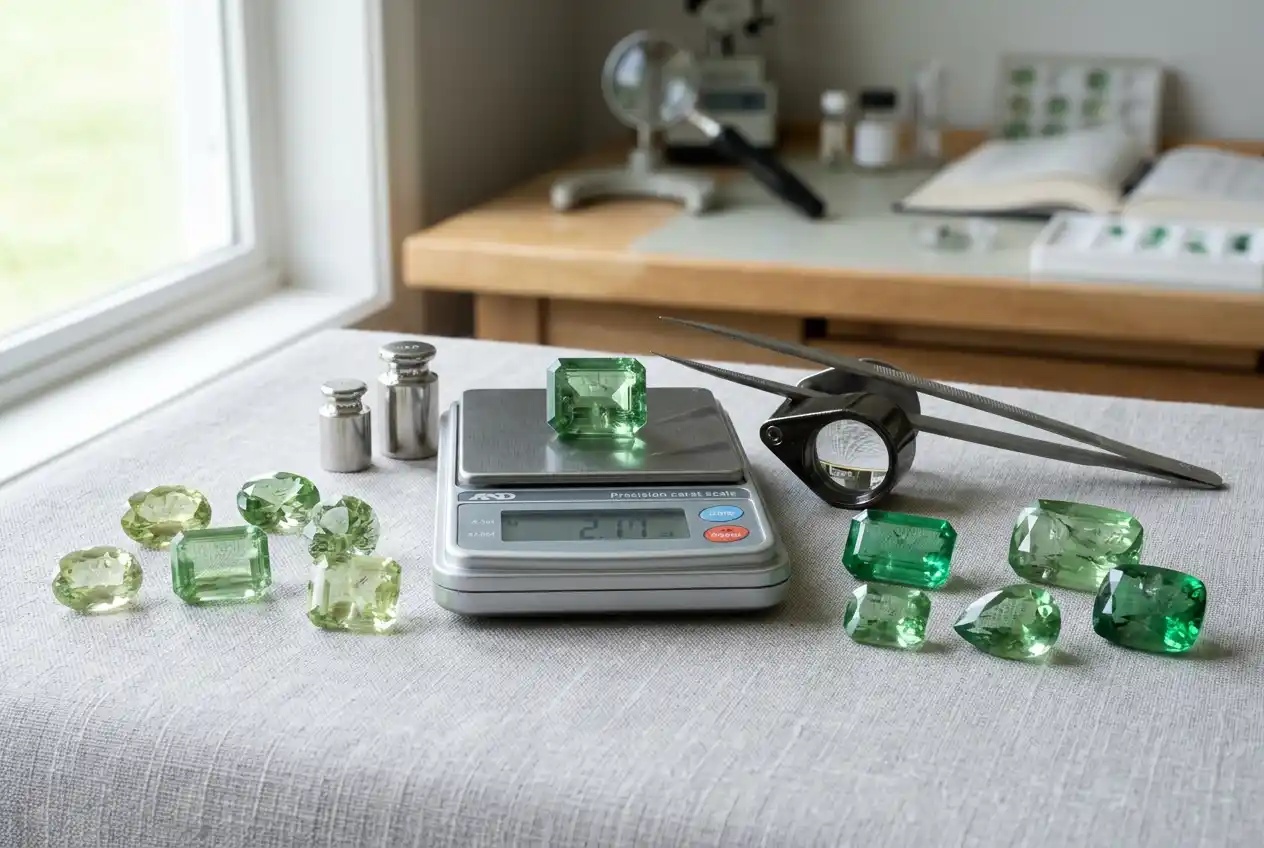
Hiddenite Price Per Carat: 8 Value Drivers for Green Spodumene
Hiddenite price per carat can vary from roughly $50 to $150 for pale or included green spodumene sold at commercial quality to several hundred dollars per carat for attractive transparent stones with stronger natural green color, good clarity, and careful orientation. Fine gems with vivid green color, convincing natural identity, excellent transparency, and desirable provenance can move into approximately $300 to $1,000 per carat, while unusually fine collector stones with strong chromium-related color, important size, stable appearance, and reliable documentation may reach higher levels. The Price rises most sharply when the stone combines genuine rarity with attractive color rather than merely carrying the hiddenite name.
Hiddenite is the green variety of spodumene, LiAlSi₂O₆, and its most historically important occurrence is associated with North Carolina in the United States, where the variety was named after mineralogist and explorer William Earl Hidden. Fine natural hiddenite is commonly associated with chromium-related green coloration and can range from light yellow-green through fresh medium green to richer emerald-like shades. The term is sometimes used loosely in the marketplace for green spodumene from other sources, so identification, color origin, and locality claims deserve more attention than they would for an inexpensive common gemstone.
Spodumene is strongly pleochroic, meaning the color changes according to crystallographic viewing direction. This makes cutting orientation central to value because one direction may display a much stronger green while another appears pale or yellowish. The mineral also has pronounced cleavage and is brittle despite a Mohs hardness around 6.5 to 7, which complicates cutting and setting. Fine hiddenite therefore represents not just attractive rough but successful management of color direction, internal fractures, weight retention, polish, and structural safety.
8 Value Drivers Behind Hiddenite Price Per Carat
- Natural green color and strength of chromium-related coloration
- Pleochroism and quality of cutting orientation
- Transparency, clarity, and inclusion character
- Carat weight and rarity of larger fine stones
- Cut quality, face-up brightness, symmetry, and polish
- Color stability and treatment history
- Geographic origin, especially credible North Carolina provenance
- Structural condition, natural identity, documentation, and collector demand
These eight factors interact closely because hiddenite cannot be valued accurately through color or weight alone. A large pale green spodumene with uncertain treatment history may be less valuable than a smaller natural stone whose chromium-related green is stronger, whose pleochroism has been oriented effectively, and whose provenance is well documented. The hiddenite label adds meaningful value only when the gemstone actually possesses the natural characteristics and rarity that justify it.
Typical Hiddenite Price Per Carat
The market for hiddenite is comparatively small, and there is no standardized international price schedule. Trade usage can also blur the distinction between historically defined hiddenite and green spodumene more generally, so the following ranges should be treated as practical orientation rather than fixed valuation rules.
| Hiddenite or Green Spodumene Quality | Approximate Price Per Carat | Typical Characteristics |
|---|---|---|
| Commercial quality | $50 to $150 | Pale green, visible inclusions, ordinary cutting or uncertain provenance |
| Good jewelry quality | $150 to $350 | Attractive green, useful transparency, competent cut |
| Fine quality | $300 to $1,000 | Strong natural-looking green, high clarity, good pleochroic orientation |
| Exceptional collector quality | $1,000+ | Rich color, notable provenance, fine transparency, unusual size or rarity |
| Important mineral specimens | Highly variable | Natural crystal form, locality significance, associated minerals, historical value |
These ranges become especially flexible when provenance is important. A modest faceted green spodumene and a documented historic North Carolina hiddenite may occupy very different collector markets even if they appear similar in photographs. Precision cutting can also add a strong premium because the cutter has to work around cleavage while orienting the best green direction toward the face of the gemstone.
Natural Green Color Is the Main Visible Value Driver
Fine hiddenite should display a recognizable natural green rather than a weak gray-green or nearly colorless body. The most desirable stones generally show clean yellow-green to medium or richer green without excessive brown or dull gray. Stronger green saturation can create an emerald-like impression, although hiddenite should not be valued merely according to how closely it resembles emerald because its chemistry, optical behavior, durability, and rarity are different.
Chromium is particularly important to classic hiddenite coloration. This distinction matters because not every green spodumene in commerce has the same coloring mechanism, treatment history, or provenance. A seller may use hiddenite as a convenient color term even when the gemological basis for the name has not been demonstrated, especially for material from sources outside the classic North Carolina locality.
Fine color should also remain attractive under realistic lighting. A gem that appears vivid beneath intense display lamps but weak and gray in ordinary indoor light should not receive the same premium as a stone whose green remains distinct across different environments. Color strength, tone, and transparency must therefore be considered together before The Price is judged.
Pleochroism Can Improve or Weaken the Finished Gem
Hiddenite inherits the strong pleochroism of spodumene, so a crystal can show different colors or different strengths of green depending on viewing direction. One axis may appear richer green while another becomes much paler, yellowish, or almost colorless. This directional behavior can be visually attractive, but it also creates a major cutting challenge because the cutter must choose which orientation will dominate through the table.
If the best green direction is positioned correctly, the finished gemstone can appear saturated and lively while showing subtle shifts during movement. Poor orientation can produce a pale face even when the original rough contained a much stronger green direction. This means a smaller stone cut for optimal color can be more valuable per carat than a heavier stone whose cutter prioritized weight retention.
Pleochroism should therefore be judged in the finished face-up position rather than treated as an abstract optical property. The important question is whether the directional colors make the stone more attractive and whether the cutter has used them intelligently.
Clarity Matters Strongly in Faceted Hiddenite
Transparent hiddenite is expected to show enough internal cleanliness that the green color remains the main visual feature. Natural crystals may contain fractures, veils, growth features, mineral inclusions, or other internal structures, but obvious dark inclusions and broad cloudy areas reduce value more strongly when comparable cleaner stones are available.
The type and position of an inclusion matter as much as the total amount. A small transparent feature near the girdle can have little effect on face-up beauty, while a central reflective fracture can interrupt brilliance across a large portion of the stone. Surface-reaching fractures deserve even greater attention because spodumene already has pronounced cleavage and can be vulnerable to breakage.
Fine clarity therefore requires both optical transparency and reasonable structural integrity. A gem can appear clean at first glance yet still contain a cleavage-related weakness that affects setting security. For valuable stones, magnification should be used to distinguish harmless internal features from fractures that could compromise durability.
Carat Weight Adds Value Only When Fine Color Survives
Spodumene can occur in large crystals, and other varieties such as kunzite are well known in substantial sizes. Hiddenite is different because fine green color and gem-quality transparency are not distributed uniformly through every large crystal, making bigger high-quality stones significantly harder to obtain.
The rarity premium becomes meaningful when a larger gemstone preserves attractive natural green, strong transparency, favorable pleochroic orientation, and sound structural condition. A ten-carat pale or heavily fractured green spodumene does not automatically become a collector stone merely because the scale reading is impressive.
Face-up dimensions also need to be compared with weight. Deep cutting can preserve additional carats while reducing visible spread, and a thick pavilion can darken or distort the pleochroic appearance. A lighter, broader stone with stronger face-up green may therefore provide both better visual impact and better value.
Cutting Hiddenite Requires More Than Good Proportions
Spodumene’s cleavage makes it one of the more demanding transparent gemstones to facet successfully. Strong pressure, heat, or an unfortunate orientation can cause a crystal to split, and cutters need to consider internal fractures alongside pleochroism before deciding how to orient the rough.
A well-cut hiddenite should return light across most of the face without a large central window. Excessive depth can preserve weight but may create dark areas and a small visual footprint, while shallow cutting can weaken saturation and make the gemstone look watery.
Polish and facet junctions are equally important because scratches or rounded edges reduce the crispness expected from a fine transparent gem. Precision cutting can command a significant premium because successful work may require sacrificing weight in order to protect the crystal and display the strongest green direction.
Custom shapes can be entirely appropriate when they follow the natural form of the rough. An elongated oval, cushion, emerald cut, or freeform design may outperform a standardized shape if it preserves superior color and avoids dangerous cleavage planes.
Color Stability and Treatment History Need Careful Attention
Green spodumene has a complicated relationship with radiation and color stability. Some spodumene colors can be induced or modified by irradiation, and certain artificially produced green colors may fade when exposed to light or heat. This is one reason the hiddenite name should not be applied carelessly to every attractive green spodumene.
A fine collector stone should ideally have a stable natural appearance whose color is not dependent on an unstable induced state. If a seller is charging a substantial premium for natural hiddenite, treatment history and color stability become important parts of the valuation rather than optional details.
This does not mean every pale green stone is suspicious or every darker green gem is treated. It means that unusually intense color, uncertain origin, and a high Price justify closer examination. A stable stone with credible natural identity commands greater confidence than one whose appearance changes noticeably after prolonged exposure to strong light.
North Carolina Provenance Can Add Significant Collector Interest
Classic hiddenite is historically associated with the Hiddenite area of North Carolina, and this provenance has a special place in mineralogical history. Fine crystals and faceted gems from this locality can command collector premiums because the origin connects directly with the naming and early recognition of the variety.
Locality alone should not replace visible quality. A heavily fractured pale specimen may still be important mineralogically, but it does not become an exceptional faceted gem simply because it comes from North Carolina. Conversely, a beautifully transparent green spodumene from another locality may be excellent jewelry even when collectors debate whether hiddenite is the most precise trade name for it.
For high-value stones, credible provenance adds much more confidence than an unsupported verbal claim. Old collection records, mineral labels, laboratory examination, or well-established chain of ownership can significantly strengthen collector value when the locality itself is part of The Price.
Hiddenite Versus Other Green Gemstones
Hiddenite can resemble green tourmaline, peridot, prasiolite, green beryl, diopside, and even lighter emerald in certain photographs. These stones differ in chemical composition, refractive properties, pleochroism, durability, and market value, so visual resemblance alone is not enough for identification.
Emerald is green beryl and is generally more included, harder, and much more strongly established in the international gemstone market. Green tourmaline can occur in deeper tones and often shows strong pleochroism of its own, while peridot commonly has a more yellow-green body and distinctive optical properties. Green spodumene should therefore be valued as spodumene rather than primarily as an emerald substitute.
Professional testing can separate these gemstones through refractive index, birefringence, specific gravity, spectroscopy, inclusions, and other observations. Accurate identity becomes particularly important when a hiddenite premium is being charged.
Hiddenite Durability Requires More Care Than Its Hardness Suggests
A Mohs hardness around 6.5 to 7 gives hiddenite moderate scratch resistance, but cleavage is the more important durability concern. Spodumene has pronounced cleavage and can split if struck sharply in an unfortunate direction, making it less forgiving than sapphire, spinel, or many garnets.
Rings can be made successfully with hiddenite, but protective settings and careful wear are important. Pendants and earrings expose the stone to fewer impacts and may be better choices for especially rare gems. A large stone with vulnerable corners or existing fractures deserves additional protection regardless of its carat weight.
Cleaning should remain gentle. Lukewarm water, mild soap, and a soft cloth or brush are generally safer than ultrasonic vibration, steam, or sudden temperature changes. Abrasive storage with harder gemstones should also be avoided because scratches and chipped edges can quickly reduce the clean appearance that contributes to value.
Conclusion
Hiddenite price per carat is determined by natural green color, pleochroism, clarity, carat weight, cutting, color stability, provenance, treatment history, structural condition, and collector demand. Commercial pale green spodumene can remain relatively affordable, while fine transparent stones with strong natural green color and documented provenance can rise into several hundred dollars per carat or more.
The most important buying decision is not simply whether a stone is called hiddenite. Fine value depends on whether the green is attractive and stable, whether the cutter has oriented the pleochroism successfully, whether fractures threaten durability, and whether origin or treatment claims are credible. When those characteristics align in a transparent, well-cut stone, hiddenite can occupy a rare and distinctive position among green gemstones.
FAQs About Hiddenite Price Per Carat
How much does hiddenite cost per carat?
Commercial green spodumene sold as hiddenite may begin around $50 to $150 per carat, while good transparent jewelry-quality stones can reach approximately $150 to $350 per carat. Fine natural-looking green gems with excellent clarity and strong cutting can rise into roughly $300 to $1,000 per carat, with exceptional collector material moving higher when provenance and rarity are unusually strong.
Why is some hiddenite much more expensive than other green spodumene?
The strongest premiums occur when a stone combines convincing natural green color, strong transparency, favorable pleochroic orientation, sound structural condition, useful size, and credible provenance. A pale stone of uncertain treatment history may look attractive but belongs to a different rarity category from well-documented classic hiddenite.
Is all green spodumene hiddenite?
The trade sometimes uses hiddenite loosely for green spodumene, but historically and gemologically the name is most strongly associated with naturally green, chromium-bearing spodumene, particularly the classic North Carolina material. For expensive stones, identification and origin should be described carefully rather than assuming every green spodumene is equivalent.
Does hiddenite show pleochroism?
Yes. Hiddenite can show distinctly different color strengths along different crystallographic directions, including stronger green and much paler yellowish or nearly colorless appearances. Cutting orientation determines which direction dominates the finished gemstone, making pleochroism an important value factor.
Does larger hiddenite cost more per carat?
Larger fine stones can receive a premium when strong green color, transparency, stability, and structural integrity remain intact. Size alone is not enough because spodumene can form large crystals, and a heavy pale or fractured stone may remain much less valuable than a smaller high-quality gem.
Can hiddenite color fade?
Some green colors in spodumene can be induced or altered by irradiation and may show limited light stability. This is why treatment history and color stability deserve attention when a stone has unusually strong color or carries a high collector Price.
Is North Carolina hiddenite more valuable?
Documented North Carolina origin can add meaningful collector value because the locality is historically tied to the naming of hiddenite. The strongest premiums apply when good provenance is combined with attractive color, transparency, size, and condition rather than locality alone.
Is hiddenite durable enough for everyday jewelry?
Hiddenite has moderate hardness but pronounced cleavage, so it needs more careful handling than sapphire, spinel, or diamond. It can be worn in jewelry successfully, but protected settings and avoidance of hard impacts are especially important for rings.
What makes hiddenite collector quality?
Collector-quality hiddenite combines stable natural green color, high transparency, attractive pleochroism, skilled orientation, limited distracting inclusions, significant size, strong structural condition, credible provenance, and accurate treatment disclosure.