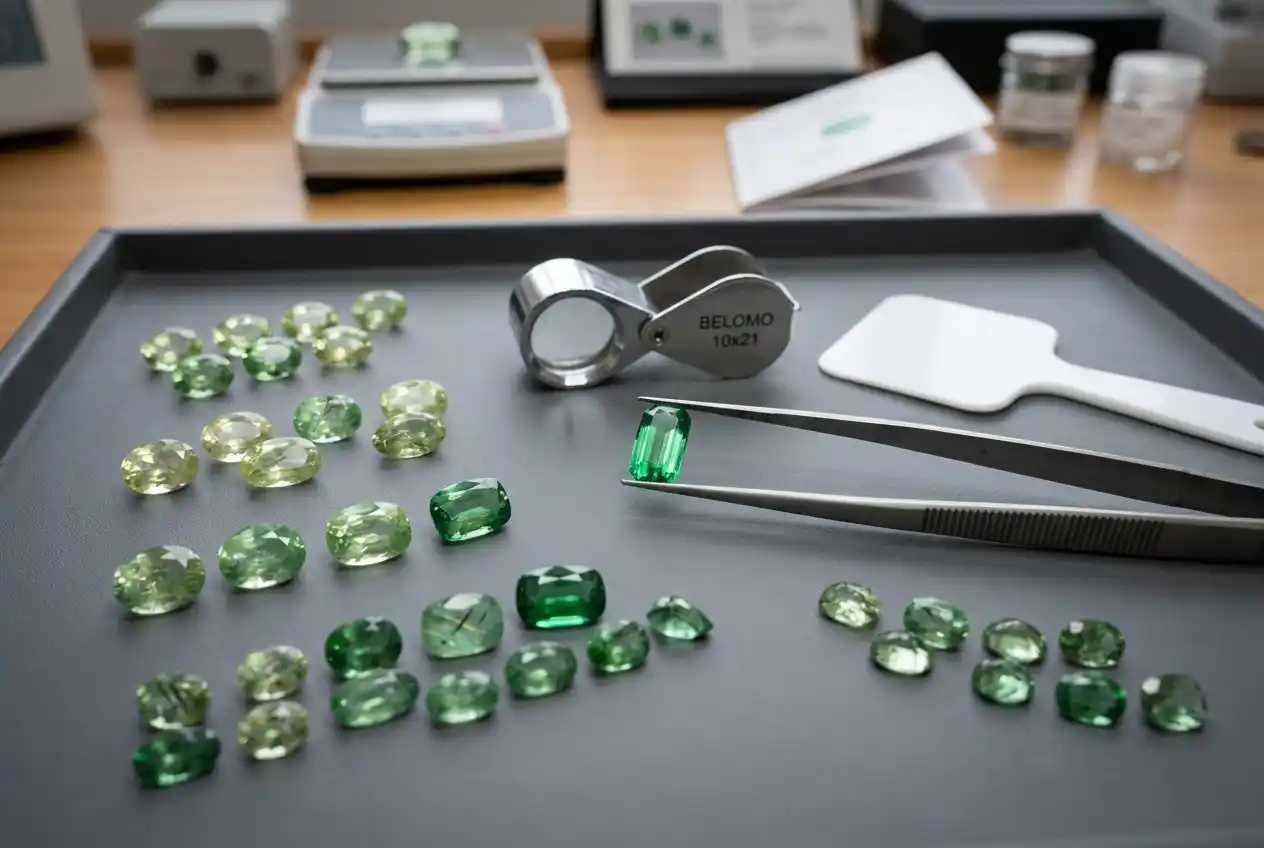
Hiddenite Quality Grading: 7 Key Standards for Color & Pleochroism
Hiddenite quality grading should begin with natural identity and color origin because the name hiddenite is sometimes applied too loosely to green spodumene. Fine hiddenite should show an attractive natural green that remains stable, enough transparency for the gemstone to look lively, and a cutting orientation that takes advantage of spodumene’s strong pleochroism instead of allowing a pale crystallographic direction to dominate. Clarity and size matter, but neither should outweigh structural condition because spodumene’s pronounced cleavage can make an apparently beautiful gem vulnerable to breakage.
Hiddenite is green spodumene with the formula LiAlSi₂O₆ and belongs to the monoclinic pyroxene family. It shares the same mineral species with kunzite, the pink to violet variety of spodumene, but its green color has a different chemical and structural origin. Classic hiddenite is particularly associated with chromium-related coloration and the historic North Carolina locality from which the variety received its name, although green spodumene from other parts of the world is also sold under the hiddenite name in modern commerce.
No universally standardized AAA or AAAA system controls hiddenite grading. A meaningful assessment therefore needs to describe the stone directly through color, pleochroism, transparency, inclusions, cut, size, treatment, provenance, and condition. This is especially important because an impressive green appearance can be created or altered in some spodumene through irradiation, while the market value of a stable naturally colored collector stone can be much higher.
7 Key Standards for Hiddenite Quality Grading
- Confirm natural green spodumene identity and appropriate hiddenite classification
- Grade green hue, saturation, tone, and color stability
- Evaluate pleochroism and cutting orientation
- Assess transparency, clarity, and inclusion character
- Judge cut quality, symmetry, polish, and face-up brightness
- Consider carat weight, dimensions, and rarity within fine green material
- Review cleavage, structural condition, treatment history, provenance, and documentation
These seven standards place the gemstone’s identity and structural behavior ahead of commercial labels. A high-grade hiddenite should not merely look green in one photograph. It should remain attractive through normal viewing angles, preserve enough transparency for clean light return, show a stable color, and be cut in a way that respects both pleochroism and cleavage.
Natural Identity Comes Before the Hiddenite Quality Grade
Green spodumene can be confused visually with green tourmaline, peridot, green beryl, prasiolite, diopside, glass, and several other gemstones. Because hiddenite can command a rarity premium, the first grading step is to establish that the stone is actually spodumene rather than assuming identity from color alone.
Gemologists can use refractive index, birefringence, specific gravity, optic character, pleochroism, spectroscopy, inclusions, and other observations to identify spodumene. The mineral’s strong cleavage and characteristic optical behavior also provide supporting evidence when the stone can be examined properly.
The hiddenite name requires an additional layer of care because market usage is not completely consistent. Historically, the term is most strongly associated with naturally green chromium-bearing spodumene from North Carolina, while modern sellers sometimes use it for green spodumene from other sources regardless of the exact coloring mechanism.
A fine quality grade should therefore make clear what is known rather than turning a trade name into proof of natural color, origin, or rarity.
Green Hue Must Be Judged Together With Saturation and Stability
High-quality hiddenite should show a fresh green that can range from yellow-green through medium green to richer shades approaching an emerald-like appearance. Strong saturation is generally desirable, but the color should remain bright enough that the stone does not look dull, brownish, or gray.
Tone affects the result substantially because a darker crystal may concentrate green color while sacrificing transparency. A lighter stone can appear more brilliant but may lack the depth associated with fine hiddenite. The best grade usually comes from a balance where green is obvious and attractive while enough light returns through the facets to keep the gemstone lively.
Color stability is part of this grade because some spodumene can develop induced colors through irradiation that may fade with exposure to light or heat. An unusually vivid green stone should therefore not receive an exceptional natural-color grade merely because it looks attractive at the moment of sale. Confidence in stable natural appearance strengthens both quality and long-term value.
Pleochroism Is Central to Hiddenite Grading
Spodumene is strongly pleochroic, which means different crystallographic directions can show noticeably different colors or color strengths. In hiddenite, one direction may produce the most attractive green while another appears pale yellow-green or nearly colorless.
A skilled cutter studies these axes before placing the table because the orientation determines which color dominates the face. If the richer green axis is used successfully, the finished stone can appear saturated while still revealing subtle color shifts as it moves. If the pale axis dominates, the gemstone can look washed out even though the rough contained much stronger color.
Pleochroism should therefore be evaluated through the face-up position and through gentle rotation. High-grade cutting makes the effect interesting without allowing large pale zones to weaken the overall color. The quality of this orientation can matter more than preserving an extra fraction of a carat.
Transparency and Clarity Need to Support the Green Color
Fine faceted hiddenite should be transparent enough that the green body color remains luminous rather than cloudy. Natural inclusions can include fractures, veils, crystals, growth features, and other internal structures, but their effect depends on position, size, relief, and structural significance.
A small transparent inclusion near an edge may have little practical influence, while a bright reflective fracture beneath the table can interrupt a large portion of the face. Heavy clouding reduces transparency and therefore weakens color depth and brilliance, making it a greater quality concern than microscopic features visible only under magnification.
Surface-reaching fractures deserve particular attention because spodumene has pronounced cleavage. A stone may appear clean enough visually yet still contain a weakness that makes setting or accidental impact risky. Fine clarity therefore requires not only a pleasing face but also reasonable internal security.
A Practical Hiddenite Clarity Framework
| Face-Up Appearance | Practical Quality Interpretation |
|---|---|
| Eye-clean with strong transparency | Fine to exceptional |
| Minor inclusions visible only under magnification | Very good |
| Small visible inclusions with limited brilliance loss | Good |
| Obvious clouds or fractures affecting transparency | Commercial |
| Significant cleavage-related fractures or structural weakness | Lower jewelry quality |
This framework is descriptive rather than an official international standard. Its purpose is to separate minor natural features from structural problems that can matter much more in spodumene than a simple inclusion count would suggest.
Cut Quality Has to Balance Pleochroism and Cleavage
Hiddenite can be challenging to facet because the cutter needs to manage three competing priorities at once: preserving strong green color, avoiding dangerous cleavage directions, and retaining as much rare rough as practical. This can lead to elongated cuts, modified ovals, cushions, emerald-style shapes, and custom designs that follow the crystal rather than conforming to a standard template.
A high-quality cut should still avoid severe windowing. If the pavilion is too shallow, the center becomes transparent and the green color appears weak. Excessive depth creates hidden weight, reduces face-up size, and can produce dark areas that make the stone look less lively.
Polish matters because transparent spodumene should show crisp facet reflections. Scratches, dull facets, chips, and rounded junctions reduce the quality grade, particularly when the body color is light enough that surface defects remain obvious.
Slight asymmetry can be acceptable when it protects the crystal from cleavage or preserves exceptional color. The goal is not perfect geometry at any cost but a finished gemstone in which color, safety, and light return have been balanced intelligently.
Size Must Be Judged Within the Fine Hiddenite Category
Spodumene crystals can become very large, so carat weight by itself does not establish rarity. The important question is whether a larger gemstone preserves desirable natural green, high transparency, stable color, good orientation, and manageable cleavage-related risk.
A substantial stone with weak color or obvious fractures may remain commercial, while a smaller gem with rich stable green and excellent clarity can receive a far higher grade. Fine size becomes meaningful only after these other characteristics have been established.
Face-up dimensions should accompany weight because cutters may preserve depth to protect the crystal or retain carats. A deep ten-carat stone can look smaller than a well-proportioned seven-carat gem, so visible spread and color performance matter more than the number on the scale.
Cleavage and Structural Condition Are Essential Quality Factors
Hiddenite’s Mohs hardness around 6.5 to 7 can create a misleading impression of durability because hardness measures scratch resistance rather than resistance to breaking. Spodumene has pronounced cleavage and can split if struck or pressured in an unfavorable direction.
The grader should inspect the girdle, corners, facet edges, and any visible fractures carefully. Chips or open cracks may indicate previous impact, while a fracture aligned with cleavage can create a particularly serious setting concern.
This structural behavior also affects jewelry recommendations. Pendants and earrings generally expose hiddenite to fewer impacts than rings, while protective ring settings can reduce risk around vulnerable edges. Condition should therefore be part of the final quality grade rather than treated only as a care issue after purchase.
Treatment History and Color Stability Need Direct Disclosure
Spodumene is known to respond to irradiation, and some induced green colors can be unstable. Exposure to daylight or heat may weaken certain artificially produced colors, creating a major difference between temporary visual intensity and durable natural quality.
A buyer should therefore be cautious when encountering very strongly colored green spodumene whose origin and treatment history are vague. This does not mean that vivid natural hiddenite does not exist. It means that exceptional claims deserve stronger evidence because treatment can affect both value and color stability.
Laboratory testing may not answer every question about historical color treatment perfectly, but professional examination, provenance, and realistic disclosure provide much greater confidence than seller terminology alone. High-grade classification should reward a stone whose color and identity are credible rather than merely dramatic.
North Carolina Provenance Has Special Historical Importance
The classic North Carolina occurrence gives hiddenite unusual historical significance among colored spodumene varieties. The locality is tied directly to the mineral’s naming and early study, which makes documented crystals and faceted gems particularly interesting to collectors.
A North Carolina origin premium should be applied after the physical gemstone has been graded. Fine provenance cannot make a heavily fractured stone into a top faceted jewel, although the same crystal may still be an important mineral specimen because locality, natural form, and collection history create a separate type of value.
Green spodumene from other locations can still be beautiful and valuable, but the exact terminology should be used carefully when the seller is charging a premium associated with classic hiddenite. Reliable provenance makes this distinction much easier to assess.
Common Hiddenite Grading Mistakes
A common mistake is assuming that the darkest green stone is automatically the finest. Excessive darkness can reduce transparency and hide the pleochroic character that makes spodumene visually interesting, while a somewhat lighter stone can deliver better brilliance and a fresher green appearance.
Another mistake is ignoring orientation. Two stones cut from similar rough can look dramatically different when one displays the strong green axis and the other is dominated by a pale direction. Carat weight can therefore be misleading when the heavier stone sacrificed color quality to preserve size.
The most serious practical mistake is overlooking cleavage. A beautiful eye-clean stone with a strategically placed fracture may be more vulnerable than a slightly included gem whose internal features are structurally harmless. Quality grading needs to account for this difference rather than focusing only on visible beauty.
Conclusion
Hiddenite quality grading should evaluate natural identity, green hue, saturation, tone, color stability, pleochroism, clarity, cutting, size, cleavage, provenance, treatment, and condition together. Fine gems display an attractive stable green while remaining transparent enough for clean light return, and their cutters orient the strongest pleochroic direction without compromising structural safety.
The hiddenite name alone should never determine quality. A high-grade stone earns its position through credible natural color, successful orientation, limited distracting inclusions, excellent polish, strong condition, and appropriate provenance. When those features occur together in a larger transparent gemstone, hiddenite can become one of the most distinctive and collectible members of the spodumene family.
FAQs About Hiddenite Quality Grading
What is the most important quality factor in hiddenite?
Color is one of the strongest visible factors, but it must be judged together with pleochroism, stability, clarity, and cutting orientation. A rich green stone can still grade poorly if the color is unstable, the face is dominated by a pale crystallographic direction, or major cleavage-related fractures threaten durability.
What color is considered the best hiddenite?
Fresh medium to richer green is generally desirable when saturation remains strong and the gemstone stays bright. Yellow-green can also be attractive, while obvious gray or brown modifiers usually lower conventional quality because they weaken the clean natural green appearance.
Is all green spodumene considered hiddenite?
The marketplace often uses hiddenite for green spodumene generally, but historically the term is most closely tied to naturally green chromium-bearing spodumene and the classic North Carolina occurrence. High-value stones should therefore be described carefully rather than assuming every green spodumene has identical rarity or origin.
Why is pleochroism important in hiddenite?
Hiddenite can show strong green in one crystallographic direction and much paler color in another. Cutting orientation determines which direction dominates the finished face, so good use of pleochroism can improve color substantially even when two stones came from comparable rough.
Should fine hiddenite be eye-clean?
Eye-clean transparency is desirable in faceted hiddenite, although small inclusions under magnification can be acceptable. Surface-reaching fractures and cleavage-related weaknesses usually matter more than harmless microscopic inclusions because they can affect durability.
Does large size mean higher hiddenite quality?
No. Spodumene can form large crystals, so size becomes valuable only when fine natural green, transparency, favorable orientation, color stability, and structural integrity are preserved. A smaller clean stone can grade much higher than a large pale or fractured gem.
Can hiddenite fade in sunlight?
Some green colors in spodumene can be induced or modified by irradiation and may be unstable under light or heat. A valuable stone with unusually vivid green should therefore have credible treatment and color-stability information rather than being assumed natural solely from appearance.
Is hiddenite suitable for rings?
It can be used in rings, but its pronounced cleavage requires careful setting and wear. Protective designs and avoidance of sharp impacts are especially important, while earrings and pendants naturally present less mechanical risk.
Are AAA hiddenite grades standardized?
No. AAA, premium, investment grade, and similar labels vary between sellers. A meaningful grade should describe green color, pleochroism, transparency, inclusions, cut, size, treatment, stability, provenance, and structural condition directly.
What makes hiddenite exceptional?
Exceptional hiddenite combines verified natural green spodumene identity, attractive stable color, strong but well-oriented pleochroism, excellent transparency, limited distracting inclusions, precision cutting, useful size, strong structural condition, and credible provenance.