7 Hidden Indicolite Benefits: Meaningful Uses, Verified Facts & Important Cautions
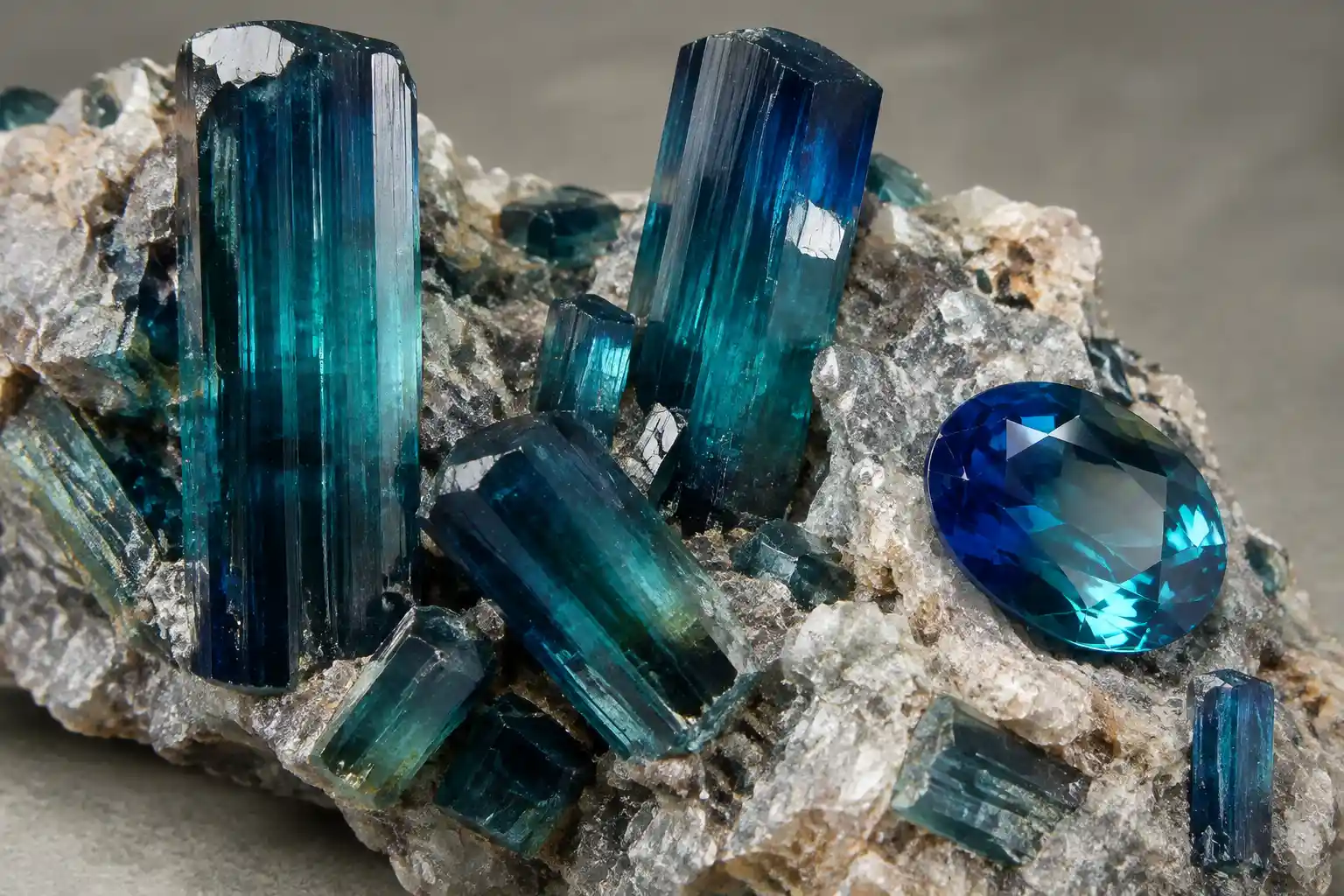
Indicolite benefits begin with one of the rarest and most desirable color ranges within gem tourmaline: blue through blue-green, teal, greenish blue, and deep indigo tones. Indicolite is a blue gem variety of tourmaline and is usually associated with elbaite or fluor-elbaite, although the tourmaline group itself contains many mineral species with highly variable chemistry. That chemical complexity is precisely why tourmaline can appear in an extraordinary range of colors and why the term Indicolite describes appearance and gem variety rather than one simple universal chemical formula.
Fine transparent Indicolite combines color with useful tourmaline durability, vitreous luster, strong pleochroism, and good faceting potential. Blue tourmaline may appear dark blue from one direction and lighter blue, greenish blue, or teal from another, so crystal orientation has a major effect on the face-up appearance of a finished gem. This makes Indicolite benefits particularly interesting for lapidaries because successful cutting depends on managing pleochroism, depth, saturation, clarity, and weight rather than simply following the external shape of the rough.
Modern crystal traditions sometimes associate Indicolite benefits with communication, calm, honesty, introspection, or emotional balance because blue is culturally linked with water, sky, quiet, and clarity. These themes can remain meaningful as personal symbolism, but they should not be confused with medical effects. Indicolite does not clinically treat anxiety, throat disorders, respiratory conditions, depression, or communication problems through ordinary wearing or handling.
7 Indicolite Benefits at a Glance
- Rare blue to blue-green color gives Indicolite strong jewelry and collector appeal.
- Pleochroism creates noticeable directional color differences that reward skilled cutting.
- Tourmaline hardness around 7 to 7.5 supports many jewelry applications with sensible care.
- Transparent crystals can produce elegant faceted gems in saturated blue and teal tones.
- Pegmatite geology connects Indicolite with complex lithium-rich mineral environments and striking mineral associations.
- Identification helps separate Indicolite from aquamarine, sapphire, apatite, glass, blue topaz, and other blue gemstones.
- Modern symbolism can represent communication, perspective, or calm when kept separate from medical claims.
Rare Blue Color Gives Indicolite Exceptional Gemstone Appeal
The strongest Indicolite benefits come from color. Tourmaline is famous for red, pink, green, black, and multicolored crystals, but fine blue material is comparatively uncommon and highly sought after. Indicolite can range from pale blue to strongly saturated blue-green and deep indigo, with some stones leaning toward teal while others approach a more classic pure-blue appearance. Mindat describes Indicolite as a blue gemmy variety of tourmaline, usually but not always elbaite or fluor-elbaite, which reflects the chemical complexity of the wider tourmaline group.
Color quality depends on more than depth of blue. Extremely dark stones can appear nearly black in normal lighting, while very pale stones may lack visual presence. Fine gems usually balance saturation with enough transparency to remain lively, and cutting can either improve or weaken that balance dramatically.
These Indicolite benefits make color evaluation especially important when buying. Someone considering Indicolite quality should look at face-up hue, tone, saturation, pleochroism, transparency, cut, and whether the stone remains attractive in normal lighting rather than only under strong photographic illumination.
Pleochroism Gives Indicolite Exceptional Optical Character
Pleochroism is one of the defining Indicolite benefits because tourmaline can show different colors or color intensities along different crystallographic directions. GIA notes pleochroism as a characteristic optical effect in tourmaline, and documented Indicolite specimens can display combinations such as greenish blue and blue depending on orientation.
For a cutter, this means orientation is crucial. If the darkest direction is placed incorrectly, the finished gem may become overly dark and lose brightness. If a lighter direction is emphasized too strongly, a potentially rich blue stone may face up as weak or grayish. The best orientation must balance pleochroism with inclusions, crystal shape, finished weight, and optical performance.
Collectors benefit from the same property because rotating a crystal can reveal substantial changes in color. This directional behavior is part of the stone’s natural optics rather than an indication that the color is artificial. In fact, strong pleochroism can help demonstrate why gemstones must be evaluated from several angles rather than from a single photograph.
Tourmaline Hardness Makes Indicolite Practical for Fine Jewelry
Indicolite shares the generally useful hardness of gem tourmaline, which commonly falls around 7 to 7.5 on the Mohs scale. This provides enough resistance to everyday scratching for rings, earrings, pendants, necklaces, and bracelets when the gemstone is structurally sound and the setting protects vulnerable areas.
Tourmaline can still fracture, particularly when a stone contains internal cracks or receives a sharp blow. Long prismatic crystals may also contain tension or growth features that affect how safely rough can be cut. Durability therefore depends on more than hardness alone.
These Indicolite benefits make the stone practical for jewelry while still rewarding sensible care. Rings should be removed during heavy manual work, and valuable gems should not be stored loose against harder stones such as sapphire or diamond. Lukewarm water, mild soap, and gentle brushing are suitable for many untreated stable stones, while aggressive heat or harsh chemicals are unnecessary.
Indicolite Offers Skilled Cutters a Rewarding Faceting Challenge
Transparent Indicolite can produce exceptional faceted stones, but cutting blue tourmaline requires more judgment than simply maximizing carat weight. Prismatic rough often has different color intensity along and across the length of the crystal, while strong pleochroism means one orientation may appear significantly darker than another.
The best cutters evaluate the rough before committing to a table direction. A long rectangular or emerald-style shape may suit the crystal’s natural geometry, while ovals, cushions, pears, and specialty designs can help manage color concentration and inclusions. Very dark rough may benefit from shallower designs that reduce the distance light travels through the stone, while lighter material may tolerate greater depth.
These Indicolite benefits become visible when cutting produces a stone that remains blue rather than black, transparent rather than windowed, and balanced rather than dominated by one distracting inclusion. A smaller well-oriented gem can therefore be more desirable than a heavier stone whose color direction was sacrificed purely to preserve weight.
Pegmatite Geology Gives Indicolite Strong Mineral-Collector Interest
Indicolite frequently occurs in granitic pegmatites, geological environments capable of concentrating lithium, boron, sodium, aluminum, and other elements involved in gem tourmaline formation. Such pegmatites can also produce quartz, feldspar, mica, beryl, spodumene, lepidolite, and other minerals, creating some of the most visually impressive collector associations found in gem mineralogy.
This geological setting gives Indicolite benefits that extend well beyond faceted gemstones. Natural crystals may show complex color zoning, blue-to-green transitions, multiple terminations, intergrowths, and associations with albite, quartz, or mica. Mindat documents Indicolite-bearing specimens from localities including Afghanistan and Brazil, illustrating the worldwide pegmatite environments capable of producing blue tourmaline.
For mineral collectors, locality and natural crystal condition can therefore matter as much as transparency. A complete blue tourmaline crystal on matrix may preserve more geological information than a cut stone, even when the crystal contains inclusions that would lower faceting value.
Gemstone Identification Separates Indicolite from Other Blue Gems
Blue gemstones overlap visually enough that accurate identification becomes another valuable part of Indicolite benefits. Aquamarine, blue topaz, sapphire, apatite, zircon, glass, synthetic products, and blue-green tourmaline can appear surprisingly similar in photographs, particularly when lighting and editing influence saturation.
Professional identification can consider refractive index, birefringence, pleochroism, density, optical character, inclusions, and spectroscopy. Tourmaline’s strong pleochroism and characteristic refractive properties provide useful clues, while transparent blue elbaite specimens can show a uniaxial negative optical character and noticeable birefringence. GIA records a representative Indicolite specimen with greenish-blue to blue pleochroism, illustrating how directional color becomes part of the gemological profile.
Someone preparing to buy Indicolite should therefore prioritize accurate species identification, realistic photographs, face-up color, clarity, dimensions, cutting quality, and any treatment disclosure rather than relying on a seller’s description of “ocean blue” or “Paraíba-like” color.
Indicolite Should Not Be Confused Automatically with Paraíba Tourmaline
One important caution within Indicolite benefits is the distinction between ordinary blue tourmaline and copper-bearing Paraíba-type tourmaline. Both can appear blue or blue-green, but Paraíba-type stones are defined by copper and manganese-related chemistry and occupy a very different commercial category.
A vivid neon blue tourmaline should therefore not be called Paraíba simply because the color looks electric. Laboratory testing is often important when copper-bearing status affects price substantially. Likewise, the term Indicolite can apply to attractive blue tourmaline without implying Paraíba chemistry, Brazilian origin, or equivalent market value.
This distinction protects buyers from paying extraordinary premiums for color alone. Gemstone value becomes more reliable when names reflect actual identity rather than resemblance to a more expensive variety.
Modern Communication and Calm Symbolism Can Remain Personal
Contemporary crystal traditions frequently connect Indicolite benefits with communication, honesty, calm, emotional expression, intuition, or introspection. Blue coloration provides a straightforward visual reason for some of these themes because blue is widely associated with water, sky, quiet environments, and reflective moods.
A person may choose Indicolite jewelry to represent honest communication in a relationship, wear it during an important professional period because blue symbolizes calm concentration, or associate a particular stone with a meaningful conversation or life change. Such symbolism can gain depth through real memories rather than from a universal crystal rule.
The wider Tourmaline healing properties sometimes extend blue-tourmaline symbolism into claims about anxiety, thyroid function, throat problems, breathing, emotional disorders, or nervous-system balance. These interpretations belong to spiritual and wellness traditions rather than established clinical medicine. Indicolite can symbolize calm communication without functioning as a medical treatment.
Important Cautions Include Heat, Fractures, Treatment, and Marketing Language
Indicolite is durable enough for fine jewelry, but responsible ownership still requires attention to fractures, internal tension, and sudden temperature changes. Tourmaline can be sensitive to rapid heat changes, and heavily included stones may be especially vulnerable. Strong steam or extreme heat should therefore not be treated as universal cleaning methods for every specimen.
Treatment disclosure also matters. Tourmaline colors can sometimes be modified through heating or irradiation depending on starting chemistry, while fracture filling or other enhancement may occur in certain commercial stones. A treated gem can still be attractive, but buyers should understand what they are purchasing when treatment influences value.
Marketing language deserves equal caution. Terms such as neon, electric, ocean, or Paraíba-like describe appearance but do not establish chemistry, origin, or rarity. Accurate Indicolite identification and realistic color evaluation protect buyers far more effectively than dramatic adjectives.
Conclusion
Indicolite benefits include rare blue color, strong pleochroism, useful tourmaline durability, faceting potential, pegmatite geology, mineral-collector appeal, gemstone identification, jewelry versatility, and meaningful modern symbolism. Its position within the chemically complex tourmaline group makes it particularly valuable for understanding how color, crystal orientation, chemistry, and cutting interact.
The strongest Indicolite benefits come from appreciating blue tourmaline for what it actually is rather than comparing every vivid stone with Paraíba tourmaline or sapphire. Fine color, transparency, pleochroism, accurate identification, and skilled cutting already provide substantial value. Communication or calm symbolism can add a personal layer without becoming a medical claim.
FAQs
What are the main Indicolite benefits?
The most practical Indicolite benefits include fine jewelry use, mineral collecting, blue-tourmaline identification, pleochroism study, faceting, pegmatite geology, and the enjoyment of a comparatively uncommon blue color within the tourmaline group. Modern themes involving communication, calm, honesty, or introspection can also carry personal meaning, but those interpretations are symbolic rather than demonstrated effects on health or psychology.
What is Indicolite?
Indicolite is the blue gem variety of tourmaline and is usually associated with elbaite or fluor-elbaite, although tourmaline chemistry is complex and not every blue specimen belongs to exactly the same species composition. Its color can range from pale blue to deep blue-green and indigo, and the name itself refers to the characteristic blue appearance.
How hard is Indicolite?
Gem tourmaline generally falls around 7 to 7.5 on the Mohs hardness scale, giving Indicolite useful scratch resistance for many jewelry applications. Like other tourmalines, it can still fracture after strong impact or rapid thermal stress, so everyday durability depends on internal condition, setting design, and how the jewelry is worn rather than hardness alone.
Why does Indicolite show different colors from different angles?
Tourmaline is strongly pleochroic, which means it absorbs light differently along different crystallographic directions. An Indicolite can therefore appear blue, greenish blue, teal, or much darker as it is rotated, and skilled cutters orient the rough carefully so the most attractive color appears through the face of the finished gem.
Is Indicolite the same as Paraíba tourmaline?
No. Indicolite describes blue tourmaline based primarily on color, while Paraíba-type tourmaline is identified by copper-bearing chemistry and can occur in vivid blue, greenish blue, or green colors. A neon-looking blue stone should not automatically be called Paraíba without appropriate gemological testing, especially when the claimed identity creates a major price premium.
Is Indicolite suitable for everyday jewelry?
A structurally sound Indicolite can work well in rings, earrings, pendants, and other jewelry because tourmaline combines attractive transparency with useful hardness. Rings still benefit from protected settings and should be removed during heavy physical work, while heavily fractured stones deserve additional care because internal weakness can matter more than surface hardness.
How should Indicolite be cleaned?
Lukewarm water, mild soap, and a soft brush are suitable for many stable untreated stones, while harsh chemicals and sudden thermal changes should be avoided. Steam or aggressive ultrasonic cleaning should not be treated as universal choices because fractures, internal tension, fillings, or other conditions can make an individual stone more vulnerable than its hardness rating suggests.
Does Indicolite help with communication or anxiety?
There is no established clinical evidence that Indicolite directly improves communication ability, treats anxiety disorders, changes thyroid function, or regulates emotional health through ordinary wearing or handling. Someone may still use the gemstone as a personal symbol of calm or honest communication, but any practical improvement comes through behavior, reflection, professional support when needed, and real-world circumstances.
Does Indicolite have healing powers?
There is no established clinical evidence that Indicolite treats respiratory illness, throat conditions, anxiety, depression, neurological problems, thyroid disease, or other physical or mental-health concerns. Indicolite benefits described as healing, communication-enhancing, calming, chakra, intuitive, or energetic effects remain spiritual and personal beliefs and should not replace qualified medical or mental-health care.